Think of the author, Thomas Hardy (1840 -1928), and your first thoughts are probably of Dorset, the county most associated with his life and where most of his novels and poems are set.
Fans of Hardy will know that in his novels he identified his semi-fictional Dorset as South Wessex, Wiltshire as Mid Wessex, Hampshire as Upper Wessex and so on, adapting the name of the early medieval kingdom. If you look carefully at the map of Hardy’s Wessex inside most editions of the novels, you will see that North Wessex corresponds to pre 1974 Berkshire with “Christminster” or Oxford, just to the north.
So, what did this author, most associated with the countryside around Dorchester, have to do with Berkshire? Well, Hardy’s paternal grandmother, Mary Head, was actually born in Reading and brought up in Fawley, a village on the downs south of Wantage. In his novel, Jude the Obscure, Hardy gave Jude the surname, Fawley, but chose to identify the village as Marygreen, after his grandmother. Similarly, Wantage becomes Alfredstone after the King Alfred who was born there, and Newbury, Kennetbridge, after its river. Along with Aldbrickham for Reading, all these places feature in Jude the Obscure, Hardy’s novel of 1895.
Another Hardy link with Old Berkshire, this time in reality rather than fiction, is with Denchworth, a village in the Vale of White Horse north of Wantage. Hardy’s sister Mary had trained as a teacher in Salisbury and accepted her first teaching post at Denchworth village school. Quite why she took a post so far north of either her home or the town in which she trained, I cannot find out. I do not believe that teaching posts were so difficult to come by in those days but I might be wrong. Perhaps she had connections with the Wantage area or had been recommended by someone. It would be interesting to find out. Mary was, apparently, very lonely in this isolated spot so her mother allowed her much younger sister Kate to live with her there. Whether Hardy ever visited his sisters in Denchworth we do not know, although it has to be a possibility.
As a successful author, Hardy and his first wife Emma lived for a time in London where they befriended some of the society figures living in the capital at the time. These included Sir Frances & Lady Jeune who, in the later years of the nineteenth century, also owned Arlington Manor, north of Newbury on Snellsmore Common. Hardy came to stay with the Jeunes in their Berkshire home in 1893 when he also visited Shaw House, Newbury at that time the property of the Eyre family.
In October of the same year, Hardy paid a visit to his grandmother’s childhood home up on the downs at Fawley. Sadly he does not seemed to have enjoyed the North Wessex downland, or at least that around Fawley, as he wrote, “Entered a ploughed vale which might be called the Valley of Brown Melancholy”.
I hope that the surrounding downland untouched by the plough was more to Hardy’s liking!
However, we do know that there was somewhere in Berkshire that was very much to Hardy’s liking. Although we do not know for sure when or how he got there, Hardy visited our own Walbury Beacon. We know this because he refers to it – as “Ingpen Beacon”- in his poem of 1896, “On Wessex Heights”.
Perhaps Hardy visited whilst he was staying with the Jeunes the previous year. Maybe they had a very early model of motor car, although it is difficult imagining one negotiating the incline to reach the top. Perhaps Hardy, and whoever was accompanying him, travelled to Kintbury station and made the rest of the journey in a horse drawn vehicle. We shall never know. However, I am sure he would have been fascinated to see the gibbet (in its late 19th century manifestation ) silhouetted against the skyline – I do so hope someone made him aware of the story of George Broomham & Dorothy Newman as I think he would have enjoyed it.
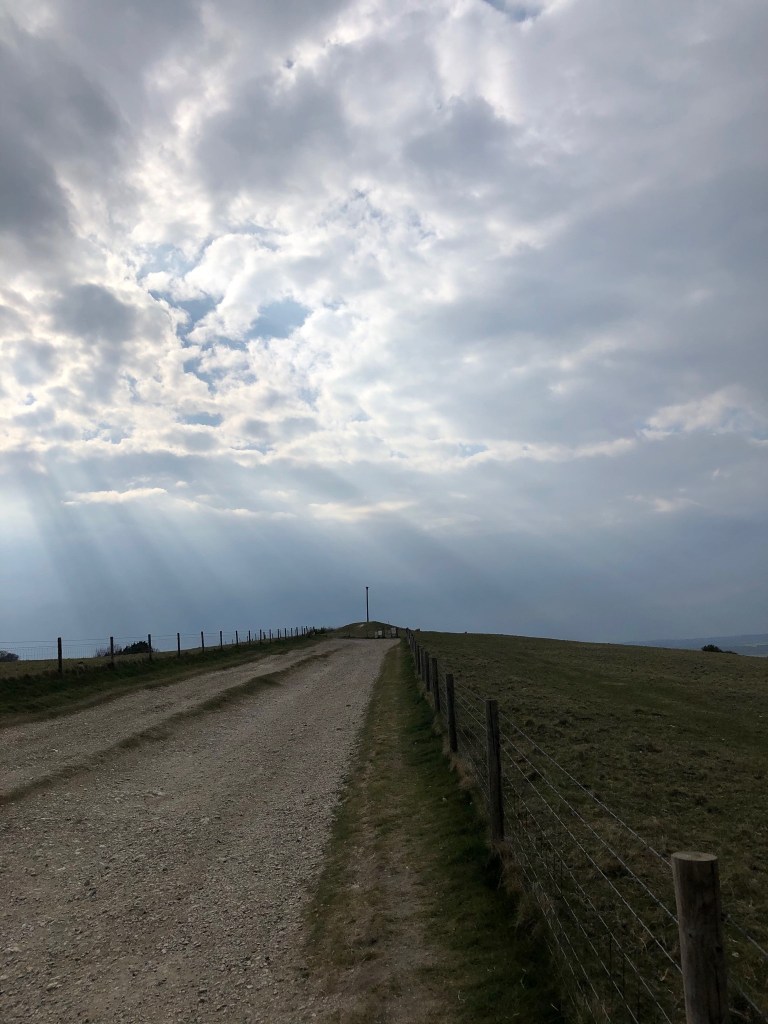
But it was the hill we know as Walbury Beacon which Hardy particularly enjoyed visiting and compared favourably with other hills across Wessex, inspiring the following:
Wessex Heights
There are some heights in Wessex, shaped as if by a kindly hand
For thinking, dreaming, dying on, and at crises when I stand,
Say, on Ingpen Beacon eastward, or on Wylls-Neck westwardly,
I seem where I was before my birth, and after death may be.
In the lowlands I have no comrade, not even the lone man’s friend –
Her who suffereth long and is kind; accepts what he is too weak to mend:
Down there they are dubious and askance; there nobody thinks as I,
But mind-chains do not clank where one’s next neighbour is the sky.
Thomas Hardy, December 1896
Theresa Lock
This article was first published in The Beacon in September 2022.
 Kintbury and Beyond