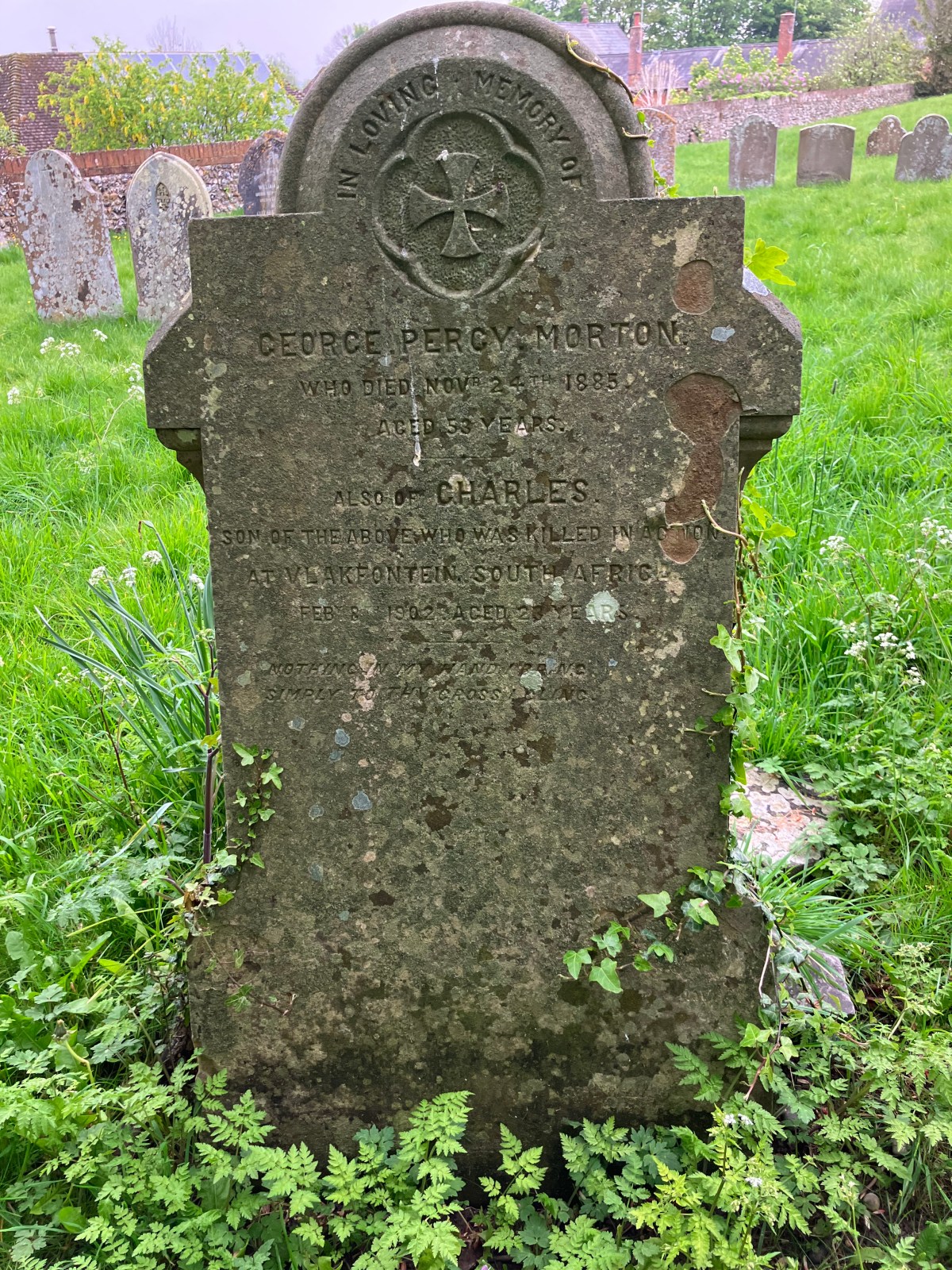
As you walk through Kintbury church yard toward the gate at the top of the path leading to the canal, pause a while to read the inscription on a stone to your right. The name at the top of this particular stone is that of George Morton who died on November 24th, 1885 aged 53. There is nothing particularly unusual about that – however, read on. The inscription below reads:
Also of Charles, son of the above who was killed in action at Vlakfontein, South Africa on Feb 8th, 1901 aged 23 years.
Charles Morton had been killed during the 2nd Boer War, a conflict fought from 1899 to 1902 between Britain and the South African Republic & the Orange Free State. At that time, it would have been very unusual for a soldier’s body to be returned to his homeland and closer reading of the grave’s inscription reveals that it does not say, “Here lies…”. So this gravestone commemorated Charles but does not mark his resting place.
I have tried to find out more about Charles Morton and his family. However, as so often happens when researching local history, my searching has raised far more questions than it has answered.
Many people wrongly believe that, in years gone by, poorer families rarely ever moved far from their places of birth. Anyone who has spent time studying family history will know this is not necessarily always the case.
Charles’ father, George, named on the gravestone, was born in Daventry, Northamptonshire in 1832 where his father, William Morton, was an innkeeper. By 1851, the Morton family had left Northamptonshire for Fulham where William – presumably embracing new opportunities – was working as a conductor on a horse-drawn omnibus.
I can find no trace of William or George Morton on the 1861 or 1871 censuses but in 1881 George turns up again, far away from the increasingly urbanised streets of Middlesex where he had lived as a child. George is now married to Ellen and they are living in West Ilsley, with their three children: Frederick, who is seven, Charles, two and a baby daughter. George is working as a groom in a racing stables.
At some point in the following ten years, however, the family experienced many changes because by the census of 1891, Charles is living in Kintbury with his mother and stepfather Edward Brooks, a labourer. According to the inscription on the gravestone I mentioned earlier, Charles’ father, George Morton had died on November 24th, 1885.
Like his father before him, Charles took up work as a groom and by the 1901 census he is living in lodgings in Crowthorne, although there is no clue as to what took the young man to work as a “groom domestic” in east Berkshire when similar work would have been available nearer home.
However, by the following year, Charles was even farther away from his mother’s home in Kintbury. As the gravestone tells us, on 8th February 1902, Charles was killed on active service in South Africa.
The inscription on the stone says that Charles died on active service in Vlakfontein, which is in the Mpumalanga Province of South Africa – the site of guerrilla fighting during the Boer War. However, the Victorian Society says that Charles was a member of the South African Constabulary who was killed at Syferfontein, also in Mpumalanga Province. It is impossible to say which is correct; the Victorian Society and the gravestone both have February 2nd as the date of death. To confuse matters further, the Forces War Records list two other Charles Mortons killed in South Africa in 1902.
As research has shown, neither Charles’ father nor his step-father were wealthy or in relatively high-status occupations. Many poorer and even middle-income people at the time were buried without gravestones. That George Morton – whose last known occupation was as a groom – should have a gravestone is, I believe, quite unusual for someone of his background at that time.
All this leads me to wonder this: Did someone with the means to have a gravestone erected in Kintbury want to commemorate a young man from the village killed abroad? Whilst some of the great and the good who saw active service are commemorated on the walls inside the church, it was never the custom to put up a plaque to the lower ranks who died in the military. As I have commented above, men of the status of George Morton were very unlikely to have a marked grave. However, by erecting a stone for him, the name of his son Charles could be added below, even though the plot in Kintbury was not his final resting place.
Perhaps someone with the wherewithal to afford a gravestone knew that some seventy years earlier, the Rev Fulwar Craven Fowle had erected a gravestone to working man, William Winterbourne. Perhaps that person felt inspired to do something similar. Perhaps that person was a former soldier. We shall probably never know unless these details are recorded somewhere in the parish records held by the diocese. It would be an interesting search to find out.
I have not been able to find a record of Charles Morton having a Commonwealth War Graves Commission burial in South Africa but it is, of course, pleasing to know that he is remembered in our churchyard.
Thomas Hardy’s poem, Drummer Hodge, written in 1899, was his response to news of the death of young country men, killed, like Charles Morton, in the Boer War:
They throw in Drummer Hodge, to rest
Uncoffined—just as found:
His landmark is a kopje-crest
That breaks the veldt around;
And foreign constellations west
Each night above his mound.
Young Hodge the Drummer never knew—
Fresh from his Wessex home—
The meaning of the broad Karoo,
The Bush, the dusty loam,
And why uprose to nightly view
Strange stars amid the gloam.
Yet portion of that unknown plain
Will Hodge for ever be;
His homely Northern breast and brain
Grow up a Southern tree,
And strange-eyed constellations reign
His stars eternally.
(C) Theresa Lock 2024
 Kintbury and Beyond