The word September comes from the Latin septem, meaning seven. In the Roman calendar it was the seventh month.
Anglo Saxons called it gerst monath or barley month. This was when they harvested barley to make their favourite drink. It was also called haefest monath or harvest month.
In 1752 the British government decided to change from the Julian calendar to the Gregorian calendar but unfortunately this meant that there was a difference of 11 days between the “old style” and the “new style “ calendars. So, for example, 3rd September became the 14th. This caused much unrest and there were street protests with people shouting, ‘give us back our eleven days’. Some people thought they would die eleven days earlier as a result of this change!
Notable dates in September
The September 3rd is the anniversary of the outbreak of the Second World War.
On the first Monday after the 4th, the Abbots Bromley Horn Dance is performed.
September 23rd is the Autumnal Equinox, one of two days in the year when day and night are of equal length.
September 29th is the Feast of St Michael and also a “quarter day”, one of the four days in the year when, traditionally, rents were due to be paid.
St Michael and folk lore
In folk lore, St Michael was said to have cast the devil to earth where he fell into a blackberry bush -it is therefore unlucky to eat blackberries after this date. Scientifically, however, the first frosts could occur after this date and reduce the vitamin C in blackberries thus reducing their goodness.
There are two local churches, Enborne and Inkpen, dedicated to St Michael (most churches with this dedication are on a hill) and until fairly recently we often celebrated these Patronal Festivals together as a benefice.
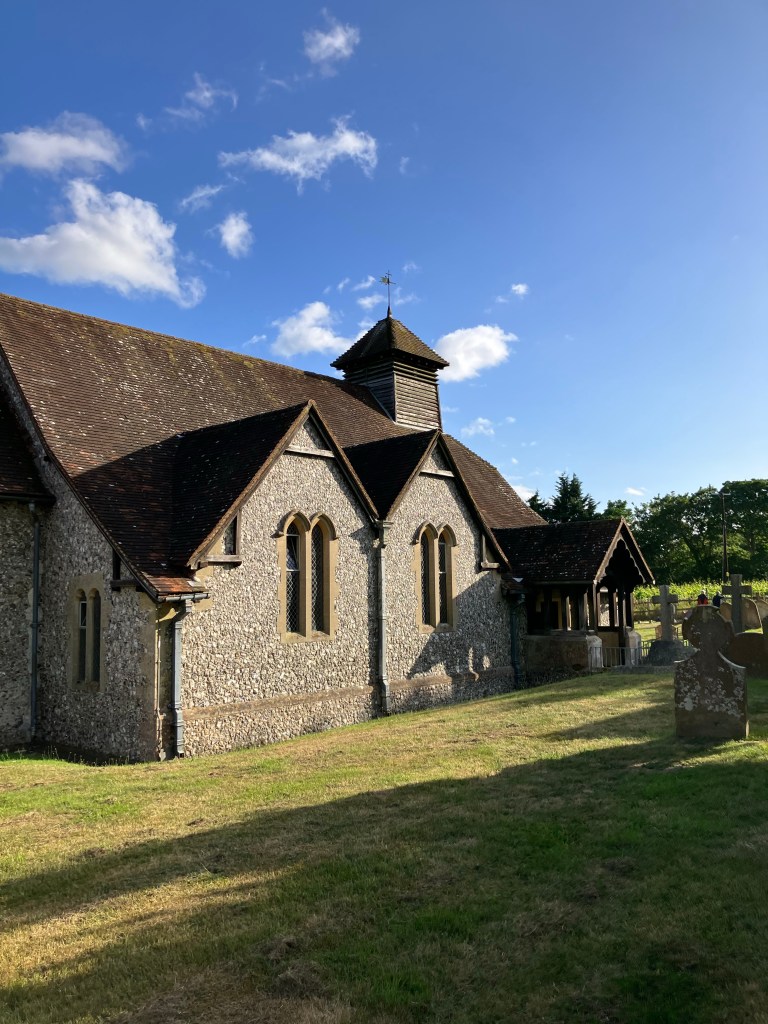
The famous St Michael ley line runs across England from the tip of Cornwall to the Eastern tip of Norfolk on the Norfolk/Suffolk border, passing through the prehistoric sites of Glastonbury and Avebury, also numerous other significant sites either named after St. Michael or St. George, both dragon slaying saints.
In his book , “The Old Straight Track” (1925), Alfred Watkins identified what he called a “church ley”, five churches which, when looked at on an OS map, can be linked by a straight line drawn between all of them. The five churches in this example are not far from Kintbury:
Here five churches – Tidcombe, Linkenholt, Faccombe, Burghclere and Sydmonton – align precisely , and on the ley are homesteads with the ancient names of Folly Barn, Bacon’s (formerly Beacon’s) Farm, and Curzon Street Farm, with fragments of present-day road in approximate alignment
Alfred Watkins, 1925, The Old Straight Track
– Penny Fletcher, September 2023
 Kintbury and Beyond