A rebel Revd?

The Reverend John Craven: Not what you’d expect in a priest?

In a letter of 1799, Jane Austen remarks that her friend Martha Lloyd has gone to visit her uncle – Rev John Craven.

John was the son of Governor Craven of Hamstead Park and brother to Martha, Eliza and Jane Craven. He was, therefore, uncle to Fulwar, Tom, Charles and William Craven as well as Martha, Eliza and Mary Lloyd.

Following the death of Governor Craven, John’s mother married the besotted Jemmet Raymond. Next she proceeded to marry her son to Jemmet’s sister, Elizabeth. Elizabeth was well off, but judged to be weak in intellect. They married in Kintbury (one presumes by Thomas Fowle, the groom’s brother in law) in 1756 when John was 24. Elizabeth owned land in Henwick, Thatcham and John at his marriage is described as ‘clerk of Henwick.’

In 1775 John became vicar of Wolverton near Basingstoke. Jemmet (John’s stepfather) had inherited the manor from his mother who had died aged 17 after his birth.

Jane did not do ‘bedroom scenes’, she was not a Jilly Cooper of the 18th century. But if she had been, then John would have provided plenty of copy!

In 1776, aged 44, John became embroiled in a divorce case brought by Mr. Potter Harris of Baughurst.

At the time, John Craven was vicar at Wolverton in Hampshire although he was actually living at Barton Court, near Kintbury. He travelled to Wolverton on a Saturday and stayed at the Potter Harris house to take the church service on Sunday.

The divorce case seems to have been quite sensational. Both a maid and Mrs Potter Harris’s cousin testified that they had seen Rev Craven enter Mrs Potter Harris’s bedroom and heard the sound of bedsprings! Also there was talk of misbehaviours in a coach and the Rev had been seen to put his hands under her skirt…

Mr Potter Harris wanted revenge and the Reverend was fined £3,000.

Despite this, John and Elizabeth Craven were married for over 20 years. There were no children so it may have been a marriage in name only.

When his wife died, Barton Court passed to another branch of the Raymond family.

In May, 1778 the papers reported:

“Last week died at Barton Court, near Newbury, Mrs. Craven, wife of the Rev’d John Craven and only daughter of the late Sir Jemmet Raymond.”

In 1779,  John married Catherine Hughes  from Letcombe, Berkshire. Catherine is the Mrs. Craven mentioned in Jane Austen’s letters:

Does Martha never hear from Mrs. Craven?


Is Mrs. Craven never at home?

Mrs Craven was, of course, Martha Lloyd’s aunt by marriage.

The Rev John Craven seems to have been rather a ‘rumbustious’ priest because his name appeared again in the local papers, this time in an argument not romantically inspired.

In essence John Craven went to a magistates’ meeting in Wantage and passed comment on something he considered an impropriety. Letters were printed in the Mercury complaining of his behaviour. There followed a meeting at the Alfred’s Head Inn in Wantage where a quarrel broke out as to who had reserved a room.  One letter to the paper says:

Did Mr. Watts tell the whole truth? That he did not know that Mr. Craven carried pistols with him on that day to Wantage – Yes Mr. Printer pistols were carried thither.

The Wantage magistrate asked how Mr Craven would react if he came to the Newbury Assizes and passed comment. John Craven replied that he would be glad to drink a bottle with him at Speen. Thereafter the vicar seems to have calmed down.

Eventually John and Catherine moved to Chilton House in Chilton Foliat, Wiltshire.  John died in 1804 after an hour’s illness. According to the notice of his death in the newspapers, he had, for many years, been acting magistrate in the counties of Gloucester, Hampshire and Wiltshire.

After her husband’s death, Catherine moved to Speen Hill near Newbury. In April 1839 her obituary read:

At her residence in Speen Hill, at a very advanced age, Mrs. Craven, relict of Revd John Craven and lamented mother of Fulwar Craven esq. The deceased lady was highly respected and esteemed by the gentry in the neighbourhood of Speen and by society in general.

References:  The Newspaper Archives, The Letters of Jane Austen. Mrs. Thora Morrish

Penny Fletcher, May 2023
Lifelong friends

Between 1739 and 1840, three generation of the Fowle family held the living at Kintbury. The first Thomas Fowle became vicar in 1739, his son Thomas in 1762, then his son, Fulwar Craven Fowle, in 1798.

Back then, it was not unusual for a living to be passed on through the family like this because the appointment of a vicar was often in the gift of a particular patron. This was the way in which Pride & Prejudice’s Lady Catherine de Bourg was able to appoint Mr Collins – although it has to be hoped that not all patrons were as interfering!

Until the middle years of the nineteenth century, there were only two universities in England: Oxford and Cambridge. Both were regarded as very fitting destinations for the sons of the educated upper and upper middle classes; Thomas Fowle the younger was no exception and he became a student at St John’s College, Oxford.

It was at St John’s College that Thomas Fowle met another student, George Austen of Tonbridge, Kent. There were no female students at either Oxford or Cambridge at that time – indeed it was to be over 150 years before women were admitted to either university. However, George Austen met his future wife at Oxford: Cassandra Leigh was the daughter of the Master of Baliol College whom he married in 1764.

George Austen & Thomas Fowle remained friends after graduation and leaving Oxford. George was appointed rector of the parish of Steventon, Hampshire in 1761 and it was here that he and Cassandra brought up their eight children. A country rector’s income was not large so to augment his earnings George opened a school in the rectory where he taught the sons of other gentlemen along with his own boys.

By now, Thomas Fowle was himself vicar of Kintbury and he and his wife, Jane, sent each of their four sons to Steventon to be educated alongside the young Austens. And so Jane & Cassandra Austen came to know Fulwar, Thomas, William and Charles Fowle in what must have seemed something like an extended family.

The Austens and the Fowles were to remain lifelong friends.

Theresa Lock, May 2023

Lord Craven of Hamstead Marshall

Eliza has seen Lord Craven at Barton, and probably by this time at Kintbury, where he was expected for one day this week…She found his manners very pleasing indeed.

Eliza has seen Lord Craven at Barton, and probably by this time at Kintbury, where he was expected for one day this week…She found his manners very pleasing indeed.

Lord Craven was prevented by company at home from paying his visit at Kintbury, but, as I told you before, Eliza is greatly pleased with him and they seem likely to be on the most friendly terms.

Jane Austen, letter to Cassandra, January 1801

The Eliza to whom Jane refers is Eliza Fowle, wife of Fulwar Craven Fowle, vicar of Kintbury and sister to Jane’s close friend Martha Lloyd. Barton – or Barton Court – was the home of Charles Dundas, M.P. and is a large house about half a mile north of Kintbury church on what would have been the old coaching road into Kintbury.

Lord Craven  was a distinguished military gentleman who  served in Flanders and was AD to the King and a favourite of Queen Charlotte. He was reputed to be a bit of a rake before his marriage – as Jane Austen remarked in her letter to Cassandra:

The little flaw of having a mistress now living with him at Ashdown Park seems to be the only unpleasing circumstance about him.

Some people believe that Jane based Willoughby in Sense and Sensibility on Lord Craven.  However, the novelist R. L. Delderfield wrote as a preface to one of his books that,

…every character in fiction is an amalgam of factors drawn from the author’s memory and imagination.

I disagree with the assumption that Willoughby’s character was based on Lord Craven’s. Why? Well Craven’s mistress was the young Harriet Wilson. Craven was 31 and unmarried at the time. Harriett was much younger and does not give Craven a good press. Her memoirs start with the line,

I shall not say why and how I became, at the age of fifteen, the mistress of the Earl of Craven…

Harriet leaves the reader in no doubt that she finds the Earl boring and old-fashioned, with his night caps and his endless talk of his cocoa trees on his estates in the Indies. She left him for Lord Melbourne.  Mind you if as a teenager one had been isolated in Ashdown House on the Lambourn Downs I think most of us would have been a tad miffed even if our career was that of ‘entertaining men’!  

Christopher Hibbert wrote that Harriet had a Swiss father and was renowned not so much for her beauty as easy manners, gaity and flighty charm. Sir Water Scott described her as smart, saucy with the manners of a  wild schoolboy. Harriet was a well-known ‘lady’ in certain circles. When she grew too old to charm, she wrote her memoirs, sent the relevant passages to the gentlemen concerned and offered to suppress it for a fee. This caused the famous reply of Wellington: Publish and be damned! 

So, I believe Harriet Wilson did not resemble the girl described as Colonel Brandon’s ward. She was seduced by Willoughby aged 17, and left without help, friend or home. He promised to return but didn’t and after breaking another girl’s heart married a rich wife.

Lord Craven on the other hand went on to marry an actress, Louisa Brunton, (without informing his very formidable mother) after Harriet had left him. They lived in Hamstead as a close family and the Countess was renowned for her gracious generosity. Obviously unlike Willoughby, Craven did not marry Louisa for money

The Georgian gossip collector Creevy, wrote that in January 1816, Lord Craven embarked, on his own yacht, for the Mediterranean. There were 70 members of his family on board at an expense of £40,000. Creevy added, somewhat ominously, that it gave a good chance to his brother Berkley, especially as he would rely much upon his own skill in the management of the vessel! Evidently they all survived Lord Craven’s seamanship and Berkley was disappointed.

Lord Craven died at Cowes in 1825 aged 55.

Penny Fletcher, May 2023

Once a mountain

Walbury Beacon Benefice is named after the point on Walbury Hill where, traditionally, a beacon has been built.

But mind-chains do not clank where one’s next neighbour is the sky.

Thomas Hardy, “On Wessex Heights

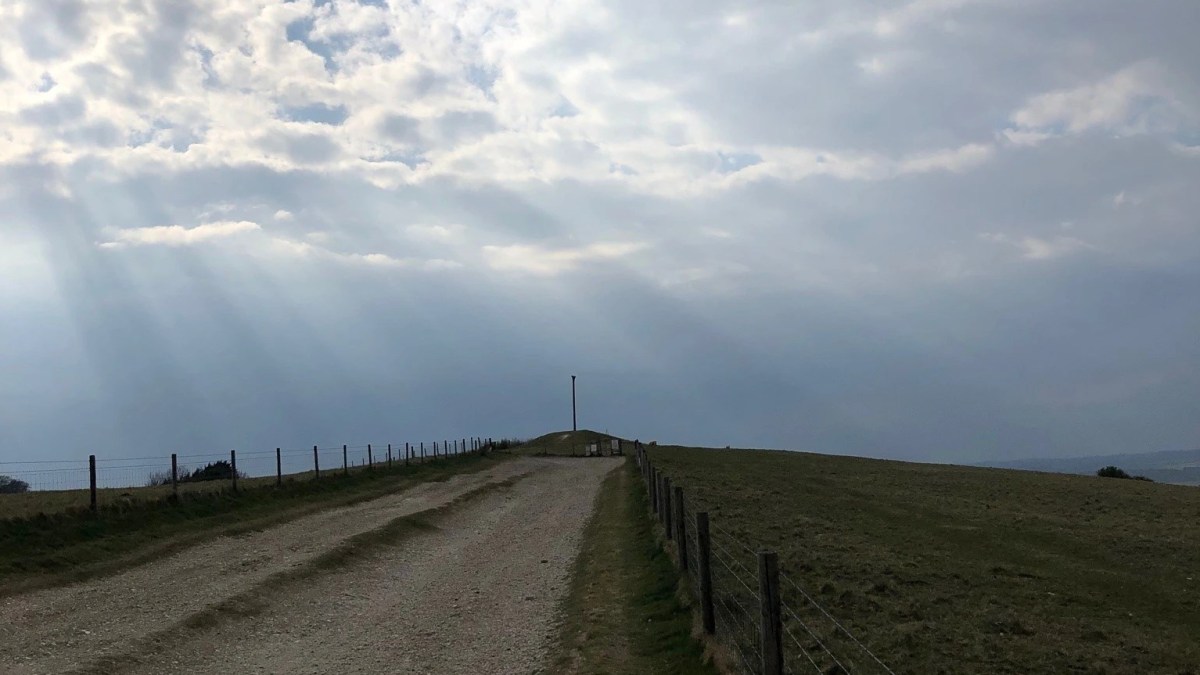
Walbury Beacon Benefice is named after the point on Walbury Hill where, traditionally, a beacon has been built. Originally beacons were lit across the south of England as an alert to the danger of invasion. More recently and at least since Victorian times, the chain of beacons has been lit to celebrate royal jubilees. Sometimes known as Inkpen Beacon, at 974 feet above sea level, Walbury Hill is the highest point on chalk in England and the site of Walbury Camp, an Iron Age hill fort, which, I believe, has never been excavated.

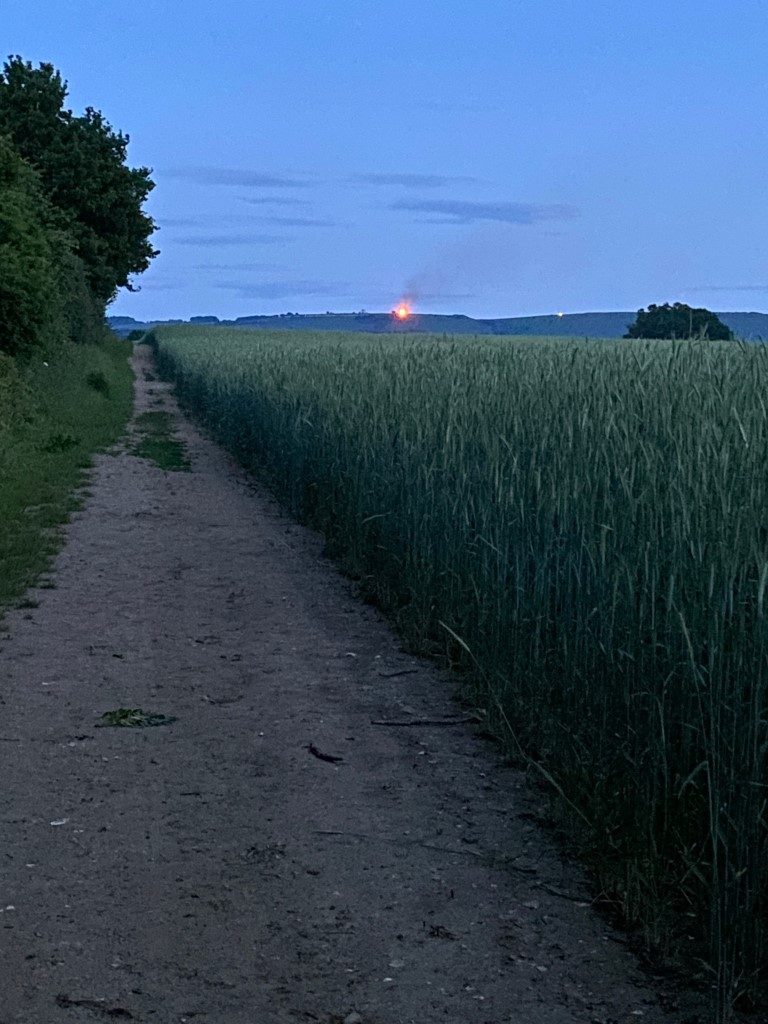
A beacon on Walbury Hill/Inkpen Beacon celebrating the Platinum Jubilee in June 2022

It will surprise some people to know that when the Ordnance Survey first surveyed this area, Walbury Hill was measured as being 1,011 feet above sea level, thus making it a mountain! However, a subsequent survey in the late C19th measured Walbury at less than 975 feet and so demoted it to the status of a hill.

Further westward along the ridge is Inkpen Long Barrow, one of only three long barrows in Berkshire but one of a cluster, most of which are located in Wiltshire and Dorset. However, it is not the long barrow that many visitors come to see, but the famous (or perhaps that should be infamous) Combe Gibbet.

Combe gibbet

Many people mistakenly believe that a gibbet was the site of a public execution, but this was not so. The original Combe Gibbet was only used once but it was not for an execution. In 1676, George Broomham and Dorothy Newman were convicted of the murder of George’s wife Martha and son, Robert. They were executed at Winchester but their bodies returned to their home parishes where they were hung on the gibbet – as a deterrent to anyone contemplating committing murder. What contributes to the general confusion between a gibbet and a gallows is the fact that the downland on the north side below the gibbet is marked on OS maps as “Gallows Down” – presumably a misnomer which has stuck!

As many of you will know, the story of Broomham and Newman inspired the then young Oxford graduate John Schlessinger, to make his first feature film, “The Black Legend”. In the late 1940s the Schlessinger family lived at Mount Pleasant, between Inkpen and Kintbury  and so the grisly local landmark would have been a familiar sight to them. With family members and friends from Oxford taking the major roles, John Schlessinger filmed the story of murder during the summer of 1948, using many local people as extras. I doubt any of these villagers had the remotest idea that this young man would one day go on to be one of Britain’s foremost directors winning 7 BAFTAs and an Oscar.

Nearly 20 years later John Schlessinger was to return to Wessex to film his adaptation of Thomas Hardy’s “Far from the Madding Crowd”. Filmed entirely on location in Wiltshire and Dorset, what fascinates me about this later work are the number of scenes which recall moments from Schlessinger’s earlier film. It is as if the inspiration he took from his work around Walbury Hill stayed with him and was used in this, one of the visually most beautiful of British films.

However, it is not only because of the Black Legend that many other people visit Walbury Hill. The Newbury Weekly News archive features various accounts of visits to the area or discussions of its history. Some time in the late C19th, the novelist and poet Thomas Hardy visited Walbury Beacon – though perhaps to confuse us even more, he calls it “Ingpen Beacon” – and referenced it in his poem, Wessex Heights:

There are some heights in Wessex, shaped as if by a kindly hand
For thinking, dreaming, dying on, and at crises when I stand,
Say, on Ingpen Beacon eastward, or on Wylls-Neck westwardly,
I seem where I was before my birth, and after death may be.

Walbury Hill might not be a mountain but it remains a much loved landmark.

Theresa Lock

Thomas Hardy and North Wessex

Think of the author, Thomas Hardy (1840 -1928), and your first thoughts are probably of Dorset, the county most associated with his life and where most of his novels and poems are set.

So, what did this author, most associated with the countryside around Dorchester, have to do with Berkshire?

Think of the author, Thomas Hardy (1840 -1928), and your first thoughts are probably of Dorset, the county most associated with his life and where most of his novels and poems are set.

Fans of Hardy will know that in his novels he identified his semi-fictional Dorset as South Wessex, Wiltshire as Mid Wessex, Hampshire as Upper Wessex and so on, adapting the name of the early medieval kingdom. If you look carefully at the map of Hardy’s Wessex inside most editions of the novels, you will see that North Wessex corresponds to pre 1974 Berkshire with “Christminster” or Oxford, just to the north.

So, what did this author, most associated with the countryside around Dorchester, have to do with Berkshire? Well, Hardy’s paternal grandmother, Mary Head, was actually born in Reading and brought up in Fawley, a village on the downs south of Wantage. In his novel, Jude the Obscure, Hardy gave Jude the surname, Fawley, but chose to identify the village as Marygreen, after his grandmother. Similarly, Wantage becomes Alfredstone after the King Alfred who was born there, and Newbury, Kennetbridge, after its river. Along with Aldbrickham for Reading, all these places feature in Jude the Obscure, Hardy’s novel of 1895.

Another Hardy link with Old Berkshire, this time in reality rather than fiction, is with Denchworth, a village in the Vale of White Horse north of Wantage. Hardy’s sister Mary had trained as a teacher in Salisbury and accepted her first teaching post at Denchworth village school. Quite why she took a post so far north of either her home or the town in which she trained, I cannot find out. I do not believe that teaching posts were so difficult to come by in those days but I might be wrong. Perhaps she had connections with the Wantage area or had been recommended by someone. It would be interesting to find out. Mary was, apparently, very lonely in this isolated spot so her mother allowed her much younger sister Kate to live with her there. Whether Hardy ever visited his sisters in Denchworth we do not know, although it has to be a possibility.

As a successful author, Hardy and his first wife Emma lived for a time in London where they befriended some of the society figures living in the capital at the time. These included Sir Frances & Lady Jeune who, in the later years of the nineteenth century, also owned Arlington Manor, north of Newbury on Snellsmore Common. Hardy came to stay with the Jeunes in their Berkshire home in 1893 when he also visited Shaw House, Newbury at that time the property of the Eyre family.

In October of the same year, Hardy paid a visit to his grandmother’s childhood home up on the downs at Fawley. Sadly he does not seemed to have enjoyed the North Wessex downland, or at least that around Fawley, as he wrote, “Entered a ploughed vale which might be called the Valley of Brown Melancholy”.

I hope that the surrounding downland untouched by the plough was more to Hardy’s liking!

However, we do know that there was somewhere in Berkshire that was very much to Hardy’s liking. Although we do not know for sure when or how he got there, Hardy visited our own Walbury Beacon. We know this because he refers to it – as “Ingpen Beacon”- in his poem of 1896, “On Wessex Heights”.

Perhaps Hardy visited whilst he was staying with the Jeunes the previous year. Maybe they had a very early model of motor car, although it is difficult imagining one negotiating the incline to reach the top. Perhaps Hardy, and whoever was accompanying him, travelled to Kintbury station and made the rest of the journey in a horse drawn vehicle. We shall never know. However, I am sure he would have been fascinated to see the gibbet (in its late 19th century manifestation ) silhouetted against the skyline – I do so hope someone made him aware of the story of George Broomham & Dorothy Newman as I think he would have enjoyed it.

The gibbet as seen today

But it was the hill we know as Walbury Beacon which Hardy particularly enjoyed visiting and compared favourably with other hills across Wessex, inspiring the following:

Wessex Heights

There are some heights in Wessex, shaped as if by a kindly hand

 For thinking, dreaming, dying on, and at crises when I stand,

Say, on Ingpen Beacon eastward, or on Wylls-Neck westwardly,

 I seem where I was before my birth, and after death may be.

In the lowlands I have no comrade, not even the lone man’s friend –

Her who suffereth long and is kind; accepts what he is too weak to mend:

 Down there they are dubious and askance; there nobody thinks as I,

 But mind-chains do not clank where one’s next neighbour is the sky.

Thomas Hardy, December 1896

Theresa Lock

This article was first published in The Beacon in September 2022.