The hidden life & legacy of Marrianne Dundas

In January 1801, Jane Austen wrote to her sister Cassandra,

Eliza has seen Lord Craven at Barton, & probably by this time at Kintbury…

The Eliza she mentions here was the wife of the Rev Fulwar Craven Fowle, vicar of Kintbury, and Lord Craven the influential land owner and member of the aristocracy then living with his mistress at Ashdown Park. But where was Barton and why was whoever lived there playing host to a local “bigwig”?
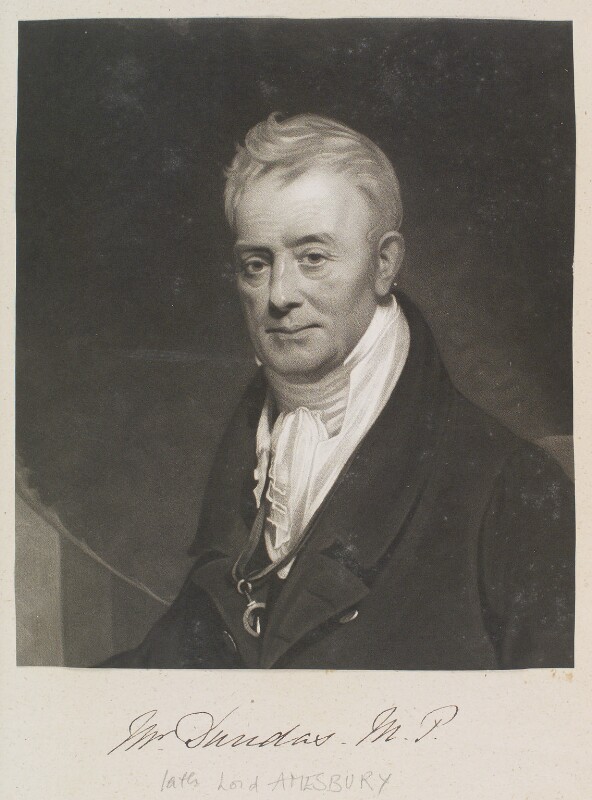
Charles Dundas, Baron Amesbury by William Say, after Sir William Beechey. Mezzotint, (1823) 8 5/8 in. x 7 1/2 in. (218 mm x 189 mm) paper size. Given by Mrs Masterman, 1963, Reference Collection NPG D11326 © National Portrait Gallery, London

Barton – or Barton Court –  still an imposing residence which can be reached along the Avenue, at that time the main route into Kintbury for traffic from the Bath Road, was the home of Charles Dundas. Since 1794 he had been Member of Parliament for the constituency of Berkshire, at that time stretching as far north as the Thames and including Wantage and Abingdon. As a member of a titled Scottish family, Dundas moved in some of the best circles of the time.

In keeping with their station in life and the fashions of the time, the Dundas family are well represented on the walls of Kintbury church where we can read that Charles and his wife, Anne Whitley, whom he had married in 1782, “had issue one daughter, Janet”. Anne died in 1812 and in 1822 Charles married Margaret Erskine, formerly Ogilvy, née Barclay.

Reading the Dundas memorials on the church walls, anyone would conclude that Charles Dundas had just one daughter. However, research into historical records reveals that this was not the case. Charles’ daughter Marrianne was most likely born in 1793. Her mother was not Anne Whitley. At the time, a child born to a mother not married to its father was often referred to as the “natural” child of whoever; Jane Austen gives an example of this in her novel, Emma, where Harriet Smith is referred to as the “natural” daughter of an unknown person Emma choses to imagine as someone well-to-do. Harriet Smith has been sent to live at a boarding school for girls and, it seems, no one acknowledges her as their daughter and her family remain a mystery.

We know from looking at the 1851 census that Marrianne had been born in Kintbury but I can find no record of her baptism or indeed who her mother might have been. It is impossible to find out anything of her early life – perhaps, like Harriet Smith, she was sent away to a girls’ boarding school. However, thanks to online marriage records, we know that in 1815 Marrianne Dundas married the Rev William Everett of Romford, Essex at the then very fashionable St George’s, Hanover Square, Westminster. We know Charles Dundas was present at the ceremony as he has signed the register.

It is particularly interesting that Marrianne is known by her father’s surname although all the available evidence suggests that Charles Dundas was never married to her mother. This was a time when a “natural” son or daughter was usually known by their mother’s surname, an example from Kintbury being William Winterbourn who, during his lifetime, was known by his mother’s name of Smith as his parents weren’t married. It would seem to me that, by the time of her marriage at least, Charles Dundas acknowledged Marrianne as his daughter. 

Marrianne and William Everett had three children: William, born and baptised in Kintbury in 1821 became a fellow of New College, Oxford and also a barrister; Charles Dundas Everett, born in Kintbury in 1825 entered the church; finally Alicia was born in Kintbury 1827. Interestingly, the 1861 census actually shows Alicia having been born at Barton Court so it has to be likely that her brothers were born there, too. There is no evidence that the Everett’s family home was ever in Kintbury; perhaps it had been decided that Barton Court was a preferable place for a confinement that the Rev Everett’s draughty vicarage!

We can only assume that Charles Dundas’ second wife was welcoming to Marrianne and her children.

On November 27th 1851, the youngest child, Alicia, married the Oxford master brewer, James Morrell of Headington, at St George’s, Hanover Square – the same fashionable church at which her parents had married. The service was taken by her brother, Charles.

James had inherited Headington Hill Hall which he had extended in the Italianate fashion and this large, imposing residence became the family home for him and Alicia. Marrianne was living there herself when she died on 4th December 1861.

James and Alicia’s only child, Emily, was born in 1854. In 1874 Emily married her cousin, George Herbert Morrell and so the Oxford brewing business continued to be run by the Morrell family for the next three generations. By the 1960s the company was run by one Colonel Morrell, a well known name in the Oxford area, not least in the Lock household as my father’s firm did a lot of work for the brewers. I believe Colonel Morrell would have been Marrianne’s great, great grandson. The natural daughter of Charles Dundas, therefore, can be regarded as the dowager matriarch of Oxford’s celebrated brewing family.

In 1953 the Morrell family sold Headington Hill Hall to Oxford City Council from whom it was later leased by one Robert Maxwell, infamous for having defrauded his employees’ pension fund and having disappeared from his yacht named the Lady Ghislaine, after his daughter.

Today, Headington Hill Hall is leased by Oxford Brookes University.

So, whilst there are many Dundas names on the walls of Kintbury church, Marrianne’s – due, I suppose, to the circumstances of her birth – is not one of them. But despite being Charles Dundas’s “natural” daughter, her fate was not that of a Harriet Smith. Her life might not be recorded on the walls of our church but through the generations her family certainly made their mark in Oxford.

One mystery, however, remains: there seems to be no way of knowing the name of Marrianne’s mother. That chapter of her story is no different from that of Harriet Smith.

Theresa Lock, July 2023

Photograph of Charles Dundas reproduced under creative commons licence: http://creativecommons.org/licenses/by-nc-nd/3.0/
A rebel Revd?

The Reverend John Craven: Not what you’d expect in a priest?

In a letter of 1799, Jane Austen remarks that her friend Martha Lloyd has gone to visit her uncle – Rev John Craven.

John was the son of Governor Craven of Hamstead Park and brother to Martha, Eliza and Jane Craven. He was, therefore, uncle to Fulwar, Tom, Charles and William Craven as well as Martha, Eliza and Mary Lloyd.

Following the death of Governor Craven, John’s mother married the besotted Jemmet Raymond. Next she proceeded to marry her son to Jemmet’s sister, Elizabeth. Elizabeth was well off, but judged to be weak in intellect. They married in Kintbury (one presumes by Thomas Fowle, the groom’s brother in law) in 1756 when John was 24. Elizabeth owned land in Henwick, Thatcham and John at his marriage is described as ‘clerk of Henwick.’

In 1775 John became vicar of Wolverton near Basingstoke. Jemmet (John’s stepfather) had inherited the manor from his mother who had died aged 17 after his birth.

Jane did not do ‘bedroom scenes’, she was not a Jilly Cooper of the 18th century. But if she had been, then John would have provided plenty of copy!

In 1776, aged 44, John became embroiled in a divorce case brought by Mr. Potter Harris of Baughurst.

At the time, John Craven was vicar at Wolverton in Hampshire although he was actually living at Barton Court, near Kintbury. He travelled to Wolverton on a Saturday and stayed at the Potter Harris house to take the church service on Sunday.

The divorce case seems to have been quite sensational. Both a maid and Mrs Potter Harris’s cousin testified that they had seen Rev Craven enter Mrs Potter Harris’s bedroom and heard the sound of bedsprings! Also there was talk of misbehaviours in a coach and the Rev had been seen to put his hands under her skirt…

Mr Potter Harris wanted revenge and the Reverend was fined £3,000.

Despite this, John and Elizabeth Craven were married for over 20 years. There were no children so it may have been a marriage in name only.

When his wife died, Barton Court passed to another branch of the Raymond family.

In May, 1778 the papers reported:

“Last week died at Barton Court, near Newbury, Mrs. Craven, wife of the Rev’d John Craven and only daughter of the late Sir Jemmet Raymond.”

In 1779,  John married Catherine Hughes  from Letcombe, Berkshire. Catherine is the Mrs. Craven mentioned in Jane Austen’s letters:

Does Martha never hear from Mrs. Craven?


Is Mrs. Craven never at home?

Mrs Craven was, of course, Martha Lloyd’s aunt by marriage.

The Rev John Craven seems to have been rather a ‘rumbustious’ priest because his name appeared again in the local papers, this time in an argument not romantically inspired.

In essence John Craven went to a magistates’ meeting in Wantage and passed comment on something he considered an impropriety. Letters were printed in the Mercury complaining of his behaviour. There followed a meeting at the Alfred’s Head Inn in Wantage where a quarrel broke out as to who had reserved a room.  One letter to the paper says:

Did Mr. Watts tell the whole truth? That he did not know that Mr. Craven carried pistols with him on that day to Wantage – Yes Mr. Printer pistols were carried thither.

The Wantage magistrate asked how Mr Craven would react if he came to the Newbury Assizes and passed comment. John Craven replied that he would be glad to drink a bottle with him at Speen. Thereafter the vicar seems to have calmed down.

Eventually John and Catherine moved to Chilton House in Chilton Foliat, Wiltshire.  John died in 1804 after an hour’s illness. According to the notice of his death in the newspapers, he had, for many years, been acting magistrate in the counties of Gloucester, Hampshire and Wiltshire.

After her husband’s death, Catherine moved to Speen Hill near Newbury. In April 1839 her obituary read:

At her residence in Speen Hill, at a very advanced age, Mrs. Craven, relict of Revd John Craven and lamented mother of Fulwar Craven esq. The deceased lady was highly respected and esteemed by the gentry in the neighbourhood of Speen and by society in general.

References:  The Newspaper Archives, The Letters of Jane Austen. Mrs. Thora Morrish

Penny Fletcher, May 2023

Lord Craven of Hamstead Marshall

Eliza has seen Lord Craven at Barton, and probably by this time at Kintbury, where he was expected for one day this week…She found his manners very pleasing indeed.

Eliza has seen Lord Craven at Barton, and probably by this time at Kintbury, where he was expected for one day this week…She found his manners very pleasing indeed.

Lord Craven was prevented by company at home from paying his visit at Kintbury, but, as I told you before, Eliza is greatly pleased with him and they seem likely to be on the most friendly terms.

Jane Austen, letter to Cassandra, January 1801

The Eliza to whom Jane refers is Eliza Fowle, wife of Fulwar Craven Fowle, vicar of Kintbury and sister to Jane’s close friend Martha Lloyd. Barton – or Barton Court – was the home of Charles Dundas, M.P. and is a large house about half a mile north of Kintbury church on what would have been the old coaching road into Kintbury.

Lord Craven  was a distinguished military gentleman who  served in Flanders and was AD to the King and a favourite of Queen Charlotte. He was reputed to be a bit of a rake before his marriage – as Jane Austen remarked in her letter to Cassandra:

The little flaw of having a mistress now living with him at Ashdown Park seems to be the only unpleasing circumstance about him.

Some people believe that Jane based Willoughby in Sense and Sensibility on Lord Craven.  However, the novelist R. L. Delderfield wrote as a preface to one of his books that,

…every character in fiction is an amalgam of factors drawn from the author’s memory and imagination.

I disagree with the assumption that Willoughby’s character was based on Lord Craven’s. Why? Well Craven’s mistress was the young Harriet Wilson. Craven was 31 and unmarried at the time. Harriett was much younger and does not give Craven a good press. Her memoirs start with the line,

I shall not say why and how I became, at the age of fifteen, the mistress of the Earl of Craven…

Harriet leaves the reader in no doubt that she finds the Earl boring and old-fashioned, with his night caps and his endless talk of his cocoa trees on his estates in the Indies. She left him for Lord Melbourne.  Mind you if as a teenager one had been isolated in Ashdown House on the Lambourn Downs I think most of us would have been a tad miffed even if our career was that of ‘entertaining men’!  

Christopher Hibbert wrote that Harriet had a Swiss father and was renowned not so much for her beauty as easy manners, gaity and flighty charm. Sir Water Scott described her as smart, saucy with the manners of a  wild schoolboy. Harriet was a well-known ‘lady’ in certain circles. When she grew too old to charm, she wrote her memoirs, sent the relevant passages to the gentlemen concerned and offered to suppress it for a fee. This caused the famous reply of Wellington: Publish and be damned! 

So, I believe Harriet Wilson did not resemble the girl described as Colonel Brandon’s ward. She was seduced by Willoughby aged 17, and left without help, friend or home. He promised to return but didn’t and after breaking another girl’s heart married a rich wife.

Lord Craven on the other hand went on to marry an actress, Louisa Brunton, (without informing his very formidable mother) after Harriet had left him. They lived in Hamstead as a close family and the Countess was renowned for her gracious generosity. Obviously unlike Willoughby, Craven did not marry Louisa for money

The Georgian gossip collector Creevy, wrote that in January 1816, Lord Craven embarked, on his own yacht, for the Mediterranean. There were 70 members of his family on board at an expense of £40,000. Creevy added, somewhat ominously, that it gave a good chance to his brother Berkley, especially as he would rely much upon his own skill in the management of the vessel! Evidently they all survived Lord Craven’s seamanship and Berkley was disappointed.

Lord Craven died at Cowes in 1825 aged 55.

Penny Fletcher, May 2023