Christmas for the new Edwardians: December 1901

“The past is a foreign country: they do things differently there.”  L.P. Hartley

Queen Victoria had come to the throne as an eighteen year old in 1837 and reigned for 63 years. Consequently, at the turn of the century in January 1901 (the 20th century was deemed to have begun in 1901, not 1900) most people had known no other monarch.

Victoria died on the Isle of Wight on January 22nd 1901 and was succeeded by her son, the new king, Edward VII. And so, the people of Britain were no longer Victorians, but Edwardians.

So what was the Christmas period like for the new 20th century Edwardians? I looked through the pages of the Newbury Weekly News to find out.

The first thing that I noticed was that the Christmas period was much more low-key than at present with very few Christmas themed events, if any, and far fewer advertisements for Christmas goods. Life in our part of West Berkshire was not much different from any other two week period in the autumn or winter. Disappointingly, there are hardly any news reports from the villages in our area at this time although there are several reports from Hungerford and a few from Kintbury.

 A colder spell before Christmas 1901 had resulted in the canal freezing over such that the inhabitants of Hungerford had been looking forward to an ”oldfashioned” Christmas, presumably looking back to the very cold winters of the mid 19th century. Hopes were dashed, however, when the weather turned wet and windy.  To prepare for the inclement weather, inhabitants of Newbury could, if they so liked, purchase a mackintosh with velvet collar for between 5 shillings 11 pence and 18 shillings 11 pence from McIllroy & Rankin of Cheap Street, and compliment the new coat with an umbrella from 1 shilling three farthings. Bailey’s of Northbrook Street boasted selling the cheapest boots: ladies’ at 1 shilling 9 pence a pair, gentlemen’s at 2 shillings 6 pence and children’s at 1 shilling 4 pence.

Despite the availability of wet weather clothing, Hungerford Primitive Methodist choir abandoned their customary carol singing in the town as the weather was considered too bad to go out. Perhaps instead they stayed at home and read by the light of a gas lamp, obtainable form Joseph Hopson of Newbury, which, it was advertised, would burn for 10 hours for only a farthing.

Although outdoor carol singing might have been abandoned, the pages of the NWN reveal that much local indoor entertainment was music- based. “Choral classes” were established in Kintbury with a Mr. S. Argyle conducting. The choir were practising a cantata called “King Harold” by Cunningham Wood. Also in Kintbury, a musical evening was held in the Wesleyan Methodist church on December 18th where members of the newly formed Guild Band were hoping to raise funds for a harmonium by presenting a concert of religious songs, instrumentals and readings.

“The band is only in its infancy, “ the NWN reported, “ and does not yet expect criticism but promises to be worth hearing at no distant date”.

For the more energetic ladies of Hungerford, a Spinsters’ Dance was held at the Town Hall on a Friday before Christmas. It was attended by between 80 and 90 people and took place between 8 o’clock and 3 o’clock, which, I am presuming, was am rather than pm, although the report does not specify!

I had expected to read something of children’s Christmas parties but, if these were held in the local villages, no reports of them appeared in the pages of the NWN. Fundraising, however, did continue in Kintbury, where, in the week before Christmas, £1, 15 shillings 11 pence was raised by the children of St Mary’s School for Dr Barnado’s Waifs Association.

On the subject of schools and education, however, a letter in the NWN reveals that a very retrogressive attitude toward education still existed in some sectors of society, despite this being the 20th century. A letter printed just after Christmas and sent from a former Newbury teacher reads:

“Sir, I am sorry to notice in your paper that there are a few people who are still of the opinion that education is not good for farm labourers and other working folk…

They themselves do not object to education but on purely selfish grounds they would keep it from the poor lest they should be less servile.”

If educational opportunities did not present themselves for the new Edwardians, servile or otherwise, an advertisement in the local paper suggested a career in the military might be beckoning as recruits were wanted for all branches of His Majesty’s army. I wonder how many local lads responded to the offer.

On the Monday after Christmas, the Craven Hunt met at Wallingtons, Kintbury, the residence of Mr William Hew Dunn. Attended by various of the great and the good of the area, the occasion was “of particular interest” as a portrait  of Mr Dunn was presented to him in recognition of his service to the hunt.

Elsewhere, the Christmas period was a quiet one; at Hungerford market, corn had been in short supply due to the meagre attendance of farmers and traders. Anyone looking to buy “Native Guano” however, could obtain a 1 cwt bag mail order, which would be sent carriage paid to any station in England on receipt of a postal order for 5 shillings. I wonder how many were delivered to Kintbury, or whether the local equine population provided local gardeners with all they required.

The Christmas period does not seem to have been a time of conspicuous consumption and over-spending for the new Edwardians. However, should any one of them need some extra money, and just so happen to have an old set of false teeth lying around, an advertisement in the NWN of January 1902 has the answer.  RD & JB Fraser of Princes Street, Ipswich would buy your old false teeth from you. So the new century was not without opportunities to make that bit of extra cash!

(C) Theresa Lock 2024

In search of Christmas past

With Christmas lights in Newbury’s Northbrook Street and shops already decked out for the festive season, even though, at the time of writing this, it is not yet even December, I began to wonder how different Christmas might have been in years gone by.

So I turned once more to the pages of local newspapers, care of the British Newspaper Archive and found, perhaps surprisingly, that it is quite difficult to find much reporting at all specifically relating to Christmas at the end of the nineteenth century.  

Throughout the century, it was usual for local shops and businesses to advertise the arrival of new stock by placing small advertisements in the columns of the Newbury Weekly News. With no illustrations and a minimum of text, a shop would announce that, for example, new winter coats or shoes were in stock. In the weeks closest to Christmas, similarly low-key advertisements announced the arrival of Christmas cards and suitable presents.

 By the later .years of the century, it seems to have become a thing for the paper to report on the displays of “Christmas meats” in the windows of various butchers’ shops. But of specifically seasonal parties, events or entertainment, I could find very little evidence. Christmas, it seems, was a much lower-key event. 

I narrowed my search to reports from Kintbury and neighbouring villages but once again I found very little to distinguish the Christmas season from any other time of the year in respect of the subject matter covered. That is, with a very few exceptions and these are almost all characterised by being reports of how the wealthier principal families were benevolent to the less well off, and how enthusiastically this benevolence was received by the grateful recipients. One imagines there must have been much forelock tugging.

In January 1888, the Newbury Weekly News reported on a tea having been held at the “Big House” (sic), home of Mr & Mrs Cole of West Woodhay. All the children of the parish attended  and there followed a “capital display of fireworks” attended by all parishioners. However, the display was, “allowed to pass off without any exhibition of enthusiasm, owing to the indisposition of Mr Cole, for whose speedy recovery every inhabitant of West Woodhay is most desirous”.

No shouts of “Oooh” or “Ahhh” as rockets went up and burst into colours, presumably.

Afterwards the “usual presents of game and coals were again distributed”, about which I would imagine, the grateful villagers were allowed – probably expected – to look enthusiastic.  

The Coles were not the only local family of standing in their village to give to the less well off. In Enborne, Mr K. H. Valpy of Enborne Lodge and in Hamstead Marshall, Mr James Bishop of Hamstead Park both “most generously” gave gifts of clothing and coal to the parishioners of their respective villages. Whilst much is made in the NWN’s reporting of the generosity of certain families, the fact that many other people were quite obviously in need of this kind of charitable giving goes unremarked upon. This, of course, is before the days of the welfare state and a time when dire poverty could lead to admittance to the workhouse.

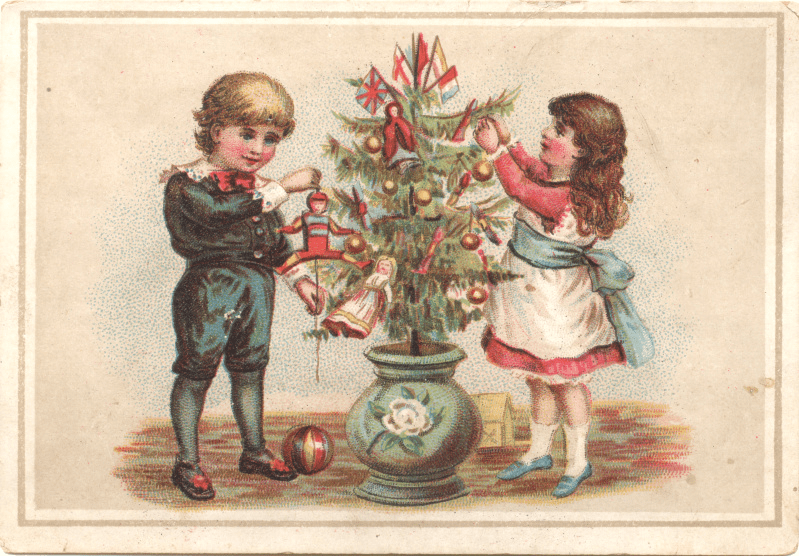
In December 1903, two hundred of the younger children from St Mary’s School, Kintbury and Christ Church School ( between Kintbury and Inkpen) all received “ a printed invitation, enclosed in an envelope” which I think was a rather pleasing touch on the part of Mr and Mrs Whiston of Barrymores, Kintbury. On December 27th, the children enjoyed a, “bountiful spread” after which there was a, “hearty indulgence” in games. “Handsome presents” were given out from a huge Christmas tree  for which the children “showed their gratitude by loud and hearty cheers.” 

On Boxing Day, 1907, the children attending Christ Church School  were given, “a splendid treat” due to the “kindness of Miss Dunn of Wallingtons.” Following “a good tea” a “fine Christmas tree was lighted up, from which each child received a bag of sweets and toys, besides a very useful present in the shape of a garment.”

Bearing in mind that the “lighting up” of the Christmas tree would have involved candles attached to the branches, I think I would have wanted to stand well back as this would have been a fire hazard. I do like the fact that Miss Dunn gave each child sweets and toys as well as a garment, so her idea of a Christmas gift must have seemed much more interesting the young recipients. Accompanying teachers were all given “something useful” whatever that was, and oranges & sweets were in abundance.

The children heartily cheered Miss Dunn, as, of course, they would have been expected to do so. However, for many children the gift of a toy must have been very welcome, so perhaps the cheering was genuinely heart-felt.

Perhaps, for some better-off villagers, being seen to be charitable was what mattered, to enhance one’s standing in the community. This might not have been the case, but it does make me wonder. According to the NWN of January 1907, a Mr and Miss Hinton had recently taken up residence in the “remote village” of Combe, where they lived at the manor. During Christmas week, the Hintons organised “an unusual treat” in the form of an, “entertainment” which was held at the manor and to which “nearly everyone turned out in the snow”. Most of the entertainment consisted of songs or piano pieces although the audience also enjoyed gramophone selections. For many villagers I expect this would have been the first time they heard recorded music. If there was a Christmas tree, fire works or presents, the Newbury Weekly News report did not mention it.

Reporting styles of the time mean that each account is littered with words such as, “splendid”, “hearty”, “generous” and so on. Social mores of the time meant that poorer villagers were expected to be subservient to the upper or upper middles classes and be appreciative of the charity they bestowed on them. Despite this, however, the Christmas parties, in particular, must have been eagerly anticipated and enjoyed by the children. Gifts of coal, game birds or clothing would have been welcomed by many even if not necessarily living in poverty but on a restricted budget.

I like the sound of Miss Dunn’s party in particular; it seems she took care to give presents that were both practical and fun. Also, it is interesting to note that a legacy of the Dunn family still exists in Kintbury: for well over a hundred years, Mrs Dunn’s Kintbury Charity has given grants to young people of the village.

© Theresa A. Lock 2023

Illustrations: Public domain, Wikimedia Creative Commons