Celebrating Ethel King Martyn and the murals of Inkpen church

In Medieval England, many church walls were decorated with colourful murals depicting Biblical scenes or the lives of saints. In an age of mass illiteracy, these images helped in the teaching of scripture and often provided a warning of what might happen to those who strayed from the narrow path of righteousness. “Doom” paintings depicting the day of judgement were popular if rather uncomfortable to look at.

 For poorer people whose homes were very much devoid of colour, the bright paintings on otherwise white interior walls must have provided something to gaze at and wonder. Sadly, so very many were painted over in the years following the Civil War (1642 – 1651) when they were regarded as idolatrous by the  puritanical protestants. Much later, other murals were destroyed during the eighteenth and nineteenth century when the fashion for “restoration” meant that they were painted over in favour of plain white interior walls.

Where these murals have survived, it is frequently just the reds and reddish browns which can be seen today. One such example in this area is in St Michael’s, Enborne where there is a painting of the Annunciation at the east end of the north wall. What other paintings have been lost we shall never know.
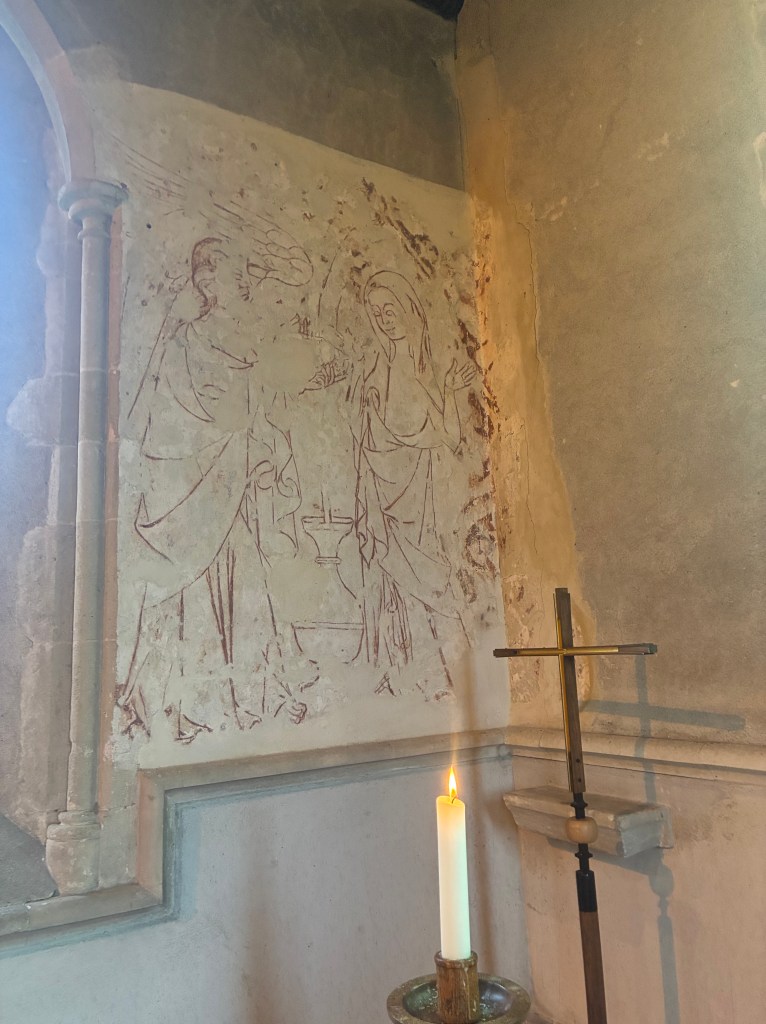
Mural, St Michael’s & All Angels, Enborne

In the late nineteenth century, St Michael & All Angels’ church in Inkpen was “restored”. According to the Reading Mercury of March 1897 the church had, in the words of its rector, “long fallen into a lamentable state of decay”. As a result, a restoration, lasting more than a year, had seen the greater part of the church rebuilt and, “the only ancient portions of the actual fabric are the exterior walls and one west window” remained.

Medieval wall paintings had been  discovered when the plaster was stripped from the walls but these were badly decayed. However, the architect, Mr C.C. Rolfe decided that there should be new and at that time very modern murals to grace the newly restored interior.

The person chosen for this work was Miss Ethel King Martin, an artist and sculptor.

Ethel had been born in Bristol in 1863, the daughter of Samual – a physician – and his wife Katharine. She studied at the Slade School of Fine Art in London’s Gower Street, then a very new establishment which had opened in 1871. It was groundbreaking as, unlike other art schools, it enabled women to study on the same terms as men, in particular with reference to life drawing. Other students studying there at around the same time included the illustrator Kate Greenaway and Evelyn De Morgan.

At this time, the influence of the Pre Raphaelite Brotherhood of some 40 or 50 years earlier could still be seen in contemporary work. The “Brotherhood” which included D.G. Rossetti, William Holman Hunt, J.E. Millais and Ford Maddox Brown was a group of artists dedicated to painting in a style which had, they believed, existed “before the time of Raphael.”

Pre Raphaelite paintings are bright, clear and bold, their subjects mostly devoid of the swirling drapery or dark backgrounds of earlier works.
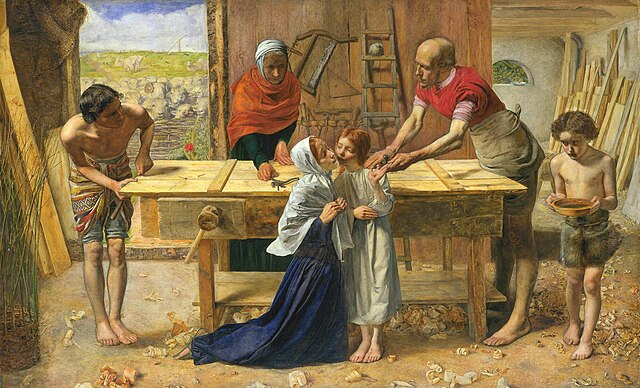
Christ in the house of his parents: John Everett Millais

Their work used bright colours and achieved a realism by having friends and family as models, giving their work a contemporary feel. Later other artists and craftsmen joined their circle of influence, most notably William Morris and Edward Burne Jones.   
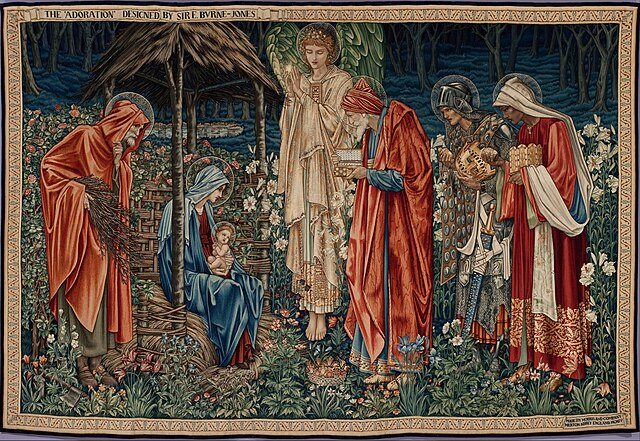
Adoration of the Magi: Edward Burne Jones

In turn, Morris and Burne Jones became influential in what has become known as the Arts & Crafts movement – in part a reaction to factory made and mass produced items. Emphasis was placed instead  on traditional crafts in arts and design.
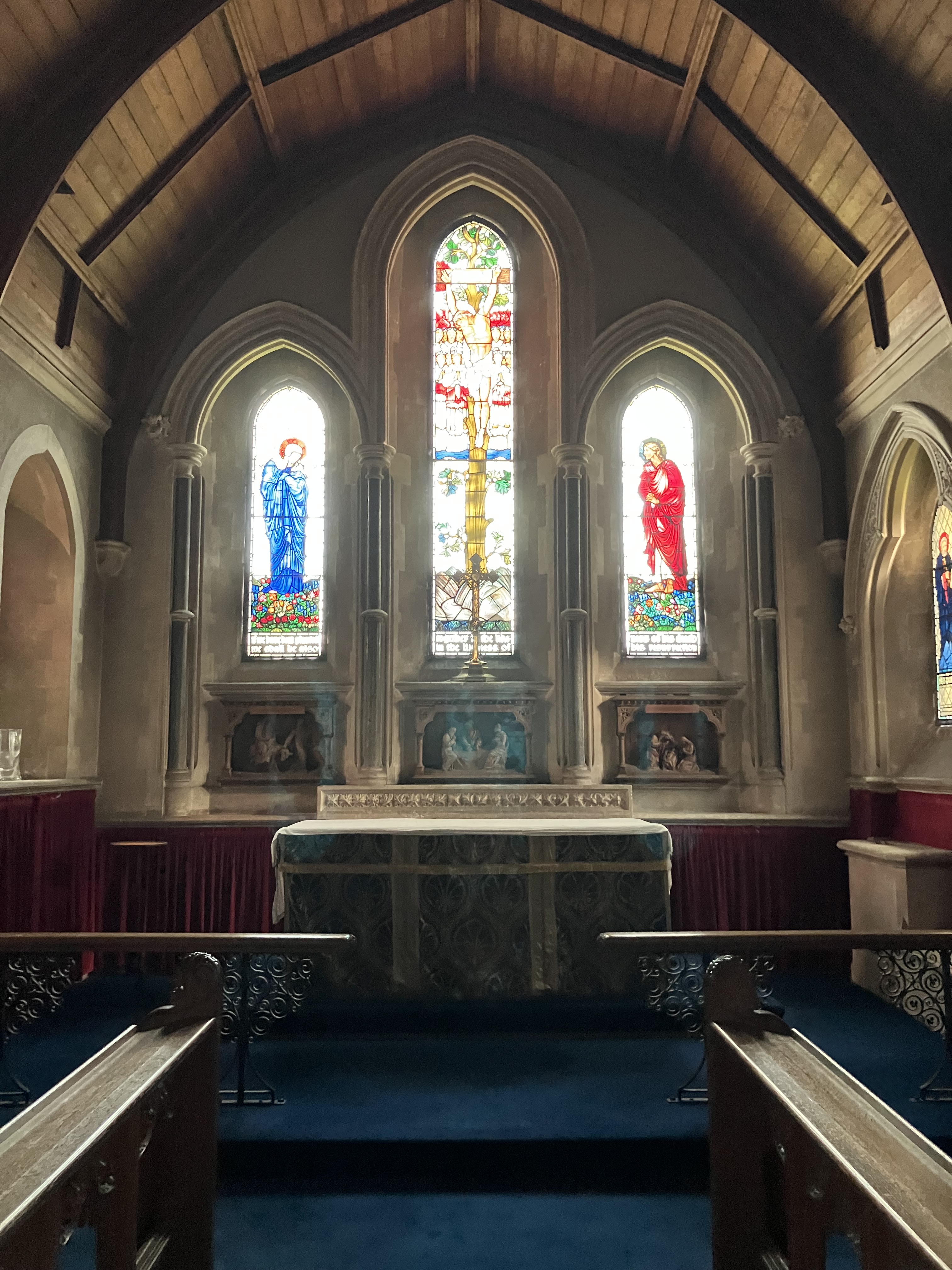
A Morris & Co stained glass window at West Woodhay

One name associated with the Arts & Crafts movement is Walter Crane, remembered particularly for his illustrations of children’s books.   
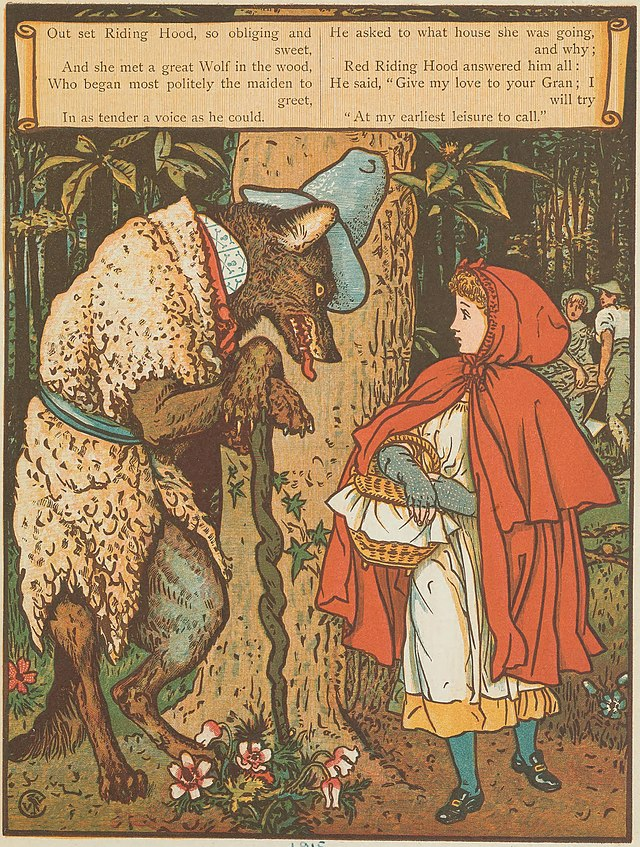
Illustration for “Little Red Riding Hood” by Walter Crane

Another was Kate Greenaway – a near contemporary of Ethel Martyn who had studied at the Slade some years earlier and who, like Walter Crane, is particularly remembered for her illustrations of children’s books.
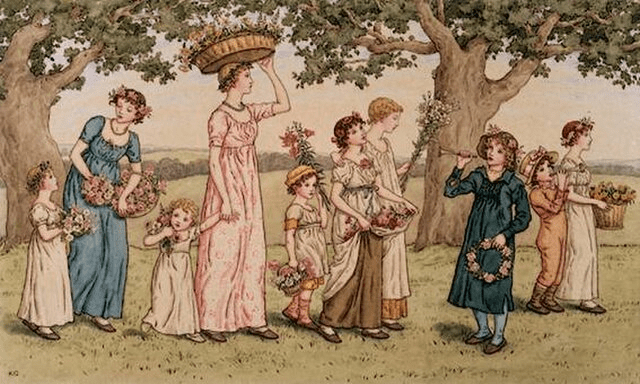
“May Day” by Kate Greenaway

Another female student in the early years of the Slade was Evelyn De Morgan. Her work, which frequently features the female form, also shows the influence of the Pre Raphaelites.
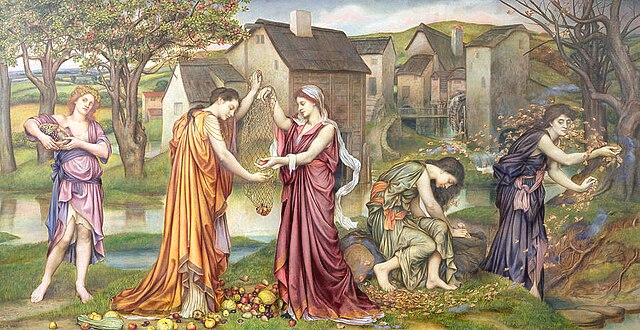
The Cadence of Autumn: Evelyn De Morgan

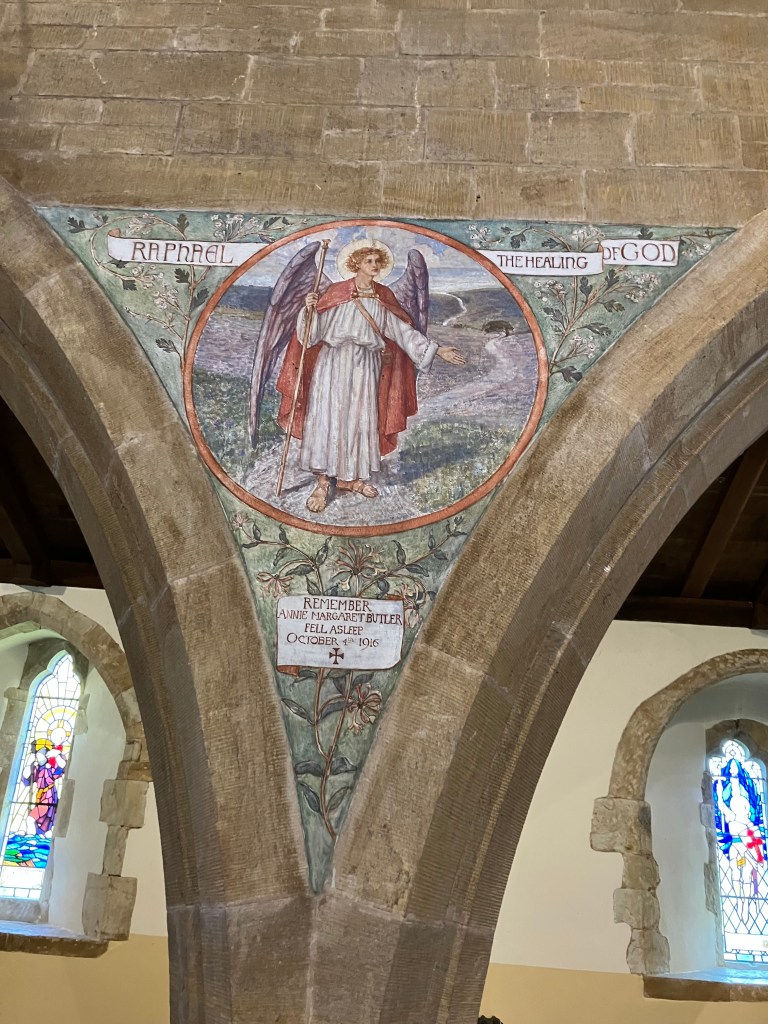
By the time of the “restoration” of St Michael’s Inkpen, Ethel King Martyn was an established painter and illustrator, having been elected Associate of the Royal Society of Printmakers in 1892 and then Fellow in 1902. She had also exhibited at the Royal Academy. Her work at Inkpen was completed in 1910 and remains as beautiful today as it was then.
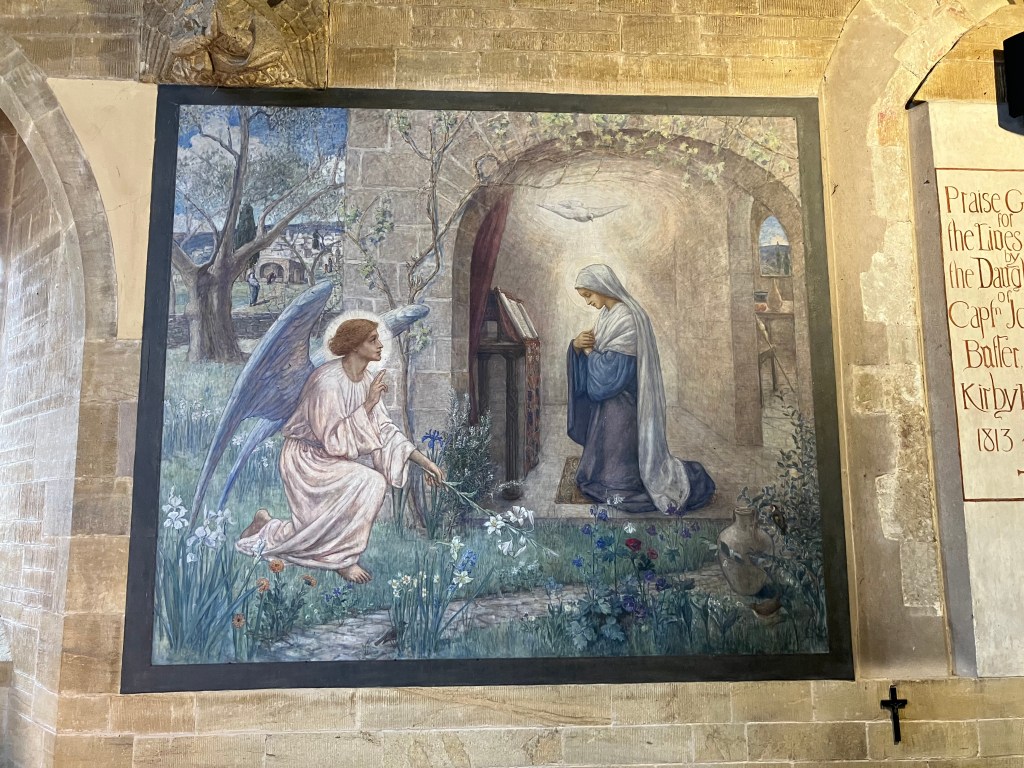
The Annunciation: Ethyl King Martin, St Michael & All Angels, Inkpen

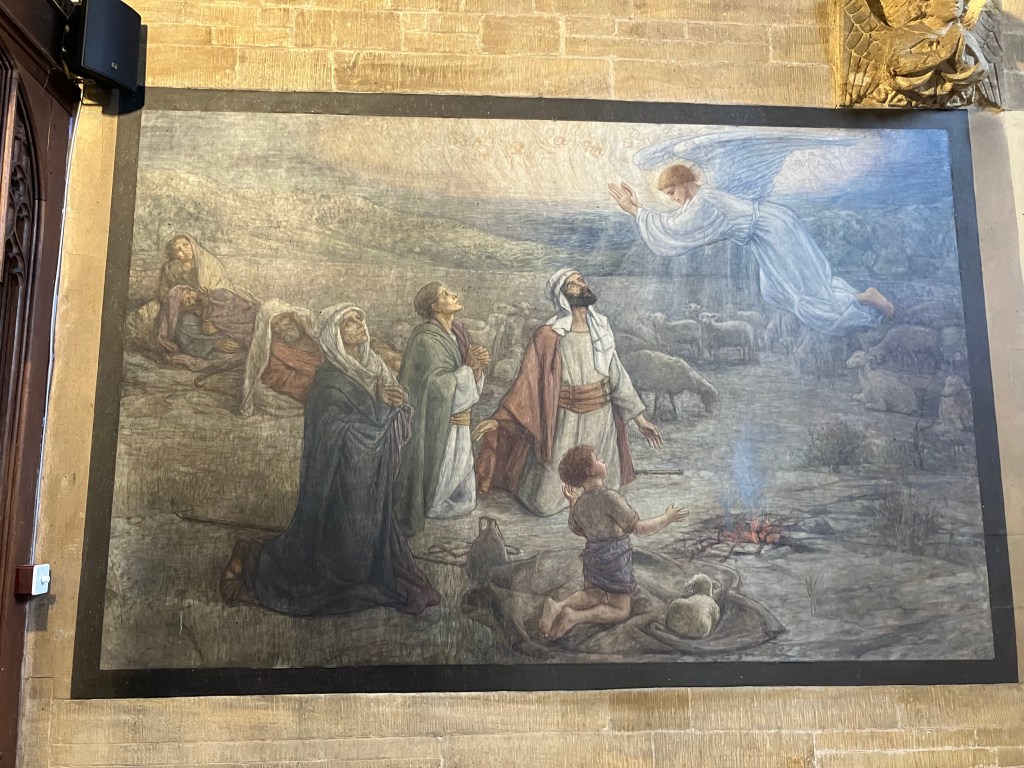
It is, I think, easy to see the influences of the Pre Raphaelite painters in Ethel’s work in terms of the use of bright colours, composition and realism as well as an appealing story-book quality reminiscent of Walter Crane and Kate Greenaway.
.
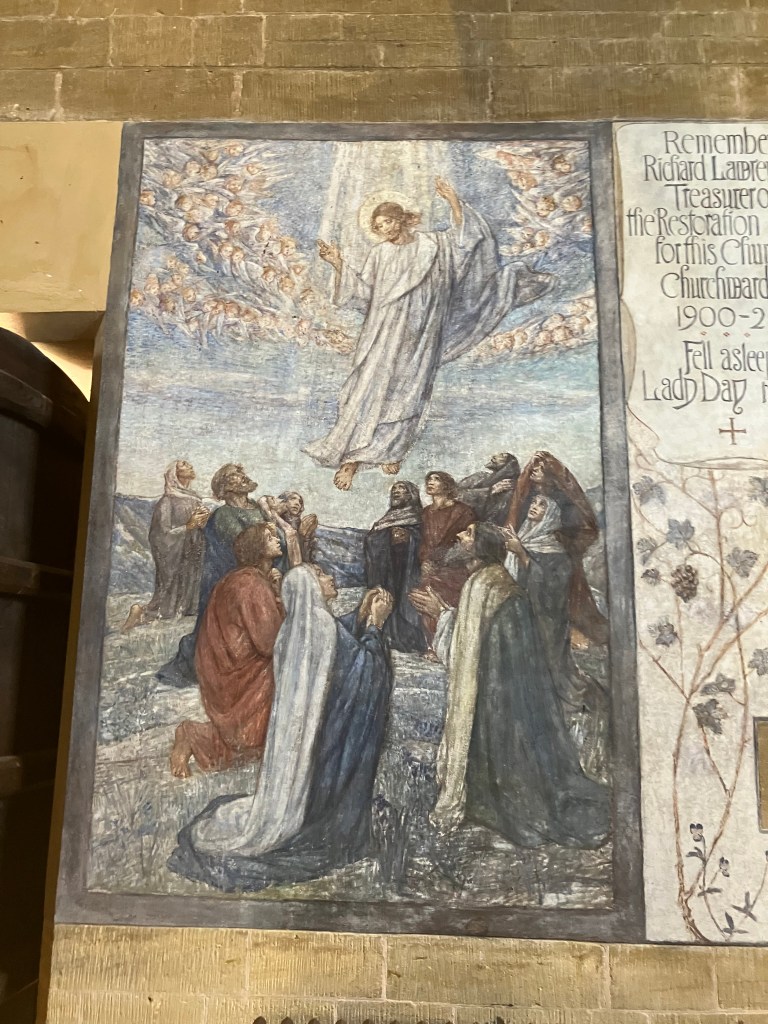
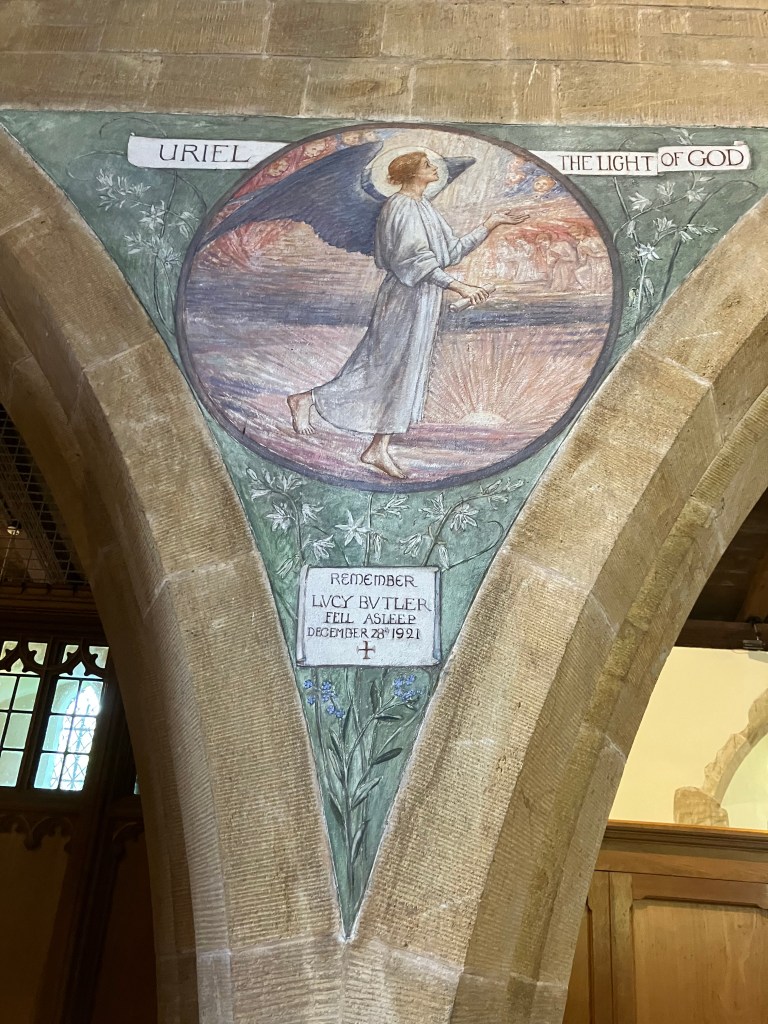
The Ascension: Ethel King Martyn
Uriel: Ethel King Martyn
Raphael: Ethel King Martyn

Some time ago, I wrote an article for this blog called, “Our churches: Not what they seem?” When I researched that article, using sources from the nineteenth and early twentieth century, I hardly ever came across the name of a woman – certainly there were no references to female architects, designers, builders or, of course, priests. Nationally, some women had achieved recognition alongside the men who were their contemporaries – I have already mentioned Kate Greenaway and Evelyn De Morgan in the field of art and design, however, they are in the minority.

Ethel King Martyn never married but lived with her twin sister, Agnes. She died in Budleigh Salterton, Devon, in 1938. You may never have heard of her before reading this, and her work has never, as far as I am aware, been reproduced on posters or greetings cards. But her work on the walls of the church at Inkpen is, I believe, stunning, and for that she should be celebrated.

(C) Theresa A. Lock 2026

Christchurch: Kintbury’s missing church

When I first wandered into Christchurch churchyard sometime in the mid 1970s, I assumed it was a very long-established cemetery. I had no idea that a Victorian Gothic Revival church had stood on the site until the 1950s.

So what is the story of Christchurch, and why, less than a hundred years after it was newly built, was it demolished?

Back in the days of high numbers attending church services and – for many – no means of transport other than by foot, parishoners living in homes remote from the nearest town or village would have faced a long and often muddy or dusty trek to attend Sunday worship. In response to this problem, “chapels of ease” were built to serve the requirements of scattered communities and by the 1860s a need for such a chapel was identified in the Kintbury/Inkpen area. The Earl of Craven donated land for the project and its position at Kintbury Crossways must have seemed the ideal location between the villages of Kintbury and Inkpen.

The architect chosen for this project was Thomas Talbot Bury, a person well known to the diocese. He had designed St Mary’s, Lambourn Woodlands and St Gregory’s, Welford, both in the early 1850s as well as working on St Mary’s, Kintbury in what Pevsner was, much later, to call a “heavy handed restoration”. The old vicarage in Kintbury is also the work of Thomas Talbot Bury. Architecturally, it seems, he was the man of the moment.

The new church was to be in the fashionable “Decorated Gothic” style, one which took inspiration from medieval buildings such as Westminster Abbey and Salisbury Cathedral. However at 95 feet long and 46 feet wide, Christchurch would be of modest size with pews enough for 250 adults. All seating would be free.

The tower, however, was to be particularly eye-catching, and was described in the Illustrated London News as being:

“…very effective, both from its massiveness and from the picturesque appearance of the spire, which is of tile in two stages with perforated woodwork intervening.”

The building was to be constructed of locally made brick with Bath stone and the work carried out by local craftsmen. A Mr Cumnor from Kintbury was to be responsible for the brickwork and plaster while fellow Kintburian, Mr Cruise was to be responsible for the woodwork. A Mr Keats from Newbury was the mason chosen to work with the Bath stone.

When it came to the stained glass windows, however, craftsmen from further afield were sought. Heaton & Butler were leading stained glass window designers and manufacturers, working in the fashionable Gothic Revival style. They had already produced a window for St Mary’s, Kintbury: theirs is the window to the left of the south door, featuring Jesus walking on the water.

The Illustrated London News mentions a “good sculpture” of the Last Supper by “Mr Farmer”. I think this most likely refers to Farmer of Farmer & Butler, a London firm of architectural sculptors who had worked on sculptures for the Natural History Museum.

There was also to be a richly carved pulpit and font.

The total cost of building this new church came in at  £3133, 1shilling, 9 1/2d. This might not seem a lot to us today but it needs to be remembered that this was at a time when the average wage for the labouring people attending its services was around 10 shillings (50 pence) a week. Furthermore, at the time of the building being opened, only £1835, 3s 0¼d had been raised whilst it was intended that £2035 3s 01¼d should be raised by a subscription and grants. A further sum of £1097 18s 8¼d should be achieved, it was hoped, by, “opening services and subsequent efforts.” One can only imagine the sort of discussions being held by those responsible for overseeing the financing of the project when the full cost was not realised before the church was opened.

“My First Sermon”, John Everet Millais. City of London Corporation

However, certain of the upper classes had deep pockets, and it would have looked good to be seen as a benefactor of this new place of worship. Members of the Dunel family of Barton Court, Kintbury, presented the pulpit, font and reredos; the sacramental plate and six of the windows were given by the Rev J.W. Dundas and two chancel windows by Talbot Bury himself.

The completed church was consecrated on Tuesday, May 28th 1867 by the Lord Bishop of Oxford. The Newbury Weekly News reported on the event and noted in particular the Minton tiles on the chancel steps, the splendid altar cloth, the elaborate reredos and the handsome font supported by marble columns. It was reported that, “an air of comfort and extreme neatness pervades the interior”. Christchurch, it seems, epitomised Victorian values of good taste and design.

Although most of Christchurch’s 250 “free” seats must have been intended for the less wealthy people living in scattered communities between Inkpen and Kintbury, it seems the great and the good turned out to attend that first service. In the style of reporting typical of the mid-19th century, the Newbury Weekly News name-checked well over thirty people including Rev H.W. Majendie, J.W.Dundas, G.C.Cherry Esq. ,Captain Butler, RN. and T. Bury, F.S.A. himself. One wonders if any of the local agricultural labourers crept quietly in at the back.

I do not know if the £1097 18s 8¼d outstanding cost was easily raised in the months or years after Christchurch was consecrated. So far I have found out very little about the life of the church over the next eighty years. But we do know that by the 1940s the building had severe problems and required extensive repairs. Whether this was due to neglect, stresses resulting from the effects of two world wars upon a rural community or problems inherent in the building’s structure, I have not been able to find out. There is a suggestion that the building was suffering from an infestation by death-watch beetle, but I have not been able to confirm this. Was it simply that Christchurch was not loved enough as a place of worship for anyone who could afford it to contribute to its repairs? By the middle of the twentieth century, the neo-gothic style of architecture so beloved of the Victorians was out of fashion, derided and disliked; it was still some time before the better examples would be championed by John Betjeman. In Newbury, St Joseph’s RC church, opened in 1928, and St John’s, opened in 1955, are both examples of how fashion and tastes in architectural styles had changed.

“My second sermon” John Everet Millais, City of London Corporation

Whatever the reason, in 1948 the decision was taken to close the church and in the mid 1950s it was pulled down. By the time I wandered into the churchyard in 1975, all traces of the building had long gone.

It all seems so sad to me: the craftsmen who worked on that building in the 1860s must have done so with pride, probably thinking their work would last for, perhaps, hundreds of years. Mrs Dunel had presented the font in memory of her children; perhaps she imagined it would be in use to baptise other people’s children for many, many years to come. I am sure none of the people who worked, or contributed in other ways, with pride and love to achieve what must have been – for some years at least – an impressive building, imagined that within the space of a lifetime the decision would be made to tear it down.

Tessa Lock.