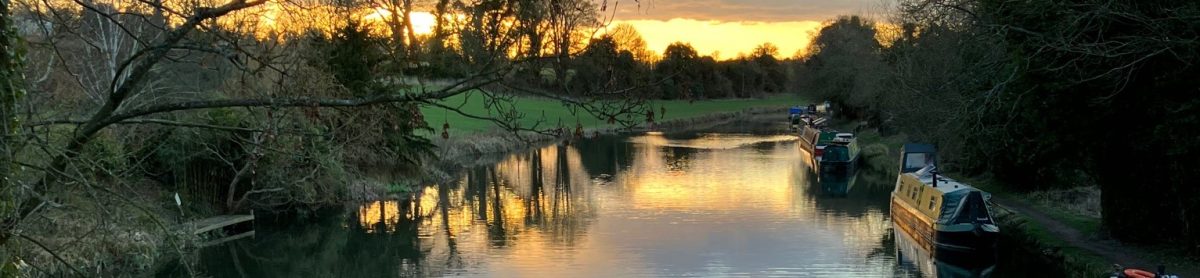

The history of Wallingtons, however, has not always been so peaceful.
At the end on the eighteenth century, the house belonged to Samuel Dixon, a barrister at Lincoln’s Inn, who lived there with his sister, Elizabeth.
Samuel Dixon employed as his servant one Benjamin Griffiths, a labourer living in Kintbury about whom there appears to have been a suggestion of a suspicious past. Griffiths had been one of the toll-keepers at the Colnbrook toll gate on the Bath Road in Buckinghamshire when, in 1781, his partner had been murdered. Although another person confessed to the murder, it seems this did not stop the finger of suspicion being pointed at Griffiths. Samuel Dixon was a trustee of one of the turnpike trusts, so perhaps this had something to do with his decision to take Griffiths on – we shall never know.
Samuel Dixon was in London on 7th April 1784 when Robert Griffiths broke into Wallingtons, stole a brace of pistols and a gun belonging to his master then set the house alight in several places. According to the Oxford Journal it was, “entirely burnt to the Ground with all the Furniture, Linen etc, a very curious Library of Books and Manuscripts, Pictures and other valuable Effects, nothing of consequence being saved.”
At first, Griffiths seemed to have got away with the crime and was actually sent to notify his master of the tragedy. However, his behaviour caused suspicion. When charged, Griffiths, “ cut his throat in a terrible manner but missing the windpipe it was sewed up and he is perfectly recovered.”
Griffiths was committed to Reading Gaol and stood trial in July 1784, where he was found guilty and condemned to death. Samuel Dixon tried to have the sentence commuted which perhaps seemed a strange thing to do for someone accused of burning down your house. Perhaps, however, there were circumstances of which he was aware and which history does not relate. His efforts were to no avail and Griffiths was hanged on 7th August 1784.
As a wealthy home owner, Samuel Dixon had been able to insure Wallingtons which he had rebuilt soon after the fire. We do not know for sure who the architect was at that time, although Pevsner says the north front, “appears to have had a Gothic makeover in the late C18th.”
Samuel Dixon died in 1792. In his will he left 5 guineas to two of Griffiths’ children – not an insignificant sum at that time.
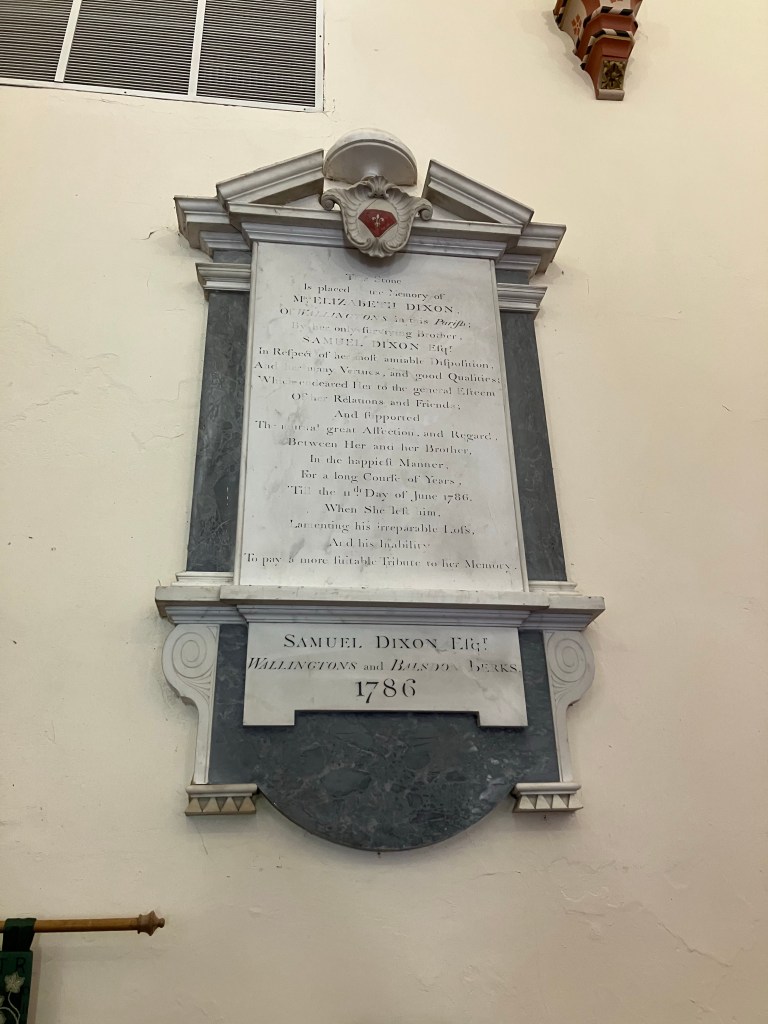
Elizabeth Dixon had died in 1786 and in her will she left money for the provision of a fire engine for Kintbury – presumably in the hope that no other family would have to suffer the fate of having their house burnt down.
The Wallingtons as we know it today is largely the work of the architect Temple Moore who remodelled the house for the then owner, William Hew Dunn between 1891 and 1893. Temple Moore’s work is in the then very fashionable Gothic Revival style.
As for Elizabeth Dixon’s fire engine, it is now in the West Berkshire Museum in Newbury.
– Penny Fletcher, September 2023
References:
Brother Anthony Porter: Wallingtons: A History of the House and Estate and the Families who have lived here. (inkpenhistory.uk/archive/Wallingtons)
The Oxford Journal & Reading Mercury (British Newspaper Archive)
Tyack, Bradley & Pevsner: The Buildings of England: Berkshire
 Kintbury and Beyond