Olive Emma Witt

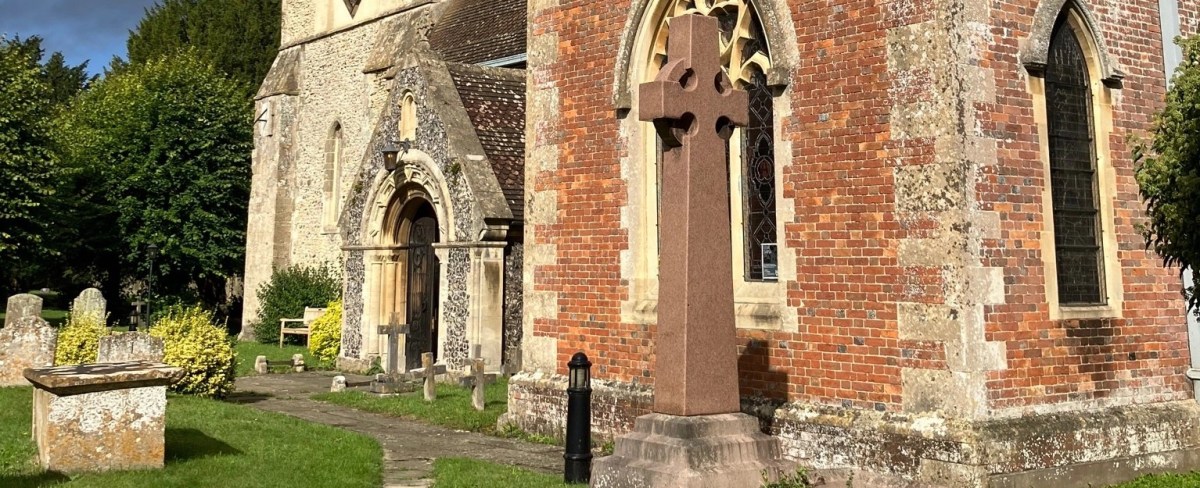
Should you turn to look to your left as you walk up the path to St Mary’s Church, Kintbury, you will see a rather unusual grave marker.

Should you turn to look to your left as you walk up the path to St Mary’s, Kintbury, you will see a rather unusual grave marker. Rather than being stone, as are the great majority of grave markers, this one, standing little over three feet high, is of metal, probably tin, and enclosed in a five-sided wooden frame. From a distance it looks a little like a larger version of a Victorian schoolchild’s slate; perhaps this was deliberate , because the person commemorated was  six year old Olive Emma Witt, who died in 1896.
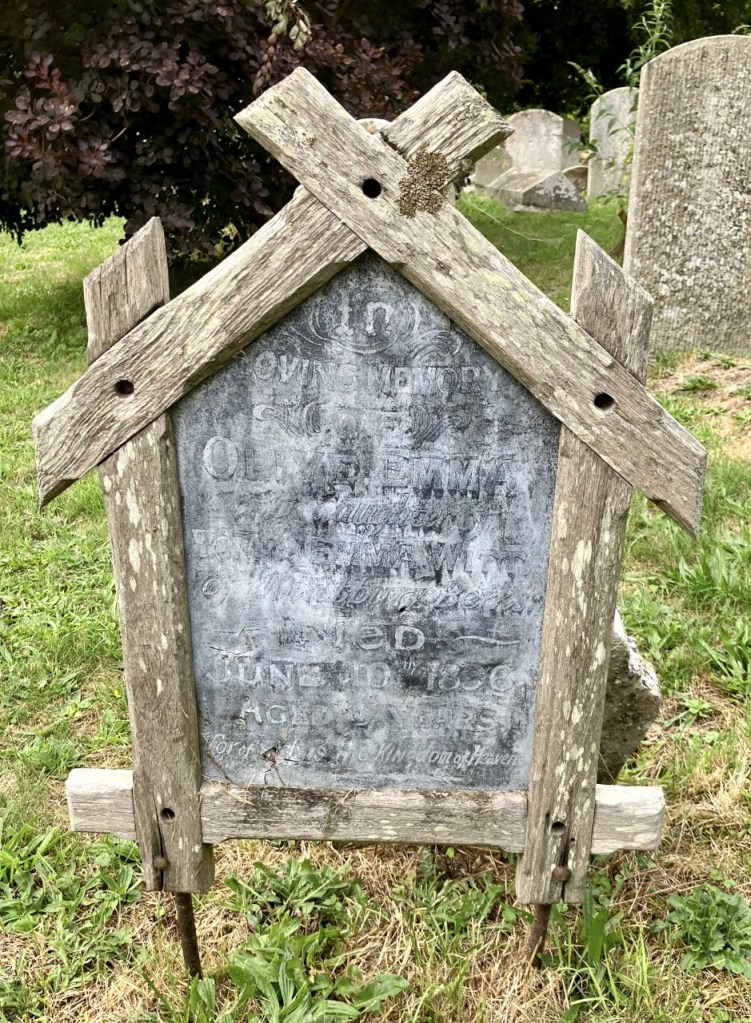
Olive Emma Witt’s grave marker in Kintbury church yard

The Witts were not originally of Kintbury. Olive’s father, Tom, had been born in 1846 at Braemore, Hampshire, where his father, Charles had been an agricultural labourer. Emma Witt had been born in Salisbury in 1850.

At the time of the 1871 census, Tom was working as a gardener in Salisbury and it has to be likely that it was around this time that he met Emma Skeet, the local girl who would become his wife.

By 1881, the Witts had moved north out of Wiltshire to west Berkshire where Tom now worked as a gardener at Elcot. The family had grown: Walter had been born in 1877 and Herbert in 1880.

It would seem that Tom Witt was an ambitious young man – by the census of 1891 he is a farm bailiff at Inlease Farm on the Hungerford Road out of Kintbury where they have been living for at least six years now. Two more children had been born: Charles in 1885 and Olive in 1890. The household must have been a busy and possibly crowded one as the Witts had four young men lodgers: two carters and two ploughboys, all working on the farm.

Some time within the following six years, Tom progressed from being a bailiff at Inlease to a farmer in his own right at Cullamores Farm on the road out of Kintbury towards Inkpen. Very sadly, however, it was here that, on June 10th, 1896, little Olive died. The grieving family put an announcement in the Newbury Weekly News.

The census of 1901 shows Tom & Emma still at Cullamores with Tom described as an “Employer”. The distinction between “Employed” and “Employer” was particularly significant in an age of increasing social mobility, particularly for someone like Tom whose father had been an agricultural labourer like so many thousands of men in the middle of the century. Tom & Emma were coming up in the world.

Herbert, now 20, was working on the farm. Charles, however, had turned his back on farming and at 16 was a carpenter’s apprentice. Walter had left Kintbury altogether, and was now a police constable at Rochester Row Police Station in London.

The end of the nineteenth century saw decreasing numbers of workers employed in agriculture and this national trend seems to have been reflected in the family experience of the Witts. By 1911, Walter was married with a daughter and living in Harrow, Middlesex. He was still with the Metropolitan Police. Herbert, who had previously been working on the family farm, had followed his elder brother into the police force, but for him a force not so far from home as he was in Wantage.

By 1911, Tom was 64 and no longer working in agriculture and no longer himself an employer. Furthermore, he and Emma have left Kintbury and were now living in Newland, Cogges, close to Witney in Oxfordshire. He has returned to his first occupation, that of gardener and on the census is identified as a “worker”.  

The trajectory of Tom Witt’s life experiences would have mirrored those of many of his contemporaries. Born into an agricultural labourer’s family, Tom had improved his life chances becoming upwardly mobile until he could describe himself as a farmer and employer – a distinction which mattered in this ultra class conscious time. By the time Tom and Emma’s sons had been born, universal education would have given them a far better start in life than that experienced by their grandfather Witt in Hampshire, enabling them to join the police force and ensuring their place in the lower middle classes.

We do not know exactly why Tom & Emma left Cullamores farm but it has to be likely that the slump in agriculture had something to do with it. This was a time when many thousands were still leaving the countryside for the growing towns whilst others were emigrating overseas. For Tom & Emma, perhaps the move northwards to Witney was a fresh start away from the world – and the social status – they had lost.

I wonder if they ever returned to Kintbury and to the little grave in St Mary’s churchyard -the journey back then from Witney would have required three changes of train on the Great Western Railway. The forty mile journey across the downs by road would have been slow and unlikely to be completed easily within a day.

Why Olive’s grave marker was of tin rather than stone I do not know. Iron crosses are not unknown in churchyards but a grave marker of tin is something I have seen nowhere else.

But then, any exploration of family history – any family – raises far more questions than it ever answers.

Tessa Lock
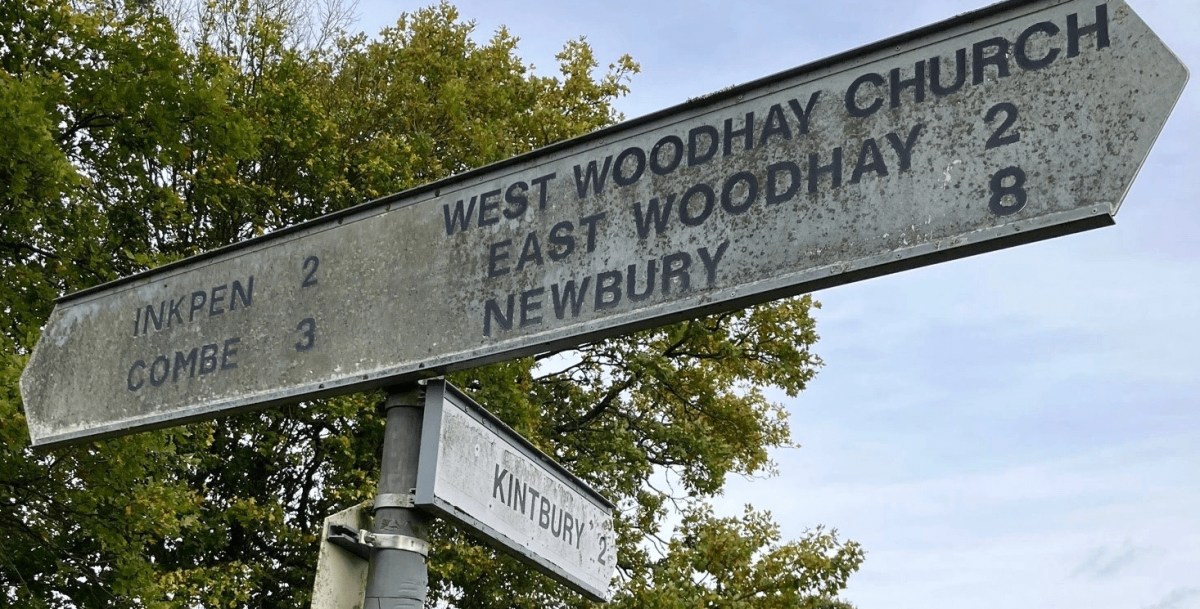
Where in the world is Combe?

Close scrutiny of the 1901 census shows something rather odd about the inhabitants of Combe.  On first sight it would seem that many of the 90 or so inhabitants identified as having been born in Hampshire but were now living in Berkshire – a sort of mass migration across the border to the north. Had they left behind them a deserted village somewhere like Imber on Salisbury Plain or Tyneham in Dorset? If not, what had happened sometime in the previous ten years?

Close scrutiny of the 1901 census shows something rather odd about the inhabitants of Combe.  On first sight it would seem that many of the 90 or so inhabitants identified as having been born in Hampshire but were now living in Berkshire – a sort of mass migration across the border to the north. Had they left behind them a deserted village somewhere like Imber on Salisbury Plain or Tyneham in Dorset? If not, what had happened sometime in the previous ten years?

What had actually occurred happened a long way from Combe; in the hallowed debating chambers and offices of Westminster the late Victorian governments had been bringing in laws to change how the country was being governed at a local level. Late nineteenth century policy changes are totally mind boggling unless you are one of those people for whom study of such minutiae brings you deep joy. However, put simply the 1894 Local Government Act enabled elections to take place for district and parish councillors. In doing so it brought a level of democracy much nearer for many people. This was mostly men, although the 1894 Act enabled women who owned property to vote in local elections.

Before district and parish councillors could be elected, it was necessary to determine where district and more importantly parish borders actually were. A glance at early nineteenth century county maps will show that back then not all county boundaries were where they are now. One such example is Combe which was originally in Hampshire although for the purposes of the Poor Law it was part of the Hungerford Union. This meant that anyone in Combe unlucky enough to fall upon hard times such that they could not look after themselves might find themselves in the workhouse in Hungerford.

In July 1894 a Joint Enquiry was held by representatives of the County Councils of Wiltshire, Berkshire and Hampshire to define more conveniently the county boundaries between those three administrative areas. At that time, the boundary between Berkshire and Hampshire passed right through the middle of Walbury camp and just to the north of the gibbet, as you can see on old OS maps.

Representing Combe, the vicar – and also Poor Law Guardian – Rev George Pearson expressed the view that his parishioners would rather their village to be in Berkshire. It was easier to get to Hungerford than either Kingsclere or Andover for what the Newbury Weekly News reported as “magisterial” purposes and for paying the rates into the Hungerford Bank. Questioned as to where the nearest Union (or workhouse ) was in Hampshire, the Rev Pearson explained that the one in Kingsclere was 10 or 11 miles away across difficult roads. Other members of the Enquiry concurred with this.

Absent from the meeting was Mr A.C. Coles, Combe’s representative of the landed gentry and, presumably, the most significant person in the community. However, his representative, a Mr Browning, informed the enquiry that Mr Coles was anxious that the parish should be transferred to Berkshire as it would be more convenient for highway purposes and that there were only one or two paupers in the parish, anyway.

I have to say the precise significance of this remark is lost on me, although  I would hazard a guess that the implication is that the poor of Combe are not going to be a drain on the rates of those in the Hungerford Union area.

And so, in this rather prosaic way, Combe – despite being on the other side of the one-time mountain and highest point on chalk in England – came in to Berkshire and turned its back on Hampshire. Its ninety-something inhabitants, from the Coles in the manor house to the two paupers in their cottages, moved without going anywhere because the roads into Hungerford were better and more convenient despite the climb up and over Walbury Beacon. The boundary was redrawn so that Berkshire included Combe Wood and Eastwick and there it has stayed ever since.

St Swithun’s church stayed in the diocese of Winchester, at least for the time being. In the years that followed it was transferred to the diocese of Salisbury and then back again, moving eventually to the diocese of Oxford in the early 1960s.

I have heard of other reasons being given for why the county boundary across our benefice was moved. However, I can find no other reasons other than those given above – essentially the convenience of road communications between Combe and Hungerford in implementing the 1894 Act.

I would love to hear from anyone else who might know or have evidence otherwise!

Tessa Lock

This article was first published in “The Beacon” in 2022