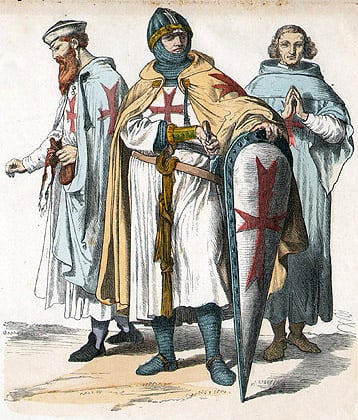
For many people, their mental image of a knight from the “olden days” (whenever that was!) is of a male figure brandishing a sword, his face covered by a cylindrical helmet and wearing a white tabard on which is emblazoned a large red cross of St George.
This enduring picture book image most likely has its origins in an actual medieval Christian military and religious order known as “The Poor Knights of the Temple of King Solomon”, or more familiarly, the Knights Templar. Originally founded to protect Christians on pilgrimages to Jerusalem, they followed the austere Rule of Templars which restricted, amongst other things, the eating of meat to three days a week and an insistence upon wearing only plain clothing.
The Knights were recognised by the Pope in 1129 and were supported by rulers throughout Europe such that they eventually became very wealthy, owning property in many countries.
However, after coming into disrepute, the Order was eventually dissolved in the early fourteenth century and its lands given to the Order of the Hospital of St John.
So what is their link with the hamlet of Templeton, between Kintbury and Inkpen? It is believed that, as its modern name implies, this was once the site of a house belonging to the Knights Templar and then subsequently to the Knights Hospitallers of St John. Although it is difficult to find out very much about the early history of the settlement, the online archives of the Newbury Weekly News and the Reading Mercury have some interesting reports from 1884 concerning archaeological finds there.
In the early 1880s, Templeton Manor belonged to the Dunn family. They were having an extension built and the architect for the work just happened to be Newbury architect and eminent local historian, Walter Money.
As the workmen were digging a foundation trench in land which had never previously been built upon, three skeletons were discovered at a depth of about eighteen inches. According to the report in the Newbury Weekly News, the remains represented men of “robust form and vigorous physique”, of average stature, about 5 feet 8 inches. Unfortunately, the skulls, which at the time would have been the only way of getting more vital evidence, were missing. This, of course, was in the years before DNA profiling and other scientific techniques which would be able to indicate gender and more about a person’s origins.
According to the report, no coffins were found with the remains, which were “laid in regular order”, head to toe and in east to west orientation.
This discovery must have been of particular interest to architect and enthusiastic local historian Walter Money, who, a few months later, submitted the results of some research to the Reading Mercury.
According to Money’s research, as reported in the Reading Mercury, the manor of Templeton with Walkott (sic) had belonged to the Preceptory of the Knights Hospitallers at Sandford, near Oxford. Then, on 28th December 1543, it was granted by the King, Henry VIII, “upon the possessions of the hospitallers being vested in the Crown, to Richard Brydges Esq of West Shefford and John Knyght Esq of Newbury.”
It is difficult to imagine the area around Kintbury and Inkpen in medieval times. At Balsdon farm, slightly to the south of Templeton, a moat still exists which is believed to have surrounded a thirteenth century manor house but it is otherwise very difficult to picture a landscape in which almost all our modern points of reference are missing – with the exception of our village churches, that is.
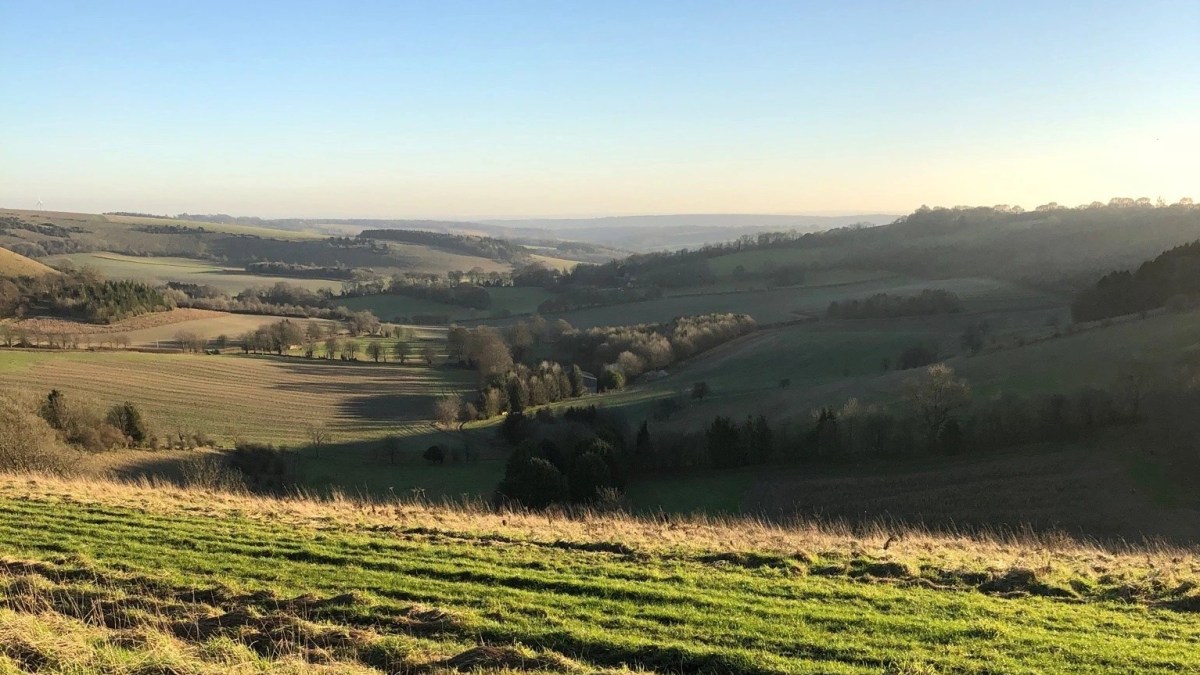
Perhaps, some seven hundred or more years ago, Knights Templar, having disembarked their ship at a south coast port, made their way up and over the downs, travelling northwards. Perhaps they carried with them travellers’ tales of Jerusalem, of encounters with Jews and Muslims, of seemingly strange beliefs and perhaps complex new mathematical and scientific ideas previously unheard of in medieval England. Maybe, when they reached Walbury Hill and looked down to the north west, they were relieved to see the familiar sight of Inkpen and Kintbury in the distance and considered themselves to be nearly home.
“Season of mists and mellow fruitfulness,
Close bosom-friend of the maturing sun.”
– Ode to Autumn by John Keates
The word September comes from the Latin septem, meaning seven. In the Roman calendar it was the seventh month.
Anglo Saxons called it gerst monath or barley month. This was when they harvested barley to make their favourite drink. It was also called haefest monath or harvest month.
In 1752 the British government decided to change from the Julian calendar to the Gregorian calendar but unfortunately this meant that there was a difference of 11 days between the “old style” and the “new style “ calendars. So, for example, 3rd September became the 14th. This caused much unrest and there were street protests with people shouting, ‘give us back our eleven days’. Some people thought they would die eleven days earlier as a result of this change!
Notable dates in September
The September 3rd is the anniversary of the outbreak of the Second World War.
On the first Monday after the 4th, the Abbots Bromley Horn Dance is performed.
September 23rd is the Autumnal Equinox, one of two days in the year when day and night are of equal length.
September 29th is the Feast of St Michael and also a “quarter day”, one of the four days in the year when, traditionally, rents were due to be paid.
St Michael and folk lore
In folk lore, St Michael was said to have cast the devil to earth where he fell into a blackberry bush -it is therefore unlucky to eat blackberries after this date. Scientifically, however, the first frosts could occur after this date and reduce the vitamin C in blackberries thus reducing their goodness.
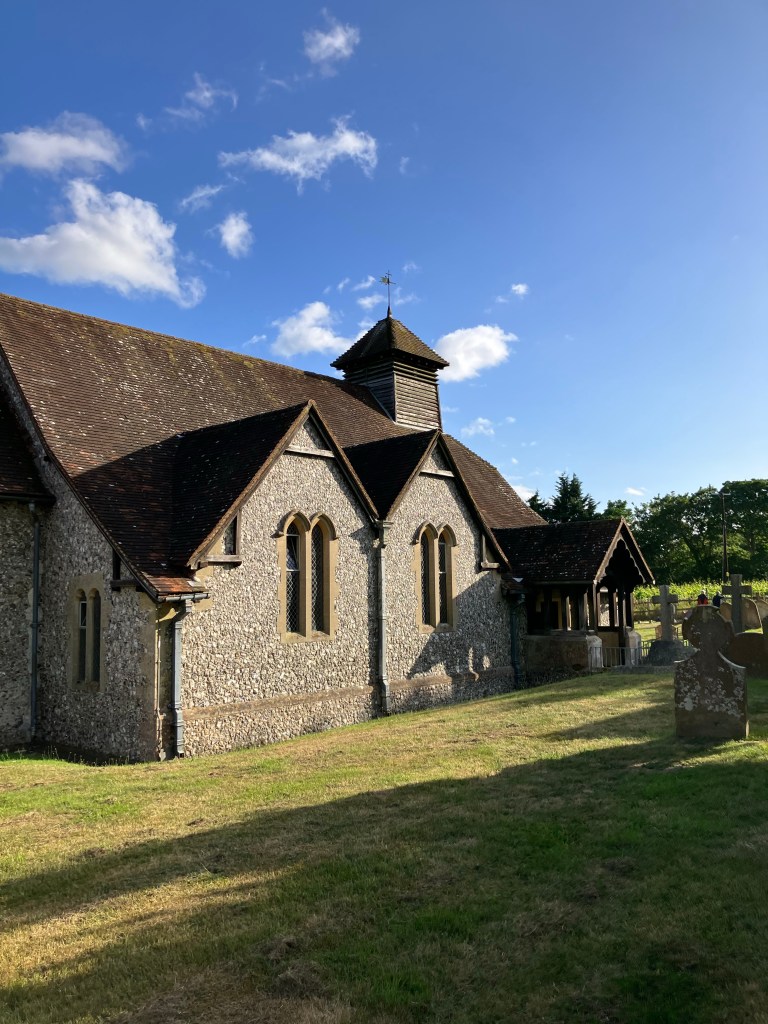
There are two local churches, Enborne and Inkpen, dedicated to St Michael (most churches with this dedication are on a hill) and until fairly recently we often celebrated these Patronal Festivals together as a benefice.
St Michael’s Enborne (c) 2023 T Lock
The famous St Michael ley line runs across England from the tip of Cornwall to the Eastern tip of Norfolk on the Norfolk/Suffolk border, passing through the prehistoric sites of Glastonbury and Avebury, also numerous other significant sites either named after St. Michael or St. George, both dragon slaying saints.
In his book , “The Old Straight Track” (1925), Alfred Watkins identified what he called a “church ley”, five churches which, when looked at on an OS map, can be linked by a straight line drawn between all of them. The five churches in this example are not far from Kintbury:
Here five churches – Tidcombe, Linkenholt, Faccombe, Burghclere and Sydmonton – align precisely , and on the ley are homesteads with the ancient names of Folly Barn, Bacon’s (formerly Beacon’s) Farm, and Curzon Street Farm, with fragments of present-day road in approximate alignment
According to records kept by the National Archive, at the time of the 1901 census, just over 40% of adult women in the UK were employed as domestic servants.
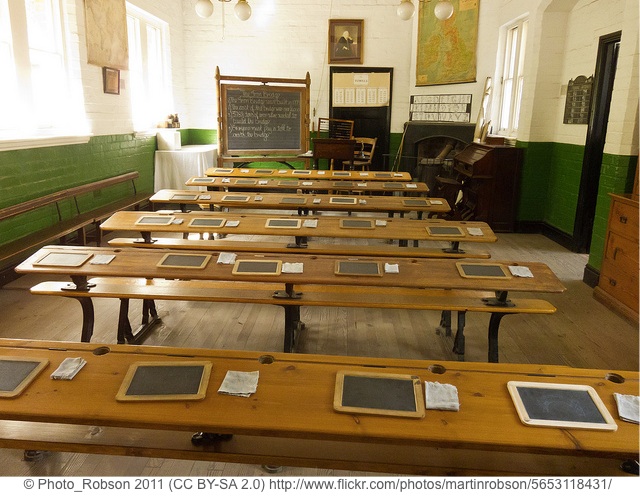
The early 20th century was a time when access to education and onwards to the professions was denied the great majority of young women for whom a position in the household of a wealthy family might have seemed the only employment option. For a significant minority, however, there were alternatives to domestic servitude.
In the nineteenth and early twentieth century, Kelly’s Directories published lists of gentry, landowners, charities and those employed in commerce for every town and village throughout England. Listed under “Commercial” in the 1903 edition for Berkshire, Kelly’s Directory records 64 names in Kintbury, 33 in Inkpen, 17 in Enborne, 11 in Hamstead Marshall and 1 in Combe. But of the grand total of 130 people involved in “commerce” across what is now our benefice, only 13 are women.
In Kintbury, Mrs Maria Abraham and Mrs Ann Bance are both listed as bakers while Mrs Harriet Penny is a butcher. Mrs Eliza Peck is a shopkeeper and Mrs Elizabeth Taylor is a beer retailer, presumably running a pub. In Inkpen, Mrs William Killick is a grocer. It is likely, I think, that most of these women, if not all, are widows continuing with the businesses previously run by their husbands.
The same would appear to be true for the two carriers listed by Kelly’s: Mrs Emma May in Inkpen and Mrs James Miles in Hamstead Marshall are both continuing with businesses recorded in the 1901 census as having been run by their husbands. Of course, it may well have been that the women had long helped their spouses run the family business, but this would not have been recorded by the census enumerator.
Women had been employed by the Post Office nationally since the 1870s, where they could sort the mail and operate the telegraph system. In Inkpen, the Post Office at Upper Green was run by Miss Matilda Goodfellow Froom and in Kintbury by Mrs Emma Page who is also listed as a stationer. Although the smallest village, even then, Combe has its own post office, which is run by Miss Rose M. Salt.
Two women to have control of what must have been larger businesses are Mrs John Goddard of Hamstead Marshall and Mrs Mary Jane Dymond of Inkpen who are both listed by Kelly’s as farmers.
According to the 1881 census, John Goddard was farming 67 acres. In Hamstead Marshall. By 1891, his son, Richard was also working on the farm. However, John died in 1894 and by the census of 1901 Martha, John’s widow, is recorded herself as farmer with Richard employed by her.
It is a similar story over in Inkpen where Mary Jane Dymond had been running her 30 acre farm for over twenty years since the death of her husband John.
It would be easy to presume that these women must have had equal status with the men running similar businesses close by. Surely Eliza Peck or Maria Abraham’s experience of running their shops would have been largely similar to that of the male shopkeepers further down the road? Would life on a farm have been so very much different for Mary Jane Dymond or Martha Goddard when compared to farms run by men?
Apart from everyday sexism expressed in such phrases as , “the weaker sex” and “a woman’s place is in the home” and so on, the perceived inferior status of women was enshrined in certain laws. For example, whilst many women would have controlled a business budget, they would not have been able to open a bank account in their own names or apply for a loan.
However, for Mary Jane Dymond, Martha Goddard and the rest, the position of women in society was changing – but very, very slowly. The 1882 Married Women’s Property Act had enabled women to own and control property in their own right although it was not until 1922 that the Law of Property Act gave men and women equal rights to inherit property from each other.
Women ratepayers – that is to say, women who owned or rented property – had been able to vote in borough and county elections since 1888. So most, if not all, of the women in business in 1903 would have been able to vote for their local councillors although as women there were not able to stand for election themselves. Women – and many poorer men- were still unable to vote in parliamentary elections.
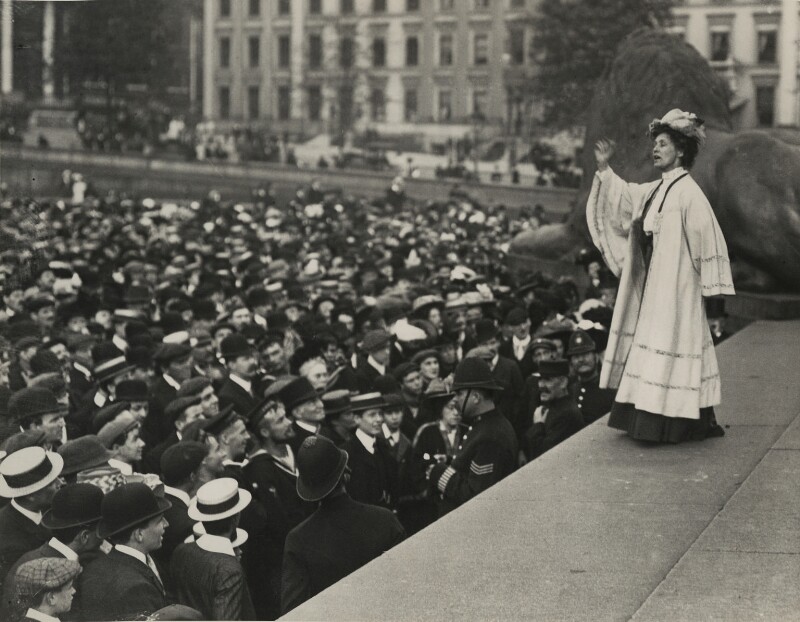
In 1902, textile workers in the north of England had presented a petition to parliament demanding votes for women and 1903 saw the formation, at the home of Mrs Emmeline Pankhurst in Manchester, of the Women’s Social & Political Union, a campaigning group concerned with extending the franchise to women. It is likely that both these events passed by even the most avid newspaper-reading folk of West Berkshire – however, news of the burgeoning women’s suffrage movement would gradually appear in the pages of the Newbury Weekly News.
Emmeline Pankhurst addressing a crowd in Trafalgar Square by Central Press, by Central Press, bromide press print, October 1908, 7 in. x 8 7/8 in. (177 mm x 226 mm) image size, Given by Terence Pepper, 2008, Photographs Collection, NPG x131784
The NWN of March 31st 1904 reported that the local Women’s Liberal Association held a packed meeting at which Mr Richard Heldene MP spoke on the subject of women’s suffrage. In 1906 members of the same association listened to an address given by Mrs Eva McLaren, “in favour of political rights for women”.
It seems that the issue of women’s suffrage had not always been taken seriously. On 21st March 1907, the NWN carried a report of a debate in Reading at which Mr Mackarness, MP for South Berkshire had spoken. According to the report,
…there was a great deal of joking on the subject but for his part he always looked on it from a common sense point of view… They had given women votes in all local affairs therefore he could not quite see upon what line of argument … they were to refuse them a vote in Parliamentary matters.
Whilst the NWN was happy to report objectively on debates or speeches in favour of women’s suffrage, this seems not to have been the case when covering the actions of more militant campaigners such as the members of the WSPU. On 28th March, 1907, it reported,
The women suffragists made another scandalous disturbance on Wednesday in avowed attempts to enter the House of Commons.
But it would seem that not everyone in the area agreed that the tactics employed by the more militant suffragettes ( as they were eventually known to distinguish them for the more peaceful suffragists ) were “scandalous”.
In November 1909, the newspaper of the WSPU, “Votes for Women” reported that a Miss Keevil, “is speaking at two meetings in Newbury. Sympathizers there are very anxious to hear about militant methods.”
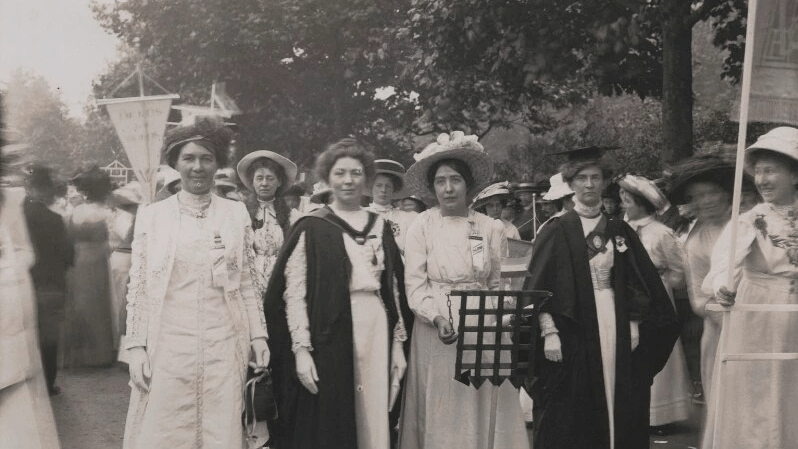
In June 1911, the same newspaper reported that there were to be outdoor demonstrations in Reading, Newbury and Basingstoke, and that the Newbury & Reading contingent would march under a banner bearing the words, “Pro aris et foris”. A Miss Daukes of Newbury would be acting as sergeant, the newspaper reported. The WSPU was nothing if not well organised and this was expressed in the use of such military language.
“Votes for Women” was eventually replaced by a new newspaper representing the WSPU campaign, The Suffragette. Copies were sold in Newbury Market Place and reports included the successful, “At Home” held by Newbury’s Mrs Whittington and a meeting held at the Guildhall Hotel, Mansion House Street. The campaign for women’s suffrage had definitely come to town.
Nationally, Emmeline Pankhurst’s WSPU involved women from all social classes at all levels of the organisation. However, it must have been far easier for women of comfortable financial means and less demands upon their time to participate in local campaigning. Marian Daukes, Hon Sec of the Newbury WSPU branch, was the daughter of an architect and lived during the early 1900s at a house called Diglis on the Andover Road. At the time of the 1891 census she had been living on independent means in Surrey which suggests that she was most likely of the class of women able to spend their time as they chose. To working women such as Mary Jane Dymond and Martha Goddard, or Maria Abraham and Ann Bance, Marian’s life would have seemed a world away from theirs. It is impossible to know if these women from the villages ever saw a copy of The Suffragette, sold in Newbury Market Place. We do not know what they would have thought, had they read anything in the NWN of the campaign for women’s suffrage – I think it likely that some would have ignored it, others would have been appalled at the more disruptive or militant campaigns, whilst others may well have approved – but possibly secretly.
The 1907 Qualification of Women Act allowed women to be elected as borough and county councillors, also as mayor. Thus women were able to participate in local decision making for the first time. In Newbury, it was not until 1922 that Elsie Kimber was elected the town’s first female councillor. Elsie went on to become the first female mayor in 1932 and first woman Alderman in 1943.
The Representation of the People Act of 1918 granted the right to vote to all men over 21 but only to women over 30 who owned or rented property with a yearly value of at least £5, or to be married to a man who qualified to vote in local government elections. For many women who had run businesses or taken the places of men in agriculture or other industries during the 1914 to 1918 war, this must have been a bitter disappointment. For the many women still employed in domestic service, their position in the eyes of the law had changed very little.
In May 1919, political discussion came to Kintbury when a meeting of the Kintbury Branch of the South Berks Women’s Unionist Association, an organisation of the Conservative party, was held in the Coronation Hall. In attendance were many well known ladies of the village including Mrs Dunn and Mrs A.E. Gladstone. One speaker, the Hon Ethel Akers-Douglas spoke of the urgent need for self education with regards to politics. Another, Mrs W.A. Mount, wife of the local Member of Parliament, spoke of the “threat” of a Labour candidate in the constituency at the next general election. She explained the party’s intentions to see the conditions of the working men improved, however, “when people said there could be full equality, it was their duty to point out that such a state of things was absolutely impossible.”
Such was the mind-set of many at the time, although we do not know how many of the women running shops or businesses, particularly on behalf of men killed or disabled in the war, would have agreed with her. I wonder what Elsie Kimber, at her family’s shop in Newbury, would have thought.
Women were not granted equal voting rights with men until 1928. The first woman to be elected to the Westminster Parliament was Constance Markievicz in 1918, although as a member of Sinn Fein she refused to take her seat and so the distinction of being the first woman to sit in parliament goes to Lady Nancy Astor who won the Plymouth Sutton seat in 1919.
Emmeline Pankhurst believed that, once women achieved parliamentary representation, it would follow that other legislation to benefit the lives of women would soon be enacted. I think she would have been shocked to know just how long it took for women to achieve equality with men in so many areas. Back in 1903, Mary Jane Dymond would have been unable to open a bank account independently. This situation did not change until the 1960s and it was not until the 1970s that a woman could apply for a loan without having her application endorsed by a man – literally any man. Similarly, the Equal Pay Act did not come into law until 1970 before which it was quite legal for businesses, including high street banks, for example, to offer career prospects to young men with salaries higher than those offered to similarly qualified young women.
I believe Marian Daukes and her fellow WSPU supporters in Newbury would be disappointed – or even incredulous – that by the 2019 parliamentary election, out of 650 seats only 220 were filled by women. Similarly, although the position of women in society has changed in many ways that would surprise a Mary Jane Dymond or Martha Goddard, many businesses still have only male names over the door or in trade directories. Further more, to see the words, “And daughter” on a commercial vehicle is still very, very rare. So much has changed, but then, so much has remained the same.
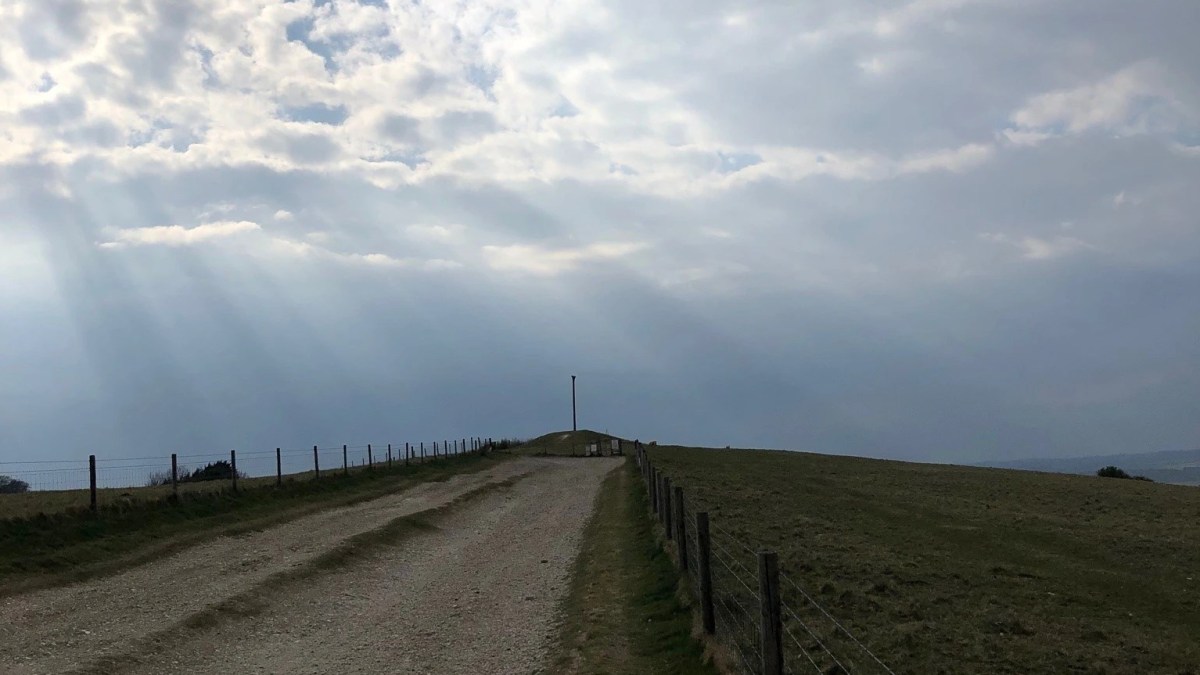
Walbury Beacon Benefice is named after the point on Walbury Hill where, traditionally, a beacon has been built.
But mind-chains do not clank where one’s next neighbour is the sky.
Thomas Hardy, “On Wessex Heights“
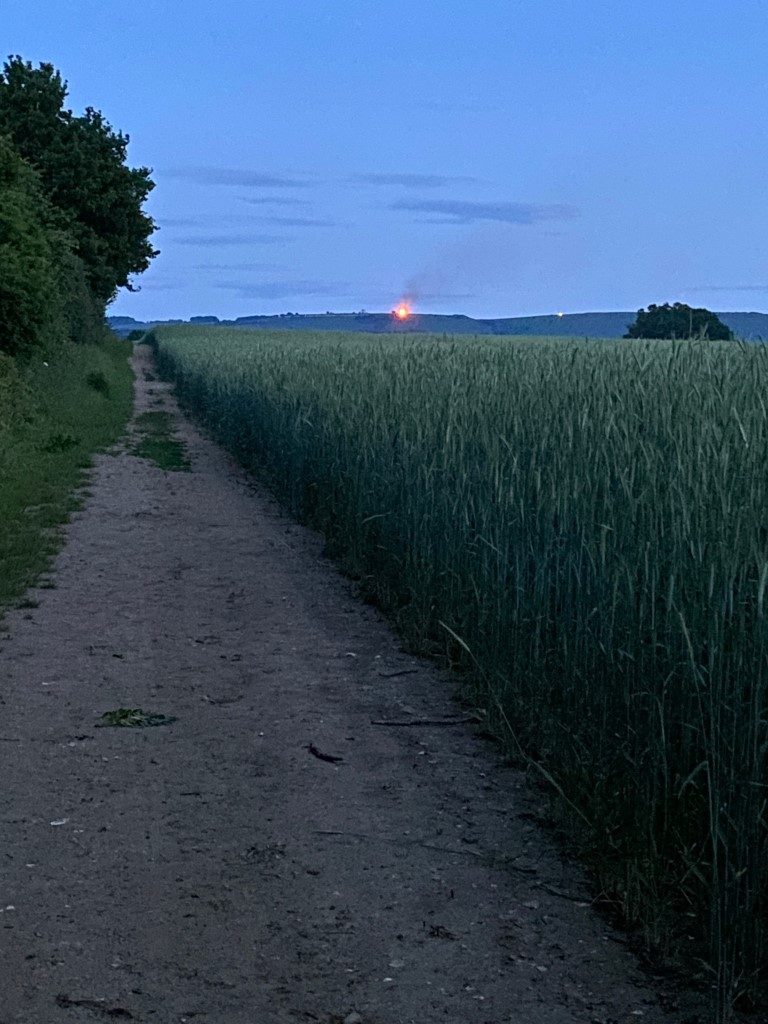
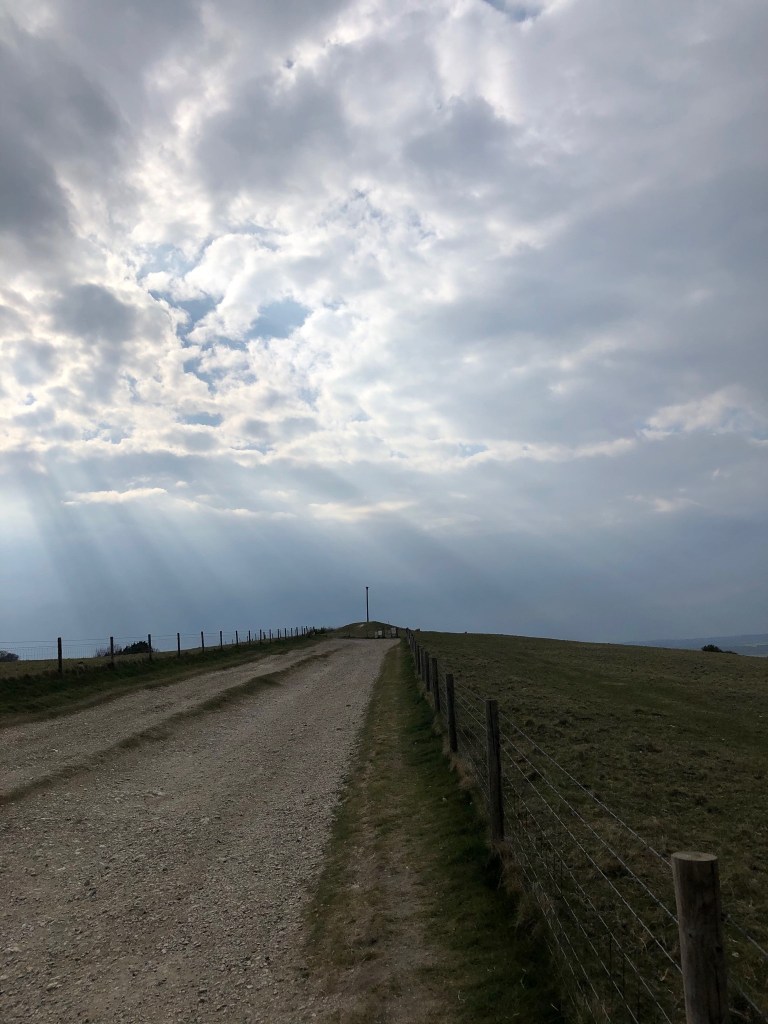
Walbury Beacon Benefice is named after the point on Walbury Hill where, traditionally, a beacon has been built. Originally beacons were lit across the south of England as an alert to the danger of invasion. More recently and at least since Victorian times, the chain of beacons has been lit to celebrate royal jubilees. Sometimes known as Inkpen Beacon, at 974 feet above sea level, Walbury Hill is the highest point on chalk in England and the site of Walbury Camp, an Iron Age hill fort, which, I believe, has never been excavated.
A beacon on Walbury Hill/Inkpen Beacon celebrating the Platinum Jubilee in June 2022
It will surprise some people to know that when the Ordnance Survey first surveyed this area, Walbury Hill was measured as being 1,011 feet above sea level, thus making it a mountain! However, a subsequent survey in the late C19th measured Walbury at less than 975 feet and so demoted it to the status of a hill.
Further westward along the ridge is Inkpen Long Barrow, one of only three long barrows in Berkshire but one of a cluster, most of which are located in Wiltshire and Dorset. However, it is not the long barrow that many visitors come to see, but the famous (or perhaps that should be infamous) Combe Gibbet.
Combe gibbet
Many people mistakenly believe that a gibbet was the site of a public execution, but this was not so. The original Combe Gibbet was only used once but it was not for an execution. In 1676, George Broomham and Dorothy Newman were convicted of the murder of George’s wife Martha and son, Robert. They were executed at Winchester but their bodies returned to their home parishes where they were hung on the gibbet – as a deterrent to anyone contemplating committing murder. What contributes to the general confusion between a gibbet and a gallows is the fact that the downland on the north side below the gibbet is marked on OS maps as “Gallows Down” – presumably a misnomer which has stuck!
As many of you will know, the story of Broomham and Newman inspired the then young Oxford graduate John Schlessinger, to make his first feature film, “The Black Legend”. In the late 1940s the Schlessinger family lived at Mount Pleasant, between Inkpen and Kintbury and so the grisly local landmark would have been a familiar sight to them. With family members and friends from Oxford taking the major roles, John Schlessinger filmed the story of murder during the summer of 1948, using many local people as extras. I doubt any of these villagers had the remotest idea that this young man would one day go on to be one of Britain’s foremost directors winning 7 BAFTAs and an Oscar.
Nearly 20 years later John Schlessinger was to return to Wessex to film his adaptation of Thomas Hardy’s “Far from the Madding Crowd”. Filmed entirely on location in Wiltshire and Dorset, what fascinates me about this later work are the number of scenes which recall moments from Schlessinger’s earlier film. It is as if the inspiration he took from his work around Walbury Hill stayed with him and was used in this, one of the visually most beautiful of British films.
However, it is not only because of the Black Legend that many other people visit Walbury Hill. The Newbury Weekly News archive features various accounts of visits to the area or discussions of its history. Some time in the late C19th, the novelist and poet Thomas Hardy visited Walbury Beacon – though perhaps to confuse us even more, he calls it “Ingpen Beacon” – and referenced it in his poem, Wessex Heights:
There are some heights in Wessex, shaped as if by a kindly hand For thinking, dreaming, dying on, and at crises when I stand, Say, on Ingpen Beacon eastward, or on Wylls-Neck westwardly, I seem where I was before my birth, and after death may be.
Walbury Hill might not be a mountain but it remains a much loved landmark.
Think of the author, Thomas Hardy (1840 -1928), and your first thoughts are probably of Dorset, the county most associated with his life and where most of his novels and poems are set.
So, what did this author, most associated with the countryside around Dorchester, have to do with Berkshire?
Think of the author, Thomas Hardy (1840 -1928), and your first thoughts are probably of Dorset, the county most associated with his life and where most of his novels and poems are set.
Fans of Hardy will know that in his novels he identified his semi-fictional Dorset as South Wessex, Wiltshire as Mid Wessex, Hampshire as Upper Wessex and so on, adapting the name of the early medieval kingdom. If you look carefully at the map of Hardy’s Wessex inside most editions of the novels, you will see that North Wessex corresponds to pre 1974 Berkshire with “Christminster” or Oxford, just to the north.
So, what did this author, most associated with the countryside around Dorchester, have to do with Berkshire? Well, Hardy’s paternal grandmother, Mary Head, was actually born in Reading and brought up in Fawley, a village on the downs south of Wantage. In his novel, Jude the Obscure, Hardy gave Jude the surname, Fawley, but chose to identify the village as Marygreen, after his grandmother. Similarly, Wantage becomes Alfredstone after the King Alfred who was born there, and Newbury, Kennetbridge, after its river. Along with Aldbrickham for Reading, all these places feature in Jude the Obscure, Hardy’s novel of 1895.
Another Hardy link with Old Berkshire, this time in reality rather than fiction, is with Denchworth, a village in the Vale of White Horse north of Wantage. Hardy’s sister Mary had trained as a teacher in Salisbury and accepted her first teaching post at Denchworth village school. Quite why she took a post so far north of either her home or the town in which she trained, I cannot find out. I do not believe that teaching posts were so difficult to come by in those days but I might be wrong. Perhaps she had connections with the Wantage area or had been recommended by someone. It would be interesting to find out. Mary was, apparently, very lonely in this isolated spot so her mother allowed her much younger sister Kate to live with her there. Whether Hardy ever visited his sisters in Denchworth we do not know, although it has to be a possibility.
As a successful author, Hardy and his first wife Emma lived for a time in London where they befriended some of the society figures living in the capital at the time. These included Sir Frances & Lady Jeune who, in the later years of the nineteenth century, also owned Arlington Manor, north of Newbury on Snellsmore Common. Hardy came to stay with the Jeunes in their Berkshire home in 1893 when he also visited Shaw House, Newbury at that time the property of the Eyre family.
In October of the same year, Hardy paid a visit to his grandmother’s childhood home up on the downs at Fawley. Sadly he does not seemed to have enjoyed the North Wessex downland, or at least that around Fawley, as he wrote, “Entered a ploughed vale which might be called the Valley of Brown Melancholy”.
I hope that the surrounding downland untouched by the plough was more to Hardy’s liking!
However, we do know that there was somewhere in Berkshire that was very much to Hardy’s liking. Although we do not know for sure when or how he got there, Hardy visited our own Walbury Beacon. We know this because he refers to it – as “Ingpen Beacon”- in his poem of 1896, “On Wessex Heights”.
Perhaps Hardy visited whilst he was staying with the Jeunes the previous year. Maybe they had a very early model of motor car, although it is difficult imagining one negotiating the incline to reach the top. Perhaps Hardy, and whoever was accompanying him, travelled to Kintbury station and made the rest of the journey in a horse drawn vehicle. We shall never know. However, I am sure he would have been fascinated to see the gibbet (in its late 19th century manifestation ) silhouetted against the skyline – I do so hope someone made him aware of the story of George Broomham & Dorothy Newman as I think he would have enjoyed it.
The gibbet as seen today
But it was the hill we know as Walbury Beacon which Hardy particularly enjoyed visiting and compared favourably with other hills across Wessex, inspiring the following:
Wessex Heights
There are some heights in Wessex, shaped as if by a kindly hand
For thinking, dreaming, dying on, and at crises when I stand,
Say, on Ingpen Beacon eastward, or on Wylls-Neck westwardly,
I seem where I was before my birth, and after death may be.
In the lowlands I have no comrade, not even the lone man’s friend –
Her who suffereth long and is kind; accepts what he is too weak to mend:
Down there they are dubious and askance; there nobody thinks as I,
But mind-chains do not clank where one’s next neighbour is the sky.
Thomas Hardy, December 1896
Theresa Lock
This article was first published in The Beacon in September 2022.