Elizabeth Caroline Fowle: A story of good intentions thwarted

Elizabeth Caroline Fowle, known to her family as Caroline and  born in Kintbury, 1798, was the 4th child and second daughter born to Rev Fulwar Craven Fowle, the vicar of Kintbury, and his wife Eliza.

Caroline’s elder sister, Mary Jane, had been born in 1792, and her younger sister, Isabella, in 1799.

Caroline’s grandfather had been the sometime governor of South Carolina, Charles Craven of Hamstead Park, and his wife Elizabeth. Lord Craven of Hamstead Marshall was a cousin of her father’s. As the daughter of the vicarage, however, it is likely that Caroline did not enjoy such a lavish or opulent lifestyle despite her family’s lineage.

Caroline was baptised in Kintbury on January 19th 1798 by the Rev James Austen, brother to Jane and Cassandra Austen. James and Fulwar had been friends since their boyhood when Fulwar had been a pupil at the school run by James’s father, Rev George Austen, at Steventon in Hampshire.

Growing up in Kintbury, Caroline would have met other members of the Austen family when they came to stay at the vicarage, as well as Jane Austen’s lifelong friend, Martha Lloyd, who was also Caroline’s aunt, being her mother’s sister. Cassandra Austen, Jane’s sister, had become engaged to Caroline’s uncle Tom but sadly he had died in 1797 before they could marry.

We know very little about Caroline’s life growing up. In 1801, Jane Austen wrote to Cassandra that Caroline “is improved in her person; I think her now a really pretty child. She is still very shy & does not talk much.”

In April 1827, Mary Jane Fowle married Lieutenant Christopher Dexter, travelling with him to India. Unfortunately he died in Madras in 1834 so Mary Jane returned to Kintbury alone.

Isabella married John Lidderdale, the local general practitioner in 1845 and continued to live in Kintbury.

Caroline never married. On the 1841 census she is recorded as living alone and described as a gentlewoman. When Cassandra Austen died in 1845, she left £1000 to Caroline in her will. As it happens, this was the very same amount left to Cassandra in the will of Thomas Fowle, Caroline’s uncle. Cassandra also left to Caroline a large Indian shawl which had once belonged to Mrs Jane Fowle, Caroline’s grandmother. Quite why Caroline was the only sister to benefit from Cassandra’s will, we do not know.  

At the time of the 1851 census, Caroline was living at the house known as Barrymores, off the Inkpen Road. The census shows that she had two live-in servants and was described as being of “independent means” both of which suggest that Caroline was relatively well -off.

A copy of Caroline’s will, now in the Berkshire Records Office shows that she wished Kintbury villagers as well as family members to benefit from her legacies. She wanted her money to pay for a school room, with a garden or playground, to be built or purchased for village children. There was to be a new organ for the church and various family members including her nieces and nephews were also to benefit.

Sadly, most of Caroline’s good intentions came to nothing. A problem arose for her executors and the Solicitor General had to be consulted because, “she had been of unsound mind about six months before her death and had been placed in a (indistinct) expensive private Lunatic Establishment.” As a result, “ the expenses of her maintenance exceeded the amount of her income so that her friends were obliged to make considerable ( indistinct ) out of their own monies to meet the demands of the establishment in the removal of her body for internment”.

The establishment at which Caroline died was Otto House in Kensington – a long way from the village in which she had spent all her life. We have no way of knowing exactly what had been the cause of her being “of unsound mind”; this might have been a form of dementia or any other mental health condition which, it is very likely, would have been poorly understood when Caroline died in 1860.

Furthermore, we have no idea why Caroline had been sent to Otto House. Perhaps, John Lidderdale, Kintbury’s GP and Caroline’s brother-in-law, believed it to be the best place for her oven though there must have been establishments nearer.  

Mary Jane Dexter continued to live in Kintbury until her death in 1883. At the time of her death she was living with her widowed sister, Isabella Lidderdale. Isabella died in 1885. All three sisters are buried in Kintbury.

It is an interesting thought that Mary Jane, Caroline and Isabella would have been three of the last people in Kintbury to have known Jane Austen in person, to have been able to say, “Yes, we knew her, she was a good friend of our parents”.

Sources and references:

Jane Austen’s Letters. Collected and Edited by Deirdre Le Faye. 1995

Copy of the Will of Elizabeth Caroline Fowle, Berkshire Records Office

Ancestry  

The canal comes to Kintbury and beyond

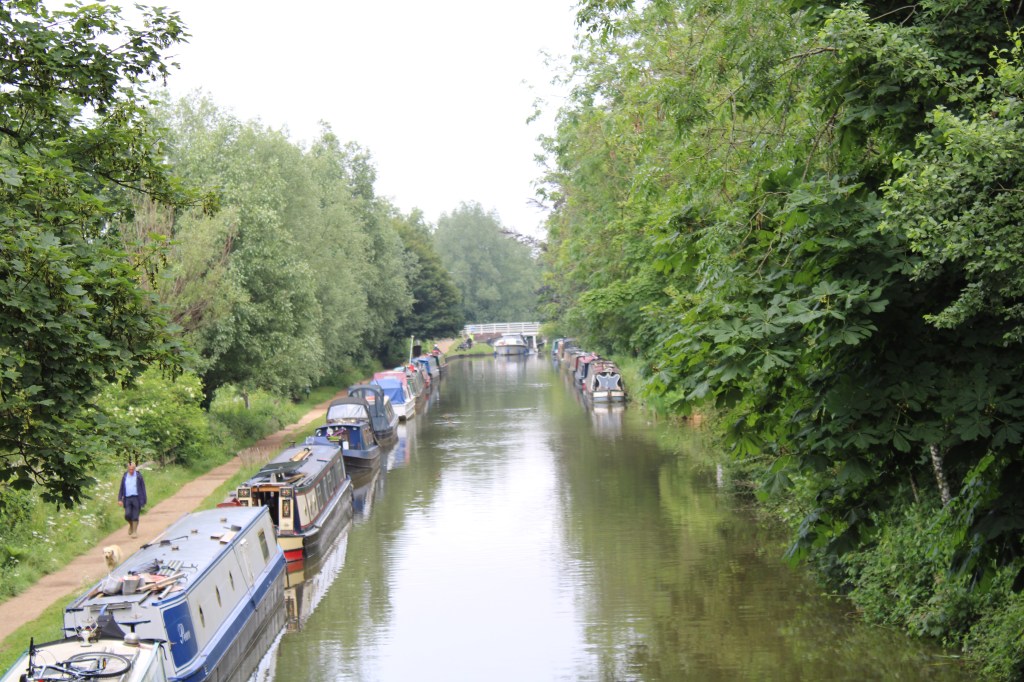
It is difficult to imagine Kintbury without the canal; today the Kennet and Avon has become part of the natural landscape as much as the streams of the Kennet and the surrounding meadows. However, it was not always so.

The very first canal to be built in England was the Bridgewater Canal, constructed in 1761 to carry coal from the Duke of Bridgewater’s coal mines to the newly industrialised Manchester. Over the next 70 years, many more followed, not as an amenity to facilitate leisure activities as we may think of canals today, but as part of the industrial revolution. Canals were, at the time, the easiest and cheapest way to transport heavy materials for distribution from source to work shop or factory.

Business owners, landed gentry and the like would have followed the progress of the canal network and the economic advantages it brought to each area. In March 1788, a meeting was held in Hungerford “to consider the Utility of an Extension of the Navigable River from Newbury to Hungerford as far further as shall hereafter be thought eligible.”

Obviously, the proposed canal was going nowhere without the co-operation of other landowners; not surprisingly, the idea was sold to them by insisting that a subsequent reduction in the price of the carriage of coals and other heavy materials would significantly advantage their estates.

The landowners, it seems, were easily won over and in its edition of October 14th 1793, the Reading Mercury published the following:

“Notice is hereby given, That application is intended to be made to Parliament in the next session, for leave to bring in a Bill and to obtain an Act for making and maintaining a navigable canal and communications for Boats, Barges and other Vehicles… from the River Kennet at or near the town of Newbury … to the River Avon at or near the City of Bath.“

We are so used to the presence of the canal today that it is easy to forget this proposal and its impact in its day must have been very similar to the decision in the late 1960s that the new M4 motorway should be built across the Berkshire Downs.

The first chairman of the Kennet & Avon Canal Company was to be Charles Dundas Esq., MP for Berkshire since 1794. He lived at Barton Court, near Kintbury.

The engineer to be responsible for the new canal was the relatively inexperienced young Scotsman, John Rennie. However, very few people had actually built canals at this time so new skills had to be learnt and adapted from the  experience of military engineers.

There were, of course, no mechanical diggers, earth movers or any other high tech equipment available to Rennie and his workforce. The 40 feet wide and 5 feet deep canal was dug entirely by men using picks, shovels and wheelbarrows. The men – known as “navvies”, a shortened form of “navigators” – were mostly recruited from agricultural workers who could earn much more working on the canal than they had been able to on the land. Unfortunately, though perhaps not surprisingly, gangs of young men, most probably living away from their homes and families for the duration, often turned to drinking and drunken, disruptive behaviour became a feature of the navvies’ life style.

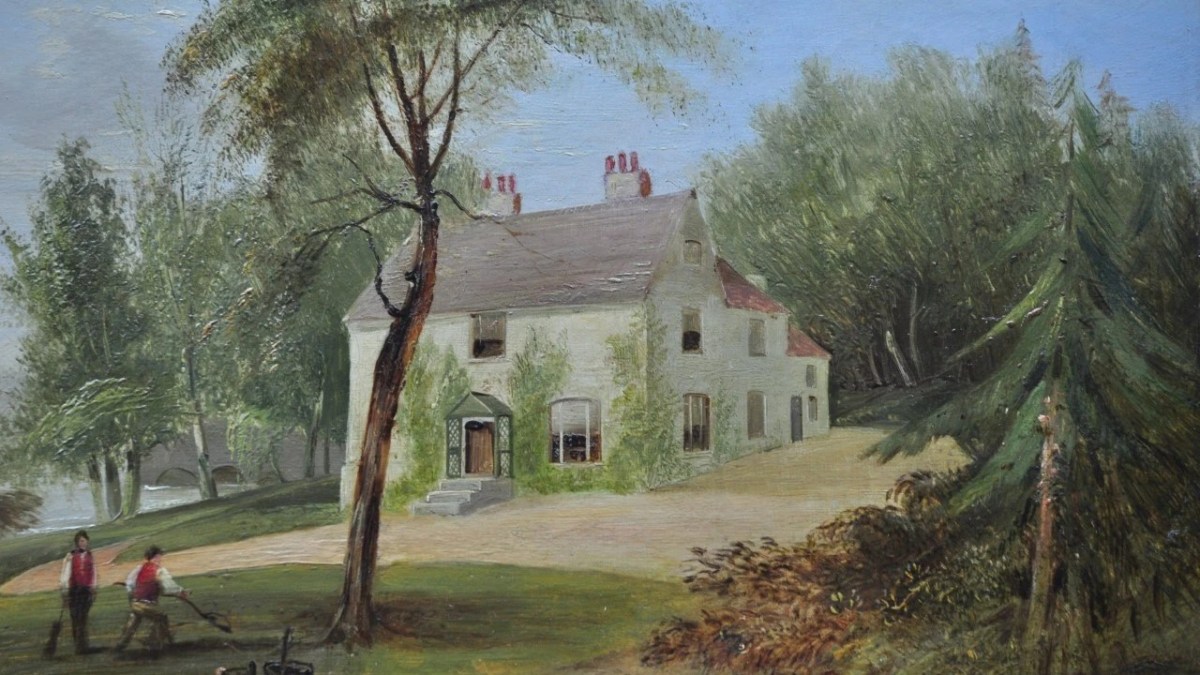
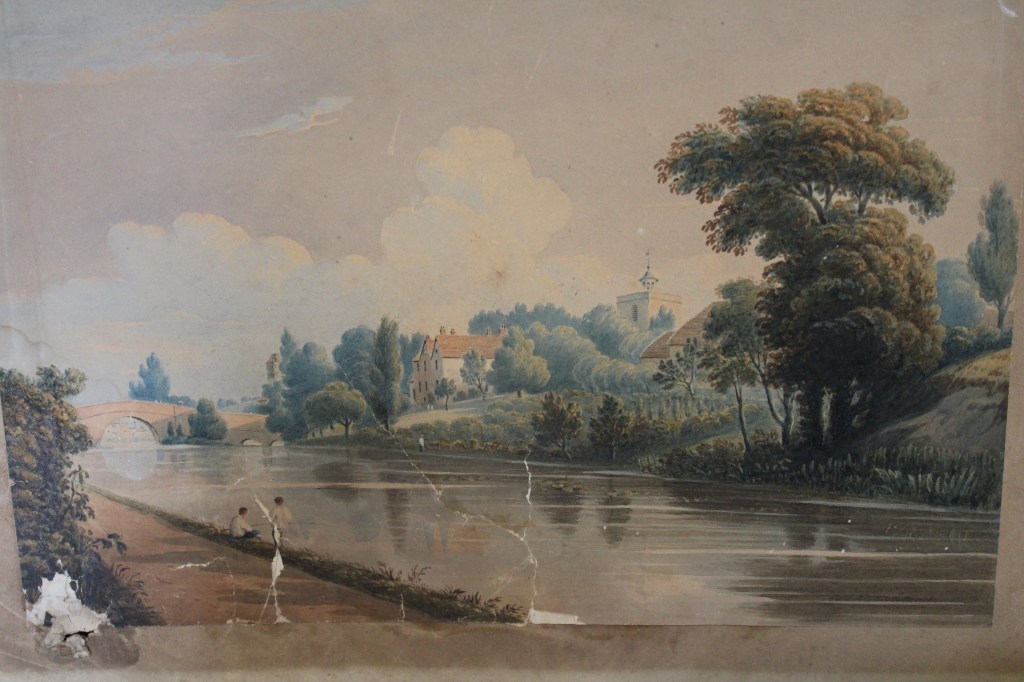
As it passed just to the north of Kintbury, the canal avoided most of the village although one notable exception was the vicarage. At that time, this was the much older house that predated the 1860 Victorian gothic building and was the one known to Cassandra & Jane Austen. We know that various members of the Austen family would have stayed with the Fowle family at the vicarage during the years of the canal’s construction or just after and I cannot help but wonder what Jane would have thought of all the earth moving and construction work being carried on just yards from the house. 

In June 1797, the eastern end of the Kennet & Avon canal opened from Newbury to Kintbury. The Reading Mercury reported,

“A barge of near 60 tons having on board the band of the 15th Regiment of Dragoons left Newbury at twelve o’clock and arrived at Kintbury at half past two where the Committee of Management, having dined with their chairman, Charles Dundas, Esq., embarked at six.”

Kintbury had entered the canal age. A wharf was built opposite the Red Lion (now the Dundas Arms) to facilitate the transport by barge rather than the slower carriers’ cart and this benefitted local businesses such as the whiting industry. This was the march of progress and the future was to be horse-drawn and afloat.

But that, of course, was before the railway!

References:

Reading Mercury (britishnewspaperarchive.co.uk)

The Kennet & Avon Canal Trust ( katrust.org.uk)

The Waterways Trust (thewaterwaystrust.org.uk)

Hungerford Virtual Museum (hungerfordvirtualmuseum.co.uk)

How violence at a football match led to accusations of witchcraft

If the events of 1598 are anything to go by, football violence is nothing new!

One of the oldest monuments in St Mary’s church, Kintbury is a brass situated to the right of the altar commemorating John and Alice Gunter. John died in 1598 and according to the inscription on the brass, there is a similar monument in Sisister ( the old name for Cirencester in Gloucestershire ) where Alice died.

For all we know, John and Alice lived a quiet life when they were in Kintbury. However, the same cannot be said for other family members who achieved a certain notoriety during their lifetime. 

Anne Gunter, the youngest child of Brian Gunter, had been baptised in Hungerford in 1584. By 1598, Brian was lay rector at North Moreton, in the Vale of the White Horse.

There are several versions of what happened next but the main events of the story go something like this:

Some time in 1598, a football match was held in North Moreton. Back then, the sport did not enjoy the rules or regulations that we have today – a match could involve any number of people and take place over a very wide area, not a specified pitch. However, one aspect we are still familiar with today was the occasional outbreak of associated violence. It seems that, during the game, two brothers, John and Richard Gregory, along with Brian Gunter’s son, William, were involved in some sort of fight. Brian Gunter intervened, hitting Richard and John with the pommel of a dagger. As a result of the injuries caused by this, both brothers died.

Not surprisingly, the deaths of the brothers resulted in animosity between the Gregory and Gunter families. When Anne Gunter became ill in 1604 and then again the following year, Brian Gunter tried to blame Elizabeth Gregory along with Agnes Pepwell and her daughter Mary for causing Anne’s illness. This was, of course, at a time when many people believed in witches and witchcraft and it was not uncommon for certain women to be blamed when unexplained illnesses or deaths occurred in a village.

The wide range of symptoms which Anne was experiencing, including vomiting and fits, Brian Gunter maintained, were the result of her being bewitched. It is more likely, however, that these symptoms were the result of the toxic mixture including wine and salad oil which he had made his daughter drink.

Elizabeth Gregory and Mary Pepwell were tried for witchcraft at Abingdon in 1605. They were found not guilty.

Brian Gunter was not happy with this verdict and managed to take his grievance to the king, James I. James referred the case to the Archbishop of Canterbury who in turn referred it to Samuel Harsnett, an Anglican cleric who was later to become the Archbishop of York and someone known to be skeptical about the popular belief in witchcraft. The case was eventually heard in the Star Chamber, a court of appeal that sat in the Palace of Westminster.

When she was cross questioned, Anne admitted that her illness had been faked and that her father had persuaded her to play out the deception. It is thought that she was eventually acquitted since she had been coerced into cooperating with her father’s plot to discredit the Gregory family.

It is possible that Harsnett and other members of the church became involved in this case, taking it to the higher court, as they wanted to see an end to those profiting from exorcisms in which non existing “daemons” were “driven out” of gullible victims.

Further reading:

The Bewitching of Anne Gunter: A Horrible and True Story of Football, Witchcraft, Murder and the King of England By James Sharp

https://www.davidgunter.com/2017/11/07/violent-football-witchcraft-and-the-king-james-bible-another-gunter-connection-

Kintbury Women’s Institute in the 1930s

The Women’s Institute is a community based organisation for women which originated in Canada in 1897. By the 1930s branches had been formed throughout Great Britain and Northern Ireland.

Penny Fletcher’s perusal of Kintbury W.I. minutes through the 1930s reveals a world of thrift, a need for economy and an enthusiasm for self-help.

On Friday 9th May, 1930, a meeting was held in the Coronation Hall to consider forming a Women’s Institute in Kintbury. Mrs Clifton-Browne, wife of the sitting MP, addressed the 56 women present and afterwards it was decided to form a branch of the W.I. in Kintbury.

The first meeting took place in the Coronation Hall on 11th June, at 2.30pm. Eighty-four ladies joined and enjoyed a most helpful demonstration of ‘Fruit Bottling’. Stalls and  Entertainment Committees were formed, and 3d was to be charged for tea. There was to be a minimum age of 16 and women from Hamstead Marshall would be eligible to join.

The K.W.I. was in business.

At the second meeting thirty-six new members joined bringing the total membership to one hundred and thirty. These  pioneers were treated to a talk on “Myths and Legends of Trees and Flowers”. Members were hesitant, through either shyness or modesty, as to whether they would enter for a Handicraft Exhibition.

It was proposed and seconded that the Coronation Hall caretaker be given 1/6 (12.5p)  each meeting for carrying water for tea and that she should charge for laundering tablecloths and tea towels etc. The pattern was established for one afternoon meeting and one evening.

In August, the meeting was held at Hungerford Park, home of the President, Mrs. Turner. One hundred members attended. Mrs. Toynbee was due to speak on “Health” but she arrived too late so “various competitions and amusements” were indulged in and a very happy time was had by all. It was past 7.00pm when the Hungerford Band played ‘God Save the King’ and members returned by coach having had a “real good time”.

The September meeting had a good attendance. Members suggested that in future speakers should stand on the platform the better to be heard at the back of the hall. There were also requests for talks on herbs, classes on First Aid, Home Nursing, Glove Making, Dressmaking and Cookery.  The business at this September meeting was followed by a talk on, “Travel in The Sahara”, two violin solos from Mrs. Thomas and community singing. “Musical parcels” caused much merriment.

The glove making classes were started as requested  and during the rest of this first year there were also talks on Dressmaking and The League of Nations.

However an attempt to practise for a community singing competition was not successful as the hall was too dark owing to the electric light being cut off. There was, however, a Round Table Conference on Dental Treatment.

In January 1931 the Hall Committee raised the rent to 5/- (25p ) for monthly meetings and 2/- (10p) for committee meetings. The January and February meetings were held in the afternoon because of the weather but it was impossible to carry out the January programme because the electricity was cut off again. In February, the bad weather kept the attendance down to sixty.

The Institute now settled into a regular pattern. The lectures included a speaker from the blind veterans’ society, St. Dunstan’s. He was described in the minutes as a, “brave and interesting man”, who was listened to attentively. Other talks covered a variety of topics including health, soft slipper making and sweet making.

Competitions included: the best ironed cotton garment, pegging clothes onto a line in a given time (the winning time 2 minutes 10 seconds), and a workman’s dinner made for a maximum of 6d (2.5p).

In December a Round Table Conference was held on “My Best Cold Remedy” and “My Pet Economy”. Finance was clearly a pressing issue at this time and the members had already decided to postpone the purchase of a tea trolley to save money. Also in that month a letter was received from H.Q. urging members to “Buy British Goods” to help the country in this “time of crisis”.

1932 opened with a lecture “From Plantation to Tea Pot” by a Lyon’s representative with lantern slides of Indian tea estates and the tour of the London factory by The Prince of Wales.

During 1932 other talks were given on The History of Kintbury by Mrs Mabel Bowen and Mrs. Turner’s visit to India. The lantern slides which accompanied these lectures were always shown by Mr. Chislett. The social time held such delights as card games, gramophone records and sketches. After a discussion as to whether the W.I. should contribute towards a new piano for the hall, it was decided on the advice of the Treasurer that money should not be given because there was a need for greater economy.

The weather was very cold and showery in February 1932. Each year W.I. members bought bulbs in the autumn and in the spring the resulting blooms were judged by the gardener at Barton Court, by kind permission of Colonel Lawson.

1932 saw Inkpen W.I. performing a “Tableux –scenes from eight countries” and  the printing of Mrs. Bowen’s “History of Kintbury and The Great Bell”, which cost £1.10/- (£1.50p) Copies sold at 6d (2.5p). Fifteen copies of “The County Cookery Book, From Hand to Mouth” were sold.

It was suggested that a Jumble Sale be held to finance a charabanc (an open topped coach) outing to Bournemouth but so many jumble sales were being held that it had to be a Whist Drive. It was also proposed to form a Croquet Club but it was impossible to find a ground and would have entailed expenditure.

The 1932 Christmas party made a profit of £2-4s-2d ( £2- 21p) which was given to the Nursing Association.

During 1933, talks were given on re-modelling hats, home dying, a nature talk with slides, and  herbs and their value –this given by a medical herbalist. The inevitable travelogue for 1933 was on Japan. Miss Johnson demonstrated “the best use of an old macintosh”. Competitions included: packing a parcel in a given time; refooting stockings; a woman’s dress for 4/-(20p) and a child’s for 2/- (10p) and reseating boys’ knickers! Members sang, danced and produced sketches.

Classes in hat making were started and members agreed to help at Newbury Market Stall each month. A charabanc outing to Bognor was arranged for 6th July, fare 5/- (25p) ,children under five-free.   A Baby Show was organized and Mrs. Frances Belk and her pupils gave an exhibition of dancing.

The year ended with the Social Services League asking members to help by sending materials or attending working sessions.  By February, 1934, The Social Services Working Party had sent 550 garments to Reading and Gateshead and were working on a community blanket.

The W.I. members willingly agreed to help in a combined effort to pay off the hall debt for heating. Controversy arose regarding the giving of prizes for competitions and the President urged the awarding of marks instead

In March 1934 the meeting had to be abandoned due to bad weather –only 35 members attended.

Folk Dancing was rather popular especially after the meeting in May, when eight members of the English Folk Dance and Song Society gave a talk and demonstration. The Girl Guides attended and the minutes called it “a merry meeting”.

The most interesting talks of the year were “What Countrywomen of the World are Doing”; ”The Handy Woman” with many useful tips for safety, mending and comforts for the home; and an inspiring talk by Mrs. Norman May on ”Our Institute” when apparently her remark about ‘broody hens’ caused much amusement.

In October a handicraft and produce exhibition was held and opened to the public. There were 232 entries and the Thrift Cradle was offered to Savernake Hospital, Marlborough.

The year ended with members bringing their children to a Punch and Judy Show which was much enjoyed by young and old.

1935 opened with yet another travelogue, this time by a Mrs. Seymour who had moved to Kintbury and had been to Fiji. Economy was still clearly very much an issue as the competition was for something new produced from something old. First prize went to a child’s pullover, skirt and knickers; and second to a coatee, dress and bonnet produced from a lady’s blouse.

Mrs. Bowen urged members to make the meetings more enjoyable socially.

In April ideas for the Jubilee celebrations were discussed and a tea for 300 children was decided upon. The resulting event was a great success.

 A talk on birds to which husbands and friends were invited was pronounced one of the most enjoyable talks ever –this truly voiced the opinion of all present, apparently.

Mrs. Clifton-Browne gave a “useful” talk on “Using our wits to use our bits” which appeared to be many practical garments from women’s underwear. She also gave the W.I. a “jolly social half an hour by introducing new games”. It is to be hoped Mabel Bowen appreciated this.

In July, the Flower Show was cancelled due to lack of exhibits and Shefford Woodlands were congratulated upon winning the ‘Sun-Ray Diagram’- whatever that was!

In September Lady Glyn talked on “Clinics and Physical Training”. After demonstrating exercises she spoke of their value to all women whether busy mothers or women of leisure. After this invigorating talk members were soothed by Mrs. Robinson and Mrs. Johnson playing the harp and piano.

October produced a very wet afternoon and late arrivals. They came to hear Inspector Taggart of The Women’s Auxillary Service talk on Women Police and their work. She stressed that they exist mainly to assist in cases concerning women, girls and children. There was also a short address from a W.I. visitor from Rhodesia (now Zimbabwe).

1936 opened with the death of the King on 20th January. A subscription was sent towards a wreath that had been sent to Windsor.

The year’s travel talks took place in March and July and were on Mallorca and Sweden. A request for  a lower rental for the hall was met with a reply from Mr. Killick that he regretted all the committee could do was to allow the W.I. to have 11 meetings for £5 instead of £5-10s.

Mrs. Baring asked for help as she was having  “some poor persons from London” to spend time in her garden. In July she gave particulars of the treat that she intended to give these “poor” Londoners.

The summer outing to Brighton was to cost 7/6 (37.5p) and there was a competition for “Six conditions to help promote’ happy and healthy motherhood.”

A “Bring & Buy” sale raised £1 – 12s -9d  ( £1-62p ) to go towards the extension to Newbury Hospital.

The Newbury Agricultural Show was held at Elcot Park in September of this year and Inkpen and Kintbury joined forces to visit it and run a stall.

At the Annual Meeting it was decided to form a choir and Mrs. Turner appealed for small gifts for Kintbury inmates of the Hungerford Institution ( the workhouse ) and toys for the Personal Service League. Both these appeals received a very good response. It was also decided that in the event of a member dying, they would give one dozen red roses with a sprig of rosemary, tied with a green ribbon.

Social half hours consisted this year of folk dancing, whist drives, old time choruses and table games.

The year ended with “character songs” – a jolly effort judged by Major Fleetwood – and a mime entitled “The Tale of a Royal Vest” which ended amidst enthusiastic applause.

The 1936 Children’s  Party, which had been postponed because of the King’s death, had now been postponed again because, “there was so much illness about”.

The Great Western Railway Co sent slides of Lorna Doone and Westward Ho country for which Mr. Chislett, as always, lent his lantern and showed the slides.  In the following month of March he again assisted Colonel Johnson Smith with his lantern lecture on East Africa. This last was followed by country dancing by the Kintbury Team – and they well deserved the hearty clap accorded to them.

In April, Mrs. Bowen, as a representative for The Preservation of Rural England, asked to be informed of the destruction of wild flowers and other such damage. Rural England must have been the topic of the year for the May talk was on trees and later in the year members were asked to “collect sheep’s wool from hedgerows for making a co-operative patchwork quilt.”

In June a photograph was shown of the W.I. decorated wagon for the Coronation Day procession. Mrs. Baxendale then asked if anyone was interested in  a trip to Paris – but no one was. October produced a most inspiring lecture by Mrs Coslett on “How to Turn Ourselves into what We Want to Be” after which the audience left no doubt as to their appreciation by the applause accorded her.

Social half hours and competitions included: home made buttons, dressing a model in a sheet, a smelling competition (?), hats from crinkly paper and pins –this last was popular and twelve artistic  models were displayed. In October it was remarked that too many whist drives were being held in the village. The year ended with Miss. K. Weatherby singing carols and giving a brief description of the age and origin of each. A small choir of W.I. members rendered the Grasmere Carol.

1938 opened with members offering to work on a banner. Afternoon meetings were changed from 2.30pm to 2.45pm and the Keep Fit Classes were postponed until the autumn due to the difficulty in obtaining an instructor.

February brought forth a discussion on the advantages of a drainage scheme and this was followed in April by a Mr. Raine from Hungerford who gave a short talk on the possibilities of a drainage scheme in Kintbury.

In March the ever hopeful Mrs. Baxendale asked for names for a trip to Holland.

A Whist Drive was successful enough to raise £4-9s-6d  (£4 – 47.5p) for the outing and it was decided to go to the Zoo. The cost was to be 5/6 (27.5p), children 3/- (15p)  with 1/- (5p) deposit to be forfeited if members failed to go. There was much enthusiasm for starting a cricket team which was to be financed by a Jumble Sale. That spring all members agreed to plant two tubers of Sharpes express potatoes and send the crop to an institution or hospital. Members were also asked to bring daffodils for the same cause.

In the summer it was announced that Harry Offer, son and grandson of two members, was one of only four children in the country to win the RSPCA Band of Mercy competition styled ‘Animals in our Garden’. Five other W.Is joined Kintbury in July for a meeting at Hungerford Park, home of Mrs. Turner. In September, owing to exceptional weather, the Flower Show schedule was  omitted.

Also in September the decision was finally taken to begin Keep Fit Classes. The cost was to be 2/6 (12.5p) for 24 lessons. Unfortunately the start was delayed for at least a week owing to the “International Situation.”

The W.I. was asked to raise funds for the decorating of the Coronation Hall and so it was planned to run two socials, one for the Hall and one for the Cricket Club.

In October ’38, Miss Ada Ward delighted all with her descriptive talk on a ”Day in London”. Her charming personality and ready wit acted as a tonic after the anxiety of the previous week.

The year included the usual travelogue, this time on Spain. Lady Peel spoke on folk songs, Mrs. Goodheart spoke on Fish Cookery, and there was a talk on local history – presumably by local historian Mabel Bowen.

The year ended with particulars being given of a new Pension Scheme, pamphlets explaining which could be obtained from the Post Office.

– Penny Fletcher, October 2023
Our Village Schools in the late 19th century

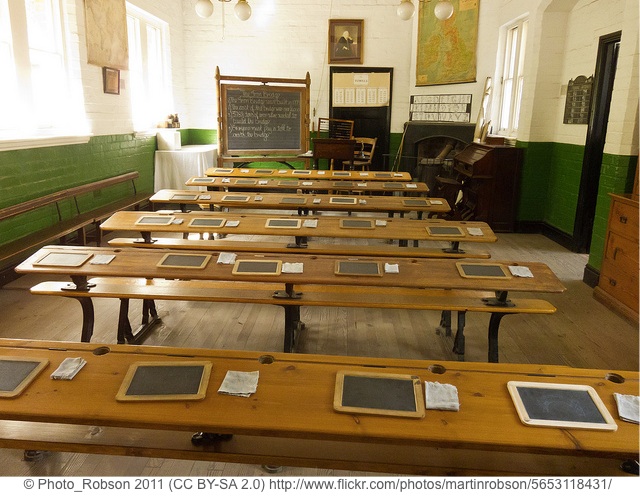
Today, three of our local villages have village schools. Two of them, Inkpen and Enborne, are still based in their original Victorian buildings just like many other primary schools in West Berkshire. However, you might be surprised to find out that, at the end of the nineteenth century, there were twice that many village schools in our area.

By the middle of the nineteenth century, many towns and villages benefitted from schools established by churches or charitable organisations. However, it was not until Forster’s Education Act of 1870 that local school boards were created with the power to levy rates to finance building and running of so-called National Schools in their areas. Thus universal education became available to all children up to the age of 13.

It would be fascinating to research our village schools through documents in the Berkshire Records Office. For now, however, I decided to begin my research by looking at the 1881 census as by this time those schools opened as a result of Forster’s Act would be well established.  

At the time of the 1881 census, the occupant of the Kintbury St Mary’s school house is 25 year old James Humphries, originally from Ditton Marsh, Wiltshire. James is described as a “certificated teacher” meaning he has gained a professional qualification at a teacher training college. His sister, Catherine, 20, who is living with him, is described as “assistant teacher” which might indicate that she trained to teach by learning “on the job” as a pupil teacher which was how the majority of teachers  qualified at that time. How Kintbury parents would have viewed this fresh faced young man and his even younger sister, both in positions of authority over the village sons and daughters, we can only imagine!

James and Catherine did not stay in Kintbury for long, or so it seems. In November 1883 the Newbury Weekly News reported on a recent Diocesan Inspection at the school which found it to be, “in very good condition. The children are well taught throughout.” The master at this time was a Mr T. Sadgrove. But he did not stay long either. In May of the following year the NWN carried a report concerning the schoolboy Alfred Sturgess who was charged with stealing 2 shillings and 6 pence from the National School Board ( in other words, from St Mary’s school ), the case being proved by the master who was then W. Garrett Jones.

Perhaps Messrs Humphries, Sadgrove and Garrett Jones all found Kintbury too challenging to stay long, or perhaps they were ambitious and wanted to move on to bigger schools in towns. So far I can find no record of any of them to suggest where they were living when they moved on from Kintbury, or if they even stayed in teaching.

Things were different down the road in Inkpen. In 1881 the occupant of the village school house is 49 year old certified teacher Jesse Collins. Jesse was a retired naval captain originally from East Tilbury, Essex, whose teaching post in 1871 had been in Portsmouth. 

Interestingly, Jesse’s wife, Charlotte, is also described on the census as “School mistress”, although at this time women were not – officially – allowed to teach after they had married.

Life in the relatively isolated, rural community of Inkpen must have been very different to life in Portsmouth for the Collinses, although it seems to have suited them as they were still there in 1891. Despite, that is, Jesse having appeared before the local magistrates in 1884, charged with having assaulted one Alfred Abraham, a school boy, and having been fined 5s and 16s 6d costs. Perhaps the experience of his former naval career led Jesse to take this in his stride as he is otherwise involved with the local community and, according to the NWN, with local politics.

If Inkpen was a relatively isolated rural community, then Enborne was more so. Back then as now, the school with its adjoining school house was in an isolated spot in Crockham Heath, on the road up to Wash Common where, in 1881, the school mistress was 58 year old Ann Elizabeth Pears. Ann was an experienced teacher: in 1871 she had been teaching near Salisbury in Wiltshire and in 1861 in Suffolk.

According to a report in the NWN of March 1887, two men broke into the school house when Ann was away from home and stole 10 shillings and a quantity of brandy. This must have been particularly unpleasant for a woman living on her own in an isolated house and might have contributed to Ann’s decision to move on. By the time of the 1891 census, Ann has relocated to Hampshire but not yet retired from teaching. At 68  Ann is head teacher at East Woodhay school.

Today there is no primary school in the village of West Woodhay – by modern standards it would probably be considered too small a community to support its own school. The censuses of 1881, 1891 and 1901 indicate that there were no teachers living in the village in those years which suggests to me that there was not a school or accompanying school house ( the usual Victorian arrangement, common in many local villages.) The evidence suggests that West Woodhay’s children attended East Woodhay school as, in December 1903, the NWN reported that a request had been made for a footbridge to be placed “over the water between East and West Woodhay” as “children went down there on their way to school and got their feet damp.”

However, for fifty years, from about 1903 to 1961, West Woodhay did have its own school, marked on early 20th century OS maps as being somewhere near the village hall but on the opposite side of the road. Perhaps surprisingly, the NWN does not seem to have covered the opening of the school although the 1911 census shows assistant teacher, Celia Cook, 29, from Walworth, London, living in the school house.

Another local school I have, so far, found out very little about is Christchurch. Built at Kintbury Crossways close to the now demolished church which shared its name, Christchurch School opened in 1870 to relieve crowding at the established school down in Kintbury. Whilst the Reading Mercury reported on the opening, for some reason the more local paper, the NWN, did not.

I can find no record of the head teacher at the time of the school’s opening. However, the NWN of February 1884 reported that complaints had been made that a mistress, Agnes Peacock, had been ill treating the children. Unfortunately, a parent, Mary Ann Nash of Kintbury, had decided to take things into her own hands after Miss Peacock had patted her son on the hand by way of discipline. The teacher reportedly pushed the boy and he fell over. Nash went to the house where Miss Peacock was lodging and struck the teacher on the head with a stick. She was subsequently charged with assault and fined 9 shillings 6 pence with 10 shillings 6 pence costs.

As the smallest village in our benefice, then as now, it is perhaps most surprising that Combe had its own school. Although I can find no trace of when it first opened, the NWN of September 1894 reported that the school in the village had been, “nobly restored” with, “all the necessary requirements”. Local dignitary, Mr A.C.Cole had, “spared no expense” and the village children no longer had to walk to the neighbouring school, 2 or 3 miles distant. The school house furniture was supplied as a gift from Mrs Cole, as was that of the school, “according to government requirements”. Three cheers, then, for the Cole family.

In 1901, the schoolmistress at Combe was 34 year old Elizabeth Dingwall. Born in Chelsea, Elizabeth had been teaching in Fulham in 1891. At Combe, she shared the school house with her sister Isabella, a nurse and, although life the tiny village must have been very different from Chelsea or Fulham, the Dingwall sisters are still there in 1911.

One thing that has surprised me in researching this is that none of the teachers, either masters or mistresses, are local people. Whether this was a deliberate policy or coincidence, it is impossible to say for certain, although the weight of evidence suggests to me that the school boards deliberately chose to appoint people from out of the local area. For those single schoolmistresses, living alone in a village schoolhouse, life must have been very lonely. Whilst we know very little about the lives of Ann Elizabeth Pears, Celia Cook, Agnes Pocock or Elizabeth Dingwall, we do know a bit more about a schoolmistress living and working about 20 miles from here, in Denchworth, formerly North Berkshire, in the 1860s. Mary Hardy had been born near Dorchester in Dorset and trained to teach at the teacher training college in Salisbury so she was a “certified teacher”. Denchworth village school, 80 miles from her home and family, was her first post for which she was paid £40 a year and expected to play the church organ. Mary found the experience of living in Denchworth to be so lonely that she persuaded her parents to allow her younger sister, Kate, still a school pupil herself, to come to Berkshire to live with her.

We know a little more about Mary Hardy than we do about most Victorian village schoolmistresses because her brother, Thomas, was to become the celebrated novelist and so some of her correspondence is preserved in Dorset Museum. But while the names of most of the other women – and men – are mostly forgotten, many of the nineteenth century school houses are still standing. During my time as a supply teacher I was lucky enough to work in many village schools still using their original buildings, though now much adapted and extended. The school house has been, in some instances, sold off but in others the former living accommodation is now used as classrooms, staff rooms or storage. As you walk from late 20th century extensions back into those Victorian rooms, there is, I think, a distinct change in atmosphere, an awareness that you have entered somewhere that has been in constant use for over 150 years.

Tessa Lock September 2023

A devastating fire and the Kintbury fire engine

Wallingtons is an imposing red brick gabled house on the south western edge of Kintbury. Known today as St Cassians and belonging to the De La Salle brothers, it is used as a popular retreat for young people; parties of teenagers from various Catholic schools across the country can often be seen making their way there from Kintbury station.

The history of Wallingtons, however, has not always been so peaceful.

At the end on the eighteenth century, the house belonged to Samuel Dixon, a barrister at Lincoln’s Inn, who lived there with his sister, Elizabeth.

Samuel Dixon employed as his servant one Benjamin Griffiths, a labourer living in Kintbury about whom there appears to have been a suggestion of a suspicious past. Griffiths had been one of the toll-keepers at the Colnbrook toll gate on the Bath Road in Buckinghamshire when, in 1781, his partner had been murdered. Although another person confessed to the murder, it seems this did not stop the finger of suspicion being pointed at Griffiths. Samuel Dixon was a trustee of one of the turnpike trusts, so perhaps this had something to do with his decision to take Griffiths on – we shall never know.

Samuel Dixon was in London on 7th April 1784 when Robert Griffiths broke into Wallingtons, stole a brace of pistols and a gun belonging to his master then set the house alight in several places. According to the Oxford Journal it was, “entirely burnt to the Ground with all the Furniture, Linen etc, a very curious Library of Books and Manuscripts, Pictures and other valuable Effects, nothing of consequence being saved.” 

At first, Griffiths seemed to have got away with the crime and was actually sent to notify his master of the tragedy. However, his behaviour caused suspicion. When charged, Griffiths, “ cut his throat in a terrible manner but missing the windpipe it was sewed up and he is perfectly recovered.”

Griffiths was committed to Reading Gaol and stood trial in July 1784, where he was found guilty and condemned to death. Samuel Dixon tried to have the sentence commuted which perhaps seemed a strange thing to do for someone accused of burning down your house. Perhaps, however, there were circumstances of which he was aware and which history does not relate. His efforts were to no avail and Griffiths was hanged on 7th August 1784.

As a wealthy home owner, Samuel Dixon had been able to insure Wallingtons which he had rebuilt soon after the fire. We do not know for sure who the architect was at that time, although Pevsner says the north front, “appears to have had a Gothic makeover in the late C18th.”

Samuel Dixon died in 1792. In his will he left 5 guineas to two of Griffiths’ children – not an insignificant sum at that time.

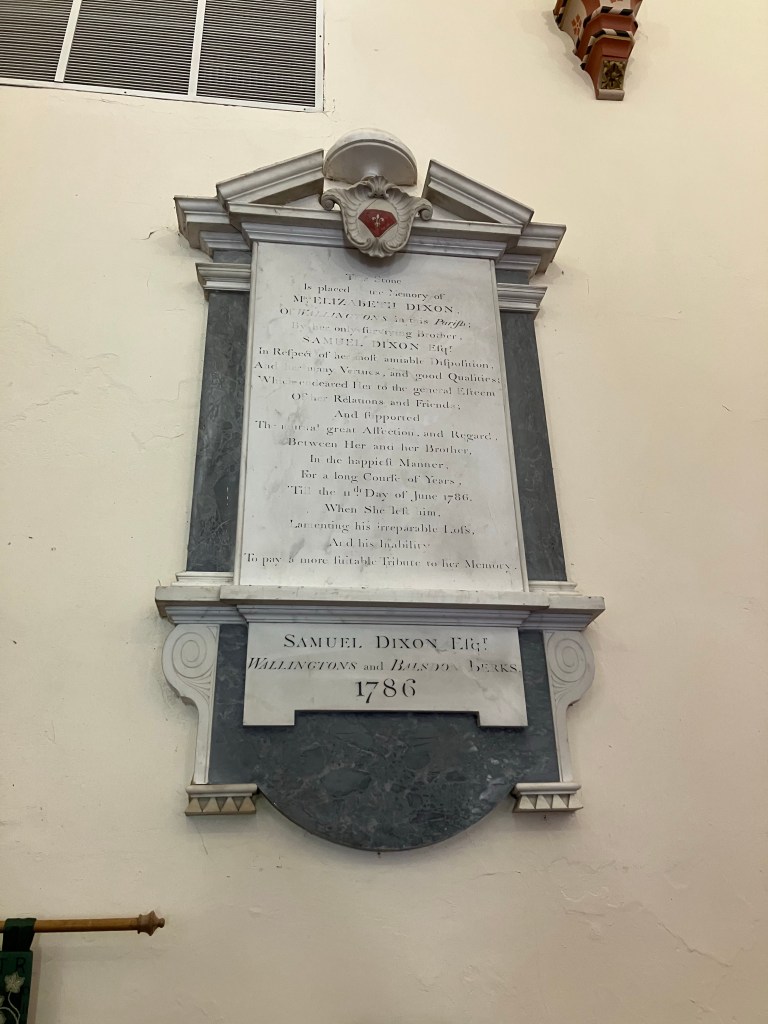
Samuel Dixon’s memorial in Kintbury church

Elizabeth Dixon had died in 1786 and in her will she left money for the provision of a fire engine for Kintbury – presumably in the hope that no other family would have to suffer the fate of having their house burnt down.

The Wallingtons as we know it today is largely the work of the architect Temple Moore who remodelled the house for the then owner, William Hew Dunn between 1891 and 1893. Temple Moore’s work is in the then very fashionable Gothic Revival style.

As for Elizabeth Dixon’s fire engine, it is now in the West Berkshire Museum in Newbury.

– Penny Fletcher, September 2023

References:

Brother Anthony Porter: Wallingtons: A History of the House and Estate and the Families who have lived here. (inkpenhistory.uk/archive/Wallingtons)

The Oxford Journal & Reading Mercury (British Newspaper Archive)

Tyack, Bradley & Pevsner: The Buildings of England: Berkshire

Templeton & the Knights Templar

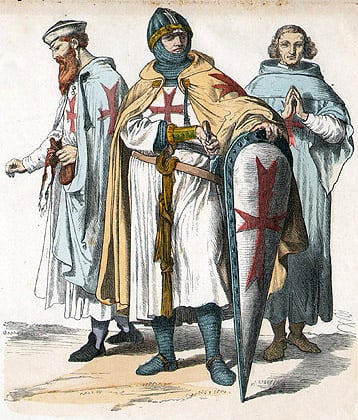
For many people, their mental image of a knight from the “olden days” (whenever that was!) is of a male figure brandishing a sword, his face covered by a cylindrical helmet and wearing a white tabard on which is emblazoned a large red cross of St George.

This enduring picture book image most likely has its origins in an actual medieval Christian military and religious order known as “The Poor Knights of the Temple of King Solomon”, or more familiarly, the Knights Templar. Originally founded to protect Christians on pilgrimages to Jerusalem, they followed the austere Rule of Templars which restricted, amongst other things, the eating of meat to three days a week and an insistence upon wearing only plain clothing.

The Knights were recognised by the Pope in 1129 and were supported by rulers throughout Europe such that they eventually became very wealthy, owning property in many countries.

However, after coming into disrepute, the Order was eventually dissolved in the early fourteenth century and its lands given to the Order of the Hospital of St John.

So what is their link with the hamlet of Templeton, between Kintbury and Inkpen? It is believed that, as its modern name implies, this was once the site of a house belonging to the Knights Templar and then subsequently to the Knights Hospitallers of St John. Although it is difficult to find out very much about the early history of the settlement, the online archives of the Newbury Weekly News and the Reading Mercury have some interesting reports from 1884 concerning archaeological finds there.  

In the early 1880s, Templeton Manor belonged to the Dunn family. They were having an extension built and the architect for the work just happened to be Newbury architect and eminent local historian, Walter Money. 

As the workmen were digging a foundation trench in land which had never previously been built upon, three skeletons were discovered at a depth of about eighteen inches. According to the report in the Newbury Weekly News, the remains represented men of “robust form and  vigorous physique”, of average stature, about 5 feet 8 inches. Unfortunately, the skulls, which at the time would have been the only way of getting more vital evidence, were missing. This, of course, was in the years before DNA profiling and other scientific techniques which would be able to indicate gender and more about a person’s origins.

According to the report, no coffins were found with the remains, which were “laid in regular order”, head to toe and in east to west orientation.

This discovery must have been of particular interest to architect and enthusiastic local historian Walter Money, who, a few months later, submitted the results of some research to the Reading Mercury.  

According to Money’s research, as reported in the Reading Mercury, the manor of Templeton with Walkott (sic) had belonged to the Preceptory of the Knights Hospitallers at Sandford, near Oxford. Then, on 28th December 1543, it was granted by the King, Henry VIII, “upon the possessions of the hospitallers being vested in the Crown, to Richard Brydges Esq of West Shefford and John Knyght Esq of Newbury.” 

It is difficult to imagine the area around Kintbury and Inkpen in medieval times. At Balsdon farm, slightly to the south of Templeton, a moat still exists which is believed to have surrounded a thirteenth century manor house but it is otherwise very difficult to picture a landscape in which almost all our modern points of reference are missing – with the exception of our village churches, that is.

Perhaps, some seven hundred or more years ago, Knights Templar, having disembarked their ship at a south coast port, made their way up and over the downs, travelling northwards. Perhaps they carried with them travellers’ tales of Jerusalem, of encounters with Jews and Muslims, of seemingly strange beliefs and perhaps complex new mathematical and scientific ideas previously unheard of in medieval England. Maybe, when they reached Walbury Hill and looked down to the north west, they were relieved to see the familiar sight of Inkpen and Kintbury in the distance and considered themselves to be nearly home.

Tessa Lock September 2023

A Woman’s Place?

According to records kept by the National Archive, at the time of the 1901 census, just over 40% of adult women in the UK were employed as domestic servants.

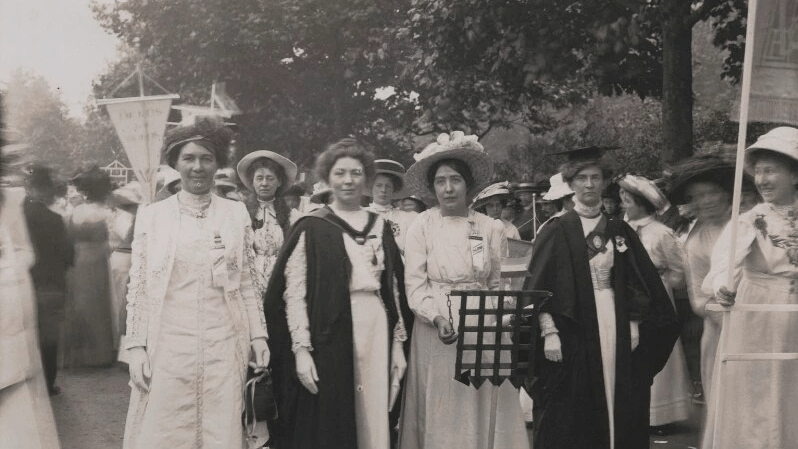
Image: Suffragette March in Hyde Park, by Christina Broom. Cream-toned velox print, 23 July 1910
4 1/2 in. x 5 5/8 in. in. (113 mm x 144 mm), given by Winifred Margaret Broom, 1940, Photographs Collection, NPG x17396 © National Portrait Gallery, London.

The early 20th century was a time when access to education and onwards to the professions was denied the great majority of young women for whom a position in the household of a wealthy family might have seemed the only employment option. For a significant minority, however, there were alternatives to domestic servitude.


In the nineteenth and early twentieth century, Kelly’s Directories published lists of gentry, landowners, charities and those employed in commerce for every town and village throughout England. Listed under “Commercial” in the 1903 edition for Berkshire, Kelly’s Directory records 64 names in Kintbury, 33 in Inkpen, 17 in Enborne, 11 in Hamstead Marshall and 1 in Combe.  But of the grand total of 130 people involved in “commerce” across what is now our benefice, only 13 are women.

In Kintbury, Mrs Maria Abraham and Mrs Ann Bance are both listed as bakers while Mrs Harriet Penny is a butcher. Mrs Eliza Peck is a shopkeeper and Mrs Elizabeth Taylor is a beer retailer, presumably running a pub. In Inkpen, Mrs William Killick is a grocer. It is likely, I think, that most of these women, if not all, are widows continuing with the businesses previously run by their husbands.

The same would appear to be true for the two carriers listed by Kelly’s: Mrs Emma May in Inkpen and Mrs James Miles in Hamstead Marshall are both continuing with businesses recorded in the 1901 census as having been run by their husbands. Of course, it may well have been that the women had long helped their spouses run the family business, but this would not have been recorded by the census enumerator.

Women had been employed by the Post Office nationally since the 1870s, where they could sort the mail and operate the telegraph system. In Inkpen, the Post Office at Upper Green was run by Miss Matilda Goodfellow Froom and in Kintbury by Mrs Emma Page who is also listed as a stationer. Although the smallest village, even then, Combe has its own post office, which is run by Miss Rose M. Salt.

Two women to have control of what must have been larger businesses are Mrs John Goddard of Hamstead Marshall and Mrs Mary Jane Dymond of Inkpen who are both listed by Kelly’s as farmers.

 According to the 1881 census, John Goddard was farming 67 acres. In Hamstead Marshall. By 1891, his son, Richard was also working on the farm. However, John died in 1894 and by the census of 1901 Martha, John’s widow, is recorded herself as farmer with Richard employed by her.  

It is a similar story over in Inkpen where Mary Jane Dymond  had been running her 30 acre farm for over twenty years since the death of her husband John.

It would be easy to presume that these women must have had equal status with the men running similar businesses close by. Surely Eliza Peck or Maria Abraham’s experience of running their shops would have been largely similar to that of the male shopkeepers further down the road? Would life on a farm have been so very much different for Mary Jane Dymond or Martha Goddard when compared to farms run by men?


Apart from everyday sexism expressed in such phrases as , “the weaker sex” and “a woman’s place is in the home” and so on, the perceived inferior status of women was enshrined in certain laws. For example, whilst many women would have controlled a business budget, they would not have been able to open a bank account in their own names or apply for a loan.

However, for Mary Jane Dymond, Martha Goddard and the rest, the position of women in society was changing – but very, very slowly. The 1882 Married Women’s Property Act had enabled women to own and control property in their own right although it was not until 1922 that the Law of Property Act gave men and women equal rights to inherit property from each other. 

Women ratepayers – that is to say, women who owned or rented property – had been able to vote in borough and county elections since 1888. So most, if not all, of the women in business in 1903 would have been able to vote for their local councillors although as women there were not able to stand for election themselves. Women – and many poorer men- were still unable to vote in parliamentary elections.


 In 1902, textile workers in the north of England had  presented a petition to parliament demanding votes for women and 1903 saw the formation, at the home of Mrs Emmeline Pankhurst in Manchester, of the Women’s Social & Political Union, a campaigning group concerned with extending the franchise to women. It is likely that both these events passed by even the most avid newspaper-reading folk of West Berkshire – however, news of the burgeoning women’s suffrage movement would gradually appear in the pages of the Newbury Weekly News.

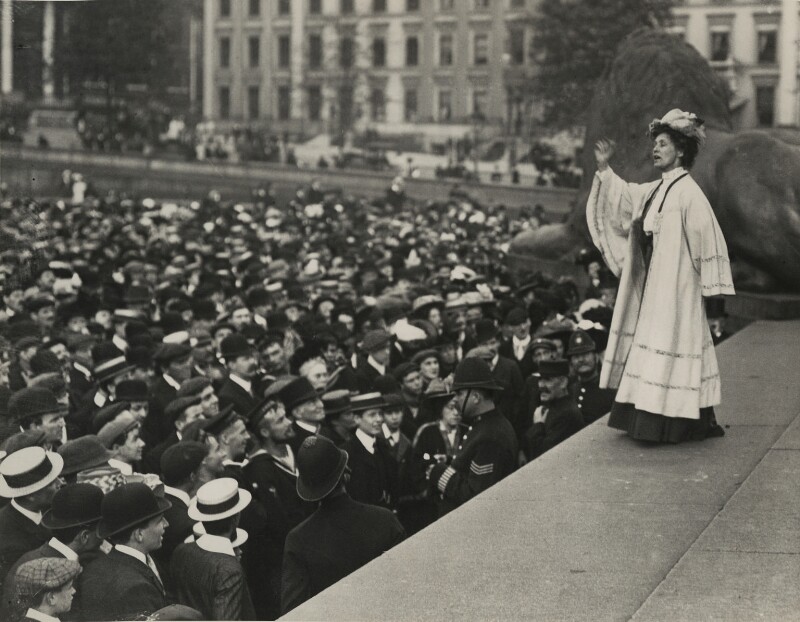
Emmeline Pankhurst addressing a crowd in Trafalgar Square by Central Press, by Central Press, bromide press print, October 1908, 7 in. x 8 7/8 in. (177 mm x 226 mm) image size, Given by Terence Pepper, 2008, Photographs Collection, NPG x131784

© National Portrait Gallery, London

The NWN of March 31st 1904 reported that the local Women’s Liberal Association held a packed meeting at which Mr Richard Heldene MP spoke on the subject of women’s suffrage. In 1906 members of the same association listened to an address given by Mrs Eva McLaren, “in favour of political rights for women”. 

It seems that the issue of women’s suffrage had not always been taken seriously. On 21st March 1907, the NWN carried a report of a debate in Reading at which Mr Mackarness, MP for South Berkshire had spoken. According to the report,

…there was a great deal of joking on the subject but for his part he always looked on it from a common sense point of view… They had given women votes in all local affairs therefore he could not quite see upon what line of argument  … they were to refuse them a vote in Parliamentary matters.

Whilst the NWN was happy to report objectively on debates or speeches in favour of women’s suffrage, this seems not to have been the case when covering the actions of more militant campaigners such as the members of the WSPU. On 28th March, 1907, it reported,

The women suffragists made another scandalous disturbance on Wednesday in avowed attempts to enter the House of Commons.

But it would seem that not everyone in the area agreed that the tactics employed by the more militant suffragettes ( as they were eventually known to distinguish them for the more peaceful suffragists ) were “scandalous”.

In November 1909, the newspaper of the WSPU, “Votes for Women” reported that a Miss Keevil, “is speaking at two meetings in Newbury. Sympathizers there are very anxious to hear about militant methods.”

In June 1911, the same newspaper reported that there were to be outdoor demonstrations in Reading, Newbury and Basingstoke, and that the Newbury & Reading contingent would march under a banner bearing the words, “Pro aris et foris”. A Miss Daukes of Newbury would be acting as sergeant, the newspaper reported. The WSPU was nothing if not well organised and this was expressed in the use of such military language.

“Votes for Women” was eventually replaced by a new newspaper representing the WSPU campaign, The Suffragette. Copies were sold in Newbury Market Place and reports included the successful, “At Home” held by Newbury’s Mrs Whittington and a meeting held at the Guildhall Hotel, Mansion House Street. The campaign for women’s suffrage had definitely come to town.

Nationally, Emmeline Pankhurst’s WSPU involved women from all social classes at all levels of the organisation. However, it must have been far easier for women of comfortable financial means and less demands upon their time to participate in local campaigning. Marian Daukes, Hon Sec of the Newbury WSPU branch, was the daughter of an architect and lived during the early 1900s at a house called Diglis on the Andover Road. At the time of the 1891 census she had been living on independent means in Surrey which suggests that she was most likely of the class of women able to spend their time as they chose. To working women such as Mary Jane Dymond and Martha Goddard, or Maria Abraham and Ann Bance,  Marian’s life would  have seemed a world away from theirs. It is impossible to know if these women from the villages ever saw a copy of The Suffragette, sold in Newbury Market Place. We do not know what they would have thought, had they read anything in the NWN of the campaign for women’s suffrage – I think it likely that some would have ignored it, others would have been appalled at the more disruptive or militant campaigns, whilst others may well have approved – but possibly secretly.

The 1907 Qualification of Women Act allowed women to be elected as borough and county councillors, also as mayor. Thus women were able to participate in local decision making for the first time. In Newbury, it was not until 1922 that Elsie Kimber was elected the town’s first female councillor. Elsie went on to become the first female mayor in 1932 and first woman Alderman in 1943.

The Representation of the People Act of 1918 granted the right to vote to all men over 21 but only to women over 30 who owned or rented property with a yearly value of at least £5, or to be married to a man who qualified to vote in local government elections. For many women who had run businesses or taken the places of men in agriculture or other industries during the 1914 to 1918 war, this must have been a bitter disappointment. For the many women still employed in domestic service, their position in the eyes of the law had changed very little.

 In  May 1919, political discussion came to Kintbury when a meeting of the Kintbury Branch of the South Berks Women’s Unionist Association, an organisation of the Conservative party, was held in the Coronation Hall. In attendance were many well known ladies of the village including Mrs Dunn and Mrs A.E. Gladstone. One speaker, the Hon Ethel Akers-Douglas spoke of the urgent need for self education with regards to politics. Another, Mrs W.A. Mount, wife of the local Member of Parliament, spoke of the “threat” of a Labour candidate in the constituency at the next general election. She explained the party’s intentions to see the conditions of the working men improved, however, “when people said there could be full equality, it was their duty to point out that such a state of things was absolutely impossible.”

 Such was the mind-set of many at the time, although we do not know how many of the women running shops or businesses, particularly on behalf of men killed or disabled in the war, would have agreed with her. I wonder what Elsie Kimber, at her family’s shop in Newbury, would have thought.

 Women were not granted equal voting rights with men until 1928. The first woman to be elected to the Westminster Parliament was Constance Markievicz in 1918, although as a member of Sinn Fein she refused to take her seat and so the distinction of being the first woman to sit in parliament goes to Lady Nancy Astor who won the Plymouth Sutton seat in 1919.

Emmeline Pankhurst believed that, once women achieved parliamentary representation, it would follow that other legislation to benefit the lives of women would soon be enacted. I think she would have been shocked to know just how long it took for women to achieve equality with men in so many areas. Back in 1903, Mary Jane Dymond would have been unable to open a bank account independently. This situation did not change until the 1960s and it was not until the 1970s that a woman could apply for a loan without having her application endorsed by a man – literally any man. Similarly, the Equal Pay Act did not come into law until 1970 before which it was quite legal for businesses, including high street banks, for example, to offer career prospects to young men with salaries higher than those offered to similarly qualified young women.

I believe Marian Daukes and her fellow WSPU supporters in Newbury would be disappointed – or even incredulous – that by the 2019 parliamentary election, out of 650 seats only 220 were filled by women. Similarly, although the position of women in society has changed in many ways that would surprise a Mary Jane Dymond or Martha Goddard, many businesses still have only male names over the door or in trade directories. Further more, to see the words, “And daughter” on a commercial vehicle is still very, very rare. So much has changed, but then, so much has remained the same.

Theresa Lock, July 2023

Acknowledgements:

Photographs in this article have been reproduced under creative commons licence: http://creativecommons.org/licenses/by-nc-nd/3.0/

The railway comes to Kintbury & beyond

From, “Something of great public interest” to “stupidity second to none”.

For hundreds of years, the fastest form of transport known to most people, either in towns or villages, was the four or five miles an hour of the carrier’s cart. The heady speeds achieved by the stage coach might be enjoyed by the wealthier classes but for most, life could only continue at a gentle, plodding pace.

Then the railways arrived, first in the industrialised north then, thanks to Isambard Kingdom Brunel, in the south and west as well. By 1841, Brunel’s Great Western Railway between London and Bristol had fully opened and for the very first time passengers could experience travelling through the Vale of the White Horse at over 25 miles an hour.

Clearly, railways were the transport of the future and many in our part of Berkshire were keen for a slice of the action. In 1845 an Act of Parliament was passed which, with the support of the already well-established GWR,  created the Berks & Hants Railway Company. This was to be a branch line from the Great Western, leaving the main line just south west of Reading towards Theale. This was the “Berks” section of the line; the “Hants” section turned south east towards Basingstoke.

There were to be four stations on the way to Newbury: Theale, Aldermaston, Woolhampton and Thatcham, then to the west, Kintbury and Hungerford. The line finally opened on the very cold morning of 21st December 1847 when, according to the report in the Newbury Weekly News of December 24th, there were initially few spectators but, as the day advanced, however, ” the bustle began to increase and it was very evident that something of great public interest was occurring.”

The NWN was not impressed by the speed of the new service which covered the  eight and a quarter miles between Newbury & Hungerford –  with one stop at Kintbury –  in 25 minutes, but commented, “this will doubtless be improved”. The reporter seems to have forgotten that this speed was probably four times faster than a carrier’s cart would have completed the same distance, but perhaps expectations had been raised by the railway company.  

However, those who travelled along this new branch line were, apparently, unanimous “with respect to the very great smoothness, absence of oscillation and of noise which appears to distinguish the Berks & Hants from other railways.”

It would be interesting to know how many of these travellers enjoyed seats in first class carriages and how many, if any, took that first journey in a second or third class carriage.

Many of the wealthier classes of our villages – the inhabitants of West Woodhay House, Kirby House, Hamstead Marshall Park, Barton Court and so on – might well have availed themselves of the opportunity to travel up to London at previously unimagined speeds though I doubt many cottagers would have joined them. For some people, the arrival of the railway meant a serious decline in business: canal travel could in no way compete with the speed of the train, for example. Coach travel took a blow, too: previously, seven horse-drawn coaches a day had left Newbury for Reading but this service was soon discontinued.

William Huskisson M.P. was famously the first person to die in a railway accident when he was unable to get out of the way of a moving engine before it ran him over. That had been in 1830. But other people failed to appreciate how dangerous it could be to get too close to a fast moving engine.

The Bath Chronicle of November 1847 reported the story of , “a lad in the employment of Mr Alderman of Kintbury” who was crossing the line at Hamstead (sic) with a donkey and cart when he saw an engine coming down the line, “at a pretty rapid rate”. Presumably to get a better view , the young man, “actually pulled up with his donkey and cart on the middle of the line on which the engine was running.” His stupidity, the paper opined, was second to none.

Luckily, “the son of Mr Gibbons of Hamstead” was passing by and he ran up to him and, “succeeded in hurrying the donkey off the line just as the engine came up.”

You can imagine something the conversation  in the Gibbons’  household that evening!

It is perhaps not surprising that fare dodging arrived with the railways. The Reading Mercury of January 1848 reported the case of Daniel Gingell and Richard Tiggell who had jumped out of a second class carriage at Kintbury, “to evade the payment of their fares and thereby defrauding the company.” They were fined £2 3s 6d each (the equivalent of several weeks pay at least) or one month’s imprisonment.

I bet they didn’t do it again.

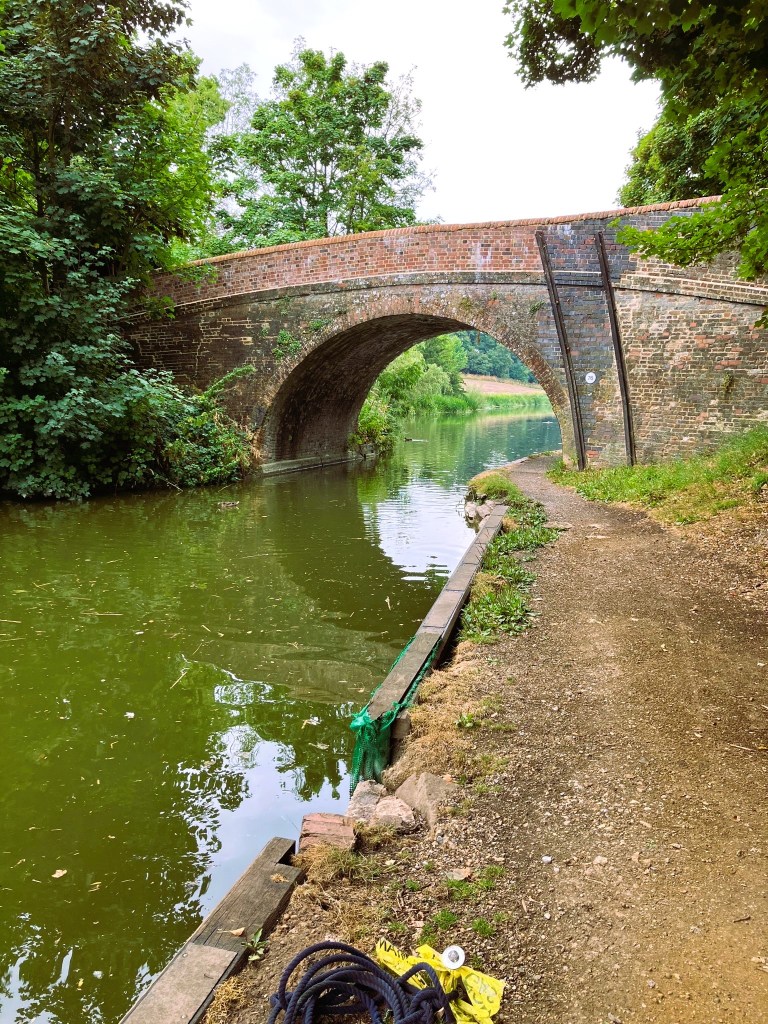
By 1862, our branch line was extended to Devizes. Originally, this line was of Brunel’s preferred broad gauge of 7 feet ¼ inch although lines across the Great Western were eventually replaced by standard gauge to conform with the rest of the country’s growing railway network. However, if you walk along the canal to Vicarage Bridge, Kintbury (left), you will see two lengths of former broad gauge rails being used to buttress the bridge on the east facing side. A relic of Brunel’s engineering!

If you are a railway enthusiast or if you know anything about the early days of the Berks & Hants railway, I would really like to hear from you. Email me at kintburyandbeyond@gmail.com 

Tessa Lock

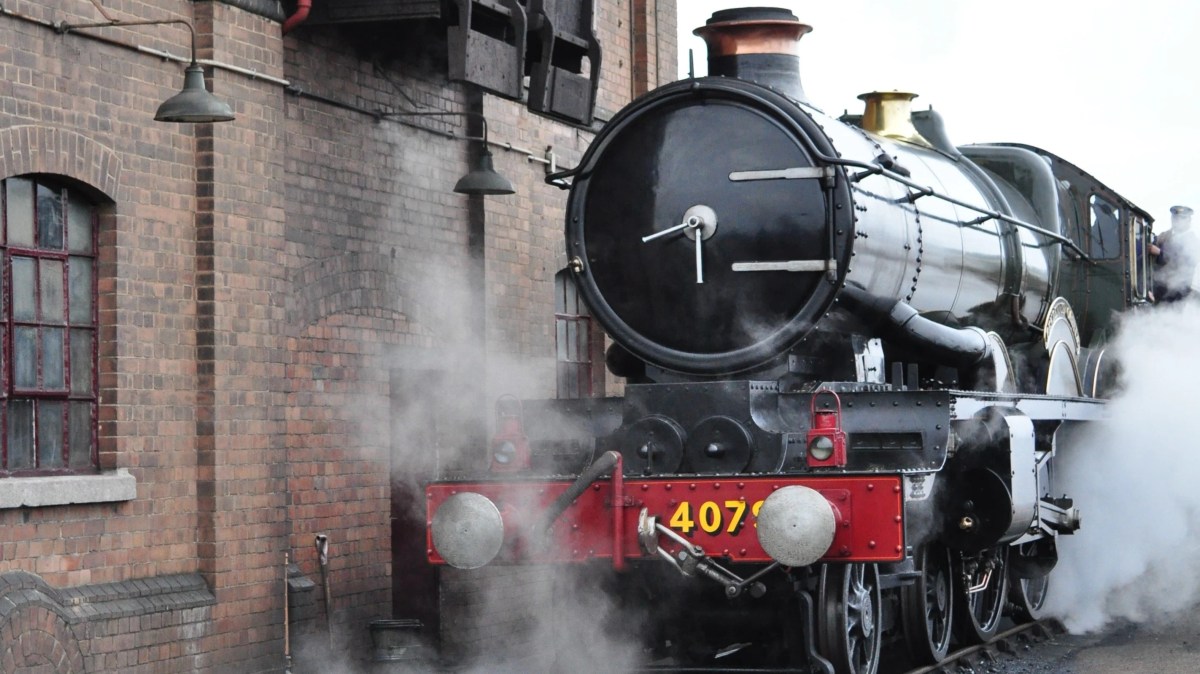
Note from the editor: We do not have a photo of a wide gauge engine, and have had to make do with standard gauge GWR Pendennis Castle no. 4079, pictured here at Didcot Railway Centre. Apologies!

Kintbury’s Rev Fulwar Craven Fowle – Sheep farmer?

When anyone speaks of a priest’s ”flock” it might be presumed they are using a rather old-fashioned term for his or her congregation. However in the case of Kintbury’s Fulwar Craven Fowle (1764 -1840) his flock were actually sheep: the relatively new variety – at the time – of New Leicesters.

Sheep had been important to English agriculture for hundreds of years, primarily for their wool which was an important export as well as the material from which most clothing was made. Indeed the Lord Chancellor had sat on the “woolsack” – a symbol of the importance of wool to the economy, since the time of Edward III.


By the end of the eighteenth century, the industrial revolution had resulted in a rapid growth of towns and an increasing urban population needing to be fed. Improvements in farming helped meet the challenge and for some wealthier landowners able to experiment with stock breeding and crop growing, agriculture became a new science.

Robert Bakewell of Dishley in Leicestershire was one of the many farmers concerned with a more scientific approach to breeding. In 1760 he had produced a new variation of the traditional Leicester sheep, capable of an increased production of high quality fatty meat, popular at the time. Production of mutton was now of greater importance to the sheep farmer than production of wool.  

During the Napoleonic Wars (1805 – 1815), it had not been possible to import Merino wool – used in the production of fine cloth -from Spain. So, partly due to an initiative by “Farmer” George III, Merino sheep were imported into England so that fine wool could be produced domestically.


Throughout the eighteenth and nineteenth century, the preferred method of keeping sheep was by “folding”. This method was particularly popular on poorer chalk soils such as on downland and involved keeping the sheep in relatively small pens constructed of hurdles. The folded sheep would be fed on root crops such as turnips which had been found to improve the condition of the ewes and the ultimate survival of lambs, particularly twins. As they ate, the sheep would also be fertilising the land – important in an age when more specialised fertilisers were as yet unavailable. The pens or “folds” would be moved along the downland at regular intervals, making this an effective way of fertilizing the soil but a very time consuming one.


By the early nineteenth century, more breeders were moving away from keeping sheep traditional to their particular area. Kintbury’s Rev Fulwar Craven Fowle was one such who chose the faster maturing New Leicester breed which he kept on his land at East Woodhay, just over the border in Hampshire.

In 1820, Rev Fowle was admitted to the Hampshire Agricultural Society, an association of the land owning classes which included the nephew of his friends Jane & Cassandra Austen: one Edward Knight junior Esq of Chawton House.

South Downs and Merinos were the breeds of sheep usually seen at the Hampshire show at this time. However, in June 1820, Rev Fowle exhibited a pen of Leicesters – the very first time this new breed had been seen there. According to the report in the Hampshire Chronicle, they “excited much attention” and were admired for their, “weight, symmetry, smallness of bone and lightness of offal.”

Rev Fowle was praised for his husbandry. The appearance of his animals, “reflected the highest credit on the management of Mr Fowle.”

Regarding feeding, “their actual state of maturity was attained without the assistance of either corn or cake, sliced Swedish turnips having constituted their sole food…”  

This was a time when the potential weight of an animal counted more than most other features so it was decided to conduct an experiment comparing Fowle’s New Leicesters with Merino sheep belonging to Mr Simmonds of St Cross. Three three-year-old New Leicesters were to be kept and fed with three three-year-old Merinos and three two-year-olds of each breed were to be folded together.

When the results were compared the following year, the three- year- old Leicesters had shown a greater increase in weight than the Merinos although the two-year-old Merinos had shown the superior increase. A similar experiment concluding in 1822 showed the advantage to favour the New Leicesters.


Although Rev Fowle is praised for his husbandry, the reality was most likely that a shepherd in East Woodhay was the one responsible for the day-to-day care of the New Leicesters. As always, the working people who supported the upper and landed classes passed through history almost totally unrecorded, particularly in the years before census returns. So here’s to that unknown shepherd.

The working people, however, were not the ones able to instigate change even though it was their hard graft that saw it through. There are some well-known names from amongst the landed and upper classes who experimented and contributed to improvements in agriculture from the eighteenth century onwards. In this area, Jethro Tull (1674 – 1741 ) who farmed at Prosperous, near Hungerford is probably the best well-known. However, the contributions from the less well-known such as Rev Fowle, competing with their contemporaries in local agricultural societies, would also have played their part in the agricultural revolution.

Theresa Lock, June 2023

Sources:

  • Hampshire Chronicle, British Newspaper Archive (on line)
  • “On the sheep’s back” : The rise and fall of English Wool by Richard Martin. (cotswoldwoollenweavers.co.uk)