Celebrating Pentecost in the countryside

Pentecost or Whitsun is the date in the Christian calendar which commemorates the Holy Spirit descending upon Christ’s disciples following his death and resurrection, and occurs on the seventh Sunday after Easter.

The old English word hwit can mean  “bright, radiant; clear, fair”.

Years ago, the newly baptised wore white at this time. (In the 50s when I was young it was a time for Confirmation, when we also wore white). It is one of the three festivals when one is supposed to take communion: Christmas, Easter, Whitsun.

In medieval times, it was an important date because those in domestic service to a landowner would be free to celebrate. Among the traditions associated with Whitsuntide are Whit Walks, including brass bands and choirs. Whit fairs and parades also took place during the break, along with Morris dancing.

Drinking Whitsun ales was customary. In 1826, answering a survey, the Kintbury’s Rev’d Fulway Craven Fowle was asked the question:

Have you any Wake or Whitsun-ale doles, annual processions or perambulations?

He answered:

“Chiefly at night. A drunken whitsuntide and not a sober feast.”

One presumes this also applied to other villages near by: Inkpen, West Woodhay, Hamstead Marshall etc.

Penny Fletcher, June 2023

Jane Austen : Our Kintbury Connection

This story begins in the second half of the eighteenth century with the families of two West Berkshire priests.

 In 1771, the Reverend Noyes Lloyd became vicar of Enborne, a small village to the west of Newbury in Berkshire. Noyes and his wife Martha had three daughters: Martha, Eliza and Mary, and a son Charles.

A few miles further to the west, in Kintbury, the Reverend Thomas Fowle the younger had been vicar since 1762. His wife, Jane, was the sister of Martha Lloyd over at Enborne. Thomas & Jane Fowle had four sons: Fulwar Craven, Thomas, William & Charles.

When  Jane & Thomas Fowle were considering an education for their boys, they decided to send them to an establishment run by an old friend of Thomas’s from his university days. The friend was one George Austen who had opened up his vicarage home in Steventon as a school for boys.

This might seem to us a very odd thing to do but back in the eighteenth century it was not unusual. And so despite having seven children of their own living at home, the Austens welcomed even more young men to share their vicarage with them. What Mrs Austen thought of this is not recorded but it would seem that she was perfectly happy with the arrangement!

 And so, Fulwar, Thomas, William & Charles Fowle were to spend some of their formative years in the home of the Austens and of course, they got to know the Austen children, including Jane & Cassandra, very well.

Jane herself was still quite little when the first of the Fowle brothers arrived at her home. To her it must have been something like having extra brothers in the house.


At this time, obtaining a degree from Oxford or Cambridge, and becoming ordained as a clergyman was considered a very solid, respectable career path. Fulwar Craven Fowle went on to obtain a degree from Oxford then followed his father into the church and eventually became vicar of Kintbury in 1798. By this time he had married his cousin from Enborne, Eliza Lloyd, daughter of the Rev Noyes Lloyd. Jane Austen’s brother James – a good friend of Fulwar – was at the wedding and this is very likely the first time he would have met the Lloyd family.

However,  Eliza’s sisters were soon to become very close friends with Jane and Cassandra. When the Rev Noyes Lloyd died, his widow and her two unmarried daughter, Martha & Mary, left Enborne rectory to live in the parsonage at Dean, very close to the Austen family home at Steventon. And so began the very close friendship between Jane & Cassandra with Martha & Mary Lloyd.


 We know from Jane’s letters that the Austen family maintained their close friendship with the Fowles at Kintbury. Several Austens – father George, the brothers, Jane & Cassandra themselves – sometimes stayed at the vicarage in Kintbury.

In 1792 Cassandra Austen became engaged to Thomas Fowle,- that is to say, Thomas Fowle III, the second son of Thomas Fowle junior and his wife, Jane. By now, Tom Fowle is an ordained minister himself, although too poor to marry. In 1796 he accepted a position as chaplain on a voyage to the West Indies but tragically died on the voyage. It was months before Cassandra – or indeed the Fowle family -received the news of his death. It must have been a very difficult time for both the Fowle family and the Austens. However, it seems as if the mutual loss only served to strengthen the relationship between Cassandra and the Fowles and she seems to have become almost a member of their extended family staying often at Kintbury.

Then, in 1797, Mary Lloyd – daughter of Noyes Lloyd of Enborne and sister to Eliza in Kintbury – married Jane Austen’s brother, James who had been widowed in 1795. Martha Lloyd continued to live with her mother at Dean but on Mrs Lloyd’s death in 1806, she moved in with the Austens and stayed with them as they moved from Southampton to Bath and finally Chawton.

I think this tells us a lot about the position of women at this time. Martha Lloyd of Enborne could claim aristocratic ancestry – indeed, her grandfather was the Honorable Charles Craven sometime governor of Carolina. Her grandmother, the former Elizabeth Staples was the second wife of Jemmet Raymond and a bust of her likeness can be seen on the very elaborate Scheemakers tomb in Kintbury church – a monument which, when it was new, was extremely expensive and would have said much about the wealth and status of those it commemorated. Yet, on the death of both her parents, Martha – as yet unmarried – does not have her own household. Until 1828 when she became Francis Austen’s second wife, she shared the home of Jane & Cassandra Austen.

If you visit Jane Austen’s house in Chawton today, you will see that Martha Lloyd was her very close friend and companion. Jane’s letters reflect the close and supportive relationship between Martha, her sister & brother-in-law at Kintbury and Cassandra and herself. Although Cassandra Austen destroyed many of her sister’s letters after Jane’s death, many of those existing are written to Cassandra while she is staying at Kintbury. In them we read of visits to Fulwar & Eliza, news of their children, the receipt of a basket of apples in return for one of fish and even a request for Charles Fowle to purchase Jane some silk stockings. Martha’s new maid, we learn, is the niece of someone from Kintbury.

And so it is that Jane’s connections with Kintbury are so much more than Cassandra’s fateful relationship with Tom Fowle. The Fowle family of Kintbury and their cousins the Lloyds of Enborne were all part of the Austens’ extended family circle and emotional support. Kintbury meant something to Jane Austen.

There are just two existing descriptions of Jane, by those who knew her. One is from her nephew James Edward Austen Leigh but the other is from our own Fulwar Craven Fowle. He recalled that she was:

“…certainly pretty – bright and a good deal of colour in her face – like a doll – no, that would not give at all the idea for she had so much expression – she was like a child – quite a child very lively and full of humour.”

We know that Jane’s last visit to Kintbury was in the spring of 1816. Fulwar’s daughter, Mary Jane Dexter, recalled that,

“She went about her old haunts and recalled old recollections with them in a peculiar manner, as if she did not expect to see them again.”

Theresa Lock, June 2023

Fifty miles of good road?

And what is fifty miles of good road? Little more than half a day’s journey. Yes, I call it a very easy distance.

Jane Austen, Pride & Prejudice

That was the opinion of Mr Darcy from Jane Austen’s novel of 1813, Pride & Prejudice. Whether many travellers of the time would have agreed with him it is difficult to say.

Of course, roads in towns and cities would have been very different from roads – where they existed – in rural areas such as ours. The villages of our benefice would have been linked back then, as now, by a network of winding lanes  but then they would have become muddy and impassable in bad weather. Street names sometimes indicate what would have been the most direct or preferred route into larger towns such as Newbury Street in Kintbury, the road which can be followed eastwards through Hamstead Marshall and Enborne to enter Newbury on the south side, or oldest, part of town. This would have been the route used by the carriers’ carts and others for whom life moved at a much slower pace.

In Jane Austen’s day many working people rarely travelled beyond a few miles from their homes – although there were, of course, exceptions, such as the servants who travelled with their more affluent employers. But for many people the local villages furnished all their day to day needs and even somewhere as small as Combe had its own shops and even a post office.   

But for some local people – and it goes without saying these were the upper classes – travel to the world beyond was part of their lives.

For the benefit of these people, with their liveried carriages, many roads had been steadily improving since the early years  of the eighteenth century. This was when turnpike trusts, with responsibility for improving and maintaining important routes, were set up by acts of parliament and toll houses  with their accompanying gates, became a familiar sight. So, whilst the lanes through Kintbury to Inkpen, West Woodhay and the like would have remained dusty or muddy track ways, roads linking important towns were much improved to facilitate coach travel.

At this time, Bath had become a very fashionable venue for the upper classes, many of whom travelled there from London. Consequently, the road we now know as the A4 – the Bath Road – was much repaired and widened. The stretch between Marlborough and Newbury in particular saw much improvement after 1744 when an act of parliament established a turnpike trust responsible for its repair. Milestones erected along the route at this time can still be seen today. One of its trustees was a man local to our area, a Dr Brickenden of Inkpen House, who, one can presume, could see the advantage of faster travel beyond his village.

The first public stage coaches to run between London and Bath had begun in 1657 when there were two regular services a week. By the end of the eighteenth century, however, the service had grown to over 150 a week. The Bear Inn, Cheap Street, Bath even advertised “A day and a half coach to London every Monday, Wednesday and Friday”. This was the express travel of the day.

For those able to afford to travel, mail coaches offered a more comfortable – and speedy -travelling experience. In 1782, John Palmer, a theatre owner from Bath, suggested to the Post Office in London that mail could be transported more quickly using the service he had developed for transporting his actors and stage scenery. An experimental run proved he was correct and his coach travelled along the Bath Road to London in just sixteen hours.

Mail coaches were pulled by teams of four horses, each team replaced every ten miles at one of the many coaching inns which had become well established along the Bath Road.  Journeying more frequently through the night when the road was less busy, the black and maroon coaches with the coat of arms and words, “Royal Mail” emblazoned on the doors would have made a striking sight on a moonlit night as they made their way towards the toll house by the Hoe Benham turning.

There would have been a stop, too, at the Elcot turning; we know this because mail for the local area was deposited with the blacksmith there. We have, at St Mary’s, Kintbury, a letter written by Rev Noyes Lloyd of Enborne regarding his communication with the sculptor Sheermakers regarding the monument to the former Lady Craven, now in the north transept. Presumably written and sent from London, the letter is for the Rev Thomas Fowle of Kintbury but the direction is to the blacksmith’s at Elcot. From here the mail would have been collected and distributed. For those of the letter-writing classes, having relatively easy access to a speedy mail coach route must have been a big advantage.   

But would this much improved turnpike road, along with the availability of fast travel to the bright lights of London or the fashionable resort of Bath, have really made much difference to the working villagers of Combe or Inkpen, West Woodhay or Kintbury? For those for whom travel was either by the carriers’ cart or a stout pair of boots, the answer is most probably no. The road to Newbury would have remained the lane through Enborne and the route to Hungerford was across the common.

For the toilers in the fields to the north of Kintbury, Hamstead Marshall or Enborne, the site and sounds of fashionable coaches rumbling past must have emphasised the great gulf between their lived experiences and those of the better off. So who would have used the new, improved Bath Road?

It goes without saying that the upper classes and members of the wealthier middle classes are most likely to have made the Bath Road their route of choice, particularly those who kept and maintained their own efficient carriage and horses. Dr Brickenden of Inkpen House, an early Commissioner of the Turnpike Trust, was most probably acting out of self interest in his support for the road.

Members of the Craven family of Hamstead Marshall may well have availed themselves of the fashionable amenities and social life to be had at Bath during the season. For the likes of them, a seat with very easy access to the turnpike road was equivalent to one’s country retreat having easy access to the M4 and onwards to Heathrow today.

Another person for whom the improved Bath Road must have been particularly convenient would have been Charles Dundas, member of Parliament for Berkshire from 1794 to 1832. Dundas lived at Barton Court which was – and still is – situated just off the Avenue, Kintbury. Two hundred years ago this route was one of the main roads into the village from the Bath Road, thus making access to the turnpike road particularly convenient for someone who could afford the very best carriage and team of horses. 

Kintbury to Westminster along the Bath Road was – and still is – around 65 miles so just a bit longer than the fifty miles of good road which Mr Darcy thought “ a very easy distance” to travel  in little more than half a day. I think Dundas would have needed the very best horses and several changes to travel to parliament in so short a time. However, if Palmer’s coaches managed nearly twice the distance in sixteen hours, it seems likely that the MP could have reached The House from his house on the same day as he set out, all other things, such as weather conditions, being equal.

Tessa Lock, May 2023
A rebel Revd?

The Reverend John Craven: Not what you’d expect in a priest?

In a letter of 1799, Jane Austen remarks that her friend Martha Lloyd has gone to visit her uncle – Rev John Craven.

John was the son of Governor Craven of Hamstead Park and brother to Martha, Eliza and Jane Craven. He was, therefore, uncle to Fulwar, Tom, Charles and William Craven as well as Martha, Eliza and Mary Lloyd.

Following the death of Governor Craven, John’s mother married the besotted Jemmet Raymond. Next she proceeded to marry her son to Jemmet’s sister, Elizabeth. Elizabeth was well off, but judged to be weak in intellect. They married in Kintbury (one presumes by Thomas Fowle, the groom’s brother in law) in 1756 when John was 24. Elizabeth owned land in Henwick, Thatcham and John at his marriage is described as ‘clerk of Henwick.’

In 1775 John became vicar of Wolverton near Basingstoke. Jemmet (John’s stepfather) had inherited the manor from his mother who had died aged 17 after his birth.

Jane did not do ‘bedroom scenes’, she was not a Jilly Cooper of the 18th century. But if she had been, then John would have provided plenty of copy!

In 1776, aged 44, John became embroiled in a divorce case brought by Mr. Potter Harris of Baughurst.

At the time, John Craven was vicar at Wolverton in Hampshire although he was actually living at Barton Court, near Kintbury. He travelled to Wolverton on a Saturday and stayed at the Potter Harris house to take the church service on Sunday.

The divorce case seems to have been quite sensational. Both a maid and Mrs Potter Harris’s cousin testified that they had seen Rev Craven enter Mrs Potter Harris’s bedroom and heard the sound of bedsprings! Also there was talk of misbehaviours in a coach and the Rev had been seen to put his hands under her skirt…

Mr Potter Harris wanted revenge and the Reverend was fined £3,000.

Despite this, John and Elizabeth Craven were married for over 20 years. There were no children so it may have been a marriage in name only.

When his wife died, Barton Court passed to another branch of the Raymond family.

In May, 1778 the papers reported:

“Last week died at Barton Court, near Newbury, Mrs. Craven, wife of the Rev’d John Craven and only daughter of the late Sir Jemmet Raymond.”

In 1779,  John married Catherine Hughes  from Letcombe, Berkshire. Catherine is the Mrs. Craven mentioned in Jane Austen’s letters:

Does Martha never hear from Mrs. Craven?


Is Mrs. Craven never at home?

Mrs Craven was, of course, Martha Lloyd’s aunt by marriage.

The Rev John Craven seems to have been rather a ‘rumbustious’ priest because his name appeared again in the local papers, this time in an argument not romantically inspired.

In essence John Craven went to a magistates’ meeting in Wantage and passed comment on something he considered an impropriety. Letters were printed in the Mercury complaining of his behaviour. There followed a meeting at the Alfred’s Head Inn in Wantage where a quarrel broke out as to who had reserved a room.  One letter to the paper says:

Did Mr. Watts tell the whole truth? That he did not know that Mr. Craven carried pistols with him on that day to Wantage – Yes Mr. Printer pistols were carried thither.

The Wantage magistrate asked how Mr Craven would react if he came to the Newbury Assizes and passed comment. John Craven replied that he would be glad to drink a bottle with him at Speen. Thereafter the vicar seems to have calmed down.

Eventually John and Catherine moved to Chilton House in Chilton Foliat, Wiltshire.  John died in 1804 after an hour’s illness. According to the notice of his death in the newspapers, he had, for many years, been acting magistrate in the counties of Gloucester, Hampshire and Wiltshire.

After her husband’s death, Catherine moved to Speen Hill near Newbury. In April 1839 her obituary read:

At her residence in Speen Hill, at a very advanced age, Mrs. Craven, relict of Revd John Craven and lamented mother of Fulwar Craven esq. The deceased lady was highly respected and esteemed by the gentry in the neighbourhood of Speen and by society in general.

References:  The Newspaper Archives, The Letters of Jane Austen. Mrs. Thora Morrish

Penny Fletcher, May 2023

Once a mountain

Walbury Beacon Benefice is named after the point on Walbury Hill where, traditionally, a beacon has been built.

But mind-chains do not clank where one’s next neighbour is the sky.

Thomas Hardy, “On Wessex Heights

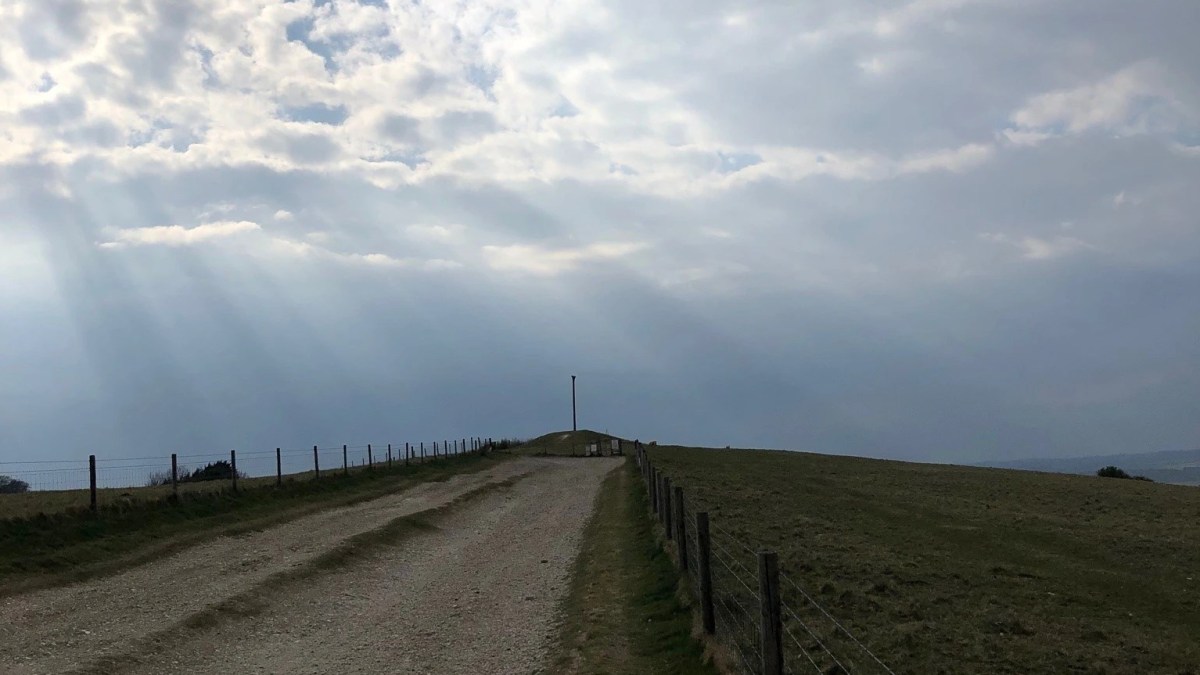
Walbury Beacon Benefice is named after the point on Walbury Hill where, traditionally, a beacon has been built. Originally beacons were lit across the south of England as an alert to the danger of invasion. More recently and at least since Victorian times, the chain of beacons has been lit to celebrate royal jubilees. Sometimes known as Inkpen Beacon, at 974 feet above sea level, Walbury Hill is the highest point on chalk in England and the site of Walbury Camp, an Iron Age hill fort, which, I believe, has never been excavated.

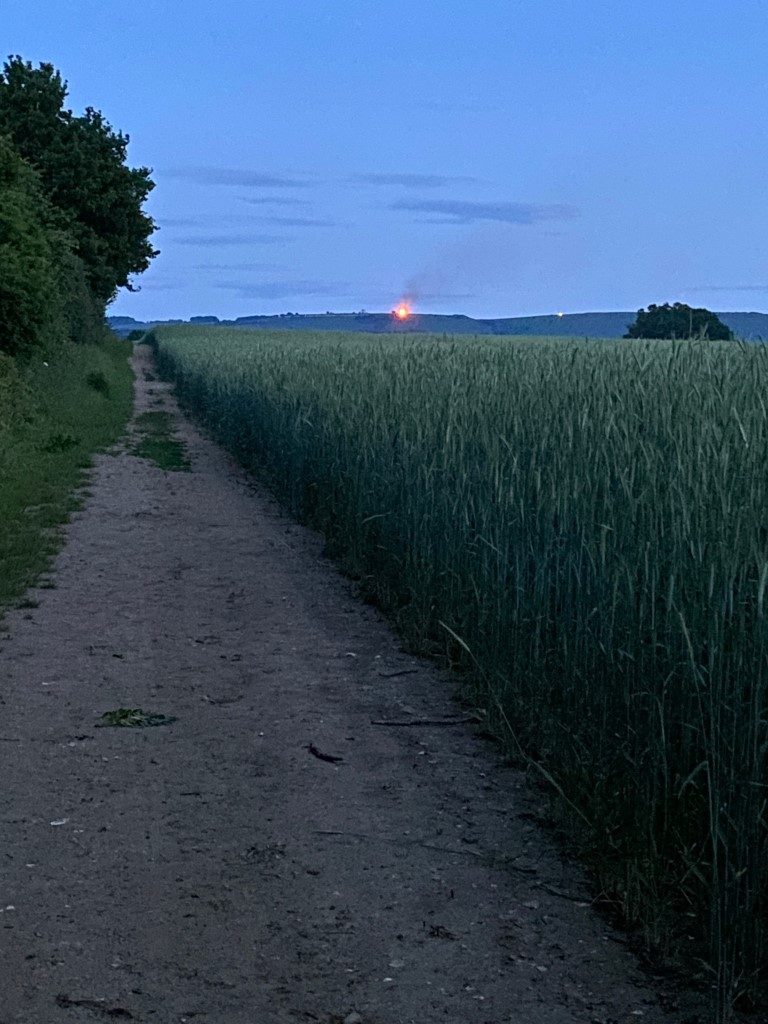
A beacon on Walbury Hill/Inkpen Beacon celebrating the Platinum Jubilee in June 2022

It will surprise some people to know that when the Ordnance Survey first surveyed this area, Walbury Hill was measured as being 1,011 feet above sea level, thus making it a mountain! However, a subsequent survey in the late C19th measured Walbury at less than 975 feet and so demoted it to the status of a hill.

Further westward along the ridge is Inkpen Long Barrow, one of only three long barrows in Berkshire but one of a cluster, most of which are located in Wiltshire and Dorset. However, it is not the long barrow that many visitors come to see, but the famous (or perhaps that should be infamous) Combe Gibbet.

Combe gibbet

Many people mistakenly believe that a gibbet was the site of a public execution, but this was not so. The original Combe Gibbet was only used once but it was not for an execution. In 1676, George Broomham and Dorothy Newman were convicted of the murder of George’s wife Martha and son, Robert. They were executed at Winchester but their bodies returned to their home parishes where they were hung on the gibbet – as a deterrent to anyone contemplating committing murder. What contributes to the general confusion between a gibbet and a gallows is the fact that the downland on the north side below the gibbet is marked on OS maps as “Gallows Down” – presumably a misnomer which has stuck!

As many of you will know, the story of Broomham and Newman inspired the then young Oxford graduate John Schlessinger, to make his first feature film, “The Black Legend”. In the late 1940s the Schlessinger family lived at Mount Pleasant, between Inkpen and Kintbury  and so the grisly local landmark would have been a familiar sight to them. With family members and friends from Oxford taking the major roles, John Schlessinger filmed the story of murder during the summer of 1948, using many local people as extras. I doubt any of these villagers had the remotest idea that this young man would one day go on to be one of Britain’s foremost directors winning 7 BAFTAs and an Oscar.

Nearly 20 years later John Schlessinger was to return to Wessex to film his adaptation of Thomas Hardy’s “Far from the Madding Crowd”. Filmed entirely on location in Wiltshire and Dorset, what fascinates me about this later work are the number of scenes which recall moments from Schlessinger’s earlier film. It is as if the inspiration he took from his work around Walbury Hill stayed with him and was used in this, one of the visually most beautiful of British films.

However, it is not only because of the Black Legend that many other people visit Walbury Hill. The Newbury Weekly News archive features various accounts of visits to the area or discussions of its history. Some time in the late C19th, the novelist and poet Thomas Hardy visited Walbury Beacon – though perhaps to confuse us even more, he calls it “Ingpen Beacon” – and referenced it in his poem, Wessex Heights:

There are some heights in Wessex, shaped as if by a kindly hand
For thinking, dreaming, dying on, and at crises when I stand,
Say, on Ingpen Beacon eastward, or on Wylls-Neck westwardly,
I seem where I was before my birth, and after death may be.

Walbury Hill might not be a mountain but it remains a much loved landmark.

Theresa Lock

Olive Emma Witt

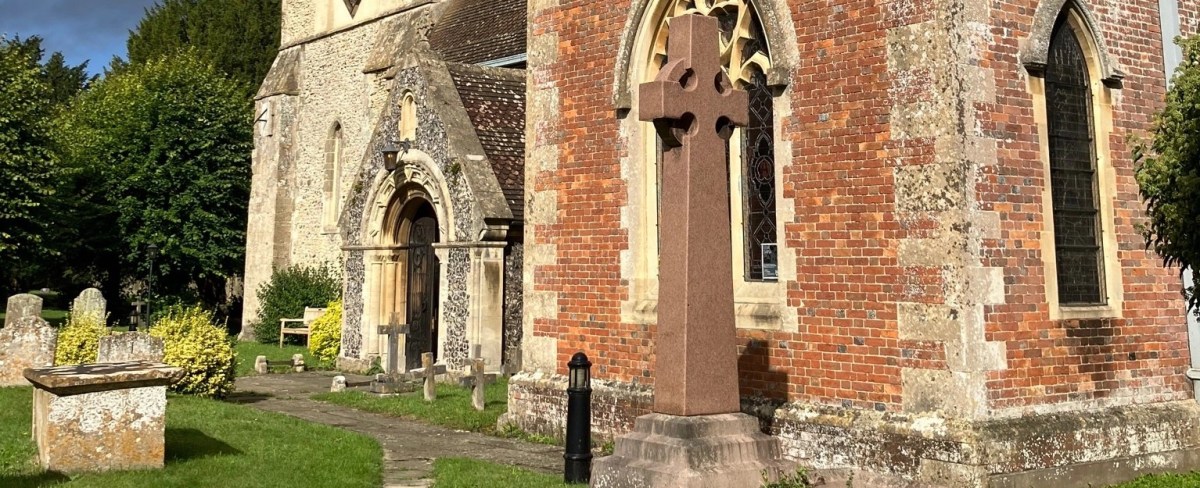
Should you turn to look to your left as you walk up the path to St Mary’s Church, Kintbury, you will see a rather unusual grave marker.

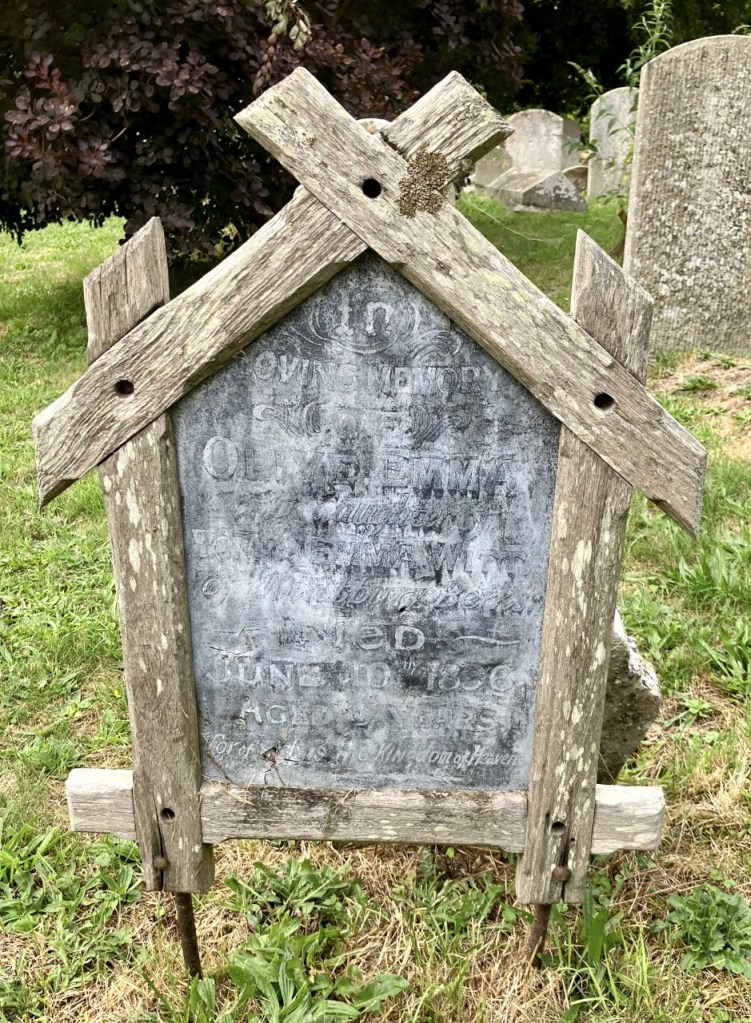
Should you turn to look to your left as you walk up the path to St Mary’s, Kintbury, you will see a rather unusual grave marker. Rather than being stone, as are the great majority of grave markers, this one, standing little over three feet high, is of metal, probably tin, and enclosed in a five-sided wooden frame. From a distance it looks a little like a larger version of a Victorian schoolchild’s slate; perhaps this was deliberate , because the person commemorated was  six year old Olive Emma Witt, who died in 1896.

Olive Emma Witt’s grave marker in Kintbury church yard

The Witts were not originally of Kintbury. Olive’s father, Tom, had been born in 1846 at Braemore, Hampshire, where his father, Charles had been an agricultural labourer. Emma Witt had been born in Salisbury in 1850.

At the time of the 1871 census, Tom was working as a gardener in Salisbury and it has to be likely that it was around this time that he met Emma Skeet, the local girl who would become his wife.

By 1881, the Witts had moved north out of Wiltshire to west Berkshire where Tom now worked as a gardener at Elcot. The family had grown: Walter had been born in 1877 and Herbert in 1880.

It would seem that Tom Witt was an ambitious young man – by the census of 1891 he is a farm bailiff at Inlease Farm on the Hungerford Road out of Kintbury where they have been living for at least six years now. Two more children had been born: Charles in 1885 and Olive in 1890. The household must have been a busy and possibly crowded one as the Witts had four young men lodgers: two carters and two ploughboys, all working on the farm.

Some time within the following six years, Tom progressed from being a bailiff at Inlease to a farmer in his own right at Cullamores Farm on the road out of Kintbury towards Inkpen. Very sadly, however, it was here that, on June 10th, 1896, little Olive died. The grieving family put an announcement in the Newbury Weekly News.

The census of 1901 shows Tom & Emma still at Cullamores with Tom described as an “Employer”. The distinction between “Employed” and “Employer” was particularly significant in an age of increasing social mobility, particularly for someone like Tom whose father had been an agricultural labourer like so many thousands of men in the middle of the century. Tom & Emma were coming up in the world.

Herbert, now 20, was working on the farm. Charles, however, had turned his back on farming and at 16 was a carpenter’s apprentice. Walter had left Kintbury altogether, and was now a police constable at Rochester Row Police Station in London.

The end of the nineteenth century saw decreasing numbers of workers employed in agriculture and this national trend seems to have been reflected in the family experience of the Witts. By 1911, Walter was married with a daughter and living in Harrow, Middlesex. He was still with the Metropolitan Police. Herbert, who had previously been working on the family farm, had followed his elder brother into the police force, but for him a force not so far from home as he was in Wantage.

By 1911, Tom was 64 and no longer working in agriculture and no longer himself an employer. Furthermore, he and Emma have left Kintbury and were now living in Newland, Cogges, close to Witney in Oxfordshire. He has returned to his first occupation, that of gardener and on the census is identified as a “worker”.  

The trajectory of Tom Witt’s life experiences would have mirrored those of many of his contemporaries. Born into an agricultural labourer’s family, Tom had improved his life chances becoming upwardly mobile until he could describe himself as a farmer and employer – a distinction which mattered in this ultra class conscious time. By the time Tom and Emma’s sons had been born, universal education would have given them a far better start in life than that experienced by their grandfather Witt in Hampshire, enabling them to join the police force and ensuring their place in the lower middle classes.

We do not know exactly why Tom & Emma left Cullamores farm but it has to be likely that the slump in agriculture had something to do with it. This was a time when many thousands were still leaving the countryside for the growing towns whilst others were emigrating overseas. For Tom & Emma, perhaps the move northwards to Witney was a fresh start away from the world – and the social status – they had lost.

I wonder if they ever returned to Kintbury and to the little grave in St Mary’s churchyard -the journey back then from Witney would have required three changes of train on the Great Western Railway. The forty mile journey across the downs by road would have been slow and unlikely to be completed easily within a day.

Why Olive’s grave marker was of tin rather than stone I do not know. Iron crosses are not unknown in churchyards but a grave marker of tin is something I have seen nowhere else.

But then, any exploration of family history – any family – raises far more questions than it ever answers.

Tessa Lock

In the time of the Romans

Imagine our area over sixteen hundred years ago in the fourth century AD. For three hundred years the country has been ruled as part of the Roman Empire and the local Celtic tribe, the Atrebates, now have a good working relationship with the incomers.

Imagine our area over sixteen hundred years ago in the fourth century AD. For three hundred years the country has been ruled as part of the Roman Empire and the local Celtic tribe, the Atrebates, now have a good working relationship with the incomers.

The regional centre is at Calleva Atrebatum (modern Silchester) – a town in the traditional Roman style but with a name reflecting the presence of the Iron Age people who were here first. Out here to the west, our area is close to the main route from Calleva to Aquae Sulis (modern day Bath) where the hot springs are an attraction to visitors. The route passes through the settlement of Spinis, which today we know as Speen.

For those living closer to this major road, the ranks of Roman soldiers, their helmets and shields glistening in the pale sunlight, have been a familiar sight. The men are not all from Rome, of course – far from it. The Roman army recruit from all over the Empire – across Europe and even North Africa. Sometimes local men from the indigenous Celtic tribes have signed up too, attracted to the idea of gaining Roman citizenship with all its advantages if you were able to complete a long period of military service, as well as the chance to travel and see the world.

Those who have travelled beyond our valley, or have spoken to others who have done so, speak of towns where the buildings are of stone with heating actually under the floor, where there is drainage and streets paved so that you are not deep in mud as soon as you leave your dwelling. This is the Roman way, and it all sounds very attractive and modern.

Indeed, some local people are wanting a piece of this new, improved lifestyle for themselves. There has been talk of local, Celtic women who have, despite family opposition, married young Roman men. Perhaps they have been attracted by the striking uniform or the offer of a more comfortable home. Who knows. But you do not have to marry into a Roman family to adopt this new way of living. Wealthier Celts have been increasingly adopting Roman ways.

Although there were no major Roman towns in our immediate area, we know that  those who were influenced by Roman ways did live in our valley. These people may have been exclusively of Roman descent, although it is more likely that they were Romano-British and therefore of possible mixed heritage or of Celtic descent but influenced by Roman ways.


Between 1950 and 1951, a teacher from St Barts Grammar School, Douglas Connah, led an excavation of a site which had been uncovered following work at the sewage works to the east of Kintbury. The excavation revealed the rectangular ground plan of a fourth century bath house, unfortunately badly damaged by ploughing and robbing out of much of its stone.

The building measured 5.25m by 4.04m with an extension to the south. At the east end was evidence of a praefurium, or furnace, to facilitate heating via a hypocaust which had been cut into the natural chalk and was still, at the time of the excavation, covered by a layer of wood ash. The building had been constructed of large flints and the lower courses of sarsen stone.

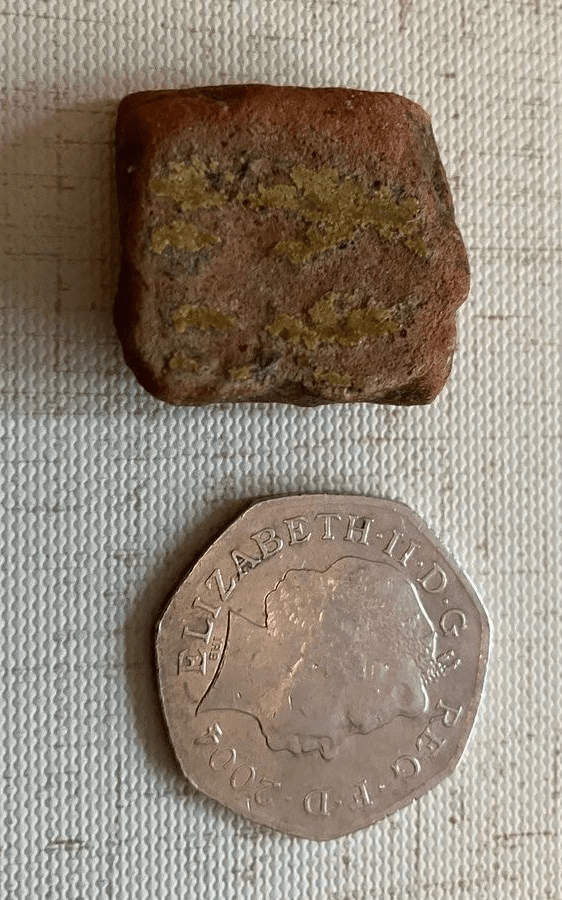
Painted plaster remains, now in West Berks Museum, indicated that the walls of the building were originally decorated whilst several tesserae suggested that there had once been a mosaic floor. It was possible to date the building to the fourth century due to pottery and a fibula brooch found in a rubbish pit nearby.

A tessera found near Irish Hill, outside of Kintbury

Although the bath house, as excavated, appeared not to have been joined to another building, it would not have been built in isolation but as part of a villa complex. It could have been on the site of a prosperous farm or indeed at the centre of a large estate. We may never know. But it is clear that sixteen hundred years ago, someone from around here wanted to build a modern, fashionable house with the latest in painted walls and mosaic flooring, and, of course, central heating.

It is sad for us that the remains of the accompanying villa have long been destroyed, most likely when the canal was constructed in the early 19th century. What happened to the broken remains of the roof tiles, the wall plaster, the tesserae? Who knows, keeping a sharp eye open when you’re walking towards Hamstead Marshall from Kintbury, you just might spot something of interest.

Tessa Lock