John Lidderdale, b.1802 & John Lidderdale, b.1839
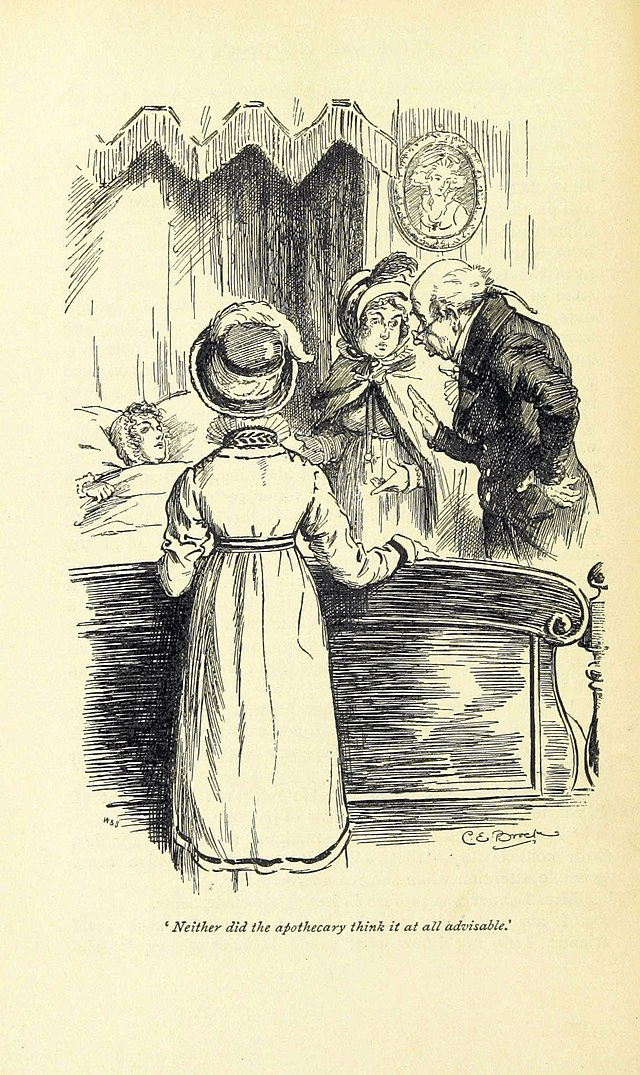
He had been at the pains of consulting Mr. Perry, the apothecary, on the subject. Mr. Perry was an intelligent, gentlemanlike man, whose frequent visits were one of the comforts of Mr. Woodhouse’s life.
As readers of Jane Austen’s novel Emma (1816) will know, the village medic, Mr Perry, was an important figure in the life of Mr Woodhouse who was constantly in need of reassurance as regards to his health. Austen describes Mr Perry as an apothecary; however, by the 1830s the Mr Woodhouses of Kintbury might have considered themselves as more fortunate as their general practitioner could be described as “surgeon”.
So who was Kintbury’s Dr Lidderdale?
John Lidderdale I had been born in Hungerford in 1802. He was the eldest son of Captain John Lidderdale of Hungerford and his wife, Ann, née Pearce. John senior had been a Captain in the 17th Hussars and his family had come, originally, from Dumfriesshire in Scotland. Ann was from a local family, having been born in Standen, near Hungerford.

In the 1820s John was a student at the London Hospital Medical College, at that time still a relatively new establishment, having been founded in 1785. He became LSA ( Licensed Surgical Assistant ) in 1825 then MRCS ( Member of the Royal College of Surgeons ) in 1826. Studying medicine at that time was expensive and John’s fees, board and lodgings may have cost him between £500 and £1000 – enormous amounts for the time. It was not as if he could expect to become a high earner upon qualifying, either; whilst a medic practising in a wealthy part of London, for example, might earn up to £1000 a year, a country doctor was more likely to make between £150 and £200, comparable to better-paid teachers.
By 1839, John is listed in Robson’s Directory as surgeon and registrar of births and deaths for the Kintbury district. At the time of the 1841 census, his younger brother James is living with him, most probably in the role of an apprentice as James would later go on to study medicine.
Four years later, John married Isabella Fowle, the youngest daughter of the late Fulwar Craven Fowle who had been for many years the vicar of Kintbury. Although it is impossible to say how prosperous or otherwise the Kintbury practice was proving to be, the 1851 census indicates that John has an apprentice, one Francis Owen, and three live-in servants. By 1861, he has an assistant, one Michael Cuff, and two live- in servants. The same year he was awarded the degree of MD ( Doctor of Medicine ) by the University of St Andrews – the prestigious Scottish university which at this time awarded the degree of MD without the recipients having to attend its campus on the Fife coast.
John Lidderdale died in October 1863. His obituary in the Newbury Weekly News noted,
“ Few men had so extensive a practice as the late doctor, and none worked harder for it. His kindness of manner, his skill and attention, and his patience in tedious cases, will ever be gratefully remembered”.
Large numbers of villagers filled the church for the funeral including many tradesmen who had closed their shops for the occasion. Kintbury certainly showed its respect for the late doctor.
However, where was this popular doctor in the strict social hierarchy of early nineteenth century England? Looking again at the Jane Austen quote I used at the top of this article, the respected Mr Perry is described as gentlemanlike. That last syllable carries a lot of weight: for as much as Perry was respected, he was not, within the hierarchy of the time, a gentleman.
And neither was Dr John Lidderdale.
The Kelly’s Directory of 1848 lists 19 Kintbury people as members of the Gentry which includes Mrs Lidderdale’s unmarried sister, Elizabeth Caroline Fowle and her widowed sister, Mary Jane Dexter. But the man who has achieved the recognition of an MRCS, who is trusted to take care of the villagers’ health, is regarded as being of lower status than the great and the good many of whom were most probably not qualified in anything.
By the time of the 1871 census, Kintbury had a new doctor. Also named John Lidderdale, this young man was the son of the John Lidderdale I’s brother, William.
William Lidderdale had been born in Hungerford in 1805. It seems likely that he had an involvement with the East India Company in his younger adult years although by 1851 he was a Chief Officer with the Coast Guard Agency living in Tyneham and then Osmington Mills, Dorset where his wife Elizabeth died in 1852.
John Lidderdale II had been born in 1839 when the family were in Ilford, Essex, then educated at a boarding school in Southampton. The 1861 census shows him to be a medical student in London although there is some evidence to suggest he had been an apprentice in Kintbury before that, presumably under his uncle. In 1861 he became a Member of the Royal College of Surgeons.
In 1863, the Board of Guardians of the Hungerford Union (in other words, those responsible for the work house ) unanimously voted him Medical Officer of the Kintbury District.
John Lidderdale II served Kintbury as general practitioner for over twenty years. These were changing times: by 1869, Kelly’s Directory had dropped the category, “Gentry” in favour of “Private Residents” in which category both John Lidderdale and his uncle’s widow, Mrs Lidderdale are included.
John Lidderdale retired in 1891 when he married Emma Louisa Mathews, the widow of a farmer from Boxford. To mark this occasion, Dr Lidderdale, “entertained to supper the whole of the adult population ( of Kintbury ), it taking two evenings to do so, and subsequently gave a tea to all juveniles aged between five and sixteen.”
To show their respect to the retiring doctor, 433 of the villagers had subscribed to the cost of a solid silver epergne engraved with the Lidderdale crest.
Both John Lidderdales are frequently mentioned in the pages of the Newbury Weekly News with regards to the sick or injured they have attended during their times as general practitioners in Kintbury. For as much as one can tell, neither were particularly involved in public life, however the reports of their respective funerals show that both had earned the respect and appreciation of village’s working people.
John Lidderdale II died in April 1894. According to the Newbury Weekly News he was remembered as, “ a kind neighbour, devoted friend and approachable councillor.”
Isabella Lidderdale, widow of John Lidderdale II continued to live in Kintbury until her death in 1884. Isabella had lived in Kintbury through times of great social change and also has the distinction of having been, quite probably, the very last village person to have known Jane Austen personally.
William Lidderdale, father to John Lidderdale II, died in Newbury in 1881 but was buried in Osmington, Dorset along with his wife.
Charles Lidderdale, brother of John Lidderdale I became an actuary of the Sun Life Assurance Company but died in Hungerford in 1863.
James Lidderdale, brother of John Lidderdale I, practised as a GP in Great Bedwyn, Wiltshire and died in 1882.
Emma Louisa Lidderdale, widow of John Lidderdale II, continued to live in Kintbury until her death in 1920. The village’s long association with the Lidderdale family had come to an end.
Sources:
The origin of the general practitioner I. S. L. LOUDON, DM, FRCGP, DRCOG Wellcome Research Fellow, University of Oxford, and Honorary Archivist, Royal College of General Practitioners
Journal of the Royal College of General Practitioners, January 1983
hhtps://www.bartshealth.nhs.uk/the-royal-london-our-history
hhtps://livesonline.rcseng.ac.uk
Newbury Weekly News via British Newspapers online
Ancestry.co.uk
(C) Theresa Lock 2025
 Kintbury and Beyond