We are delighted that David Hutchinson, a direct descendant of Kintbury swing Riots transportee, Edmund Steel, has allowed us to publish this article concerning his ancestor’s life in Australia.
Readers will already know of the ‘Swing Riots’, the trials, and the sentencing of those arrested for their participation in one form or another in the ‘Swing Riots’ that occurred in and around Kintbury and nearby districts in late 1830 – early 1831. Recently, on this website we read of the ‘Swing Riots’ Memorial Gathering in Kintbury on 12 January 2024, and the accompanying article submitted by Keith Jerrome on Remembrance of the Swing Riot Martyr, William Smith, also known as and referred to in the trials as William Winterbourne.
Readers who don’t know of the ‘Swing Riots’ or would like to know more, can simply Google ‘Swing Riots 1830-31’ and a dearth of both generalised and detailed information is there on your PC screen, ranging from scholastic research, to entire books.
Notwithstanding, unless one knows how, or has the luck to ‘stumble upon’ evidential ‘portions of’ succeeding history(s) of those of William Winterbourne’s tried and sentenced individual comrades, there is little obvious information of what subsequently occurred to them.
Following, is a ‘word sketch’ of just such one [partial] personal history, unearthed by a 3 x Great Grandson of one of the convicted and sentenced rioters:-
EDMUND STEEL was one of those arrested. EDMUND was born in 1789 at Three Legged Cross, Hampshire, to parents James Steel and Jane Steel (nee Bulpit).
1830
Edmund is one of the referred to ‘Kintbury Five Deputies’ who attended the meeting at the Hungerford Town Hall at the request of Magistrate Willes. It was Edmund Steel to whom Magistrate Willes referred in his verbal statement to the subsequent trials ‘Observing that Steel had a hatchet in his hand, he said to him, “My friend, that is a lethal weapon you have; it would split a man’s skull”, to which Steel replied, “Depend upon it, sir, it shall never injure yours”.
At the time of the Swing Riots Edmund was aged about 41 years, making him amongst the older of those sentenced. Edmond had married his wife Maria Thatcher on 30 September 1811 at St Nicholas Church, Newbury. By the date of the trial Edmund and Maria had already produced 11 children, 8 of whom survived, ranging in age from 18 years to twelve months. Edmund’s occupation is recorded as variously ‘ploughman’ or ‘maltster’ and he is recorded as being able to read and write. Edmund is described as being ‘stout’ and standing at ‘5 feet 4 inches without shoes’.
The Berkshire Family History archives record Edmund as having applied for and received Parish Relief funds on 11 occasions in the 12 months before his trial.
Following his arrest, Edmund and his fellow prisoners were held at the Mansion House at Newbury, and eventually had to be transported from Newbury to Reading for the ‘Special Commission’ trial. An account of that event states: “Before those committed could be tried by the Special Commission they first had to be conveyed from Newbury to Reading. “Harrowing and heart-rending was the scene that took place when the vans that were to convey the main body of the prisoners drew up in the Market Place.” A troop of Lancers and the Yeomanry, with sabres drawn, were “the imposing military escort responsible for seeing the prisoners safely lodged in the county gaol.” The men were brought out in batches while “Women fought their way through the surging throng praying for a parting word with their husbands or relatives before they took leave of them perhaps for ever.” A particularly distressing sight was witnessed when “a poor woman with eight children and an infant at the breast rushed forward to press the manacled hands of her husband as he took his seat in one of the vehicles.”. Newbury has not witnessed a sadder procession through its ancient streets”. It is very likely the poor lady and her manacled husband referred to were Maria (eight children) and Edmund Steel.
1831
Edmund was one of those tried who were sentenced to death. The severity of the trial sentencing generally drew quick response from a significant proportion of the local community and some Elders, concerned that the sentences were too harsh. Subsequently, with supporting petitions to the King and other Authorities, testimony from Magistrate Willes and possibly other Elders, Edmund’s death sentence was commuted to Transportation for the Rest of His Life.
On January 27th 1831, the sentenced prisoners were transported from Reading to the prison hulk ‘York’ in Gosport (Portsmouth Harbour). Conditions aboard the prison hulks is well documented, and could generally described as appalling:-
The “York”, to which the Berkshire men were assigned, was an old 90-gun line-of-battle ship, sold to the Convict Establishment in 1820 and destined to serve as a floating prison for the rest of her days. On her three decks she housed on the average about five hundred prisoners, in addition to the officers and guards who occupied the quarter-deck and stern cabins.
On their arrival the convicts would have been paraded on the quarter- deck where they were mustered and received by the captain. Their prison irons were then removed and handed over to the jail authorities who departed as the convicts were taken to the forecastle. There every man was forced to strip and to take a thorough bath, after which each was issued with an outfit consisting of a coarse grey jacket, waistcoat and trousers, a round-crowned broad-brimmed felt hat, and a pair of heavily nailed shoes. The hulk’s barber having shaved and cropped the convict’s heads. each man was double-ironed and taken on deck to receive a hammock, two blankets and a straw palliasse. A guard then marched the laden and fettered prisoners below deck where they were usually greeted with roars of ironic welcome from the convicts already incarcerated there.
The lower decks were divided into sections by means of iron palisading, with lamps hanging at regular intervals, and these sections were sub-divided by wooden partitions into a score or so compartments, each of which housed from 15 to 20 convicts. Newcomers were allotted to the lowest deck where the air was foulest, and bilge water occasionally slopped through the cracks in the floor boards. Weaklings were congregated on the middle deck, usually the most crowded of the three. Those who had served the greater part of their sentence without being transported were accommodated in the upper deck, the most airy and consequently the most healthy and pleasant. On these decks the convicts existed when not at work and slept at night. Never were they free from the chain between ankle and waist, which was one of the badges of their state, and which clanked and rattled with their every movement. Their bodies, their clothes, their beds and the very walls of the hulk itself were infested with vermin.
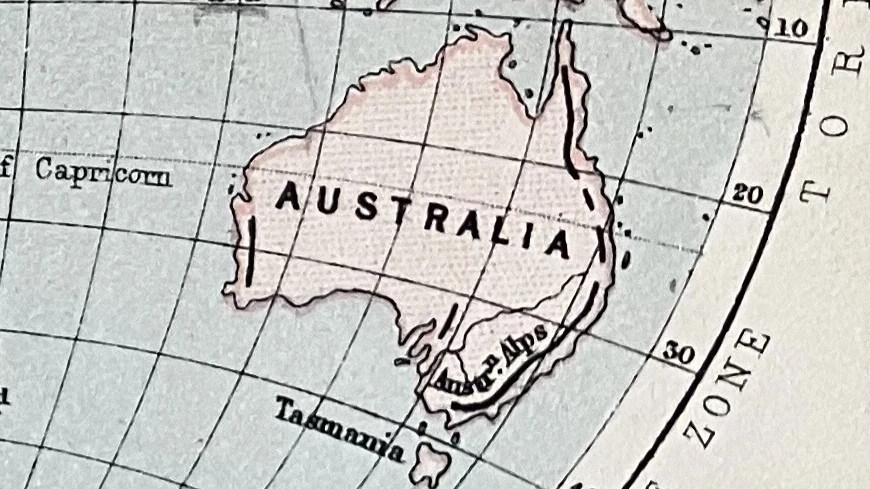
Edmund was fortunate insofar as his tenure in the prison hulk ‘YORK’ was limited to only one week. On 2nd February 1831 Edmund was transferred to the transport ship ‘Eliza II’, bound for Van Diemen’s Lands (VDL), known today as the Australian Island State Tasmania, with a cargo of 224 male only convicts, plus Captain, Surgeon, Gaolers, and Crew.
Eliza II, described as having been built in British India in 1806, was a 511 Ton (later 538 Ton) merchant ship. All the Australia & VDL convict ships were chartered merchant ships. None were specially commissioned convict ships. It is not yet discovered what accommodations were on-board to house the convicts, or how many decks there were. Some of the ships that transported convicts were notoriously over-crowded and unsanitary, and many voyages resulted in many lost lives en-route to VDL.
After a voyage of 112 days, Eliza II arrived at VDL, landing at Hobart Town on 29th May 1831, no lives were lost on the voyage. Hobart Town is today the capital city of Tasmania.
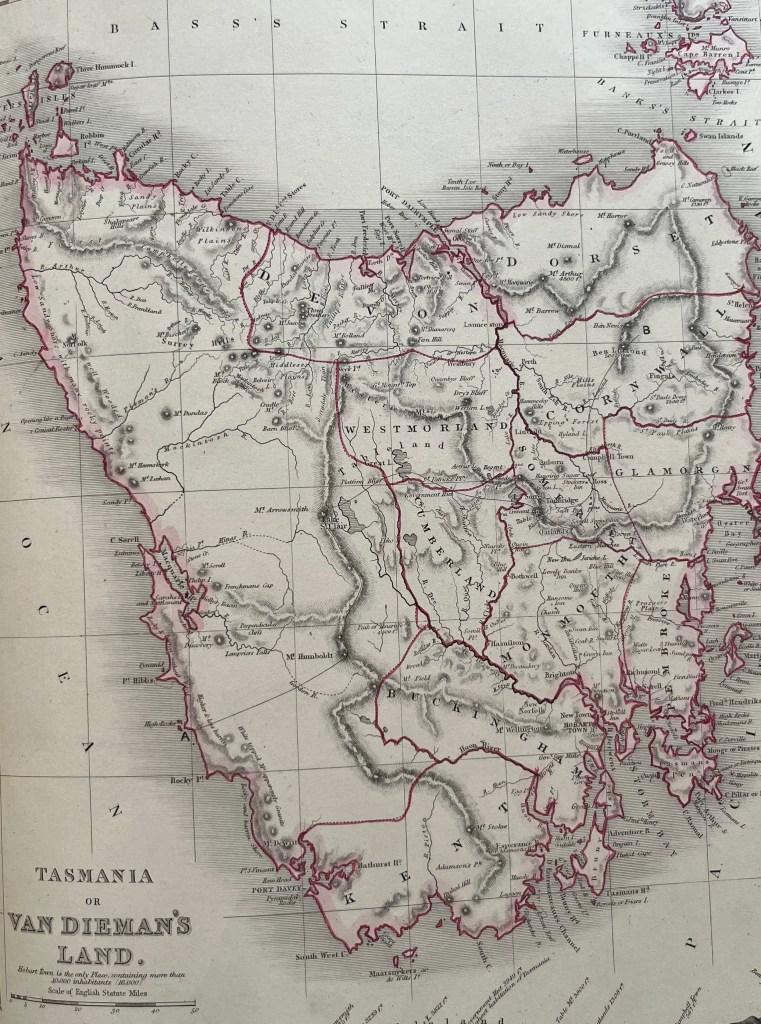
It is important in the context of this sketch account of Edmund Steel to provide some background to Van Diemen’s Land:-
VDL
The pre-history of VDL is that it was inhabited continuously by Indigenous Aboriginal Peoples for some 30,000 years before being ‘discovered’ by the Dutch seafarer/explorer Abel Tasman in 1642, sailing from Batavia (Jakarta, in Indonesia today) on instruction from his superior Anthony van Diemen, Governor of the Dutch Settlements in the Indian Archipelago to explore the coast of the ‘Great South Land’ as the landmass of Australia was then known. However, VDL was not known to be an island until 1798-99 when it was first circumnavigated by Mathew Flinders and George Bass in their sloop ‘Norfolk’.
Around 1784-85 it was proposed by Henri Peyroux de la Coudreniere, a French politician, to the Spanish Government that there were advantages for the Spanish Crown to settle VDL, but there was no interest from the Spanish. Henri later proposed the same to the French Government, but again nothing resulted. Sealers and Whalers are recorded as having based themselves on VDL and its surrounding Islands as early as 1798. In August 1803 the English Governor Philip King, of the settled English Colony New South Wales (Australia), sent a military party to VDL to prevent any claim to the Island from the French.
The arrival of white people (sealers and whalers, but especially later the British Colonialists) in VDL was totally disastrous for the Indigenous Aboriginal Peoples, and remains, even today, as a matter of great sadness, and heated debate.
VDL was initially governed from the remote New South Wales, but eventually, in 1856 the Colony of VDL was granted responsible free self-government with its own parliament, and the name of the Colony was changed to Tasmania.
From the early 1800’s to the 1853 abolition of penal transportation, VDL was the primary penal colony in Australia. A total around 73,000 convicts were transported over the years to VDL.
BACK TO EDMUND STEEL
On their arrival in VDL it was common for the convicts to be ‘assigned’ to work as labour to Free Settlers (business proprietors, farmers, households, etc), or to work in Government Gangs. EDMUND STEEL on arrival in VDL in 1831 was fortunate to have found himself ‘assigned’ as a labourer to free Settler Robert (Rob) Taylor, Farmer, of property in the MacQuarie River District, very possibly due to Edmund’s past farm labourer work history. The MacQuarie River District is in the Centre-North of VDL, in the Epping Forest area, below the (now city) of Launceston. At this time Rob Taylor owned 4,000 acres of land, including his late father’s estate ‘Valleyfield,’ and rented another 2,000 acres. It is not yet known if other convicts were already or subsequently assigned to Rob Taylor, but the isolation of the Macquarie River District from Hobart Town and other areas of mass convict habitation may have been a blessing for the future of Edmund.
1834
On 19th March 1834 Edmund, with the assistance of his ‘employer’ Rob Taylor, applied to the office of the Colonial Secretary VDL for his Kintbury family (wife Maria, and eight children – John Steel born July 1814, William Steel born June 1817, Maria Thatcher Steel born September 1819, Alfred Steel born June 1821, Sarah Steel born July 1822, David Steel born November 1824, Edmund Steel born March 1826, Charles Steel born April1829) to be sent to join him in VDL. The application is endorsed by Rob Taylor, stating ‘I certify that Edmund Steel has the means of supporting his Wife and Family on their arrival in this Island, and I hereby further undertake that they shall be no expense whatever to the Government, after their arrival in this Colony. (illegible place name) MacQuarie River 19th March 1834. The application is numbered 497, and date at the head of the application form is September 1834, the two dates discrepancy possibly relates to the difficulty of travel and the distance from the Taylor property on Macquarie River to the Administrative Centre in Hobart Town, as much as to possibly the administrative workload for the administration clerks.
Sadly, wife Maria and her eight children did not undertake the journey to VDL, although it is suggested in historic research the application was fully supported by the Authorities but declined by Wife Maria. Maria ultimately passed away at Kintbury on 26th November 1844, the death certificate stating cause of death as breast cancer.
At the time of writing this sketch, no material relating to Edmund’s duties in his employ with Rob Taylor have yet been discovered, but given the degree of support Rob Taylor has signified by his endorsement note to the application for Edmund’s family to join him in VDL it is probable that Edmund enjoyed a courteous and cordial relation with Rob Taylor, possibly exceeding beyond that normally expected of ‘employer’ to ‘employee’. It is known that the Taylor Family, from patriarch George Taylor (father of Robert), a Scot who arrived with a family of eight in VDL in 1823, aged sixty two, and down through the Taylor VDL family line, were staunch Presbyterians, which may well have influenced Edmund, as he was probably housed in or on the same property as the family homestead.
As far as it is known, Edmund stayed as an assigned convict employee with Rob Taylor until at least 1837.
1837
On 24th April 1837 Edmund (and others) was granted a Free Pardon (numbered 280). The granting of the Free Pardons was result of a change of attitude by the English Government, driven by popular opinion, to cease Convict Transportation to the Colonies.
Not much is known of Edmund’s activities immediately after his Free Pardon, but it is likely that he stayed on with Robert Taylor until about 1841, and possibly his remuneration as a free person could have been elevated to above that which he may have been ‘illegally’ receiving as an assigned convict.
On 13th November 1837 Edmund married Martha Saunders (nee Pulsford), widow, at St John’s Church of England in Launceston, VDL. Martha was mother to two boys, and one girl, William Jr born 1820, James born 1929, and Emily (born at sea) 1832. The marriage certificate describes Edmund as ‘free widower’ despite him actually still being married to Maria in Kintbury, so at law his new 1837 marriage to Martha was bigamous. There seems to have been an unwritten ‘acceptance’ by authorities and churches ‘to turn a blind eye’ to circumstances such as Edmund was in, where a wife in England having declined an approval for her to join her convict husband in the colonies, ‘allowed’ the convicted husband to remarry, notwithstanding the ‘bigamy’. Perhaps this ‘acceptance’ was also available to the wife in England?, although there is no discovered evidence of this having been the case with wife Maria.
Martha Saunders had arrived in VDL with her Husband William Saunders in 1833 as free settlers. William was employed by the private enterprise Van Dieman’s Land Company as a blacksmith and wheelwright but died by drowning at East Bay (Circular Head, VDL) in 1835. In late 1836 Martha subsequently set herself up in business as a Registry for Servants, and potentially also as a Retail Grocery Store, in Launceston the principal town settlement in the north of VDL, to support herself and her three children.
The marriage of Edmund and Martha produced two children, Sampson in 1838, and Martha in 1841.
1841
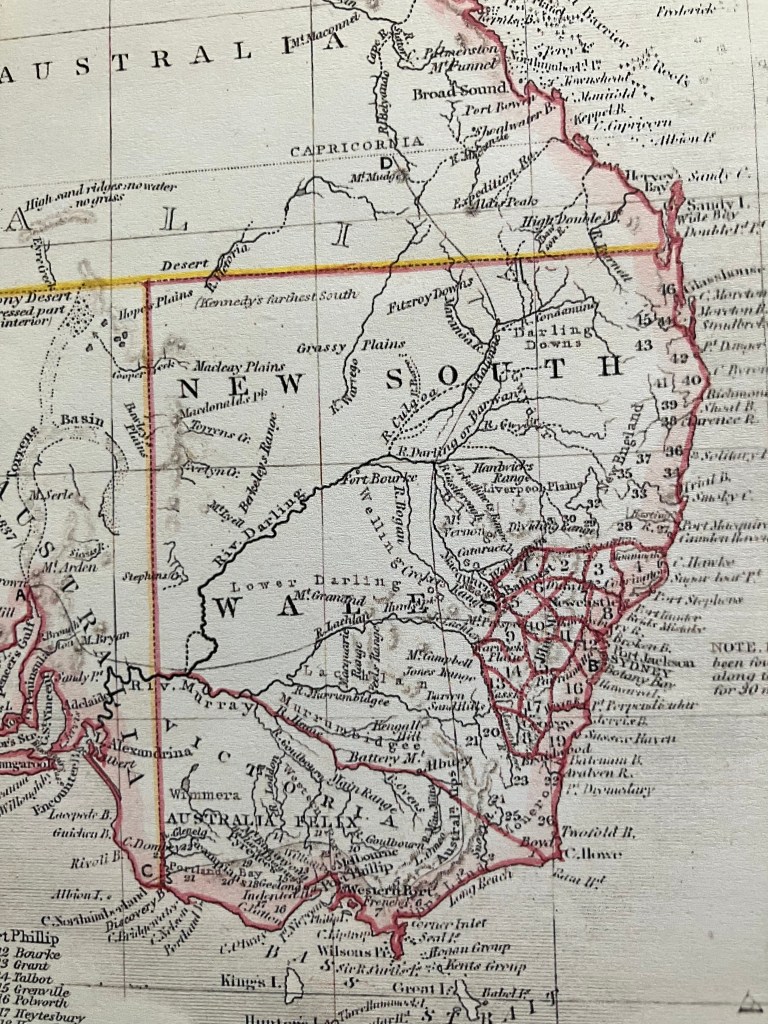
By 1841 it is recorded that Edmund, together with Martha and all 5 children, has left VDL and is now located in the Port Philip Bay colony of New South Wales (now the Australian South Eastern State of Victoria), across the Bass Strait, north of, and almost opposite, Launceston in Northern VDL.
It is not yet discovered when or how Edmund and family made this move (whether Edmund moved first and the others followed, or they all moved together) but they can only have done so by sailing ship, across the Bass Strait, being the direct route between Launceston and Port Philip Bay, and one of the ‘notoriously unpredictable’ although relatively narrow seaways of the world. Hundreds of historic shipwrecks are recorded on the shores of both sides of the Strait.
It is reported Edmund engaged in ‘Depasturing’ in various areas of Port Philip, meaning applying for and receiving Government approval, and paying for the right to graze stock on unfenced Government land for a set period of time (often for one month), that he was also in business with William Booth for a time which he dissolved in 1842 (Booth was the father of Mary Booth who married William Jr the older son of Edmund’s wife Martha in 1841. William Booth and his wife Eleanor had both arrived in New South Wales as convicts). Edmund was at various times through the period 1841 to 1847 the leasehold proprietor of larger government land grazing properties, including at Jan Juc, Steel’s South Beach Station, Indented Head, Steel’s Station Coriyule/Coryule on the Bellarine Peninsular, Point Henry. It is not difficult to believe Edmund was determined, working to a plan, and intent on achieving success as quickly as possible.
1844
In 1844, James the younger son of Edmund’s wife Martha, at age 14 and situated at the time with Martha and others of the family at the Steel’s South Beach Station, was violently and brutally murdered in an encounter with indigenous aboriginals (apparently solely for the want of his clothing and his rifle) while working alone as a shepherd in charge of a flock of grazing sheep. None of the sheep were taken. Older brother William Jr who had been working about a mile distant noticed the sheep were returning and straying into the cattle area of the property. Realising something was wrong, William Jr set out to find younger brother James and eventually found him in the evening, stripped naked, laying face down with multiple body wounds, including a tomahawk blow to the back of the neck which almost severed the head from the body. The indigenous aboriginals are said to have been from the Cape Otway district (westward from the Station). Following this sad event, Edmund is reported to have immediately removed the family from South Beach Station to a safer land holding (presumably to the East) and occupied the South Beach Station himself.
1847
On 13th March 1847 it is reported Edmund, with wife Martha and two children (the youngest two, being Sampson age 9-10, and Martha age 6-7, departed Port Philip Bay on board the ship ‘Bombay’ bound for England as Cabin Class paying passengers. It is not yet discovered, but it seems likely the next two youngest of the VDL 5 children family, James Saunders and Martha Saunders, would have remained in Port Phillip in the care of their now married older brother William Jr Saunders.
1848
On 13th March 1848 it is recorded in the ship’s Passenger log that Edmund, with wife and children Sampson and Martha, and others of Edmund’s Kinbury family (see list following) all as ‘assisted immigrants’, are aboard the ship ‘Adelaide’ returning to Port Philip from London:-
- Sarah
- David
- Edmund++
- Charles
Also on board are separately and individually recorded to be Steel’s:-
- William with wife Mary, and children George age 10, Elizabeth age 6, Edmund age 4, and an un-named infant girl born on board.
Also on board, separately and individually recorded under Widowers and Widows are Steel’s:-
- Maria Thatcher, and son James age 1 year
Not recorded as being on board Adelaid are two of the Kintbury Steel’s, being:-
- John – he never immigrated to Australia
- Alfred – he did immigrate to Australia, but at a later date
++ Edmond (son of Edmund) after immigrating to Australia on the ‘Adelaide’ is recorded as having eventually journeyed to California to join the gold rush, and thereafter appears to have returned to England.
In the Passenger lists the ages of Edmund and Martha are recorded as being younger than they really were (Edmund as 50 – when actually 59 / Martha as 45 – when actually 54), presumably to enable them to travel at Government expense as ‘Assisted Immigrants’ – (had to be not older than 50 to qualify), as were the other members of the family group, but later in the voyage they are recorded as having paid the real value of their passage (presumably their subterfuge was ‘discovered’ somehow?, or their moral sense prevailed?). They all landed at Port Philip on 22nd June 1848.
It is not yet discovered what activity each of the now extended family engaged in following their arrival in Port Philip, or how separated the family became in order for the older members to gain employment, but it is likely that the younger children would have remained with Edmund and Martha, or at least with Martha.
1851
It is recorded that Martha died on 1st June 1851, age 51, at Timboon (now known as Camperdown, in Victoria). It is not yet discovered how Martha died, or which children she had with her. Her occupation on the death certificate is described as ‘overseer’. It is not yet discovered where Edmund was at the time of Martha’s death. Timboon at that time was a large and ‘newish’ agricultural district, with property owners of names that crop up regularly in the early 1841-47 years of Edmund and Matha’s start in Port Philip, so it is very possible both Edmund and Martha were both working in the same Timboon district, probably as employees of people they had previously known before 1847, rather than property owners or lease owner employers.
Martha is buried in the Eastern Cemetery, Geelong, Victoria, Australia. The gravestone is marked with her surname as Saunders not as Steel. Sharing the grave plot with Martha are her youngest Saunders child James, his older brother William jr, and Mary the wife of William jr.
1863
It is recorded on 6th January 1863, Martha the youngest of the children produced by Edmund and Martha is married to Samuel McWilliam, at Geelong, Victoria, Australia. Martha subsequently becomes the Matriach of the (Australian) McWilliam Family, and from this event comes the beginning of the Australian (Iconic) McWilliam Winery, which continues strongly to this day.
1865
On 22nd June 1865 the Death of Edmund is recorded, at Richmond, Victoria. The death certificate records the death causes as Exhaustion, Old Age, and Senile Gangrene – medical dictionary interpretation: ‘(medicine, archaic) A form of gangrene occurring particularly in old people, and usually caused by insufficient blood supply due to degeneration of the walls of the smaller arteries’. To me it reads as though Edmund never stopped working.
The Certificate address of Edmund is given as Chapel Street, Richmond, Victoria. The address of the ‘informant’ (of the information about Edmund) is Emma Tilbury who describes herself as a ‘friend’, and giving the same address There is no information on the death certificate, or yet discovered, as to whether there may have been some of Edmund’s ‘children’ with him at the time of death. The Chapel Street accommodation detail is yet to be discovered.
Edmund is buried in Church of England – section ‘S’, grave #197, Melbourne General Cemetery, Victoria, Australia. Buried in the same grave plot with Edmund are:-
- Sarah Maria Raymond – (not researched – a grand daughter to Edmund?)
- Maria Thatcher – daughter
- Sarah – daughter
Sketch Summation
I am very proud to be one of the 3 x Great Grandchildren of EDMUND STEEL, who I discovered by accident while researching the ancestry of my late Mother. Until then I had not knowingly heard of Edmund Steel, although I can, in hindsight, recall as a child at festive gatherings of my extended family, the adults sometimes reminiscing over an ale or two, and (obviously intentional) mention of the name STEEL bringing guffawing and pointed gesturing toward my mother and her sister, being both 2 x GG children of Edmund, their lineage to Edmund being via his son Charles.
Clearly Edmund was not a ‘bad’ man. Post his arrest during the Swing riots everything discovered about his recorded life would suggest in fact that he was an honest hardworking man, devoted to his original family, and to his second family. In hindsight, I suggest Edmund was likely to have been a very poor, very frustrated parent with great concern for the future welfare of his large family before and during 1830-31, and his participation in the Swing Riots was at worst a ‘poor decision’, and probably totally influenced by ‘need’, and not by greed.
It could even be hypothesised that Edmund was in fact a ‘lucky’ man, in the sense that it is likely his Swing Riots arrest was a fortunate turning point in Edmund’s life, evidenced by the sentence, originally for DEATH but ‘luckily’ commuted to TRANSPORT FOR LIFE, and the later ‘lucky’ granting of a FREE PARDON, removed him from the rather hapless age old daily dire existence of a life of day to day struggle to exist for farm labourers in Berkshire in the 1830’s, more so for those with large families such as Edmund’s, and placed him in a vastly different life in ‘new’ VDL, where ‘luck’ placed him with Robert Taylor and his Family of devout Presbyterians, possibly able to earn some modest income (although it was ‘illegal’ for assigned convicts to be paid anything by their employers, it is reported that it was not unknown for some employers to recompense their assigned convict with cash or goods), and importantly allowed him at last to exercise his intuition and learn valuable skills in animal husbandry and possibly some business management, then ‘luckily’ to finally find and marry Martha, create a new family with her, and together relocate to Port Philip where they could put their combined skills of animal husbandry and business management to good advantage, ‘luckily’ earning sufficient for them to both return to England and recover Edmund’s original eight (adult) children.
It is clear to me that as early as 1834 when Edmund applied for permission for first wife Maria and her children to join Edmund in VDL, he had realised there was an opportunity for a better life for his entire family in VDL than in Berkshire and he wanted for them to all share in that opportunity, even though at that time of 1834 he was still a Transport for Life Convict, meaning he could never personally return to England for any reason, ever, and of course, he had no inkling that he would gain a Free Pardon in 1837.
Of course there was real tragedy for Edmund, and for his original family, and his subsequent ‘second family’ throughout this entire journey, but they all prevailed, seemingly (to me) by commonalities of Personal Endurance, Perseverance, and Love, most of which are directly attributable to EDMUND.
Through his life journey Edmund produced 13 Children and (adopted?) another 3.
Following is the known birth – death record of the entire family of Edmund in age order:-
Edmund Steel 1789 – 1865 (Age approx. 76 years)
Maria (nee Thatcher) wife (approx.) 1788 – 1845 (Age approx. 57 years)
Married 1811
Children (11) of Edmund with Maria:
John (approx.) 4 July 1812, Newbury, Berkshire, England – 11 June 1896, Oakham House, Twickenham, Middlesex, England (Age approx. 83 years)
Mary Anne (approx.) 7 Nov 1813, Swallowfield, Berkshire, England (no death record discovered – suspected infant or child death – tallies with ‘eight children’ records)
William 15 Jan 1814, Newbury, Berkshire, England – 10 Jul 1894, Mount Beppo, Queensland, (Age 80 years)
Maria Thatcher (approx.) 25 Oct 1816, Kintbury, West Berkshire, England – 18 Jan 1877, Chapel Street, Richmond, Victoria, (Age approx. 60 years)
Sarah (approx.) 8 Jun 1817, Berkshire, England – Before 11 Mar 1821 (Age approx. 3 years – tallies with ‘eight children’ records)
Alfred (approx.) 25 Apr 1819, Oare, Berkshire, England – 23 Aug 1894, Newtown, New South Wales, Australia (Age approx. 75 years)
Sarah (approx.) 11 Mar 1821, Chieveley, Berkshire, England – 1880, Victoria, Australia (Age approx. 58 years)
David (approx.) 18 May 1823, Avington, Berkshire, England – 1881,Geelong, Victoria, Australia (Age approx. 57 years)
Edmund 31 Jul 1825, Kintbury, West Berkshire, England – Bef 1865, Kintbury, West Berkshire, England (Age approx. 39 years)
Mary Thatcher (approx.) 9 Mar 1828, Kintbury, West Berkshire, England – (no death record discovered – suspected infant or child death – tallies with ‘eight children’ records)
Charles (approx.) 31 May 1829, Kintbury, West Berkshire, England – 1890, Footscray, Victoria, Australia (Age approx. 60 years)
Following is the known birth – death record of the entire family of Edmund with Martha in age order:-
Edmund Steel 1789 – 1865 (Age approx. 76 years)
Martha (nee Pulsford / Saunders) Wife approx. 1794 – 1851 (Age approx. 48 years)
Married 1837
Children (3) of Martha with William Saunders:-
William Jr Saunders 1820 – 1896
James Saunders 1829 – 1844
Emily Saunders 1832 -1918
Children (2) of Martha with Edmund Steel:-
Sampson (sometimes Samuel?) Steel 1838 VDL / Tasmania (known to be alive 1848 following return from England with Edmund, Martha, and original family members, but nothing yet discovered after that time)
Martha 1841 VDL / Tasmania – 1889 Gelong, Victoria, Australia (age 48)
REFERENCES:
The sources accessed and utilised in the preparation of this sketch include (in no special order):-
- Norman Fox’s book ‘Berkshire to Botany Bay’
- Hungerford Virtual Museum
- Berkshire Family History Society
- Berkshire Overseers Papers (CD)
- Bellarine History Society
- Portphilippioneersgroup.org.au
- Various Government Gazettes
- Various Convict / Convict Transportation Registers
- Trove
- we4kings website
- black-sheep-search.co.uk
- anu.edu.au/biography/george taylor
- Wikitionary
- Thesis of Bruce Brown Uni Tas 2004
- Thesis of Rebecca Rose Read Uni Tas 2019
- Various other thesis documents and books in the public domain ex web browsing, and other on-line research sites, the details of which I lost with a catastrophic computer failure and not backed up! (Lesson now Learned!!)
My sincere apology for any source I have inadvertently overlooked in this schedule.
I accept responsibility and apologise for any errors in fact that may have occurred in my misunderstanding of researched information, or in my transposing of information.
David Hutchinson (Octogenarian)
Perth, Western Australia. February, 2024
 Kintbury and Beyond