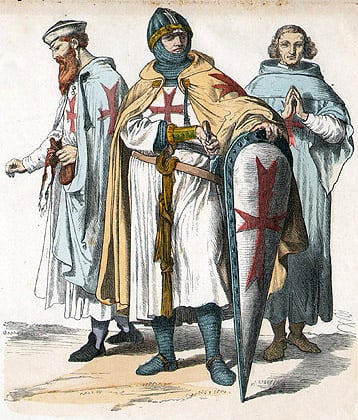
This enduring picture book image most likely has its origins in an actual medieval Christian military and religious order known as “The Poor Knights of the Temple of King Solomon”, or more familiarly, the Knights Templar. Originally founded to protect Christians on pilgrimages to Jerusalem, they followed the austere Rule of Templars which restricted, amongst other things, the eating of meat to three days a week and an insistence upon wearing only plain clothing.
The Knights were recognised by the Pope in 1129 and were supported by rulers throughout Europe such that they eventually became very wealthy, owning property in many countries.
However, after coming into disrepute, the Order was eventually dissolved in the early fourteenth century and its lands given to the Order of the Hospital of St John.
So what is their link with the hamlet of Templeton, between Kintbury and Inkpen? It is believed that, as its modern name implies, this was once the site of a house belonging to the Knights Templar and then subsequently to the Knights Hospitallers of St John. Although it is difficult to find out very much about the early history of the settlement, the online archives of the Newbury Weekly News and the Reading Mercury have some interesting reports from 1884 concerning archaeological finds there.
In the early 1880s, Templeton Manor belonged to the Dunn family. They were having an extension built and the architect for the work just happened to be Newbury architect and eminent local historian, Walter Money.
As the workmen were digging a foundation trench in land which had never previously been built upon, three skeletons were discovered at a depth of about eighteen inches. According to the report in the Newbury Weekly News, the remains represented men of “robust form and vigorous physique”, of average stature, about 5 feet 8 inches. Unfortunately, the skulls, which at the time would have been the only way of getting more vital evidence, were missing. This, of course, was in the years before DNA profiling and other scientific techniques which would be able to indicate gender and more about a person’s origins.
According to the report, no coffins were found with the remains, which were “laid in regular order”, head to toe and in east to west orientation.
This discovery must have been of particular interest to architect and enthusiastic local historian Walter Money, who, a few months later, submitted the results of some research to the Reading Mercury.
According to Money’s research, as reported in the Reading Mercury, the manor of Templeton with Walkott (sic) had belonged to the Preceptory of the Knights Hospitallers at Sandford, near Oxford. Then, on 28th December 1543, it was granted by the King, Henry VIII, “upon the possessions of the hospitallers being vested in the Crown, to Richard Brydges Esq of West Shefford and John Knyght Esq of Newbury.”
It is difficult to imagine the area around Kintbury and Inkpen in medieval times. At Balsdon farm, slightly to the south of Templeton, a moat still exists which is believed to have surrounded a thirteenth century manor house but it is otherwise very difficult to picture a landscape in which almost all our modern points of reference are missing – with the exception of our village churches, that is.
Perhaps, some seven hundred or more years ago, Knights Templar, having disembarked their ship at a south coast port, made their way up and over the downs, travelling northwards. Perhaps they carried with them travellers’ tales of Jerusalem, of encounters with Jews and Muslims, of seemingly strange beliefs and perhaps complex new mathematical and scientific ideas previously unheard of in medieval England. Maybe, when they reached Walbury Hill and looked down to the north west, they were relieved to see the familiar sight of Inkpen and Kintbury in the distance and considered themselves to be nearly home.
Tessa Lock September 2023
 Kintbury and Beyond