
Imagine our area over sixteen hundred years ago in the fourth century AD. For three hundred years the country has been ruled as part of the Roman Empire and the local Celtic tribe, the Atrebates, now have a good working relationship with the incomers.
Imagine our area over sixteen hundred years ago in the fourth century AD. For three hundred years the country has been ruled as part of the Roman Empire and the local Celtic tribe, the Atrebates, now have a good working relationship with the incomers.
The regional centre is at Calleva Atrebatum (modern Silchester) – a town in the traditional Roman style but with a name reflecting the presence of the Iron Age people who were here first. Out here to the west, our area is close to the main route from Calleva to Aquae Sulis (modern day Bath) where the hot springs are an attraction to visitors. The route passes through the settlement of Spinis, which today we know as Speen.
For those living closer to this major road, the ranks of Roman soldiers, their helmets and shields glistening in the pale sunlight, have been a familiar sight. The men are not all from Rome, of course – far from it. The Roman army recruit from all over the Empire – across Europe and even North Africa. Sometimes local men from the indigenous Celtic tribes have signed up too, attracted to the idea of gaining Roman citizenship with all its advantages if you were able to complete a long period of military service, as well as the chance to travel and see the world.
Those who have travelled beyond our valley, or have spoken to others who have done so, speak of towns where the buildings are of stone with heating actually under the floor, where there is drainage and streets paved so that you are not deep in mud as soon as you leave your dwelling. This is the Roman way, and it all sounds very attractive and modern.
Indeed, some local people are wanting a piece of this new, improved lifestyle for themselves. There has been talk of local, Celtic women who have, despite family opposition, married young Roman men. Perhaps they have been attracted by the striking uniform or the offer of a more comfortable home. Who knows. But you do not have to marry into a Roman family to adopt this new way of living. Wealthier Celts have been increasingly adopting Roman ways.
Although there were no major Roman towns in our immediate area, we know that those who were influenced by Roman ways did live in our valley. These people may have been exclusively of Roman descent, although it is more likely that they were Romano-British and therefore of possible mixed heritage or of Celtic descent but influenced by Roman ways.
Between 1950 and 1951, a teacher from St Barts Grammar School, Douglas Connah, led an excavation of a site which had been uncovered following work at the sewage works to the east of Kintbury. The excavation revealed the rectangular ground plan of a fourth century bath house, unfortunately badly damaged by ploughing and robbing out of much of its stone.
The building measured 5.25m by 4.04m with an extension to the south. At the east end was evidence of a praefurium, or furnace, to facilitate heating via a hypocaust which had been cut into the natural chalk and was still, at the time of the excavation, covered by a layer of wood ash. The building had been constructed of large flints and the lower courses of sarsen stone.
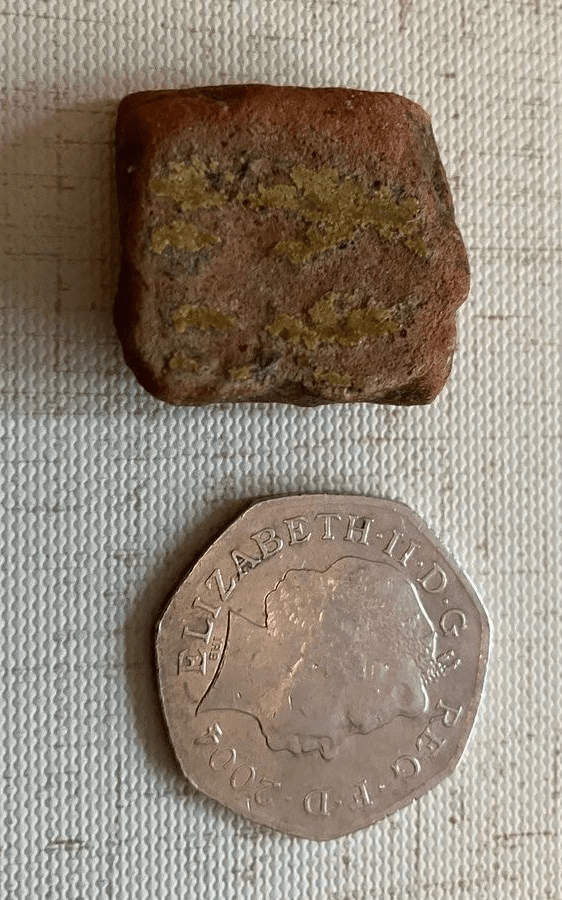
Painted plaster remains, now in West Berks Museum, indicated that the walls of the building were originally decorated whilst several tesserae suggested that there had once been a mosaic floor. It was possible to date the building to the fourth century due to pottery and a fibula brooch found in a rubbish pit nearby.
Although the bath house, as excavated, appeared not to have been joined to another building, it would not have been built in isolation but as part of a villa complex. It could have been on the site of a prosperous farm or indeed at the centre of a large estate. We may never know. But it is clear that sixteen hundred years ago, someone from around here wanted to build a modern, fashionable house with the latest in painted walls and mosaic flooring, and, of course, central heating.
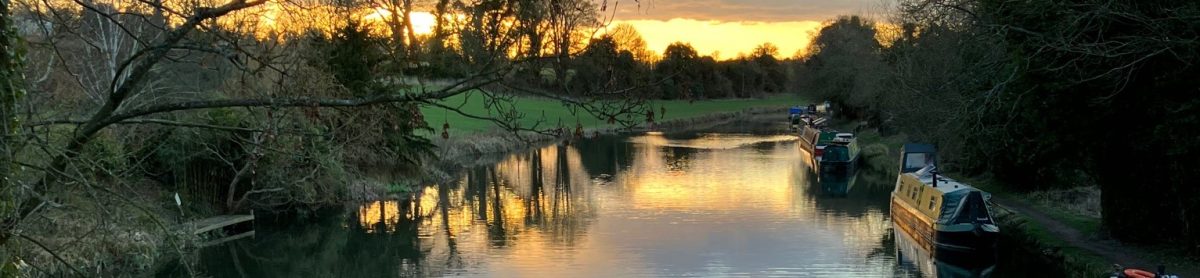
It is sad for us that the remains of the accompanying villa have long been destroyed, most likely when the canal was constructed in the early 19th century. What happened to the broken remains of the roof tiles, the wall plaster, the tesserae? Who knows, keeping a sharp eye open when you’re walking towards Hamstead Marshall from Kintbury, you just might spot something of interest.
Tessa Lock
 Kintbury and Beyond