
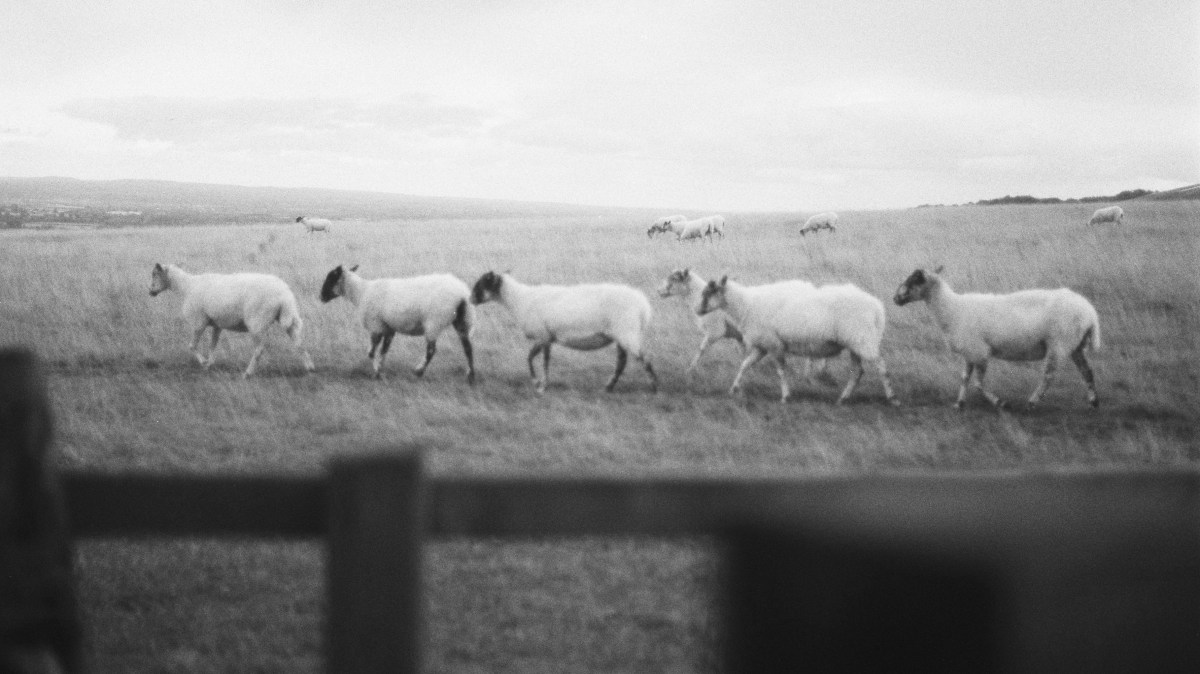
Sheep had been important to English agriculture for hundreds of years, primarily for their wool which was an important export as well as the material from which most clothing was made. Indeed the Lord Chancellor had sat on the “woolsack” – a symbol of the importance of wool to the economy, since the time of Edward III.
By the end of the eighteenth century, the industrial revolution had resulted in a rapid growth of towns and an increasing urban population needing to be fed. Improvements in farming helped meet the challenge and for some wealthier landowners able to experiment with stock breeding and crop growing, agriculture became a new science.
Robert Bakewell of Dishley in Leicestershire was one of the many farmers concerned with a more scientific approach to breeding. In 1760 he had produced a new variation of the traditional Leicester sheep, capable of an increased production of high quality fatty meat, popular at the time. Production of mutton was now of greater importance to the sheep farmer than production of wool.
During the Napoleonic Wars (1805 – 1815), it had not been possible to import Merino wool – used in the production of fine cloth -from Spain. So, partly due to an initiative by “Farmer” George III, Merino sheep were imported into England so that fine wool could be produced domestically.
Throughout the eighteenth and nineteenth century, the preferred method of keeping sheep was by “folding”. This method was particularly popular on poorer chalk soils such as on downland and involved keeping the sheep in relatively small pens constructed of hurdles. The folded sheep would be fed on root crops such as turnips which had been found to improve the condition of the ewes and the ultimate survival of lambs, particularly twins. As they ate, the sheep would also be fertilising the land – important in an age when more specialised fertilisers were as yet unavailable. The pens or “folds” would be moved along the downland at regular intervals, making this an effective way of fertilizing the soil but a very time consuming one.
By the early nineteenth century, more breeders were moving away from keeping sheep traditional to their particular area. Kintbury’s Rev Fulwar Craven Fowle was one such who chose the faster maturing New Leicester breed which he kept on his land at East Woodhay, just over the border in Hampshire.
In 1820, Rev Fowle was admitted to the Hampshire Agricultural Society, an association of the land owning classes which included the nephew of his friends Jane & Cassandra Austen: one Edward Knight junior Esq of Chawton House.
South Downs and Merinos were the breeds of sheep usually seen at the Hampshire show at this time. However, in June 1820, Rev Fowle exhibited a pen of Leicesters – the very first time this new breed had been seen there. According to the report in the Hampshire Chronicle, they “excited much attention” and were admired for their, “weight, symmetry, smallness of bone and lightness of offal.”
Rev Fowle was praised for his husbandry. The appearance of his animals, “reflected the highest credit on the management of Mr Fowle.”
Regarding feeding, “their actual state of maturity was attained without the assistance of either corn or cake, sliced Swedish turnips having constituted their sole food…”
This was a time when the potential weight of an animal counted more than most other features so it was decided to conduct an experiment comparing Fowle’s New Leicesters with Merino sheep belonging to Mr Simmonds of St Cross. Three three-year-old New Leicesters were to be kept and fed with three three-year-old Merinos and three two-year-olds of each breed were to be folded together.
When the results were compared the following year, the three- year- old Leicesters had shown a greater increase in weight than the Merinos although the two-year-old Merinos had shown the superior increase. A similar experiment concluding in 1822 showed the advantage to favour the New Leicesters.
Although Rev Fowle is praised for his husbandry, the reality was most likely that a shepherd in East Woodhay was the one responsible for the day-to-day care of the New Leicesters. As always, the working people who supported the upper and landed classes passed through history almost totally unrecorded, particularly in the years before census returns. So here’s to that unknown shepherd.
The working people, however, were not the ones able to instigate change even though it was their hard graft that saw it through. There are some well-known names from amongst the landed and upper classes who experimented and contributed to improvements in agriculture from the eighteenth century onwards. In this area, Jethro Tull (1674 – 1741 ) who farmed at Prosperous, near Hungerford is probably the best well-known. However, the contributions from the less well-known such as Rev Fowle, competing with their contemporaries in local agricultural societies, would also have played their part in the agricultural revolution.
Theresa Lock, June 2023
Sources:
- Hampshire Chronicle, British Newspaper Archive (on line)
- “On the sheep’s back” : The rise and fall of English Wool by Richard Martin. (cotswoldwoollenweavers.co.uk)
 Kintbury and Beyond