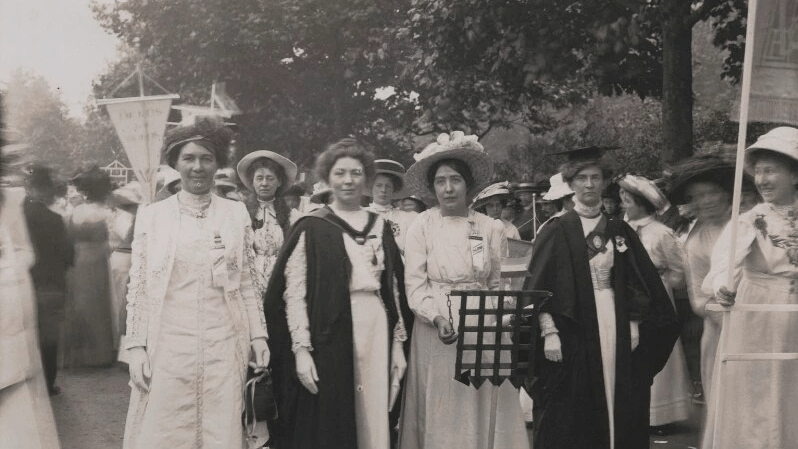
Image: Suffragette March in Hyde Park, by Christina Broom. Cream-toned velox print, 23 July 1910
4 1/2 in. x 5 5/8 in. in. (113 mm x 144 mm), given by Winifred Margaret Broom, 1940, Photographs Collection, NPG x17396 © National Portrait Gallery, London.
The early 20th century was a time when access to education and onwards to the professions was denied the great majority of young women for whom a position in the household of a wealthy family might have seemed the only employment option. For a significant minority, however, there were alternatives to domestic servitude.
In the nineteenth and early twentieth century, Kelly’s Directories published lists of gentry, landowners, charities and those employed in commerce for every town and village throughout England. Listed under “Commercial” in the 1903 edition for Berkshire, Kelly’s Directory records 64 names in Kintbury, 33 in Inkpen, 17 in Enborne, 11 in Hamstead Marshall and 1 in Combe. But of the grand total of 130 people involved in “commerce” across what is now our benefice, only 13 are women.
In Kintbury, Mrs Maria Abraham and Mrs Ann Bance are both listed as bakers while Mrs Harriet Penny is a butcher. Mrs Eliza Peck is a shopkeeper and Mrs Elizabeth Taylor is a beer retailer, presumably running a pub. In Inkpen, Mrs William Killick is a grocer. It is likely, I think, that most of these women, if not all, are widows continuing with the businesses previously run by their husbands.
The same would appear to be true for the two carriers listed by Kelly’s: Mrs Emma May in Inkpen and Mrs James Miles in Hamstead Marshall are both continuing with businesses recorded in the 1901 census as having been run by their husbands. Of course, it may well have been that the women had long helped their spouses run the family business, but this would not have been recorded by the census enumerator.
Women had been employed by the Post Office nationally since the 1870s, where they could sort the mail and operate the telegraph system. In Inkpen, the Post Office at Upper Green was run by Miss Matilda Goodfellow Froom and in Kintbury by Mrs Emma Page who is also listed as a stationer. Although the smallest village, even then, Combe has its own post office, which is run by Miss Rose M. Salt.
Two women to have control of what must have been larger businesses are Mrs John Goddard of Hamstead Marshall and Mrs Mary Jane Dymond of Inkpen who are both listed by Kelly’s as farmers.
According to the 1881 census, John Goddard was farming 67 acres. In Hamstead Marshall. By 1891, his son, Richard was also working on the farm. However, John died in 1894 and by the census of 1901 Martha, John’s widow, is recorded herself as farmer with Richard employed by her.
It is a similar story over in Inkpen where Mary Jane Dymond had been running her 30 acre farm for over twenty years since the death of her husband John.
It would be easy to presume that these women must have had equal status with the men running similar businesses close by. Surely Eliza Peck or Maria Abraham’s experience of running their shops would have been largely similar to that of the male shopkeepers further down the road? Would life on a farm have been so very much different for Mary Jane Dymond or Martha Goddard when compared to farms run by men?
Apart from everyday sexism expressed in such phrases as , “the weaker sex” and “a woman’s place is in the home” and so on, the perceived inferior status of women was enshrined in certain laws. For example, whilst many women would have controlled a business budget, they would not have been able to open a bank account in their own names or apply for a loan.
However, for Mary Jane Dymond, Martha Goddard and the rest, the position of women in society was changing – but very, very slowly. The 1882 Married Women’s Property Act had enabled women to own and control property in their own right although it was not until 1922 that the Law of Property Act gave men and women equal rights to inherit property from each other.
Women ratepayers – that is to say, women who owned or rented property – had been able to vote in borough and county elections since 1888. So most, if not all, of the women in business in 1903 would have been able to vote for their local councillors although as women there were not able to stand for election themselves. Women – and many poorer men- were still unable to vote in parliamentary elections.
In 1902, textile workers in the north of England had presented a petition to parliament demanding votes for women and 1903 saw the formation, at the home of Mrs Emmeline Pankhurst in Manchester, of the Women’s Social & Political Union, a campaigning group concerned with extending the franchise to women. It is likely that both these events passed by even the most avid newspaper-reading folk of West Berkshire – however, news of the burgeoning women’s suffrage movement would gradually appear in the pages of the Newbury Weekly News.
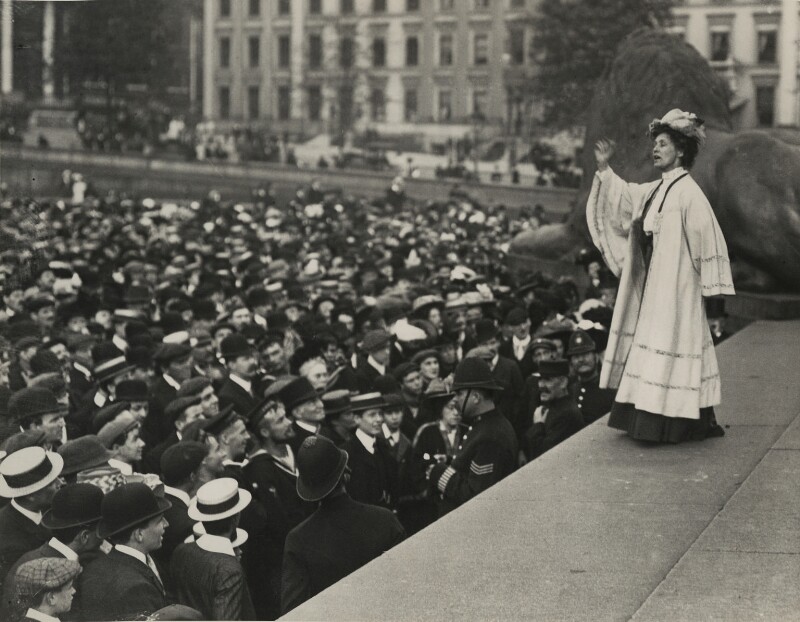
© National Portrait Gallery, London
The NWN of March 31st 1904 reported that the local Women’s Liberal Association held a packed meeting at which Mr Richard Heldene MP spoke on the subject of women’s suffrage. In 1906 members of the same association listened to an address given by Mrs Eva McLaren, “in favour of political rights for women”.
It seems that the issue of women’s suffrage had not always been taken seriously. On 21st March 1907, the NWN carried a report of a debate in Reading at which Mr Mackarness, MP for South Berkshire had spoken. According to the report,
…there was a great deal of joking on the subject but for his part he always looked on it from a common sense point of view… They had given women votes in all local affairs therefore he could not quite see upon what line of argument … they were to refuse them a vote in Parliamentary matters.
Whilst the NWN was happy to report objectively on debates or speeches in favour of women’s suffrage, this seems not to have been the case when covering the actions of more militant campaigners such as the members of the WSPU. On 28th March, 1907, it reported,
The women suffragists made another scandalous disturbance on Wednesday in avowed attempts to enter the House of Commons.
But it would seem that not everyone in the area agreed that the tactics employed by the more militant suffragettes ( as they were eventually known to distinguish them for the more peaceful suffragists ) were “scandalous”.
In November 1909, the newspaper of the WSPU, “Votes for Women” reported that a Miss Keevil, “is speaking at two meetings in Newbury. Sympathizers there are very anxious to hear about militant methods.”
In June 1911, the same newspaper reported that there were to be outdoor demonstrations in Reading, Newbury and Basingstoke, and that the Newbury & Reading contingent would march under a banner bearing the words, “Pro aris et foris”. A Miss Daukes of Newbury would be acting as sergeant, the newspaper reported. The WSPU was nothing if not well organised and this was expressed in the use of such military language.
“Votes for Women” was eventually replaced by a new newspaper representing the WSPU campaign, The Suffragette. Copies were sold in Newbury Market Place and reports included the successful, “At Home” held by Newbury’s Mrs Whittington and a meeting held at the Guildhall Hotel, Mansion House Street. The campaign for women’s suffrage had definitely come to town.
Nationally, Emmeline Pankhurst’s WSPU involved women from all social classes at all levels of the organisation. However, it must have been far easier for women of comfortable financial means and less demands upon their time to participate in local campaigning. Marian Daukes, Hon Sec of the Newbury WSPU branch, was the daughter of an architect and lived during the early 1900s at a house called Diglis on the Andover Road. At the time of the 1891 census she had been living on independent means in Surrey which suggests that she was most likely of the class of women able to spend their time as they chose. To working women such as Mary Jane Dymond and Martha Goddard, or Maria Abraham and Ann Bance, Marian’s life would have seemed a world away from theirs. It is impossible to know if these women from the villages ever saw a copy of The Suffragette, sold in Newbury Market Place. We do not know what they would have thought, had they read anything in the NWN of the campaign for women’s suffrage – I think it likely that some would have ignored it, others would have been appalled at the more disruptive or militant campaigns, whilst others may well have approved – but possibly secretly.
The 1907 Qualification of Women Act allowed women to be elected as borough and county councillors, also as mayor. Thus women were able to participate in local decision making for the first time. In Newbury, it was not until 1922 that Elsie Kimber was elected the town’s first female councillor. Elsie went on to become the first female mayor in 1932 and first woman Alderman in 1943.
The Representation of the People Act of 1918 granted the right to vote to all men over 21 but only to women over 30 who owned or rented property with a yearly value of at least £5, or to be married to a man who qualified to vote in local government elections. For many women who had run businesses or taken the places of men in agriculture or other industries during the 1914 to 1918 war, this must have been a bitter disappointment. For the many women still employed in domestic service, their position in the eyes of the law had changed very little.
In May 1919, political discussion came to Kintbury when a meeting of the Kintbury Branch of the South Berks Women’s Unionist Association, an organisation of the Conservative party, was held in the Coronation Hall. In attendance were many well known ladies of the village including Mrs Dunn and Mrs A.E. Gladstone. One speaker, the Hon Ethel Akers-Douglas spoke of the urgent need for self education with regards to politics. Another, Mrs W.A. Mount, wife of the local Member of Parliament, spoke of the “threat” of a Labour candidate in the constituency at the next general election. She explained the party’s intentions to see the conditions of the working men improved, however, “when people said there could be full equality, it was their duty to point out that such a state of things was absolutely impossible.”
Such was the mind-set of many at the time, although we do not know how many of the women running shops or businesses, particularly on behalf of men killed or disabled in the war, would have agreed with her. I wonder what Elsie Kimber, at her family’s shop in Newbury, would have thought.
Women were not granted equal voting rights with men until 1928. The first woman to be elected to the Westminster Parliament was Constance Markievicz in 1918, although as a member of Sinn Fein she refused to take her seat and so the distinction of being the first woman to sit in parliament goes to Lady Nancy Astor who won the Plymouth Sutton seat in 1919.
Emmeline Pankhurst believed that, once women achieved parliamentary representation, it would follow that other legislation to benefit the lives of women would soon be enacted. I think she would have been shocked to know just how long it took for women to achieve equality with men in so many areas. Back in 1903, Mary Jane Dymond would have been unable to open a bank account independently. This situation did not change until the 1960s and it was not until the 1970s that a woman could apply for a loan without having her application endorsed by a man – literally any man. Similarly, the Equal Pay Act did not come into law until 1970 before which it was quite legal for businesses, including high street banks, for example, to offer career prospects to young men with salaries higher than those offered to similarly qualified young women.
I believe Marian Daukes and her fellow WSPU supporters in Newbury would be disappointed – or even incredulous – that by the 2019 parliamentary election, out of 650 seats only 220 were filled by women. Similarly, although the position of women in society has changed in many ways that would surprise a Mary Jane Dymond or Martha Goddard, many businesses still have only male names over the door or in trade directories. Further more, to see the words, “And daughter” on a commercial vehicle is still very, very rare. So much has changed, but then, so much has remained the same.
Theresa Lock, July 2023
Acknowledgements:
Photographs in this article have been reproduced under creative commons licence: http://creativecommons.org/licenses/by-nc-nd/3.0/
 Kintbury and Beyond