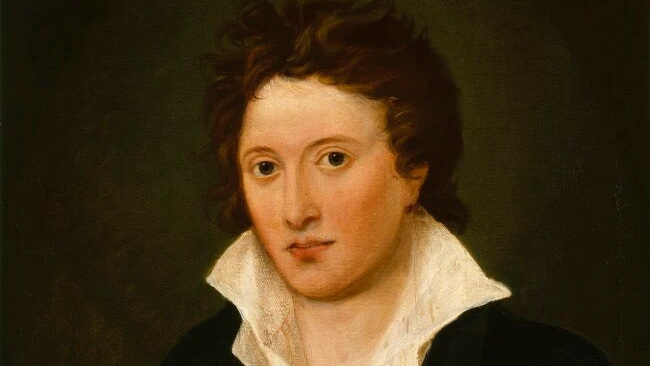
Percy Bysshe Shelley by Amelia Curran, oil on canvas, 1819, NPG 1234 © National Portrait Gallery, London
Timothy and Elizabeth had married in 1791 and made their family home at Field Place, Warnham, Sussex. They had six children: Percy, b. 1792, Elizabeth b. 1794, Mary, b. 1797, Helen b. 1799, Margaret, 1801 and John, b. 1806.
It was the two youngest daughters, Helen and Margaret, who were to live for over twenty years at Elcot. They are recorded on the 1851 census where Helen, as head of the household, is described as “Landed Proprietor”, and again in 1861 and 1871. In 1871, Helen and Margaret are described as, “Baronet’s Daughters” – a reminder that this was an age when it was quite usual for an unmarried woman to be defined in terms of who or what her father was.
A perusal of the newspaper archives suggests that Helen and Margaret Shelley led quiet, conventional lives typical of their class at the time. They were present at society weddings, made contributions to charitable causes such as the Patriotic Fund and the Royal Berks Lifeboat Fund and attended, along with many others of the great and good of West Berkshire, the prize giving ceremony to members of the Berkshire Rifles. Their life style, as far as can be seen, was respectful and would have raised few eyebrows amongst those who knew them.
This is in stark contrast to their elder brother, Percy.
Percy was seven when Helen was born. By the time she was four he had become a pupil at Eton, although his time there was not happy as he was bullied. He gained a reputation for having a violent temper and also an interest in gunpowder and blowing things up. Despite this, Percy seems to have been academically successful.
Helen was ten when her big brother went up to University College, Oxford in 1810. Here he preferred reading and conducting scientific experiments to attending lectures. He also held radical and anti-Christian views and as a consequence would have been regarded as suspicious at the time by those who feared the destabilizing consequences of the revolution in France might spread across the channel. Percy was expelled from Oxford in 1811 as a consequence of publishing a pamphlet called, The Necessity of Atheism which he distributed to members of the church hierarchy and to Oxford tutors. This did not go down well with Sir Timothy and a rift developed between father and son.
In a continuing defiance of convention, Percy, now 19, eloped to Edinburgh with Harriet Westbrook, a friend of his sisters.
For a time Percy and Harriet shared their household with Harriet’s sister, Eliza and another friend in a communal arrangement more like that which we might now associate with alternative living of the 60s and 70s. However, these relationships did not endure and in 1814 Percy fell in love with Mary Godwin, the sixteen year old daughter of philosopher William Godwin and Mary Wollstonecraft, the early feminist and author of A Vindication of the Rights of Women.
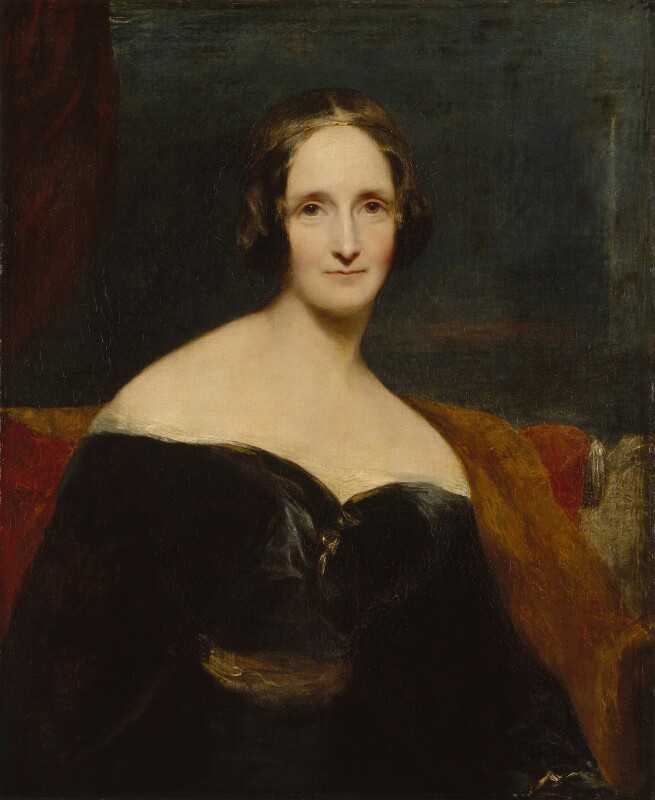
© National Portrait Gallery, London
If Helen and Margaret Shelley could be said to have led a quiet and conventional life at Elcot in the 1850s and 60s, their elder brother’s life and loves during the earlier years of the century was nothing like it. What Helen and Margaret, then in their teens, would have made of Percy’s unconventional and increasingly complex relationships coupled with his radical religious and political views, we can only wonder. Harriet, now estranged from Percy, drowned herself in the Serpentine in 1816. Despite having philosophical objections to marriage as an institution, Percy married Mary although his living arrangements and personal relationships continued to be unconventional and complex.
By this time, Percy was a successfully published poet, something that must have been a source of pride to his sisters and brother. Much of his work was based around his response to political events, such as The Mask of Anarchy, written in response to the Peterloo massacre of 1819, although it was not actually published until 1832 for fear of libel.
Whilst Percy Shelley continues to be a much respected poet whose works are read and studied to this day, it is probably Mary Shelley’s work that is better known – or at least, the title of her most famous novel is better known, even though most people will not have read the original. In 1818, when she was just eighteen, Mary began working on what was to become one of the most famous gothic horror novels of all time, Frankenstein.
Helen and Mary Shelley were of similar ages and it is interesting to wonder if the sisters-in-law ever met. Mary and Percy travelled extensively through Europe so it is difficult to say if the couple would have ever returned to Field Place. Perhaps Helen and Margaret were proud of their brother the poet whilst at the same time regretting his wayward life style. Would there have been copies of Percy’s poem and Mary’s Frankenstein on the bookshelves at Elcot? We do not know.
Percy Shelley died as a result of a boating accident off the coast of Italy in 1822 and his ashes are buried in Rome.
By the time of the 1881 census, Helen and Margaret are no longer at Elcot, but have returned to the family home of Field Place. It seems, however, that it was not to be for long. Sometime in the 1880s the sisters downsized in their living accommodation, making their home at Queen’s Gardens, Brighton, in an elegant but modest terrace house they named, Elcot House. When Helen died in 1885 they were living in Godstone, Surrey.
Theresa Lock, August 2023
Acknowledgements:
Images in this article have been reproduced under creative commons licence: http://creativecommons.org/licenses/by-nc-nd/3.0/
 Kintbury and Beyond