
So I turned once more to the pages of local newspapers, care of the British Newspaper Archive and found, perhaps surprisingly, that it is quite difficult to find much reporting at all specifically relating to Christmas at the end of the nineteenth century.
Throughout the century, it was usual for local shops and businesses to advertise the arrival of new stock by placing small advertisements in the columns of the Newbury Weekly News. With no illustrations and a minimum of text, a shop would announce that, for example, new winter coats or shoes were in stock. In the weeks closest to Christmas, similarly low-key advertisements announced the arrival of Christmas cards and suitable presents.
By the later .years of the century, it seems to have become a thing for the paper to report on the displays of “Christmas meats” in the windows of various butchers’ shops. But of specifically seasonal parties, events or entertainment, I could find very little evidence. Christmas, it seems, was a much lower-key event.
I narrowed my search to reports from Kintbury and neighbouring villages but once again I found very little to distinguish the Christmas season from any other time of the year in respect of the subject matter covered. That is, with a very few exceptions and these are almost all characterised by being reports of how the wealthier principal families were benevolent to the less well off, and how enthusiastically this benevolence was received by the grateful recipients. One imagines there must have been much forelock tugging.
In January 1888, the Newbury Weekly News reported on a tea having been held at the “Big House” (sic), home of Mr & Mrs Cole of West Woodhay. All the children of the parish attended and there followed a “capital display of fireworks” attended by all parishioners. However, the display was, “allowed to pass off without any exhibition of enthusiasm, owing to the indisposition of Mr Cole, for whose speedy recovery every inhabitant of West Woodhay is most desirous”.
No shouts of “Oooh” or “Ahhh” as rockets went up and burst into colours, presumably.
Afterwards the “usual presents of game and coals were again distributed”, about which I would imagine, the grateful villagers were allowed – probably expected – to look enthusiastic.
The Coles were not the only local family of standing in their village to give to the less well off. In Enborne, Mr K. H. Valpy of Enborne Lodge and in Hamstead Marshall, Mr James Bishop of Hamstead Park both “most generously” gave gifts of clothing and coal to the parishioners of their respective villages. Whilst much is made in the NWN’s reporting of the generosity of certain families, the fact that many other people were quite obviously in need of this kind of charitable giving goes unremarked upon. This, of course, is before the days of the welfare state and a time when dire poverty could lead to admittance to the workhouse.
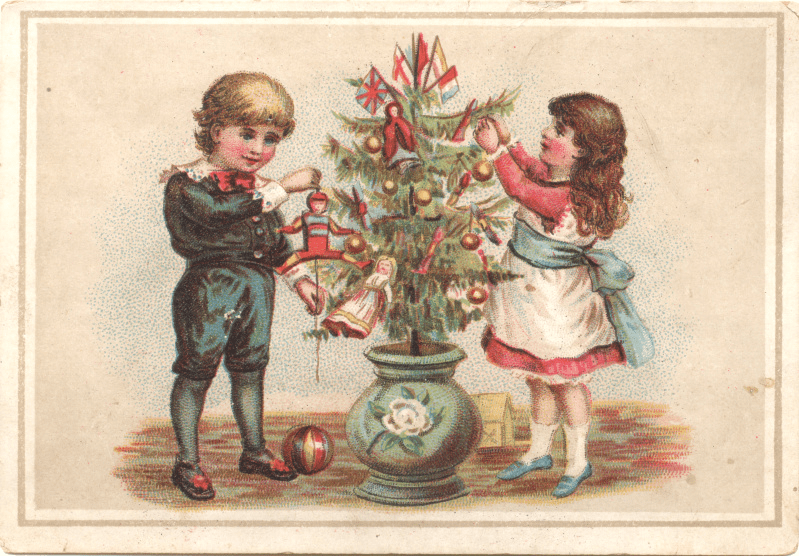
In December 1903, two hundred of the younger children from St Mary’s School, Kintbury and Christ Church School ( between Kintbury and Inkpen) all received “ a printed invitation, enclosed in an envelope” which I think was a rather pleasing touch on the part of Mr and Mrs Whiston of Barrymores, Kintbury. On December 27th, the children enjoyed a, “bountiful spread” after which there was a, “hearty indulgence” in games. “Handsome presents” were given out from a huge Christmas tree for which the children “showed their gratitude by loud and hearty cheers.”
On Boxing Day, 1907, the children attending Christ Church School were given, “a splendid treat” due to the “kindness of Miss Dunn of Wallingtons.” Following “a good tea” a “fine Christmas tree was lighted up, from which each child received a bag of sweets and toys, besides a very useful present in the shape of a garment.”
Bearing in mind that the “lighting up” of the Christmas tree would have involved candles attached to the branches, I think I would have wanted to stand well back as this would have been a fire hazard. I do like the fact that Miss Dunn gave each child sweets and toys as well as a garment, so her idea of a Christmas gift must have seemed much more interesting the young recipients. Accompanying teachers were all given “something useful” whatever that was, and oranges & sweets were in abundance.
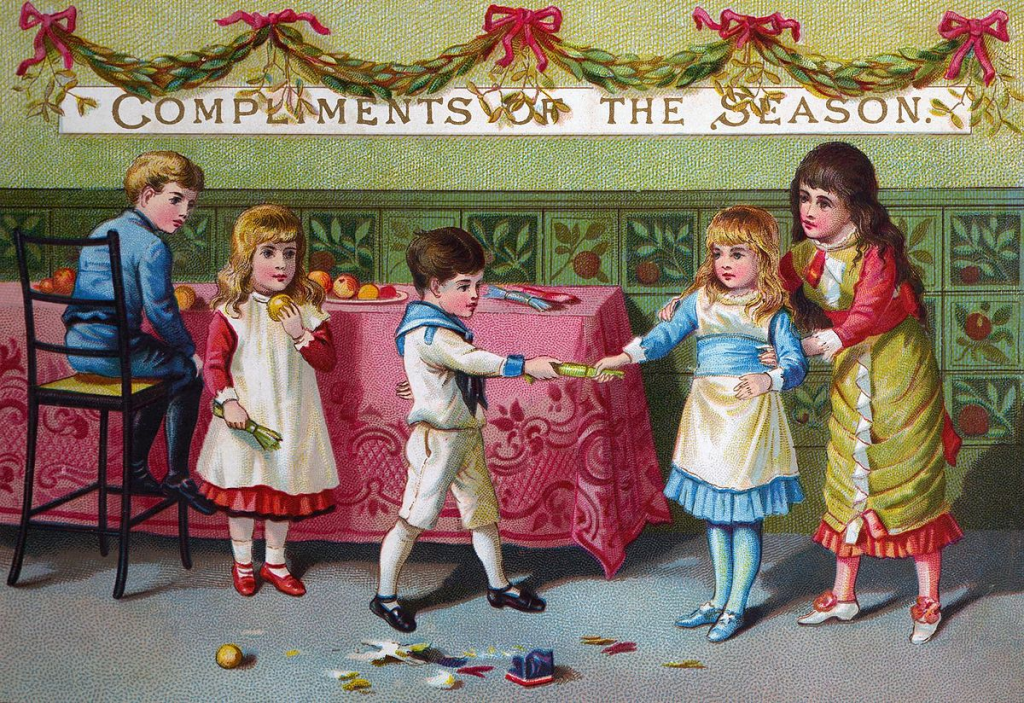
The children heartily cheered Miss Dunn, as, of course, they would have been expected to do so. However, for many children the gift of a toy must have been very welcome, so perhaps the cheering was genuinely heart-felt.
Perhaps, for some better-off villagers, being seen to be charitable was what mattered, to enhance one’s standing in the community. This might not have been the case, but it does make me wonder. According to the NWN of January 1907, a Mr and Miss Hinton had recently taken up residence in the “remote village” of Combe, where they lived at the manor. During Christmas week, the Hintons organised “an unusual treat” in the form of an, “entertainment” which was held at the manor and to which “nearly everyone turned out in the snow”. Most of the entertainment consisted of songs or piano pieces although the audience also enjoyed gramophone selections. For many villagers I expect this would have been the first time they heard recorded music. If there was a Christmas tree, fire works or presents, the Newbury Weekly News report did not mention it.
Reporting styles of the time mean that each account is littered with words such as, “splendid”, “hearty”, “generous” and so on. Social mores of the time meant that poorer villagers were expected to be subservient to the upper or upper middles classes and be appreciative of the charity they bestowed on them. Despite this, however, the Christmas parties, in particular, must have been eagerly anticipated and enjoyed by the children. Gifts of coal, game birds or clothing would have been welcomed by many even if not necessarily living in poverty but on a restricted budget.
I like the sound of Miss Dunn’s party in particular; it seems she took care to give presents that were both practical and fun. Also, it is interesting to note that a legacy of the Dunn family still exists in Kintbury: for well over a hundred years, Mrs Dunn’s Kintbury Charity has given grants to young people of the village.
© Theresa A. Lock 2023
Illustrations: Public domain, Wikimedia Creative Commons
 Kintbury and Beyond