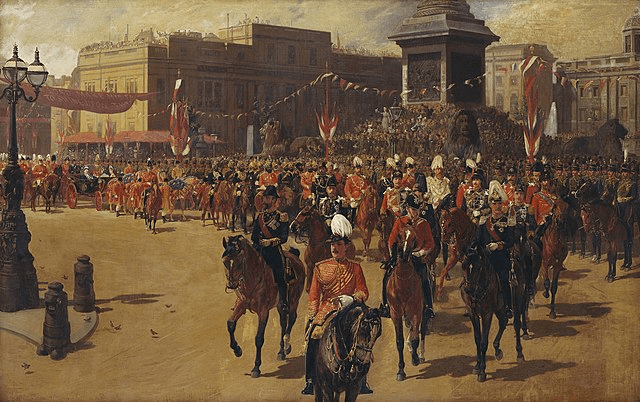
Reports in the Newbury Weekly News covered three local villages: Kintbury, West Woodhay and Combe, although the other villages would certainly have held celebrations. Reading those three reports, what is most interesting, I think, is the way in which events in the two smaller villages are organised – and presumably largely funded – by the families in their respective “big houses” to whom, it is naturally expected, the villagers will demonstrate deference and appreciation.
A church service of thanksgiving was a central to the celebrations in all three villages: at Combe villagers marched behind a banner to St Swithun’s church while St Mary’s, Kintbury flew the Royal Standard and the bells were rung.
Celebrations in the two smaller villages very much revolved around the respective “big houses” with their principal families. At Combe, Mr W.H. Cole gave his workers, game keepers and labourers on the Combe estate a meal “of hot roast beef, mashed potatoes, plum pudding and beer”, all enjoyed on the village green. The villagers, “did not fail to express themselves most grateful”, but then, it would be expected to show appreciation to those you were dependent on for employment. The meal was followed by singing and dancing, “freely indulged in by the village lads and lasses” and – presumably for the men only – the, “fragrant weed, too, liberally supplied by Mr Cole, was thoroughly enjoyed.”
At West Woodhay, celebrations kicked off in sporting vein with a cricket match although presumably this was something to be enjoyed more by the men than the women. The church service was held at a quarter past five after which parishioners proceeded to the home of Mr & Mrs Cole at “the big house” (sic) for hot roast beef and plum pudding which, the report tells us, consumed in a West Woodhay fashion “cannot be beaten.” What “West Woodhay fashion” was, we are left to wonder. The meal was followed by a “Jubilee pipe” and “a good packet of Jubilee tobacco for every man”. If anything special was given to the women of the village, the NWN report does not say. I doubt it was.
The Cole’s son, Mr A.C. Cole, had returned to his parents’ home for the celebration; he gave a speech which was, apparently, well received especially as he had recently been, “in town” where he had been, “viewing Her Majesty in her world-famed procession and at personal inconvenienced had come down to assist in making his father’s servants happy.”
So that was nice.
At 9 o’clock everyone proceeded to “our beacons” to watch bonfires and rockets.
The NWN report of the celebrations in Kintbury illustrate a village which did not revolve around one family in a “big house”, although the report mentions the names of certain influential and benevolent villagers. Celebrations commenced with a peal of church bells at 5 am so an early start was assured whether the good people of Kintbury wanted it or not! The village was decorated with bunting the like of which had never been seen before, apparently, and music was supplied by the Hungerford Town Band.
Kintbury was then, as it is now, a much bigger village than the others and this is reflected in its celebrations. A table covered with a calico cloth was placed in Dr Lidderdale’s meadow, to seat nearly one thousand people – presumably all at once! A meal of roast and boiled beef as well as boiled ham was served, accompanied by hot potatoes and plum pudding, washed down with a pint of beer or two bottles of ginger beer for each person. Somewhere referred to as “the Baths” was loaned by Mrs General Dunn for tea making. It seems no expense was spared and during the meal, children were entertained by one Professor Burssord, allegedly of London, who performed various and amusing tricks with great dexterity.
Sports and music followed the meal and about 450 children enjoyed bread and butter and cake with tea served in a Jubilee mug. I hope they were able to take the mug home with them afterwards!
Those unable to get to the event due to age or infirmity had their dinners delivered to them.
The day concluded in sports at which money prizes could be won.
What became of all that calico used as table cloths? It was later given to the local schools (interestingly, there must have been more than one either in Kintbury or the satellite hamlets) to be made into children’s garments.
Apart from the size of the village – perhaps that should be small town – the big difference between celebrations in Kintbury and the other two villages is that the event in Kintbury did not revolve around the benevolence of one particular family. The NWN report says that the celebrations were enjoyed by, “ all classes, creeds, in all conditions of life” who “evinced a desire not only to participate in the celebration but also to contribute towards the expenditure thereof.” There is no sense in which the people of Kintbury were expected to show gratitude to one particular family; there is no sense of there being forelock tugging or cap doffing to anyone in a Lord of the Manor role. The celebrations were organised – much more democratically – by a committee chaired by Mr W. H. Dunn with the vicar, Rev Edwards as vice chair. Altogether, dozens of other Kintburians contributed to making the day something to remember.
Queen Victorian lived and reigned for a further fourteen years and her Diamond Jubilee was celebrated in 1897. This , however, was a much more low key event throughout the country, perhaps because by now the aged Queen was seen very little in public – I do not know for sure. But I am sure those who celebrated in 1887 would have remembered the roast beef, the hot potatoes, the tobacco and the beer – not forgetting the Jubilee mugs – for a very, very long time!
(C) Theresa A. Lock June 2024
 Kintbury and Beyond