This, the third verse of the still popular hymn, All things bright and beautiful, is never sung today. When the hymn was first published in 1848, it was a prevalent view that God had ordained your position in life and if you were poor, that was because it was God’s will. This view persisted for much of the nineteenth century.
For the poor of Kintbury and the surrounding villages, the only option for those who had lost all means of self- support – through job loss, through unavoidable incapacity or loss of the main bread winner – was to enter the dreaded workhouse.
Conditions in the workhouse were deliberately unpleasant to deter the poor from turning to this very last resort unnecessarily. If people knew they could turn to the workhouse, so the prevailing mind set ran, they would not bother to save against hard times or support other family members in their times of need. And so conditions were harsh, food minimal and the enforced labour hard.
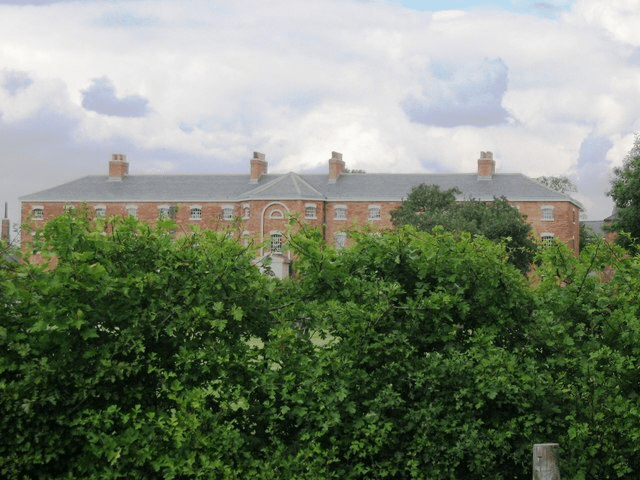
Following the 1834 Poor Law Amendment Act, villages were grouped into unions around a larger town which is why Kintbury’s destitute were housed in Hungerford Union Workhouse in what is now Park Street.
Hungerford Union Workhouse was opened in 1848; it was three storeys high and of the “Stratton” design after the workhouse in Stratton, Wiltshire.
Inmates were set to work picking oakum – that is to say beating with a mallet then unpicking by hand the tar coated hemp fibres that had been twisted into industrial rope. The finished product – the oakum -was used for such things as waterproofing the joints in wooden piping and between the planks of wooden ships. It was hard and unpleasant work and oakum pickers suffered from bleeding hands and heavy scarring as well as other more serious conditions.
According to the 1881 census, there were ten Kintbury people in the Hungerford workhouse at that time. This number included Henry Randall, a 44 year old farm labourer and his wife, Ann, 44.
In 1871, Henry – an agricultural labourer – and Ann had been living in Kintbury with their children William 8, Eliza, 6, Lucy 2 and Mary 2 months. What happened to the family in the following ten years we do not know but by 1881 Henry and Ann are inmates of the Hungerford Workhouse.
The eldest son, William, by now 18, is a ploughboy working – and most likely living – on a farm at Radley, to the north of the Bath Road. However his sister, Eliza, now 16, is in the workhouse with her parents and described as a “scholar” which seems somewhat unusual as at that time a young working class woman of 16 might be expected to have entered domestic service. Also there, is 12 year old Lucy. Mary, who would have been 10 by 1881, is not listed at all so it has to be likely that she has died. Three more children have been born to the Randalls since 1871: Lizzie, now 8, Louisa now 6, and Martha, now 3 and these are all in the workhouse with their parents.
Perhaps the arrival of more children was too much for the Randalls’ household economy or perhaps Henry had lost his job on the farm.
The Randalls of school age are listed on the census as scholars. Although the workhouse originally employed its own teacher, it seems that by 1881 the boys would have walked to the National School in the High Street, to comply, I expect, with Forster’s Education Act which had made universal education compulsory. The girls, however, received instruction from an “industrial trainer” at the workhouse.
There were 26 other children in the workhouse, all separated from their parents. Similarly, the men were separated from the women.
Twenty nine of the inmates are described as servants and twenty seven as labourers or farm labourers
What I find most surprising, however, is that several of the inmates are listed as having had a trade which might have given them a better chance of supporting themselves but clearly this was not the whole story.
One inmate, Mary Elizabeth Felford, born in Marlborough in 1834, is described as a dressmaker. In 1871 she is living in Wantage with her husband, Edmund, a saddler. However by 1881, Mary is a widow and, one presumes, unable to support herself and her two children so her only option is the workhouse. Why Hungerford, we have no way of knowing but perhaps Mary travelled there in the hope of finding more work but it did not work out. I can find absolutely no positive trace of Mary or her children after the 1881 census
John Waterhouse is an 18 year old tailor from Newhaven. Why, despite having a trade, he was an inmate of the dreaded workhouse, it is impossible to say but after 1881 he disappears completely from the census records.
Kintbury’s Charles Garlick is a widowed tailor in 1881. In 1841 he had been living with his mother Mary and 16 year old sister Rosa in Kintbury, where, interestingly, Mary is described as “Ind” usually an abbreviation for “Independent means”, suggesting that she was well off enough to support herself. What had happened in the following forty years it is impossible to find out, and both Rosa and Mary disappear from later censuses.
Jacob Brooks is a retired blacksmith of 55 who had, ten years earlier, been working on a farm and lodging at a cottage in Hungerford Church Street. However, by 1881 he is an inmate of the workhouse, most likely because he is too infirmed or otherwise unable to support himself. The workhouse would have been his only option.
But even sadder is the case of William Vincent, 39 from Little Bedwyn. He is deaf and dumb and, it seems, only appears on the 1881 census.
So what became of Kintbury’s Randall family? By 1891, William – the son who did not accompany his parents into the workhouse – is an agricultural labourer in Hungerford Newtown where his sisters, Lizzie, now 18 and Martha, now 13, are living with him.
Louisa is a servant in the family of Eli Brown at the Queen’s Arms, East Garston.
By 1901, William , Lizzie and Martha are all living with Lucy and her husband, Samuel Harding, a GWR railway worker. They were lucky, I think, to have an in-law who was able to have them lodge with him – it must have made for cramped living conditions as no artisans’ cottages at this time were spacious, but the extra income must have been welcomed.
It makes me very sad not to have found a really positive outcome for any of the Workhouse inmates I have researched here. Not everyone was a permanent resident; I know from my own family history that a set of 2x great grandparents spent sometime in the Chipping Norton workhouse. However, they survived and were able to move on with their lives – otherwise, I suppose, I would not be writing this.
I hope the Randalls’ family story had a happy ending that I have not, so far, been able to find.
(C) Theresa Lock April 2024
 Kintbury and Beyond