
The 1830 Beerhouse Act – sometimes known as “Wellington’s Act, after the prime minister of the day – allowed any rate payer to brew and sell beer on payment of a two guinea licence. This was an attempt by the government to increase competition between the brewers, to lower the prices for the consumer and to dissuade drinkers from drinking spirits such as gin, which at that time was very cheap to buy.
Not surprisingly, the act resulted in new beerhouses opening. Many were no more than houses or cottages where the householder brewed beer at home. They were nothing like what we might think of today as an inn or “pub”. It is almost impossible to identify today where our local beerhouses might have been, although it is true that some which opened as a result of the 1830 Act might have gone on to become established public houses in the modern sense.
The Reading Mercury of April 1833 has a report concerning an unfortunate event which occurred at beerhouse in Enborne.
Apparently, two young men from East Woodhay, Samuel Pocock, a carpenter and Solomon Rose a labourer, were drinking in the beerhouse, the precise location of which is unidentified. Perhaps they had been drinking for too long, or perhaps the home-brewed beer was too strong, we shall never know, but things became very unpleasant when the subject came up of a young woman known to both men. Discussion turned to argument and argument would have turned into a fight there and then, but the owner of the beerhouse intervened to stop it.
Unfortunately, the two young men were reluctant to leave the matter there and it was agreed that they should fight it out. Consequently at 7 o’clock on the following Monday they met up.
Today, such a planned fight would seem to be nothing more than an extension of a drunken brawl. However, to put this event into its early nineteenth century context, it may be that the participants did not see themselves as brawling or being particularly disorderly.
Duelling, which is to say combat between two people using guns in order to settle a dispute, had not officially become illegal until 1819 although this had not prevented some continuation of the practice among the fire arm owning classes. As a form of entertainment, bare knuckle fighting was a popular sport amongst all classes and even between some women. There had been attempts to make “prizefighting” illegal but as matches were popular and constables of the newly formed police force thin on the ground, many prizefights went ahead, anyway.
Seen in this context, therefore, a fight following a disagreement in a beer house might have seemed to those involved to be a legitimate response – almost “sporting” perhaps.
The chosen venue was a field and the young men were accompanied by John Rose and Edward Pocock, presumably to see fair play.
The ensuing fight went on for a dozen rounds before Pocock hit Rose with a violent blow under his left ear. He was killed immediately.
An inquest was held and it was discovered that the blow had ruptured a blood vessel at the base of the victim’s brain and he had lost nearly a pint of blood.
Pocock was arrested and charged with manslaughter. John Rose and Edward Pocock were charged with aiding and abetting.
It was three months before the case came to Winchester Assizes and for Rose and the two Pococks, as well as for their families and friends back in East Woodhay, it must have been a very stressful time. Sentences available to a judge at this time included execution or transportation for life as well as imprisonment. Two years previously, William Winterbourn, from the nearby village of Kintbury, had been executed for his part in the Swing Riots and he had not killed anybody.
However, the judge’s decision might come as a bit of a surprise. According to the newspaper reports of the time,
“The learned judge, in addressing the prisoners, said that there did not appear to be anything unfair in the fight which had taken place in consequence of a quarrel and under such circumstances the offence did not call for severe punishment. Sometimes, persons went out to fight for money, and when that was the case, it should be known, that all persons who were present were equally guilty with those who were actually fighting. Taking all the circumstances into consideration, and that the prisoners had already been imprisoned for three months, the sentence of the Court was that they should pay a fine of 1 shilling and be discharged.”
So, in the opinion of the judge, the fight had not been unfair. Presumably it would have been considered that both men knew the risks they were taking and so Pocock was not held culpable for Rose’s death. Furthermore, no money had been involved, which, the judge had been at pains to point out, made all the difference.
Samuel Pocock returned to East Woodhay where, in 1841, he is living with his wife, Jane and their four children.
Was Jane the woman over whom Pocock and Rose were fighting? It has to be possible, although as Jane came from Great Bedwyn, a village in Wiltshire a few miles to the west, it is unlikely.
Though I can find no record of Edward Pocock after the tragic events of 1833, John Rose, the other witness to the fight, continued to live in East Woodhay with his wife Elizabeth and their family.
Was there any ill feeling between the Pocock and Rose family? We shall never know.
References & sources:
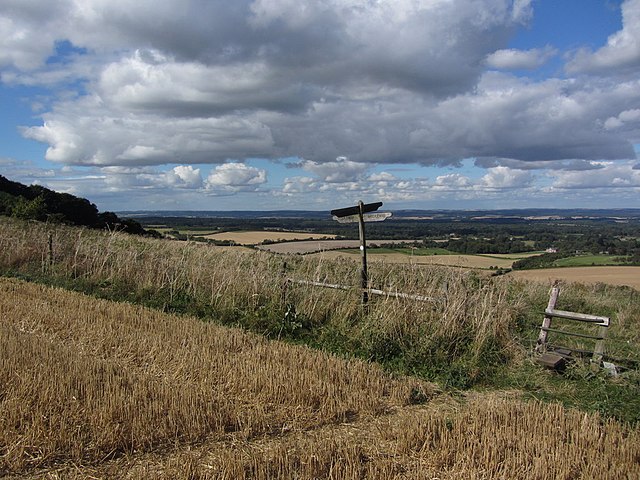
Photo: Pilot Hill, East Woodhay. Colin Park, Creative Commons
https://www.britishnewspaperarchive.co.uk/
© Theresa Lock 2024
 Kintbury and Beyond