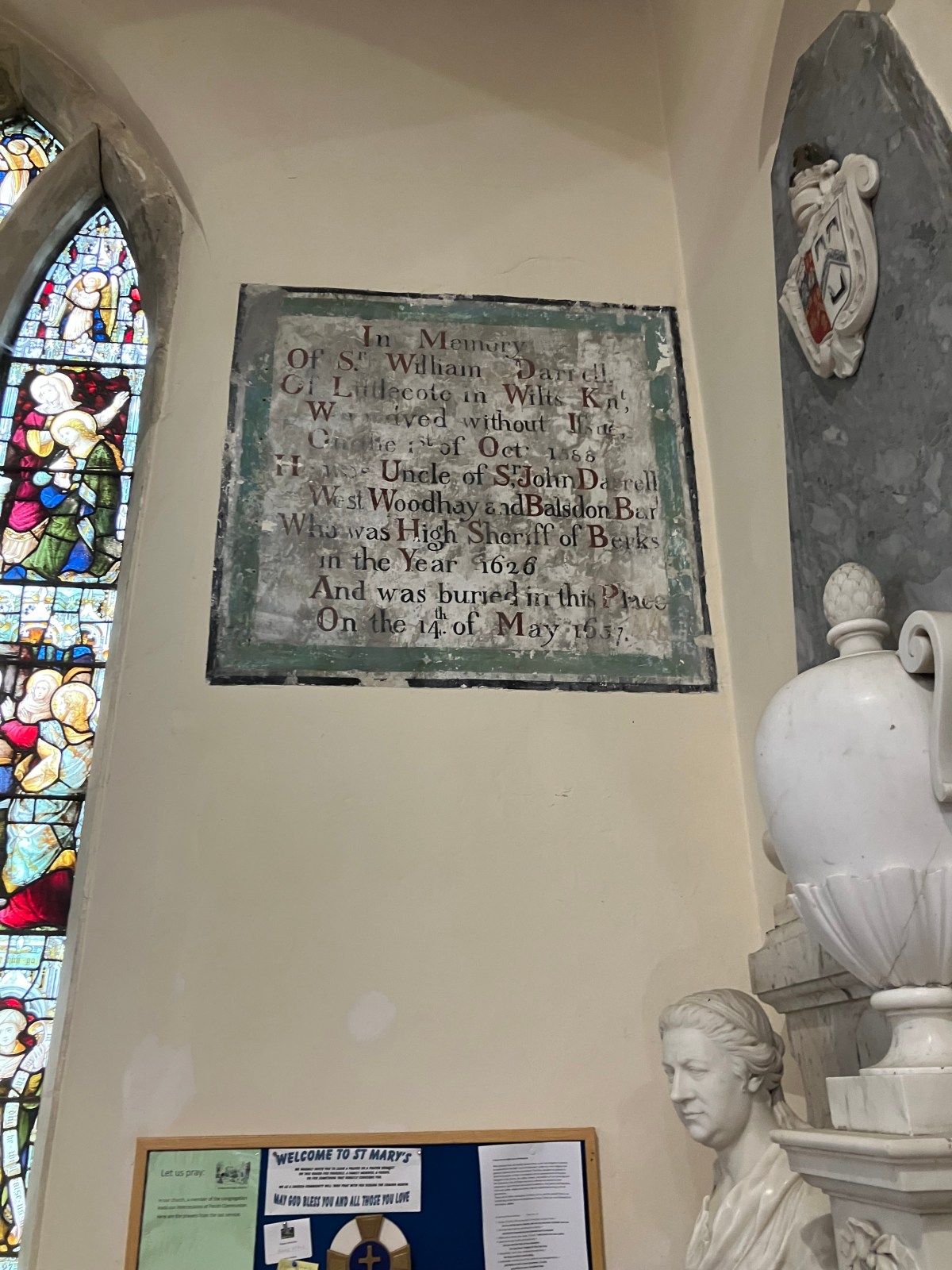
In Memory
Of Sr William Darrell
Of Littlecote in Wilts Knt
Who dyed without issue
On the 1st of Oct 1589
He was Uncle of Sr John Darrell
West Woodhay and Balsdon Bar
Who was High Sheriff of Berks
In the Year 1626
And was buried in this Place
On the 14th of May 1657
This memorial, now much faded and difficult to read, is on the wall of the north transept of St Mary’s church, Kintbury. From the information given on the memorial, one could assume that William Darrell’s main claim to fame was that he was uncle of a one-time high sheriff of the county. However, this is far from the whole story.
The “Littlecote” mentioned on the memorial is a grade 1 listed Tudor mansion, 6 miles to the west of Kintbury in the parish of Chilton Foliat, Wiltshire. It was built towards the end of the fifteenth century by Sir Edward Darrell and replaced the much earlier medieval house.
The second Sir Edward Darrell – son of he who built Littlecote – died in 1549 when his son William was just ten years old. Sir Edward left Littlecote to his mistress Mary Danyell although when he reached his legal majority of 21, William successfully challenged this in court. It was the first of many legal battles William was to engage in throughout his life.
In 1568 William had been involved in an affair with Anne Hungerford, wife of Wiltshire landowner Sir Walter Hungerford. Sir Walter sued for divorce but was defeated in court, subsequently spending three years in London’s notorious Fleet Prison.
In 1572 William Darrell was elected as Member of Parliament for the constituency of Downton in Wiltshire. This was a very small constituency with few people eligible to vote in these pre- parliamentary reform times, so Darrell’s time as a Member of Parliament probably said more about his personal influence rather than his popularity.
At the time of the Spanish Armada in 1588, Darrell is believed to have offered his support to Sir Francis Walsingham, the Protestant Queen Elizabeth’s so-called spymaster and arch enemy of those Catholics who were attempting to restore England to Catholicism.
Although there seems to be no evidence that William Darrell engaged in any form of military service, his life could, none the less, be described as colourful. Scandalous would probably be more accurate. He is believed to have had a profligate lifestyle, left bills unpaid and engaged in disputes with his neighbours frequently leading to litigation.
There are many versions of Wild Will Darrell’s story in histories, guide books and online. The monument in Kintbury church makes no suggestion of a colourful or notorious life and it is difficult to find out exactly when Darrell acquired the epithet, “Wild Will” and more colourful accounts of his life emerged. It is likely that the seventeenth century biographer, John Aubrey, may have written the earliest account although the History of Parliament website states that Darrell was first described as “Wild Will” by the popular Regency period novelist Sir Walter Scott in his poem, Rokeby. The name obviously stuck and the Wiltshire Independent of May 1855 carried the report of a Derby winning racehorse from stables in Hungerford being named “Wild Dayrel”. The paper then went on to print a detailed version of Darrell’s connection with Littlecote house and the now notorious murdered baby story.
There are many versions of this story and the main points have clearly been added to and embellished over the years. It goes something like this:
In 1575, on what may or may not have been a dark and stormy night in November, a village midwife, who might have been called Mother Barnes and may have lived in Great Shefford, was summonsed to Littlecote where a woman was in labour. The midwife was taken there on horseback, allegedly, according to some accounts, blindfolded so she could not identify where she was being taken.
On arriving at the house, the midwife was taken to an upstairs room with a roaring fire in the fireplace. A man was standing by a bed in which lay the labouring woman and he instructed the midwife to save the mother’s life. As soon as the child was delivered the man threw it in the fire ignoring the protestations of the mother, who might have been a servant.
According to some versions of the story, the midwife eventually reported what she had seen to the local magistrates, although she might not have mentioned Darrell by name. Some versions say that Darrell’s enemies decided that he was the newborn’s murderer. As proof that events had happened at Littlecote, the midwife is said to have produced a piece of the bedcurtains she had surreptitiously cut off and brought away with her.
Depending on which version of events you read, Darrell was either tried at Salisbury assizes or by the Commissioners at Newbury but escaped punishment, possibly by bribing the judge.
Although many of the supposed “facts” about Darrell’s life may well be apocryphal I think we can probably believe the memorial in Kintbury church when it states that he dyed without issue on October 1st 1589. His death was the result of a riding accident and, of course, it is almost inevitable that the story of his life has been further embellished by the supposed appearance of the ghost of the murdered infant to frighten his horse, thus causing the accident.
Despite being remembered on a monument in Kintbury church, William Darrel was buried at St Lawrence’s church, Hungerford.
Littlecote House is now a hotel – and famous for its ghosts.
Further information and sources:
https://historyofparliamentonline.org/volume/1558-1603/member/darrell-william-1539-89
https://en.wikipedia.org/wiki/William_Darrell_of_Littlecote
https://www.british-history.ac.uk/vch/berks/vol4/pp205-217
https://www.bbc.co.uk/wiltshire/content/articles/2007/05/31/psi_report_littlecote_feature.shtml
© Theresa Lock, August 2024
 Kintbury and Beyond