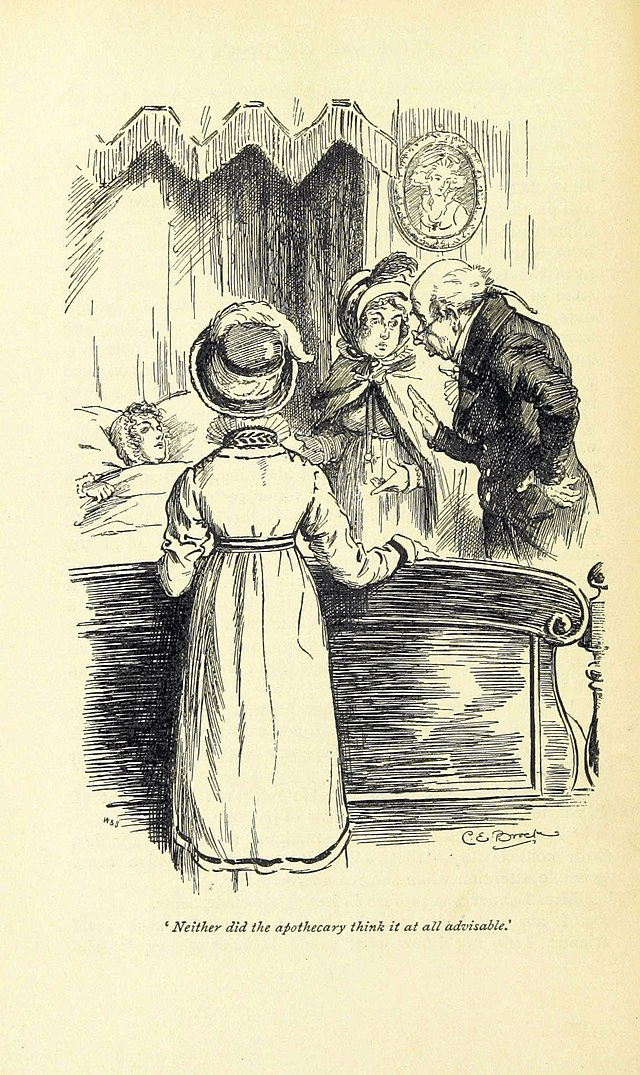
He had been at the pains of consulting Mr. Perry, the apothecary, on the subject. Mr. Perry was an intelligent, gentlemanlike man, whose frequent visits were one of the comforts of Mr. Woodhouse’s life.
As readers of Jane Austen’s novel Emma (1816) will know, the village medic, Mr Perry, was an important figure in the life of Mr Woodhouse who was constantly in need of reassurance as regards to his health. Austen describes Mr Perry as an apothecary; however, by the 1830s the Mr Woodhouses of Kintbury might have considered themselves as more fortunate as their general practitioner could be described as “surgeon”.
So who was Kintbury’s Dr Lidderdale?
John Lidderdale I had been born in Hungerford in 1802. He was the eldest son of Captain John Lidderdale of Hungerford and his wife, Ann, née Pearce. John senior had been a Captain in the 17th Hussars and his family had come, originally, from Dumfriesshire in Scotland. Ann was from a local family, having been born in Standen, near Hungerford.
In the 1820s John was a student at the London Hospital Medical College, at that time still a relatively new establishment, having been founded in 1785. He became LSA ( Licensed Surgical Assistant ) in 1825 then MRCS ( Member of the Royal College of Surgeons ) in 1826. Studying medicine at that time was expensive and John’s fees, board and lodgings may have cost him between £500 and £1000 – enormous amounts for the time. It was not as if he could expect to become a high earner upon qualifying, either; whilst a medic practising in a wealthy part of London, for example, might earn up to £1000 a year, a country doctor was more likely to make between £150 and £200, comparable to better-paid teachers.
By 1839, John is listed in Robson’s Directory as surgeon and registrar of births and deaths for the Kintbury district. At the time of the 1841 census, his younger brother James is living with him, most probably in the role of an apprentice as James would later go on to study medicine.
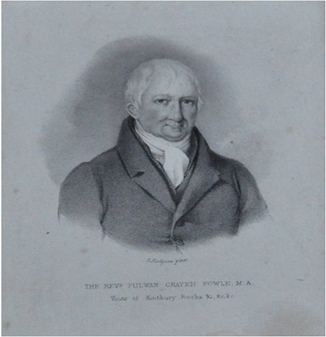
Four years later, John married Isabella Fowle, the youngest daughter of the late Fulwar Craven Fowle who had been for many years the vicar of Kintbury. Although it is impossible to say how prosperous or otherwise the Kintbury practice was proving to be, the 1851 census indicates that John has an apprentice, one Francis Owen, and three live-in servants. By 1861, he has an assistant, one Michael Cuff, and two live- in servants. The same year he was awarded the degree of MD ( Doctor of Medicine ) by the University of St Andrews – the prestigious Scottish university which at this time awarded the degree of MD without the recipients having to attend its campus on the Fife coast.
John Lidderdale died in October 1863. His obituary in the Newbury Weekly News noted,
“ Few men had so extensive a practice as the late doctor, and none worked harder for it. His kindness of manner, his skill and attention, and his patience in tedious cases, will ever be gratefully remembered”.
Large numbers of villagers filled the church for the funeral including many tradesmen who had closed their shops for the occasion. Kintbury certainly showed its respect for the late doctor.
However, where was this popular doctor in the strict social hierarchy of early nineteenth century England? Looking again at the Jane Austen quote I used at the top of this article, the respected Mr Perry is described as gentlemanlike. That last syllable carries a lot of weight: for as much as Perry was respected, he was not, within the hierarchy of the time, a gentleman.
And neither was Dr John Lidderdale.
The Kelly’s Directory of 1848 lists 19 Kintbury people as members of the Gentry which includes Mrs Lidderdale’s unmarried sister, Elizabeth Caroline Fowle and her widowed sister, Mary Jane Dexter. But the man who has achieved the recognition of an MRCS, who is trusted to take care of the villagers’ health, is regarded as being of lower status than the great and the good many of whom were most probably not qualified in anything.
By the time of the 1871 census, Kintbury had a new doctor. Also named John Lidderdale, this young man was the son of the John Lidderdale I’s brother, William.
William Lidderdale had been born in Hungerford in 1805. It seems likely that he had an involvement with the East India Company in his younger adult years although by 1851 he was a Chief Officer with the Coast Guard Agency living in Tyneham and then Osmington Mills, Dorset where his wife Elizabeth died in 1852.
John Lidderdale II had been born in 1839 when the family were in Ilford, Essex, then educated at a boarding school in Southampton. The 1861 census shows him to be a medical student in London although there is some evidence to suggest he had been an apprentice in Kintbury before that, presumably under his uncle. In 1861 he became a Member of the Royal College of Surgeons.
In 1863, the Board of Guardians of the Hungerford Union (in other words, those responsible for the work house ) unanimously voted him Medical Officer of the Kintbury District.
John Lidderdale II served Kintbury as general practitioner for over twenty years. These were changing times: by 1869, Kelly’s Directory had dropped the category, “Gentry” in favour of “Private Residents” in which category both John Lidderdale and his uncle’s widow, Mrs Lidderdale are included.
John Lidderdale retired in 1891 when he married Emma Louisa Mathews, the widow of a farmer from Boxford. To mark this occasion, Dr Lidderdale, “entertained to supper the whole of the adult population ( of Kintbury ), it taking two evenings to do so, and subsequently gave a tea to all juveniles aged between five and sixteen.”
To show their respect to the retiring doctor, 433 of the villagers had subscribed to the cost of a solid silver epergne engraved with the Lidderdale crest.
Both John Lidderdales are frequently mentioned in the pages of the Newbury Weekly News with regards to the sick or injured they have attended during their times as general practitioners in Kintbury. For as much as one can tell, neither were particularly involved in public life, however the reports of their respective funerals show that both had earned the respect and appreciation of village’s working people.
John Lidderdale II died in April 1894. According to the Newbury Weekly News he was remembered as, “ a kind neighbour, devoted friend and approachable councillor.”
Isabella Lidderdale, widow of John Lidderdale II continued to live in Kintbury until her death in 1884. Isabella had lived in Kintbury through times of great social change and also has the distinction of having been, quite probably, the very last village person to have known Jane Austen personally.
William Lidderdale, father to John Lidderdale II, died in Newbury in 1881 but was buried in Osmington, Dorset along with his wife.
Charles Lidderdale, brother of John Lidderdale I became an actuary of the Sun Life Assurance Company but died in Hungerford in 1863.
James Lidderdale, brother of John Lidderdale I, practised as a GP in Great Bedwyn, Wiltshire and died in 1882.
Emma Louisa Lidderdale, widow of John Lidderdale II, continued to live in Kintbury until her death in 1920. The village’s long association with the Lidderdale family had come to an end.
Sources:
The origin of the general practitioner I. S. L. LOUDON, DM, FRCGP, DRCOG Wellcome Research Fellow, University of Oxford, and Honorary Archivist, Royal College of General Practitioners
Journal of the Royal College of General Practitioners, January 1983
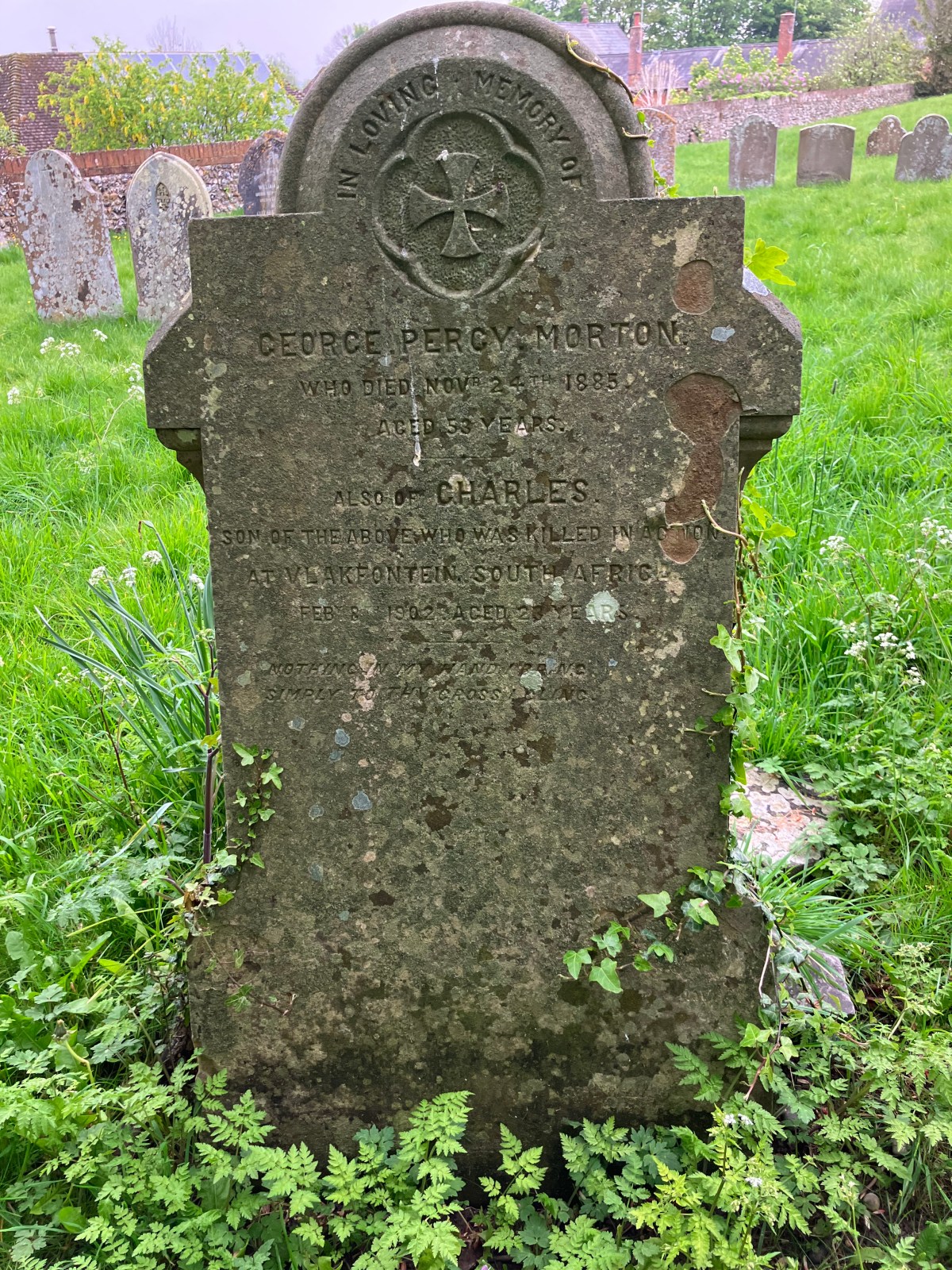
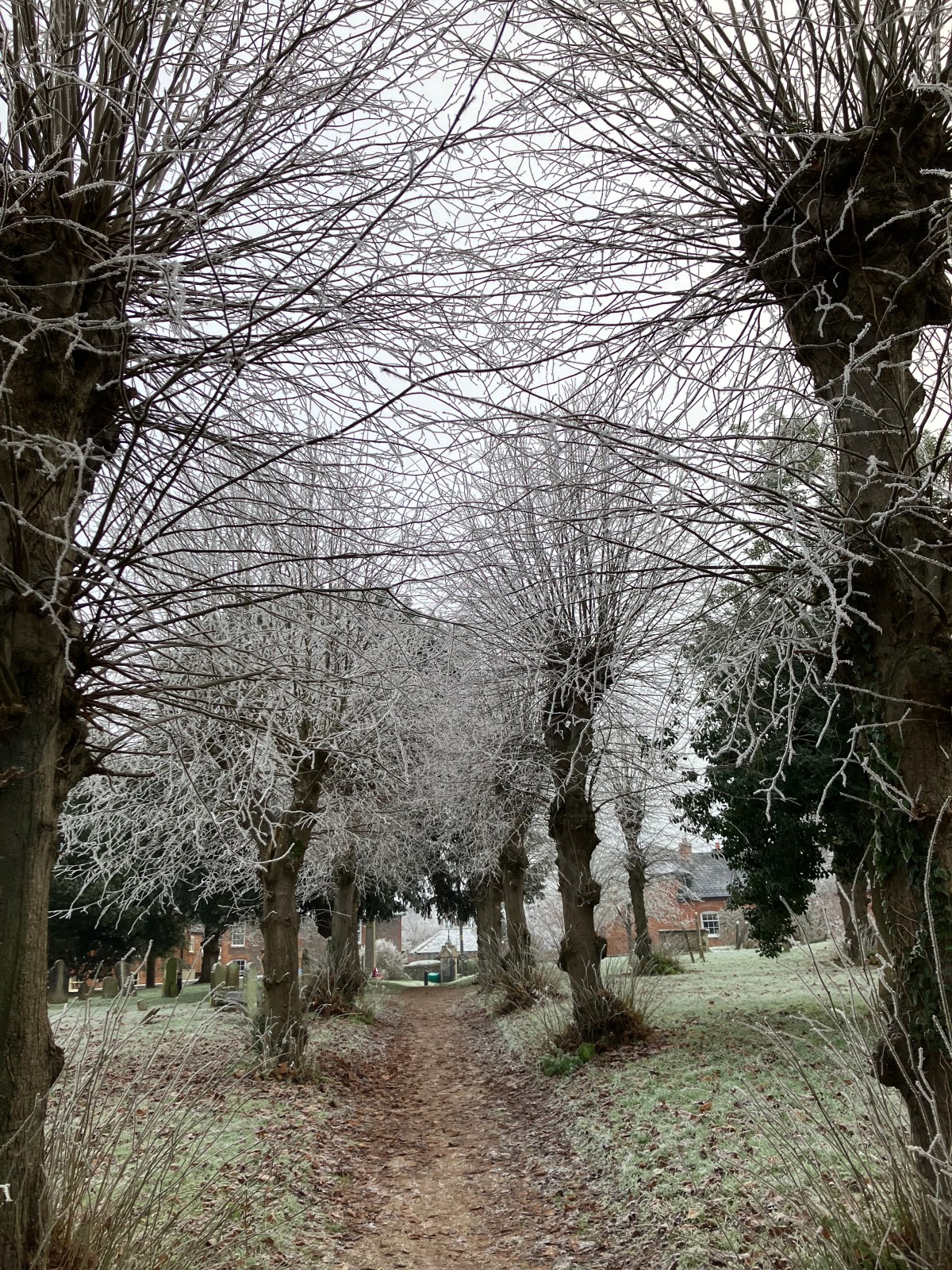
As you walk through Kintbury church yard toward the gate at the top of the path leading to the canal, pause a while to read the inscription on a stone to your right.
As you walk through Kintbury church yard toward the gate at the top of the path leading to the canal, pause a while to read the inscription on a stone to your right. The name at the top of this particular stone is that of George Morton who died on November 24th, 1885 aged 53. There is nothing particularly unusual about that – however, read on. The inscription below reads:
Also of Charles, son of the above who was killed in action at Vlakfontein, South Africa on Feb 8th, 1901 aged 23 years.
Charles Morton had been killed during the 2nd Boer War, a conflict fought from 1899 to 1902 between Britain and the South African Republic & the Orange Free State. At that time, it would have been very unusual for a soldier’s body to be returned to his homeland and closer reading of the grave’s inscription reveals that it does not say, “Here lies…”. So this gravestone commemorated Charles but does not mark his resting place.
I have tried to find out more about Charles Morton and his family. However, as so often happens when researching local history, my searching has raised far more questions than it has answered.
Many people wrongly believe that, in years gone by, poorer families rarely ever moved far from their places of birth. Anyone who has spent time studying family history will know this is not necessarily always the case.
Charles’ father, George, named on the gravestone, was born in Daventry, Northamptonshire in 1832 where his father, William Morton, was an innkeeper. By 1851, the Morton family had left Northamptonshire for Fulham where William – presumably embracing new opportunities – was working as a conductor on a horse-drawn omnibus.
I can find no trace of William or George Morton on the 1861 or 1871 censuses but in 1881 George turns up again, far away from the increasingly urbanised streets of Middlesex where he had lived as a child. George is now married to Ellen and they are living in West Ilsley, with their three children: Frederick, who is seven, Charles, two and a baby daughter. George is working as a groom in a racing stables.
At some point in the following ten years, however, the family experienced many changes because by the census of 1891, Charles is living in Kintbury with his mother and stepfather Edward Brooks, a labourer. According to the inscription on the gravestone I mentioned earlier, Charles’ father, George Morton had died on November 24th, 1885.
Like his father before him, Charles took up work as a groom and by the 1901 census he is living in lodgings in Crowthorne, although there is no clue as to what took the young man to work as a “groom domestic” in east Berkshire when similar work would have been available nearer home.
However, by the following year, Charles was even farther away from his mother’s home in Kintbury. As the gravestone tells us, on 8th February 1902, Charles was killed on active service in South Africa.
The inscription on the stone says that Charles died on active service in Vlakfontein, which is in the Mpumalanga Province of South Africa – the site of guerrilla fighting during the Boer War. However, the Victorian Society says that Charles was a member of the South African Constabulary who was killed at Syferfontein, also in Mpumalanga Province. It is impossible to say which is correct; the Victorian Society and the gravestone both have February 2nd as the date of death. To confuse matters further, the Forces War Records list two other Charles Mortons killed in South Africa in 1902.
As research has shown, neither Charles’ father nor his step-father were wealthy or in relatively high-status occupations. Many poorer and even middle-income people at the time were buried without gravestones. That George Morton – whose last known occupation was as a groom – should have a gravestone is, I believe, quite unusual for someone of his background at that time.
All this leads me to wonder this: Did someone with the means to have a gravestone erected in Kintbury want to commemorate a young man from the village killed abroad? Whilst some of the great and the good who saw active service are commemorated on the walls inside the church, it was never the custom to put up a plaque to the lower ranks who died in the military. As I have commented above, men of the status of George Morton were very unlikely to have a marked grave. However, by erecting a stone for him, the name of his son Charles could be added below, even though the plot in Kintbury was not his final resting place.
Perhaps someone with the wherewithal to afford a gravestone knew that some seventy years earlier, the Rev Fulwar Craven Fowle had erected a gravestone to working man, William Winterbourne. Perhaps that person felt inspired to do something similar. Perhaps that person was a former soldier. We shall probably never know unless these details are recorded somewhere in the parish records held by the diocese. It would be an interesting search to find out.
I have not been able to find a record of Charles Morton having a Commonwealth War Graves Commission burial in South Africa but it is, of course, pleasing to know that he is remembered in our churchyard.
Thomas Hardy’s poem, Drummer Hodge, written in 1899, was his response to news of the death of young country men, killed, like Charles Morton, in the Boer War:
They throw in Drummer Hodge, to rest Uncoffined—just as found: His landmark is a kopje-crest That breaks the veldt around; And foreign constellations west Each night above his mound.
Young Hodge the Drummer never knew— Fresh from his Wessex home— The meaning of the broad Karoo, The Bush, the dusty loam, And why uprose to nightly view Strange stars amid the gloam.
Yet portion of that unknown plain Will Hodge for ever be; His homely Northern breast and brain Grow up a Southern tree, And strange-eyed constellations reign His stars eternally.
The story of Kintbury’s Rev James Whitley Deans Dundas
In 1840, Rev Fulwar Craven Fowle, who had been a close friend of Jane & Cassandra Austen, died aged 76. He had been the third generation of his family to be vicar at Kintbury so his death must have seemed like the end of an era to his parishioners.
One wonders how Kintbury villagers felt when the next person to be appointed to the parish was a much younger man. Twenty eight year old James Whitley Deans Dundas must already have been known to local people, being the son of Admiral James Whitley Deans Dundas, a member of the well-connected and influential family of Barton Court, Kintbury. He held an MA degree from Magdalen College, Cambridge, had been ordained in 1835 and had become vicar of Ramsbury, ten miles away in Wiltshire, in 1839.
Although I have not been able to find James Dundas on the 1841 census, the 1851 census shows that he is still vicar of St Mary’s, Kintbury. He has, living with him in the vicarage, a cook/housekeeper, a kitchen maid and a groom and, although he is married his wife seems to have been absent on the night of the census. Strangely, the 1861 census also records Dundas as being married, yet his wife is absent again and his staff consists of just one waiting maid.
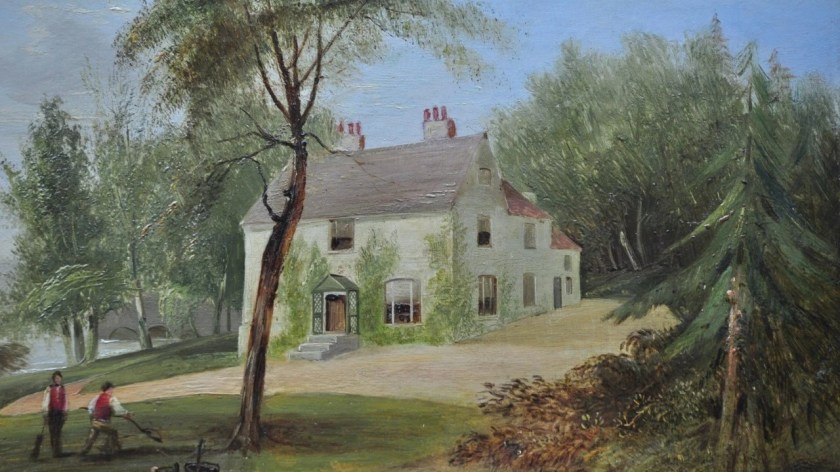
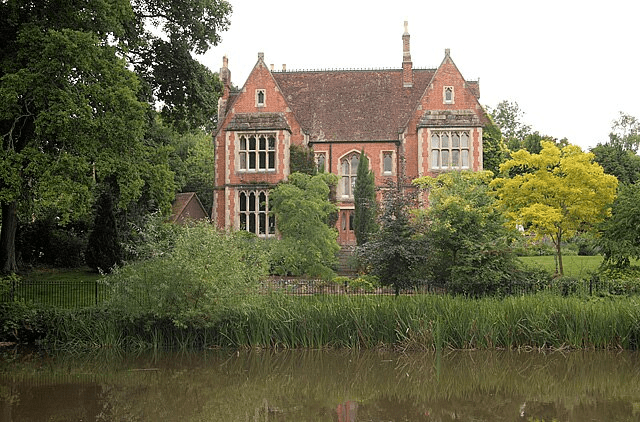
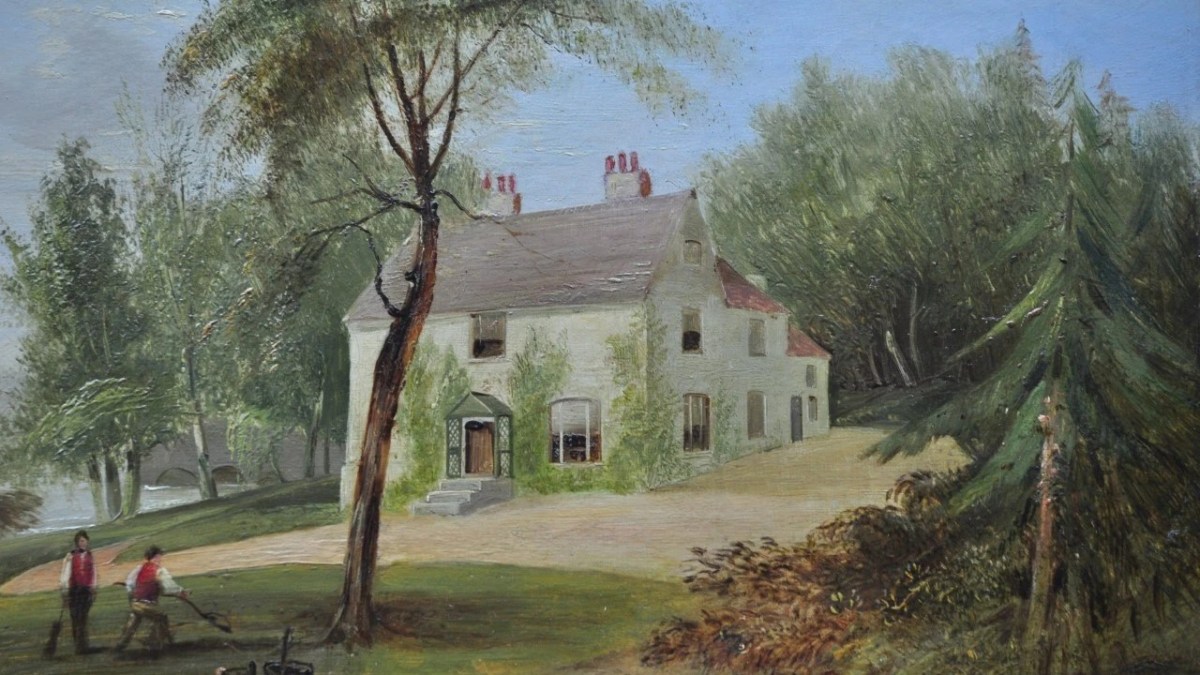
However, this must have been a time of upheaval in the vicarage, for around this time the original building – the one known to Jane and Cassandra Austen – was demolished and a new, large house in the fashionable Neo Gothic style built to replaced it. Quite why James Dundas chose to do this we do not know; perhaps the old house was in a state of poor repair or perhaps he considered it lacked the style and sophistication fitting a person of his status.
Out with the old: The vicarage known to Jane Austen was demolished
It is easy to imagine the new vicarage filled with a large family and ample servants to run it; but that was not the case. The 1871 census reveals that, whilst Dundas maintained a live-in staff of footman, cook, housemaid and groom, the many rooms did not echo to the sound of children or visiting grandchildren, and, although the vicar is still recorded as being married, Mrs Dundas is conspicuous by being absent.
Designed by Thomas Talbot Bury, the new vicarage replaced the old one in 1860
An online search reveals the rather surprising truth.
Sometime in the mid 1830s, James Dundas had entered into a relationship with Olivia Flora Burslem, the daughter of Captain Nathanial Godolphin Burslem of Harwood Lodge, East Woodhay, Hampshire. Olivia had been born while her father was serving in the army in Java, in the East Indies and it is this rather unusual place of birth which makes Olivia easier to trace on census returns.
Olivia’s relationship with Dundas seems to have been a turbulent one almost from the very beginning. Some of the details can be put together from parish records and various newspaper reports covering the proceedings of the Court of Queen’s Bench in July of 1840.
The couple had been married by special licence at East Woodhay, Hampshire, on February 11th 1836. The groom was 23 and the bride 22.
However, by 1837 the couple were living separately.
In 1839, in an attempt to bring about the dissolution of his unhappy marriage, the now Rev Dundas brought a case against a Mr Hoey of Bath, whom he accused of “criminal conversation” with Mrs Dundas. It seems that a witnesses for the prosecution, a waiter and others who worked at the Castle Hotel in Marlborough, described Mr Hoey and Mrs Dundas arriving there and posing as a married couple.
They stayed for two or three days and “had but one bed”.
The Castle & Ball, Marlborough
Although a case had been built against his wife, witnesses for the defence suggested that Dundas had not been as innocent as he had tried to make out.
The court heard how, in 1834, Dundas had become a frequent visitor at the East Woodhay home of Captain Burslem whose daughter, Olivia, was “possessed of great personal attraction.” Dundas claimed there had been a mutual attraction between the young people and that his intentions were honourable. However, during a period towards the end of 1834, Mrs Burslem had become ill and was confined to her bed for some time. During this time, “the plaintiff was base enough to take advantage of the affections of MissBurslem and to abuse the confidence reposed in him by her family by effecting her ruin.”
On learning that Miss Burslem was pregnant, the report suggests, Dundas abandoned her. It appears that it was “with great difficulty” that Rev Dundas was persuaded to marry Olivia but after Captain Burslem had settled £10,000 on his daughter and Admiral Dundas had settled £5,000 on his son, the wedding finally took place.
The court heard evidence that, from the time of the marriage, Dundas treated his new wife with cruelty and neglect. There was also evidence to suggest that he was violent towards her. It was even suggested that he had somehow encouraged her into relationships with other men to enable the possibility of a divorce under the very restrictive divorce laws of the time..
At the conclusion of the case, the jury’s verdict was: “We think hehad morally deserted her”. Dundas was not granted a divorce.
If Olivia Dundas was not living with her husband in Kintbury, where was she? Although I have not been able to find her whereabouts on the 1841 census, other sources, along with cross referencing, do reveal more about her life after her separation from Dundas.
There is evidence to suggest that Flora was in a relationship with a new partner, one Henry Dean and is styling herself as his wife. In polite Victorian society, this would have been frowned upon by those who knew the truth – although it has to be said that there were likely those willing to”turn a blind eye.” At this time, it would have been almost impossible for Flora to obtain a divorce from Dundas so for a woman who had the means and the opportunity to set themselves up in in another relationship far from the prying eyes of her original home, this was likely the only way to achieve happiness in a new family.
On May 10th 1844 a baby, Olivia Flora Dean, daughter of Henry & Olivia Flora Dean, was baptised at Christ Church, St Marylebone. The record shows that the baby had been born on February 9th 1843. Then, in June 1844, Henry, son of Olivia Flora & Henry Dean is baptised at St Peter’s, Pimlico. In both entries, Henry Dean is described as a “Gentleman” – a precise designation which would have implied social, and most likely economic, status rather than just being a polite term for a man.
How do I know that this Olivia Flora Dean is the same person as Olivia Flora Dundas nee Burslem? This is where Olivia’s rather unusual birth place of Java is helpful.
Although I have not been able to find Olivia Flora on the 1851 census, the 1861 census has a Flora Dean, aged 43 and born in Java. She is head of the household at 2, Charles Street, Westminster and lives alone. Her “Rank, profession or occupation” is described as “Householder Independent”. Of former partner Henry I can find nothing, neither is there any trace of son Henry. However, it is very likely that the daughter baptised in 1844 is now identified as Flora O. Dean, eighteen years old and at a boarding school in Brighton.
By 1871, Olivia is still living at 2, Charles Street, but by now her daughter, styled Flora Olivia, presumably to avoid confusion with her mother, is living with her. Son Henry is living there as well, and at 27 he is described as “Retired from army.”
Both Olivia and her daughter Flora are described as “annuitant” which suggests that they are being supported financially, somehow. Perhaps the absent Henry senior – if he is still alive – is supporting his partner and their child, or perhaps Olivia is being supported by other members of the Burslem family – we will never know. There has to be the possibility that both Flora and Olivia are in receipt of support from the Dundas family if not from James himself.
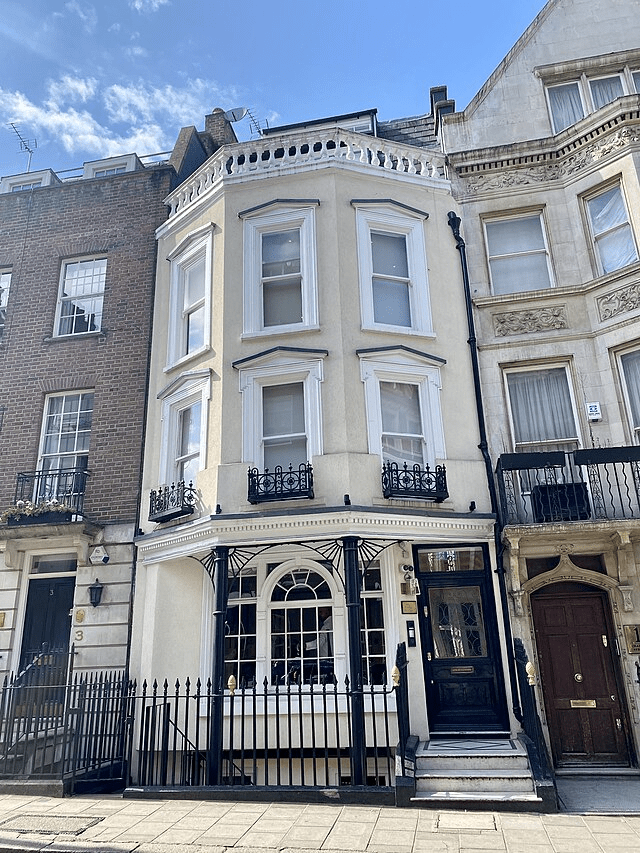
Charles Street, Westminster, today.
By 1881 Olivia Flora and her daughter are still living at 2, Charles Street, although Olivia is now described as “Widow annuitant”. But whose widow is Olivia?
James Dundas, still living in the lonely canal side vicarage in Kintbury, died in 1872 meaning that Olivia was now legally his widow, even though she had not identified or lived as his wife for so long.
Olivia Flora died in June 1881. It is the entry in the records of Brompton cemetery which confirms for me that the Oliva Flora Dean I have been following through online records is indeed the wife of Rev James Whitley Deans Dundas: the burial register records the deceased as Olivia Flora Dundas of 2, Charles Street – the address at which Olivia Flora Dean had been living for the past twenty years.
The story of Rev James Whitley Deans Dundas and the woman born Olivia Flora Burslem raises questions it is impossible to answer. What became of the child born in Bath before its parents were married? How was James able to secure the living in Ramsbury in 1839 and Kintbury in 1840 despite his somewhat notorious recent past? Or was it that no one in authority – presumably including the Bishops of Salisbury and Oxford in whose dioceses he had ministered – really bothered about it that much?
People will gossip, of course, and Kintbury is not a million miles form East Woodhay, even in a slower age of horse transport. Surely the story of a reluctant groom and a shotgun wedding would be too delicious not to pass on, from village to village? Particularly when the groom is a man of the cloth??
But whatever stories were passed on about the young priest in the 1830s, by the time of his death from heart disease in 1872, James Whitley Deans Dundas was fondly remembered. The Reading Observer spoke of his, “unceasing acts of charity and kindness” and the Newbury Weekly News said he was, “indefatigable in promoting the welfare of his parishioners”. In his time as vicar of St Mary’s, Rev Dundas had overseen a “restoration” of the church, the building of Christchurch at Kintbury Crossways and the building of a new school in the village.
Did anyone in Kintbury know of the estranged wife living in a fashionable part of London? I very much suspect that they did and there may have been raised eye brows and the occasional tuts when stories of Dundas’s past life were passed on. However, to most Kintbury villagers, the life style of the Dundas family must have been so far removed from their own that such irregularities were dismissed with a shrug. And if the Rev James Dundas was regarded as a good man, perhaps any wrong doing in his past would be forgiven.
Rev James Dundas was buried in the Dundas family vault, beneath the chancel of St Mary’s church.
Anyone who has spent some time researching the history of the Newbury area will, eventually, have come across the name of Walter Money.
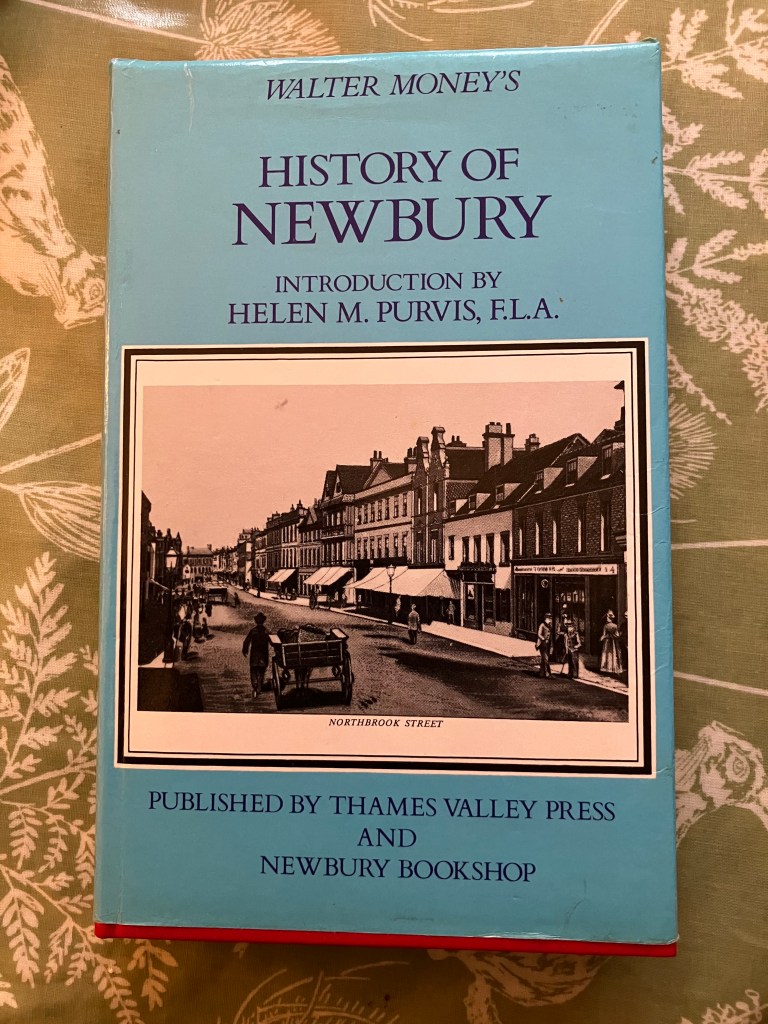
Born in Shaw-cum-Donnington, Newbury in the 1830s, both Walter and his brother James Money studied architecture in London. Both brothers returned to establish a practice in Newbury where Walter also developed a keen interest in local history and antiquity. His History of the Ancient Town and Borough of Newbury (1887) is still a very useful resource for the local historian and he is one of the people we have to thank for establishing a museum in the town.
Aside from a career as an architect and a notable antiquarian, Walter Money was prominent in civic life where his involvements included, amongst other roles, being a Church Warden at St Nicholas’ church, a promoter of the Newbury, Didcot & Southampton Railway, a member of the Town Council, a Governor of the Grammar School and manager of church schools. He was also involved with establishing Newbury District Hospital, the Clock Tower and the Falkland Memorial.
There must be few people whose interests in life have left their mark on the town as Walter Money has.
As I have said above, anyone researching local history in our area will come across the name of Walter Money. My most recent meeting with Walter occurred as I was researching what were believed to be Saxon graves originally uncovered in Kintbury during the late nineteenth century. By chance I found an article from The Journal of the Anthropological Institute of Great Britain and Ireland, 1878
“An Ancient Burial Ground at Kintbury” was submitted by Professor Rupert Jones but is the work of Walter Money. In it, Money outlines why he believed the graves to be Roman rather than Saxon.
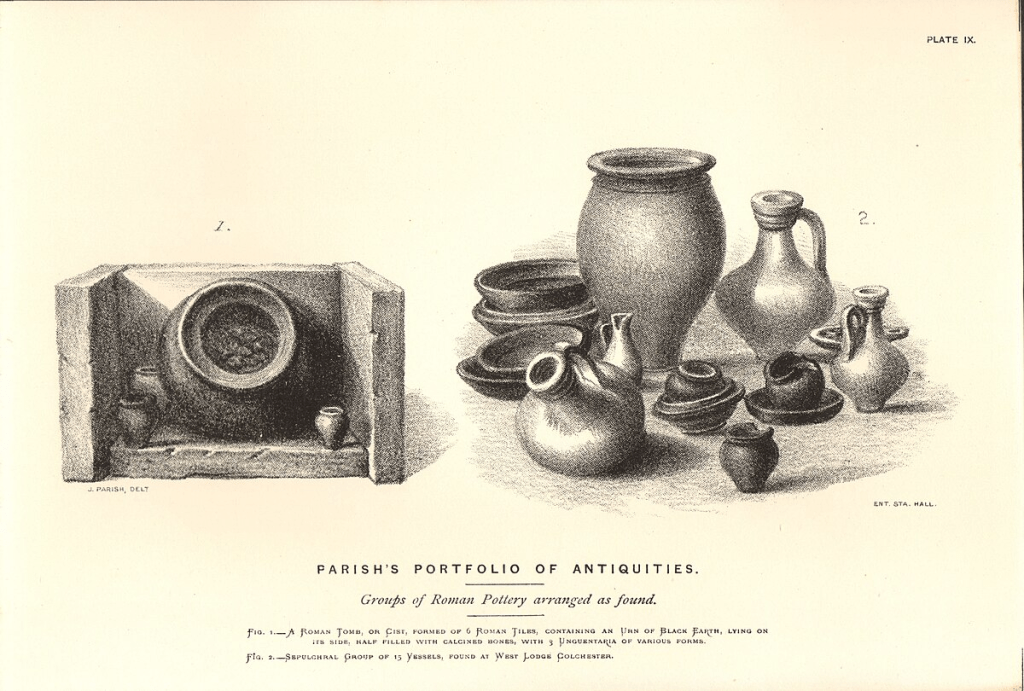
Many of the graves had been revealed when the chalk pits were excavated for the purposes of whiting manufacture. The banks of the pits were strewn with fragments of Roman pottery including, Money says, “urns and other vessels; the ware is black, brown and red but principally a dark bluish grey colour on fracture, and somewhat coarse in texture.”
Roman Pottery found in Colchester
Money says that he also found glass, two portions of hypocaust tiles and a fluted brick with plaster still adhering to the outer face. The Romans are well known for their use of hypocausts for a sophisticated heating system which the Saxons did not have and similarly the use of plaster was Roman and not Saxon. He suggests that the Saxon graves are evidence of the continued use of a Roman cemetery before the Saxons converted to Christianity.
Tiles from a Roman heating system found in Kent. Had Walter Money identified something like this in Kintbury?
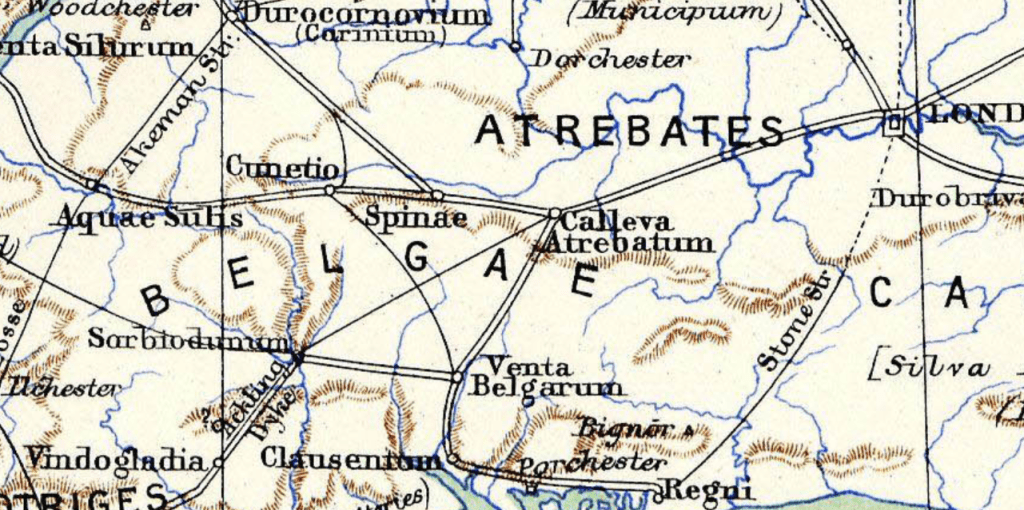
Money believed that Kintbuty was in Roman occupation, and probably a minor station on the road from Aqua Solis (sic) – Bath, through Cunetio – Marlborough, then through Lawn Coppice, Cake Wood, Standgrove, Hungerford and then Kintbury. From Kintbury the road would go on to Spinae, which he believd was the site of Newbury.
Finally, Money throws doubt on the suggestion that the graves are Saxon as graves from this period are usualy accompanied by grave goods. However, no grave goods had been found.
Today, archaeological remains can be dated using such techniques as optically stimulated luminescence, radio carbon dating and the study of a person’s DNA. Skeletons such as that belonging to the “Amesbury Archer” in Salisbury Museum can not only be dated but we also know where he travelled from in Europe before settling on Salisbury Plain. But none of these scientific advancements were avilable to Money.
I do not know what has become of the artefacts that Money describes having found – furthermore it is likely that the contexts in which they were found were never recorded as they would be today. I would like to know why neither Professor Jones, nor the distinguised antiquarian Colonel Lane Fox, who visited the site later, mentioned or drew any conclusions regarding the Roman finds. Perhaps it’s just that I cannot find those details.
We know that there was a Romano-British villa in the valley to the east of Kintbury so surely it is not such a leap to believe that Kintbury itself was a small Roman settlement. Although the evidence is slight, I find myself wanting to believe Walter Money.
References & sources:
Web Site of Friends of Newtown Road Cemetery – article by Avril Thesing
Cassandra Austen had one love in her life: Kintbury’s Thomas Fowle. Following his untimely death, it seems she forsook all others and remained single for the rest of her life.
So who was Thomas Fowle?
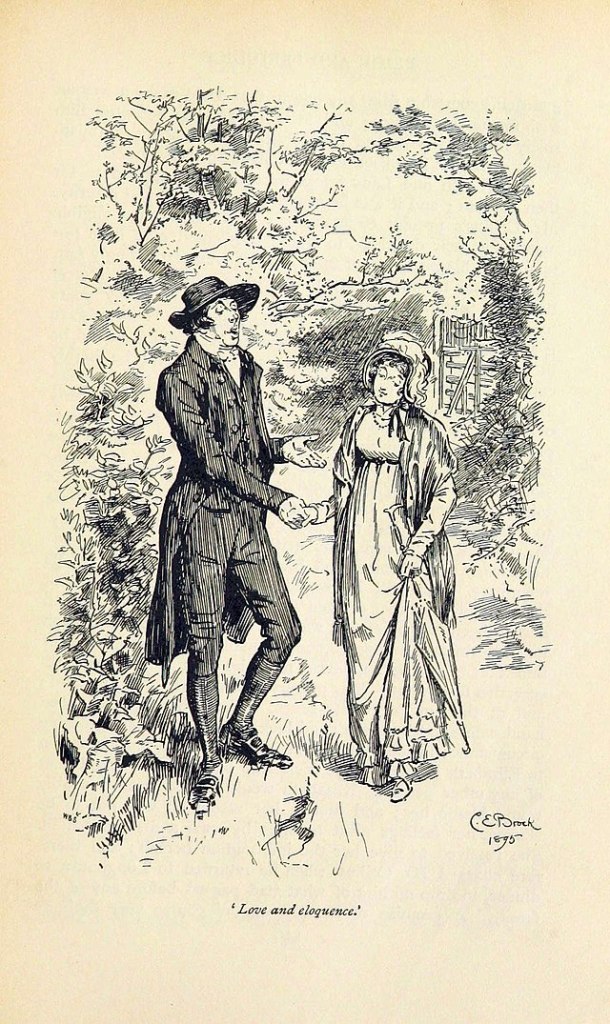
We do not know what he looked like – perhaps we have an image in our minds of the stereotypical late eighteenth century curate – perhaps that image is a sort of caricature.
The stereotypical image of a Regency curate???
If Tom looked anything like his grandmother, his uncle or indeed his older brother Fulwar, he would have had a long nose and a very defined chin. Fulwar, we know, was not particularly tall.
Tom’s brother, Fulwar
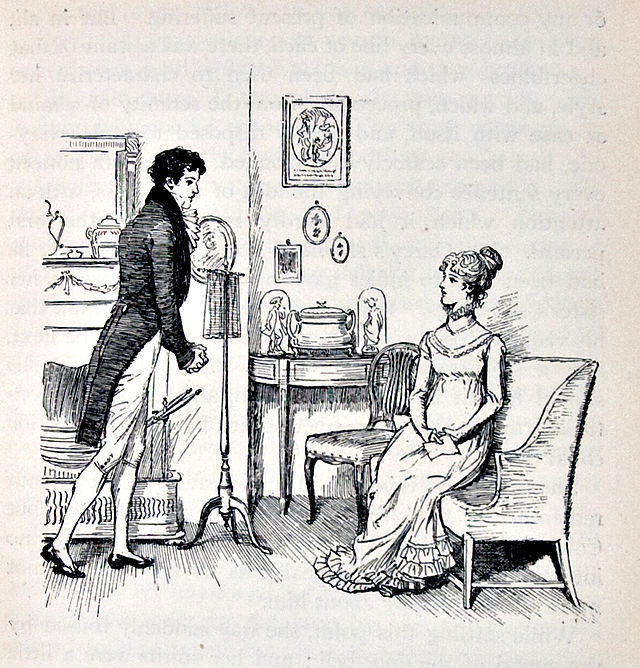
So perhaps Tom did not look like a young Colin Firth as Mr Darcy – or indeed any one else as Mr Darcy. Neither was Tom the heir to a Pemberley, in fact he was heir to very little at all. But Cassandra loved him and she must have loved him for who he was.
Not the classic Mr Darcy?
We know that Tom was born in Kintbury in 1765 and was the second son of the parish priest, also named Thomas.
These were the days of patronage and preferment and holding the living at Kintbury had become something of a family business because Thomas’s grandfather, another Thomas, had become vicar in 1741. So the Fowles were the vicarage family in this quiet backwater – all very rural, and, it is easy to imagine, all very sedate and proper.
Three generations of the Fowle family became vicars of St Mary’s, Kintbury
However, on Thomas’s mother’s side, things had been a little bit different.
Thomas’s maternal grandfather was the Honorable Charles Craven who, between 1712 and 1716, had been the governor of South Carolina. He seems to have been something of a man of action and in 1715 actually led an army of colonists and their native American allies in a war against other native American tribes who, one presumes, saw the colonisation of their country differently.
Charles’s son, Thomas’s cousin John, seems to have been a man of action but in a very different way. He took holy orders and by the 1770s was appointed to the parish of Wolverton in Hampshire although it seems he was living at Barton Court in Kintbury at this time. If there had been a tabloid press back then, John Craven would have been a favourite for supplying sensational copy with an incident involving pistols at a hotel in Wantage and a very lurid divorce case in which maids testified at having heard the sound of beds springs coming from a lady’s room John had recently entered.
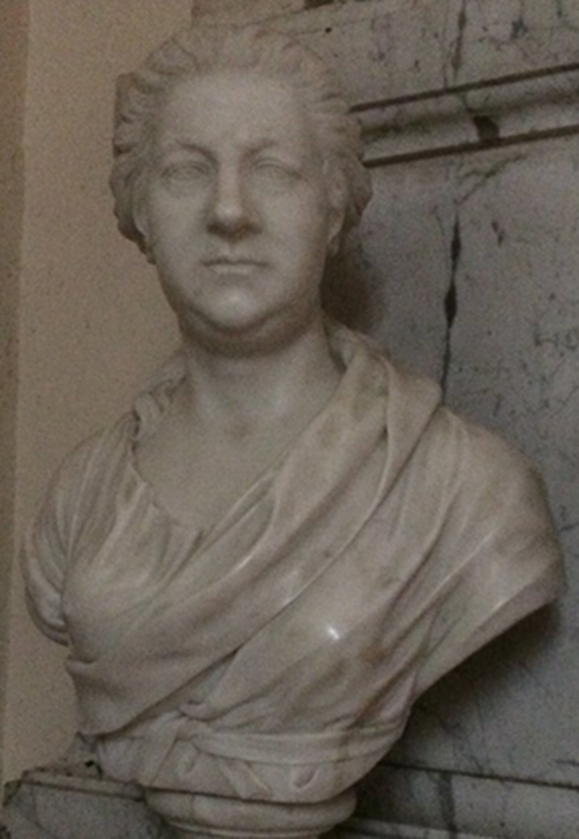
Thomas’s grandmother, Elizabeth Craven, was, we believe, something of a socialite. Her bust, now in the north transept at St Mary’s church, Kintbury, is part of the very elaborate and – when it was new – eye-wateringly expensive monument to her second husband, Jemmet Raymond. The representation of Elizabeth, presumably based on a portrait now long lost, shows face with a very stern expression.
Tom Fowle’s grandmother
Elizabeth Craven is believed to have had a difficult relationship with her daughters. One is said to have eloped with a horse dealer and another, Martha, left home to work as a seemstress under an assumed name to hide her identity. Eventually she married the Rev Noyes Lloyd of Enborne near Kintbury and became the mother of Eliza, Martha and Mary Lloyd. Jane Craven married Thomas Fowle II of Kintbury and became the mother of Thomas and his brothers, Fulwar-Craven, William and Charles.
However, the Craven relation who would have the most devastating influence on Thomas’s life has to be his cousin, William Craven, 1st Earl of Craven of the 2nd creation – to give him his full title – and the son of one of the richest men in England. Other people choose to remember him as the man who kept his mistress Harriet Wilson at Ashdown House.
One wonders what the family at Kintbury would have thought of those Craven relations – what would Thomas and his brothers have told Jane and Cassandra of their grandmother, whose memorial back then would have been to one side of the altar and therefore much more prominent? Perhaps they would have enjoyed the gossip value and agreed with Mr Bennet that we exist to make sport for our neighbours and laugh at them in our turn.
But nothing sensational or scandalous ever attached itself to the Fowles in their Kintbury vicarage. Being related to members of the extremely wealthy Craven family, was, I suppose, an advantage for both the Fowles at Kintbury and the Lloyds at Enborne since this was still the time when members of the aristocracy and more influential gentry could appoint vicars to parishes within their gift. However, having a grandfather who was an honourable and a cousin who was an earl did not mean the Fowles or the Lloyds moved easily in similar social circles. The Fowles were not wealthy. Thomas Fowle II did not send his sons to a public (expensive fee-paying) school such as those at Winchester, Harrow or Eton. Instead Fulwar, Thomas, William and Charles were sent to the vicarage at Steventon in Hampshire to be educated by their father’s friend from university days, Rev George Austen.
Thomas Fowle was 14 in 1779 when he was sent to study at Steventon, presumably with the intention that George Austen’s teaching would prepare him for a place at Oxford University. Fulwar had taken his place at the vicarage school in the previous year and it is not surprising that the Kintbury boys became close friends with the Austens of the same age, in particular with James. Cassandra was just six when Tom arrived at Steventon and ten when he left to take up his place at St John’s College, Oxford.
Home theatricals were a popular past time at Steventon and in December 1782 the young Austens, along with some of their father’s pupils, staged their own production of a contemporary play, “The tragedy of Matilda” by James Francklin. James Austen wrote a prologue for the play, which was spoken by his brother Edward, and an epilogue which was spoken by Tom Fowle. For the nine year old Cassandra, the Fowle boys must have seemed as familiar as her own brothers and it is easy to imagine how her relationship with Tom grew in the creative atmosphere of the Steventon vicarage.
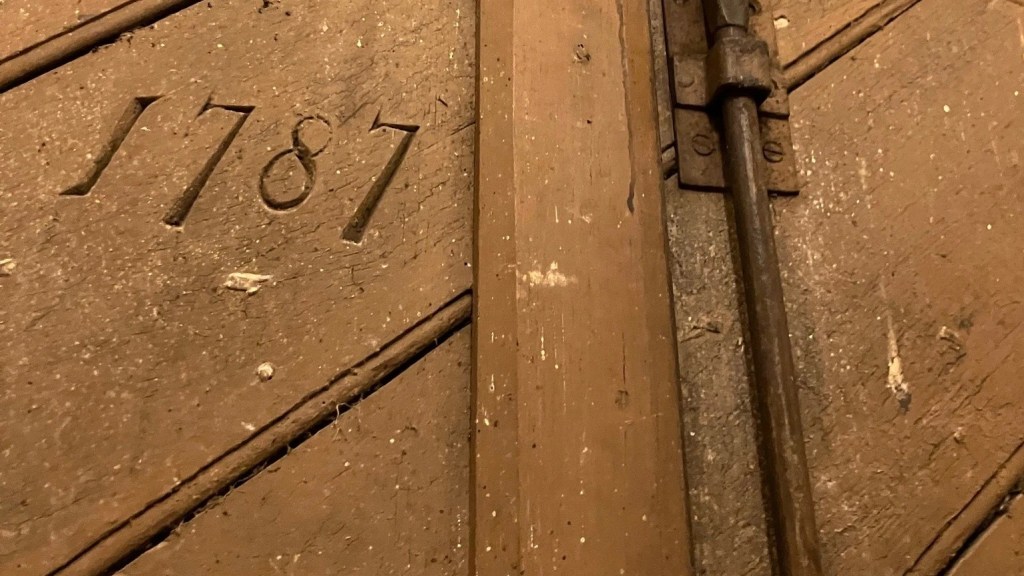
The west door to Kintbury church (detail).
The following year, 1783, Tom went up to Oxford, where he graduated with a BA from St John’s college in 1787 and then taking Holy Orders. He became curate of East Woodhay – not far from Kintbury – in 1788 and also, in the manner of the time, at another parish, Welford, also not far from Kintbury.
We know that on at least on two occasions, Tom officiated at weddings at George Austen’s church in Steventon, one in 1789 and another in December 1792. On this occasion the marriage was between Mrs Austen’s niece, Jane Cooper and one Thomas Williams Esq. Both of her parents having died, Jane was being married from the home of her aunt and uncle, with George Austen taking the place of her father, I presume, and therefore unable to officiate. I think it says something of the relationship between the Austens and the Fowles that Tom stands in for Rev Austen to officiate at this wedding rather than a local curate.
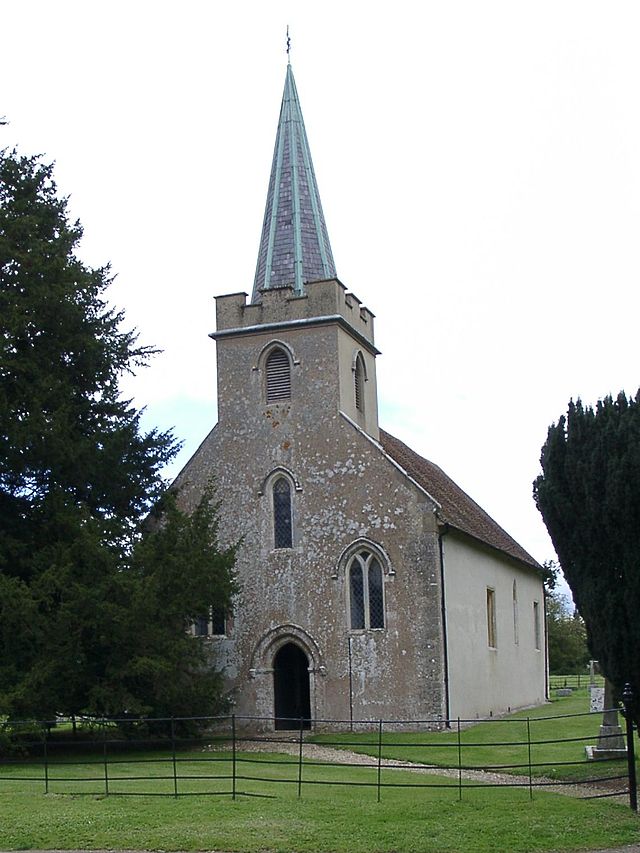
The church at Steventon
Although Cassandra was only ten when Thomas left Steventon for Oxford, we know that in later years various members of the Austen family visited their friends at the Kintbury vicarage. In a poem written at Kintbury in 1812, James Austen, who was a particular friend of Tom’s elder brother, Fulwar, recalls his visit to Kintbury in the early 1780s:
“ Yes, full thirty years have passed away,
Fresh in my memory still appears the day
When first I trod this hospitable ground…”
James recalls with affection, Jane & Thomas Fowle:
“ The father grave; yet oft with humour dry,
Producing the quaint jest or shrewd reply,
The busy bustling mother who like Eve,
Would ever and anon the circle leave
Her mind on hospitable thoughts intent.”
James Austen’s poem creates an image of a warm and welcoming family with a sense of humour, not unlike the impression we get of the Austen family themselves.
The poem has some very sad lines as James recalls Cassandra’s betrothal to Tom:
“Our friendship soon had known a dearer tie
Than friendship self could ever yet supply,
And I had lived with confidence to join
A much loved sister’s trembling hand to thine.”
James Austen
In 1788, Fulwar had married his cousin, Eliza Lloyd, whose sisters, Mary and Martha Lloyd were to become close friends with Jane and Cassandra. In 1797, Mary Lloyd became James Austen’s second wife. They had first met in Kintbury.
So this was the extended family circle Cassandra anticipated joining when she quietly became engaged to Tom in 1795. By this time she was 22 and he was 29 and for two years had been rector at the church of St John the Baptist in Allington near Salisbury in Wiltshire.
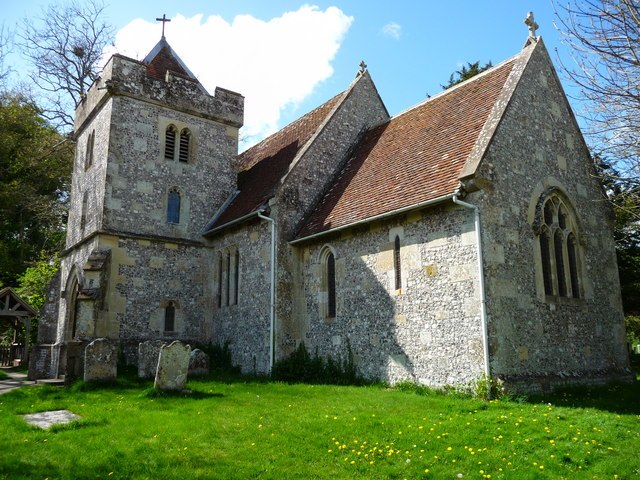
The church of St John the Baptist, Allington, Wiltshire
Family connections had given Tom the post as Allington was one of the parishes in the gift of his cousin, Lord Craven. However, the stripend Tom received from his position here was not enough to support a wife. But Lord Craven had another parish in mind for Tom, however, in Shropshire, and it seems to have been confidently expected that Shropshire was where Tom and Cassandra would be living after their wedding.
But sadly, that wedding never happened.
In 1793, Britain was at war with France. Both countries had interests in the West Indies which resulted in the conflict spreading beyond Europe and across the Atlantic. In 1795, General Sir Ralph Abercrombie was to lead a 19,000 strong expeditionary force to the West Indies. Their number included the Third Regiment of Foot whose colonelcy had recently been bought by Tom’s cousin, Lord Craven.
It is believed that Craven did not know of Tom’s engagement when he asked his cousin to accompany the troops as Regimental Chaplain, and if he had known, would not have suggested Tom should join the expedition. It is possible that Cassandra herself had forbidden Tom from mentioning it. Tom accepted the post and hurriedly made his will on 10th October. It was not witnessed, which suggests, I think, the haste in which it was completed and also perhaps the secrecy of the engagement.
Was it simply that Tom was hoping to raise enough money for him and Cassandra to live comfortably after their wedding that made this young priest accept the post? Was it that he felt he could not say no to his illustrious cousin? Tom would not be the first member of his family to make the Atlantic crossing – his grandfather had been governor of South Carolina, after all. But the journey to the West Indies was well known as potentially dangerous.
In the late autumn of 1795, Cassandra came to Kintbury to take her leave of Tom. Abercrombie’s expedition was delayed by the lack of men and equipment, but eventually sailed from Portsmouth, Hampshire, in November although bad weather in the channel caused further delays to the fleet. It seems likely that Cassandra was staying with the Fowles throughout this time.
“What a funny name Tom has got for his vessel”, Jane wrote to Cassandra on January 9th, “But he has no taste in names, as we well know, and I dare say he christened it himself.”
Then on the 15th she wrote,
“I am very glad to find from Mary that Mr & Mrs Fowle are pleased with you. I hope you will continue to give satisfaction.”
This must have been a horrible time for Cassandra ; Jane’s apparently light-hearted humour must be seen as a way of coping with a very stressful situation.
Jane had received a letter from Tom anticipating the fleet’s departure from the Devonshire port of Falmouth, which eventually happened on January 10th 1796. “By this time…they are at Barbadoes, I suppose, ” Jane wrote to Cassandra, though, of course, there would be no way of knowing that for sure.
Sadly, Cassandra would never see her Tom again. He died of yellow fever on 13th February 1797 in San Domingo and was buried at sea. Cassandra and the Fowles were expecting to hear of Tom’s return to England; instead, sometime during April they received the news of his death.
We can presume that it would have been Tom’s parents, Thomas & Jane, who would receive the news first. But it fell to James Austen and his new wife, Mary Lloyd Austen, to break it to Cassandra that Tom would never return. We can only imagine what shock waves this awful news must have sent through the now extended families of Austens, Fowles and Lloyds. According to Jane, Cassandra behaved with, “a degree of resolution and propriety which no common mind could evince in so trying a situation.”
Because Tom’s will had not been witnessed, his brothers Fulwar and William were required to swear to its veracity, which they did on May 10th 1797. He had left £1,000 to Cassandra, which, whilst not a fortune, was, when carefully invested, a very useful sum.
Tom’s death, however, was not the end of Cassandra’s relationship with the Fowles. As with Persuasion’s Captain Benwick and the family of the deceased Fanny Harville, it seems as if Cassandra’s relationship with the Fowles grew even stronger following Tom’s death and Cassandra continued to visit Kintbury.
As we know, Cassandra never married but shared her life with her sister Jane and their friend Martha Lloyd. Martha, of course, was the sister of Eliza Fowle who continued to live in the vicarage at Kintbury until her death in 1839. We know from Jane’s surviving letters and other sources that the Austens, the Fowles and the Lloyds continued to exchange visits and letters.
We know that Cassandra accompanied Jane on her last visit to Kintbury in early June of 1816. That was the occasion recalled by Mary Jane Dexter, Fulwar & Eliza’s daughter, when Jane seemed to be revisiting her old haunts as if she did not expect to see them again.
So was the visit in 1816 Kintbury’s last link with Cassandra? I think not.
Fulwar Craven Fowle’s daughters, Mary Jane, Elizabeth Caroline and Isabella had, as children, all known both Jane and Cassandra. Mary Jane married Lieutenant Christopher Dexter and lived with him some time in India. She was widowed at 31 and returned to Kintbury where she died in 1883. Isabella married a local doctor, John Lidderdale, and also lived in Kintbury until her death in 1884.
That leaves Elizabeth Caroline, the daughter who had been christened by James Austen in 1799 and described by Jane in 1801 as “a really pretty child. She is still very shy & does not talk much.”
Elizabeth Caroline Fowle never married but, like her sisters, continued to live in Kintbury. When Cassandra Austen died in March 1845, she left Elizabeth Caroline £1,000 – exactly the sum left to her by Tom – and a large Indian shawl that had once belonged to Mrs Jane Fowle, Tom’s mother.
Quite why Elizabeth Caroline should be the only member of the Fowle family to be a beneficiary of Cassandra’s will, I have not been able to find out. Perhaps, as the one Fowle sister who never married, Cassandra felt some fellow-feeling for her – maybe Elizabeth Caroline had suffered a disappointment such as Cassandra had when Tom died. Also, there is evidence to suggest that Elizabeth Caroline was not quite so well off as her sisters. Perhaps, as James Austen had baptised Elizabeth Caroline, Cassandra had stood as one of her godparents – I do not know. In 1860, Elizabeth Caroline Fowle died, having spent the last six months of her life, not in Kintbury, but as a private patient at an asylum in London.
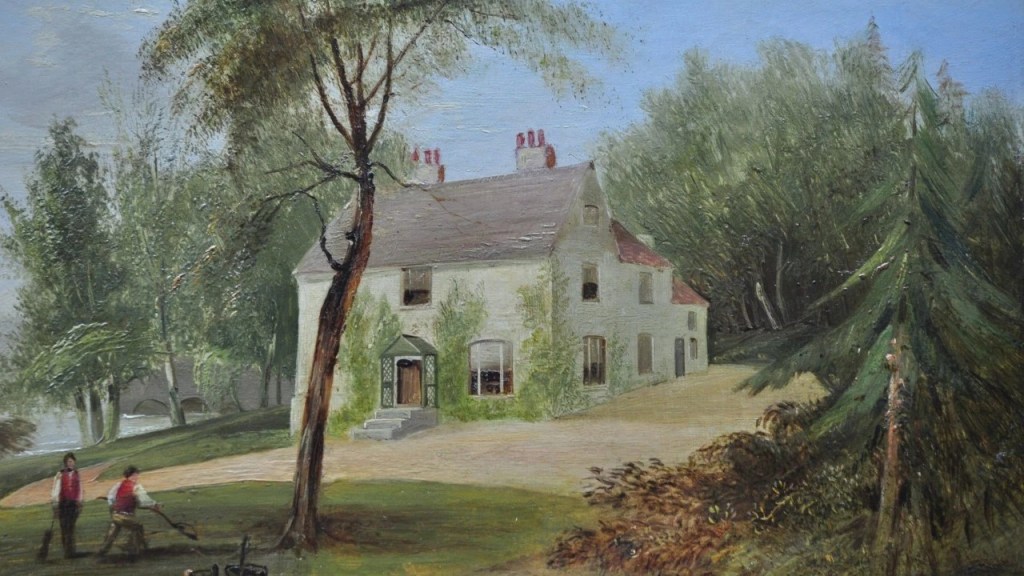
The Old Vicarage in Kintbury
In 1860 the old vicarage – the home to three generations of the Fowle family, the place where James Austen first met Mary Lloyd and where Cassandra had said her last goodbye to Tom – was pulled down to be replaced by a house in the very latest Victorian neo-Gothic style.
To this day, there are houses in Kintbury where, it is sometimes claimed, Jane Austen stayed. I believe that the only house about which we can say for sure, “Jane Austen stayed here” was the original vicarage on the banks of the canal, now long gone and replaced. Cassandra may well have continued to visit Rev Fuller and his wife Eliza there after Jane’s death. However, with regards to the other houses, I believe that it has to be likely that these were the homes of Elizabeth Caroline, Mary or Isabella and that Cassandra would have stayed with with one of them on her later visits to Kintbury. It has to be very likely that, over the years, local folk memory has somehow become confused. So, when Kintbury villagers knowingly talked to their children and grandchildren of the illustrious visitors who once stayed here, the Miss Austen of whom they spoke so respectfully was not Jane, but Cassandra.
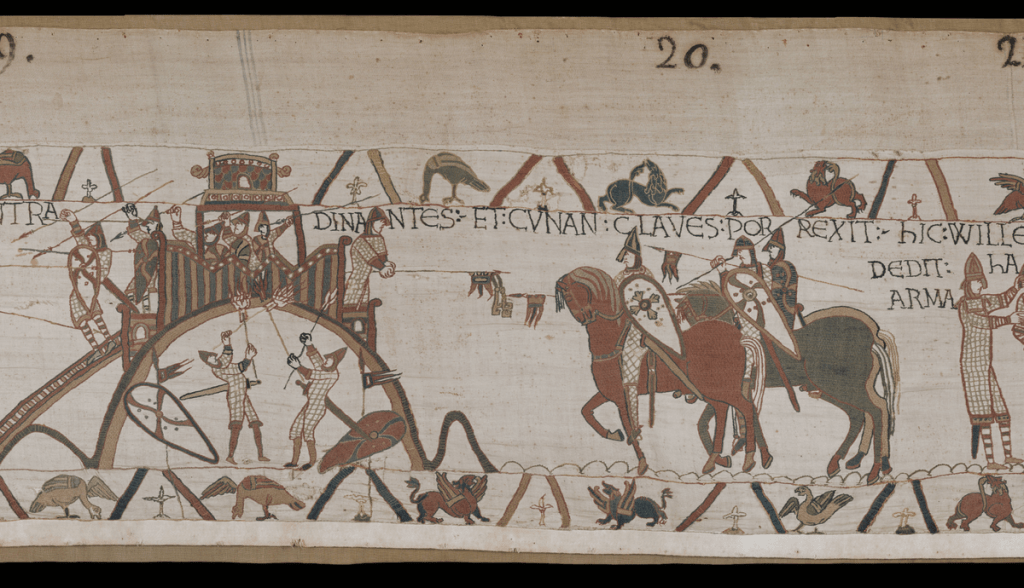
Motte and bailey castles are the stuff of children’s story books: picture a mound surrounded by a ditch and topped with a wooded palisade, inside of which is a wooden or stone fortress. Perhaps knights in armour are seen approaching on horseback, or an elegant lady wearing the inevitable wimple or cone-shaped head dress. Somewhere nearby, colourful flags and banners ripple in the wind.
In reality, the motte and bailey castles of history were introduced by the Normans after the invasion of 1066 and an example can be seen on the Bayeaux tapestry:
Windsor Castle is an example of a motte and bailey, although over the years of its existence, the building has had much more added to it. By contrast, in Oxford only the motte survives of the original castle construction.
Most interestingly, the OS map of our area records a motte in the village of West Woodhay. A little way from St Laurence’s church, but on the opposite side of the road, and now surrounded by trees, most passers-by will be totally unaware of its existence. However, thanks to the work of O.G.S.Crawford (see a previous post) we can still identify the site of early medieval activity in our area as the word “motte” in a Gothic font is clearly marked on the map. But does the presence of a motte also indicate that there was once a castle, or at least some sort of defensive structure, in the now quiet and peaceful village?
There have never been extensive excavations in the West Woodhay area – perhaps I should add, as of yet. However, in the 1930s enthusiasts of the Newbury Field Club did painstakingly dig the site. Their findings were recorded by one E. Jervoise and you can read what he discovered in volume 7 of the Newbury Field Club Journal in Newbury Library.
The West Woodhay motte is of modest size – the Field Club members recorded its rise to be just 8 feet and the diameter at the top just 30 feet. These dimensions, of course, would have dispelled any expectation of a substantial building so I can forget any fanciful thoughts of a West Woodhay castle. However, red and brown roof tiles and eighty iron nails were found on the crest of the mound, suggesting some sort of construction even if quite small. Broken pottery was found on the top of the mound and in the surrounding ditch, including rims and bases of what was believed to be at least 40 cooking pots or bowls of a type in use in the twelfth century. Some of the sherds found showed traces of glaze. The excavators weighed these finds and found there to be 40lbs of them.
The diggers also recovered soes believed to have belonged to oxen. Also discovered was what Jervoise describes as a “hone” by which he must mean a stone for the sharpening of blades. It had been, “ made of fine grained silicous schist, a rock occurring in Scotland and Normandy.” Most probably a valued or valuable item, then.
Jervoise was particularly pleased by the discovery of a small bronze buckle “of fine workmanship” and having, “an unusually perfect green patina”.
He concluded that it might have been the site of an early medieval hunting lodge and it was certainly somewhere that food was prepared and eaten.
Hunting lodges were not uncommon in the medieval period – a time when a popular sport amongst the nobility was hunting for deer or boar. The lodge would have been the place where visitors, on what in later times might have been referred to as a “straightforward hunting weekend ” would stay or just return after a day’s sport for food and refreshments. With its slightly elevated position on the motte, its view towards Walbury Hill to the south west and the wide open Kennet valley to the south east, the hunting lodge might well have been built to impress.
Although the West Woodhay motte was likely never the site of a defensive structure, or indeed anything at all like a castle, I think it is quite safe to assume that the owner of this land in the twelfth century would have been a wealthy man and most likely of Norman descent, speaking Norman French. But while the nobility and upper classes generally would have spoken Norman French, it has to be likely that those preparing the food and washing the cooking pots were of humbler stock. These working people are likely to have spoken the language of the West Saxons or even Middle English – possibly a mixture of both.
Today West Woodhay is in many ways a quintessential English village – typical of many smaller settlements on the southern chalk lands. It is difficult to imagine a time when the English language, as we speak it today, would not have been understood there. Perhaps it is even more mind boggling to imagine a time when the local land owners would have conversed in Norman French!
It is easy to forget that, before the reformation, all English parish churches would have been Catholic and all priests looked to the authority of the Pope. Although ancient buildings such as St Mary’s in Kintbury or St Michael’s in Enborne might seem to represent an enduring and continuing tradition of Christian worship, over the hundreds of years parishioners will have experienced turmoil and change particularly in respect of the break with the Catholic church in Rome.
After the Reformation, life became very difficult for those people who chose to follow the “Old” religion as keeping the Catholic faith became prohibited by law. Catholic positions in public life were restricted, for example Catholics were not allowed to enter the legal profession until 1791 and no Catholics were able to vote – even if they fulfilled other restrictive requirements – until 1829. Catholics were not accepted at either Oxford or Cambridge university until 1871.
It is not surprising, therefore, that in the south of England most people in towns or villages were either members of the Anglican church or one of the other protestant denominations – Baptist, Methodist, Congregationalist, Quaker and so on. However, some prominent families were able to maintain their Catholic faith and, in the south at least, these were mostly the wealthier families.
The Dukes of Norfolk, whose family seat is at Arundel in Sussex, are one such example. The present Duke is the country’s most eminent Catholic. Nearer to Kintbury, Sir John Throckmorton of Buckland House – the man who, in 1811 put up the wager which resulted in the Newbury Coat – was Catholic. Unusually for a small English village, mass was regularly held in the Catholic church in Buckland until the beginning of the twenty first century.
In 1893, a member of a wealthy Catholic family from the north of England chose to relocate to West Berkshire.
Humphrey J.G. Walmsley had been born in 1846 in Wigan, second son of William Gerard Walmesley & Caroline De Trafford of Westwood House, Lower Ince in what is now Greater Manchester. In common with other wealthy Catholic families of the time, the Walmesleys had a private chapel of their own which had been built between 1855 & 1856, the work having been overseen by the prominent church architect, Edward Welby Pugin.
In the world of church architecture, Pugin was a name to be reconned with. E.W. Pugin was the son of Augustus Northmore Welby Pugin, particularly remembered for having designed the interior of the palace of Westminster and the Elizabeth Tower which houses “Big Ben”. When his father died in 1875, E.W. Pugin took up the family business and continued as a successful designer of buildings in the then much admired Gothic style.
In employing E.W.Pugin to design the family chapel, the Walmesleys must have been making a statement not only of their commitment to the Catholic faith but also one which spoke of their ability to afford this addition to their home in the most fashionable design.
When Walmesley relocated to Inglewood House, a mansion near Kintbury, the nearest Catholic church was in Newbury. This must have been one of the reasons why the new owner decided to have a chapel erected at Inglewood. However, rather than commissioning the building of an entirely new place of worship, Walmesley had the chapel at his home in Wigan removed and transported brick-by-brick to Berkshire using the canal system for transportation. It must have been a slow and laborious process – to say nothing of the expense.
The re-erected chapel was consecrated on 26th July 1905 by the Right Reverend Dr Cahill, Bishop of Portsmouth. According to the Wigan Observer, the new chapel was a site to behold with an altar of marble and alabaster, the altar steps of Italian marble. The stained glass had been designed by Hardman & Co., one of the leading designers of the time. Lamps, candlesticks, candelabra and vases were of brass burnished with gold. “It is a gift to West Berkshire” the report concludes.
It seems that everything about Humphrey Walmesley’s chapel was lavish. Not surprisingly, perhaps, as this family newly arrived from the north were clearly very wealthy. During his time at Inglewood, Walmesley was able to purchase several neighbouring farms to add to his estate making him a prominent local landowner and person of standing in the Kintbury area. The 1901 census had shown that he was living on independent means and, not surprisingly, he and his wife Marie employed 16 live-in staff at Inglewood House as well as their own Roman Catholic priest.
The Walmesleys welcomed other local members of their faith to hear mass with them at their chapel thus enabling Catholics from the Hungerford area to attend a service without having to travel to Newbury or Woolhampton. I have not been able to find out if baptisms or weddings were ever celebrated at Inglewood, although I believe it must be likely that some baptisms would have been.
Inglewood House remained in the Walmesley family until 1928 when it was purchased by the De La Salle brothers, meaning it remained a centre for the local Catholic community
However, in 1972 the De La Selle brothers left Inglewood for Wallingtons, a similarly large property a little nearer to Kintbury. From 1972 the house was home to the Inglewood Health Hydro, then in 2006 it was sold to Raven Audley Court as a retirement home.
This sale was bad news for what remained of the relocated Pugin chapel and those with a fondness for Victorian ecclesial architecture, as well as those local Catholics who may have had very fond memories of hearing mass there. Despite representations to English Heritage from both the Victorian Society and the Pugin Society, the demolishers moved in before the building could be listed and subsequently preserved. The English Heritage report of 2006 gives us some idea of what it might once have looked like:
The chapel is built in Gothic style and is brick built with stone dressing.
Historic photographs indicate that the windows had tracery and stained glass.
The painted ribs to the nave ceiling and painted panels and ribs to the chancel survive as does the highly colourful tiled floor to the chancel. The tiles are Minton and are decorated with fleur-de-lys and floral motifs. There is also an elaborate metal-work rood screen in blue and gold incorporating the family coat of arms.
Historic photographs indicate that the chapel was very richly decorated internally with fixtures and fittings that were originally of the Pugin scheme. These included stained glass depicting the name saints of the Walmesley family, and a carved altar and reredos in alabaster and marble.
The walls were part covered in carved wooden panels.
All these features are believed to have been removed in the last couple of weeks.
So, to all intents and purposes, Humphrey Walmesley’s chapel was no more, its fittings and stained glass sold or given away to who knows where. The rest of the building was finally demolished and Kintbury’s small Pugin masterpiece became just a memory.
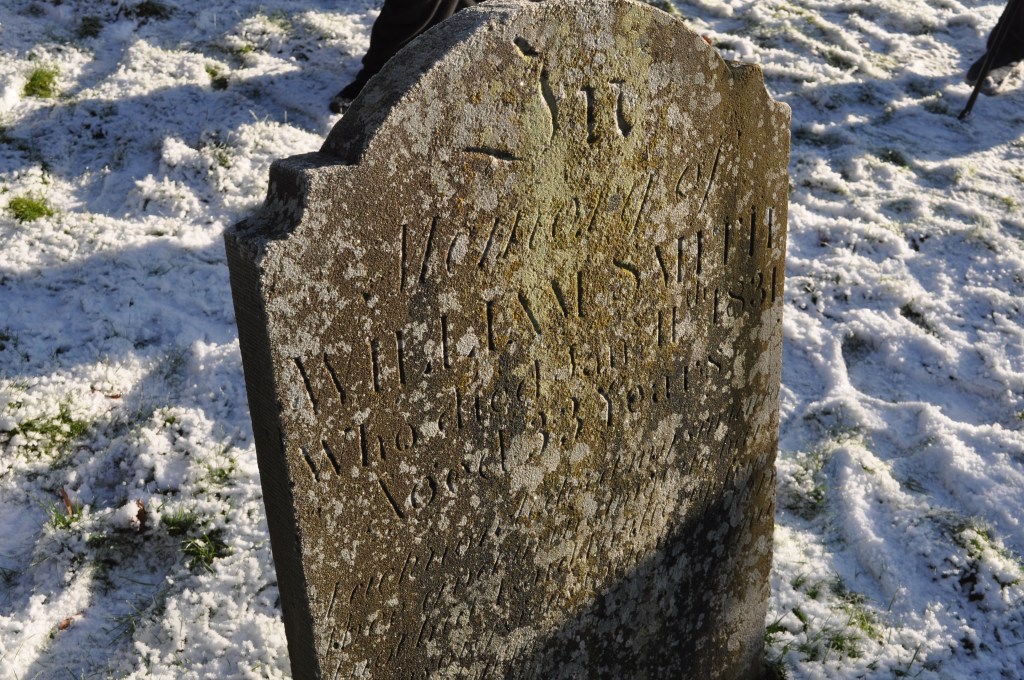
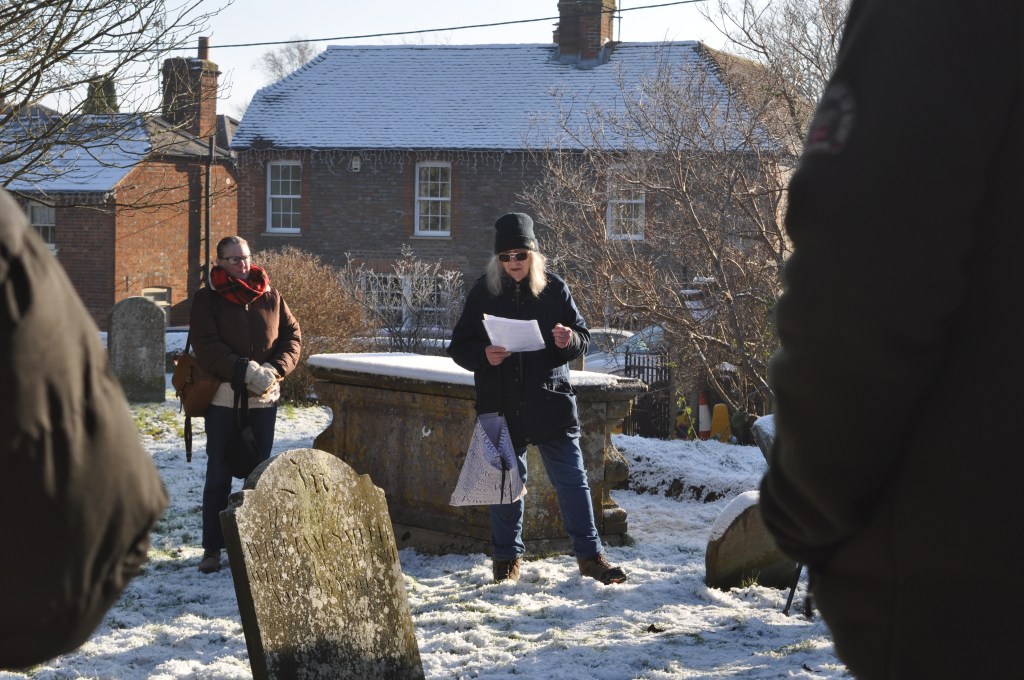
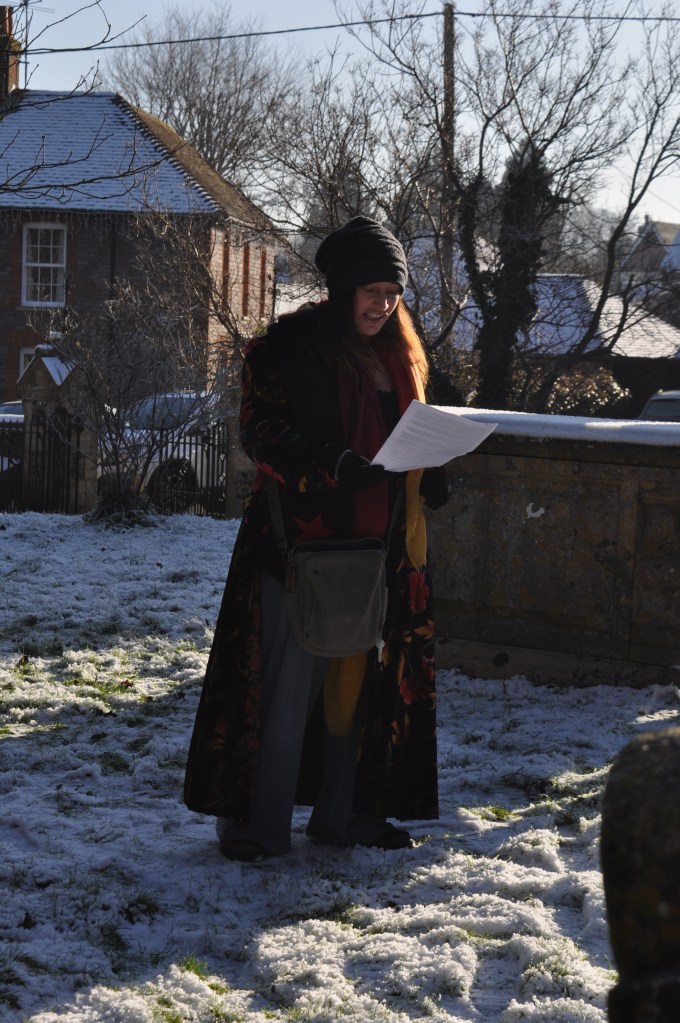
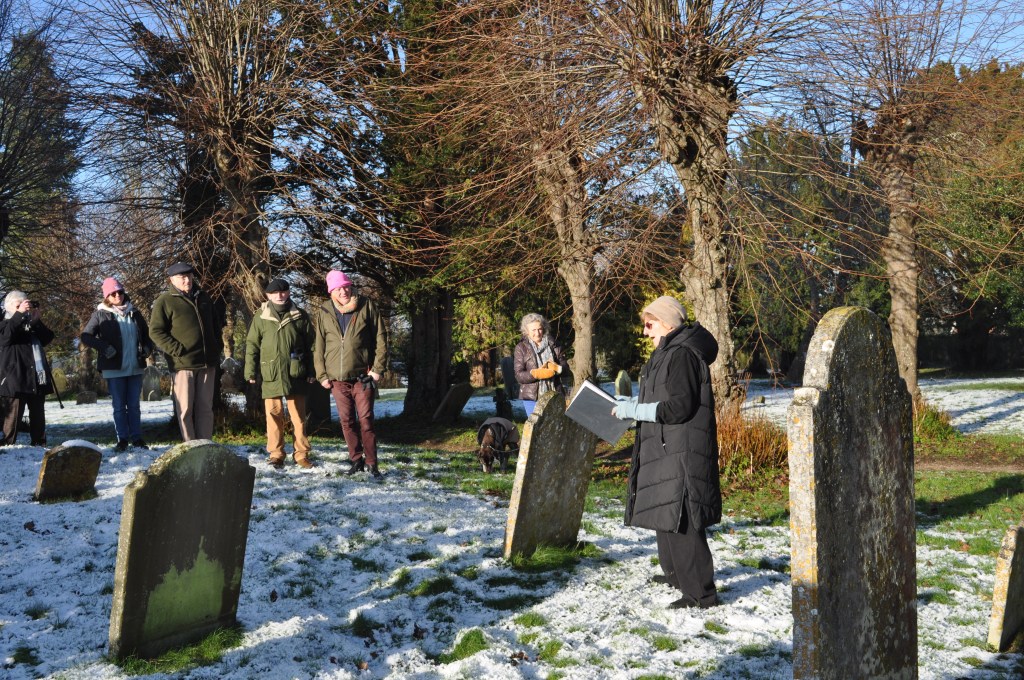
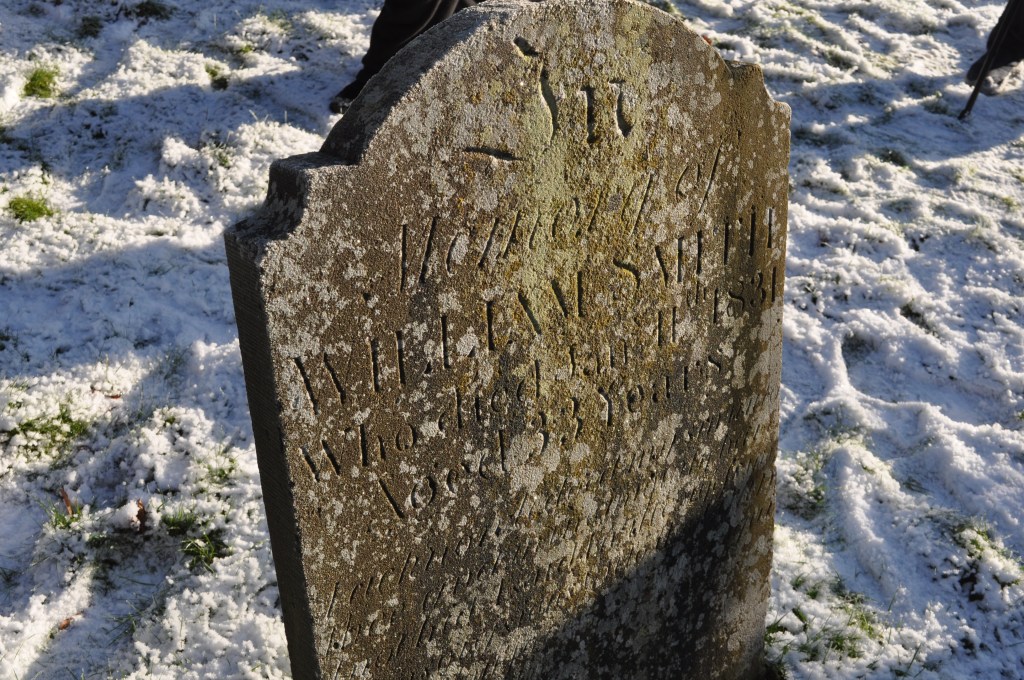
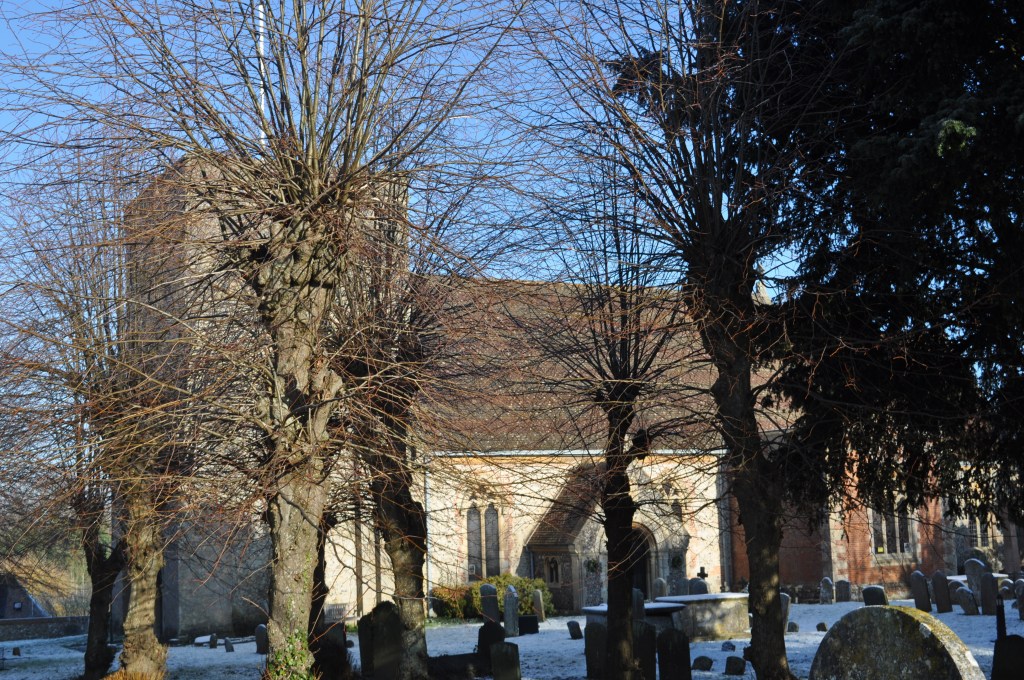
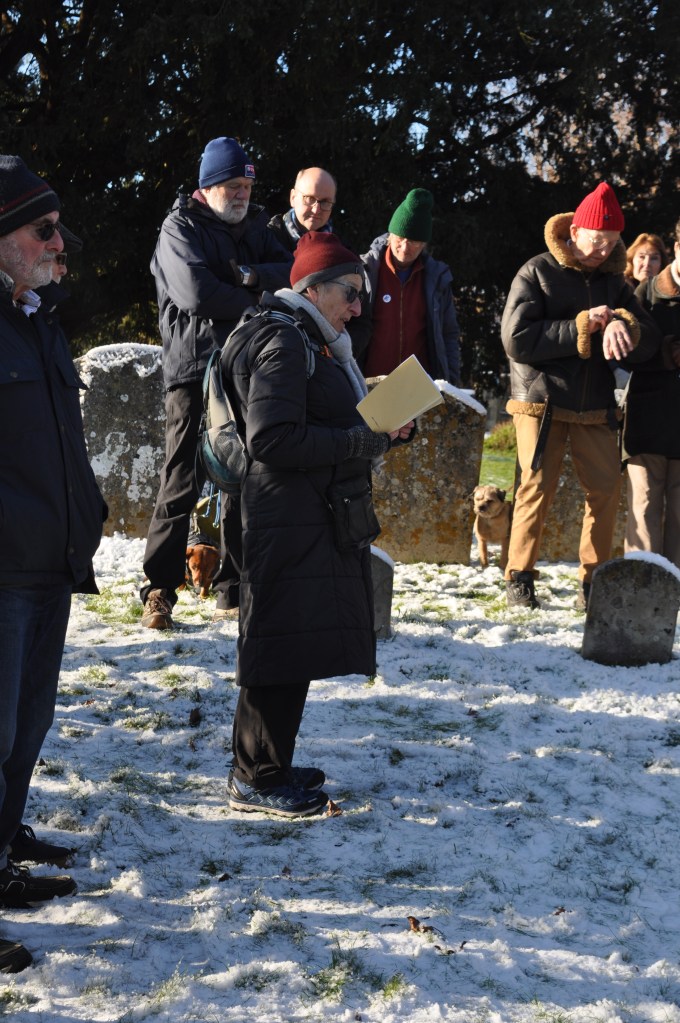
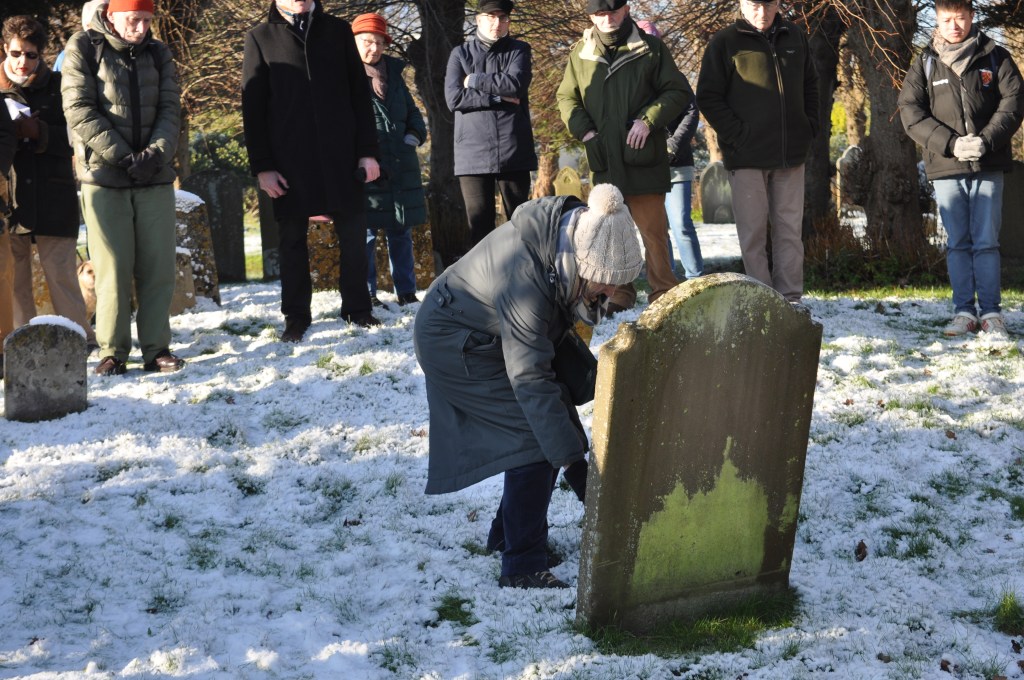
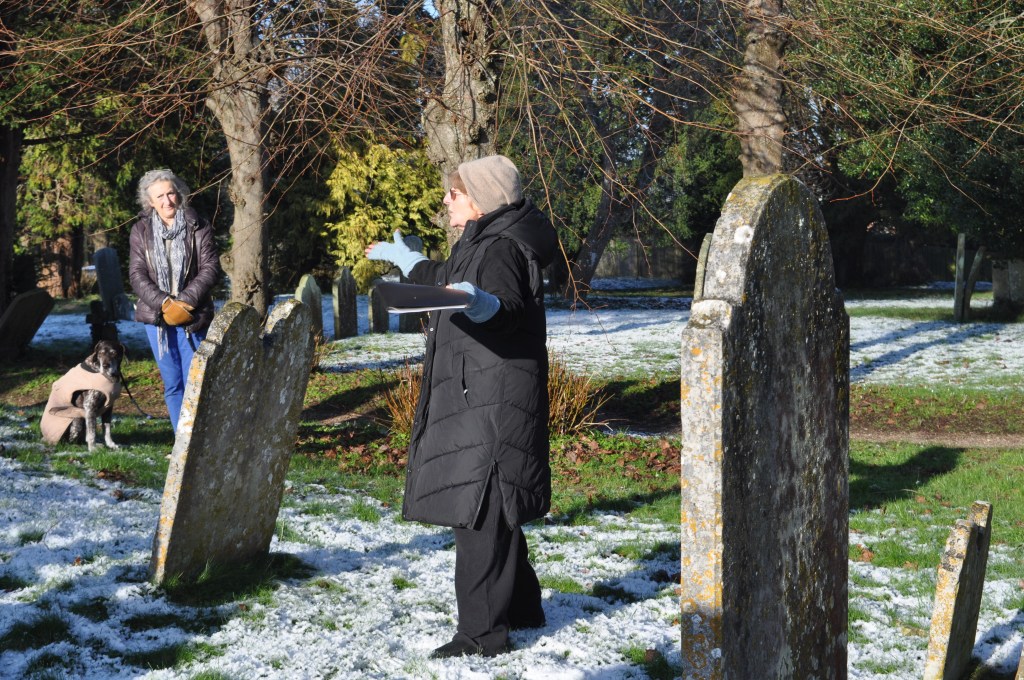
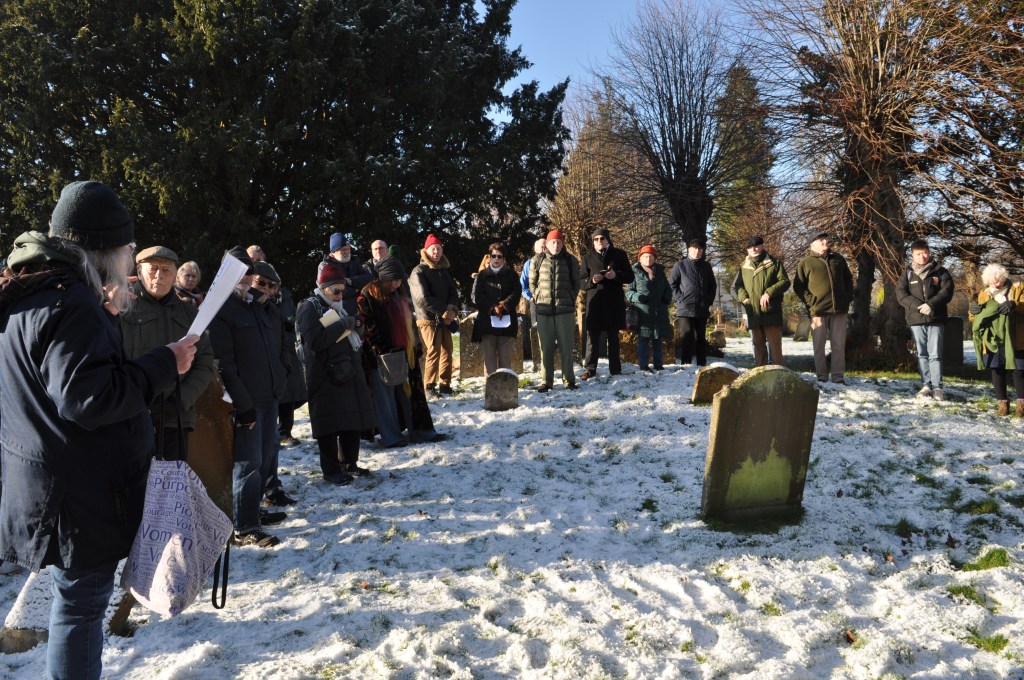
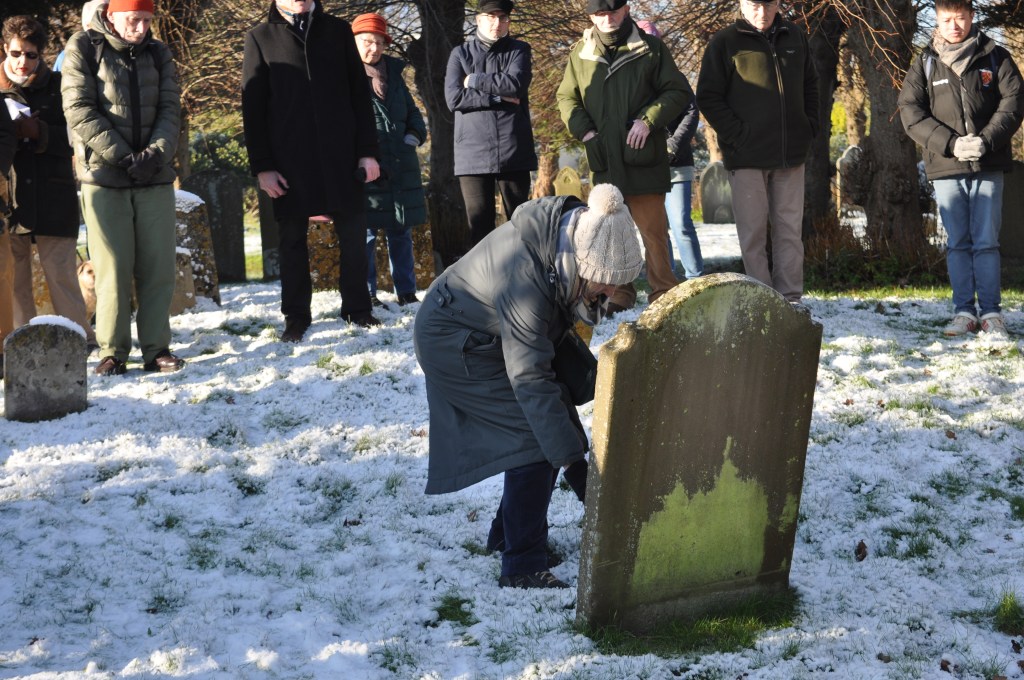
On January 11th each year, local people, family members and supporters from further afield including historians, trade unionists and those concerned with social justice, gather at the grave of William Winterbourne in St Mary’s churchyard.
William Winterbourne, also known as William Smith, was hanged at Reading Gaol at 12 o’clock on January 11th 1831. His crime was to have been involved in the protests that swept across southern England the previous autumn as labourers fought for improvements to their pay and conditions of work.
This year, the bright sunlight shone on the lichen covered stone such that William’s name could be read clearly. As his parents were not married at the time of his birth, he is buried under his mother’s name of Smith, in accordance with the custom of the time.
This year, we were joined by over twenty people who gathered to listen to accounts of how the Swing Riots had impacted on this part of West Berkshire, and William’s involvement in them.
All Photos (C) Chloë Wells
You may be interested in further posts about the Swing Riots in West Berkshire, those involved, and also what happened to one who was convicted and transported to Australia:
“The past is a foreign country: they do things differently there.” L.P. Hartley
Queen Victoria had come to the throne as an eighteen year old in 1837 and reigned for 63 years. Consequently, at the turn of the century in January 1901 (the 20th century was deemed to have begun in 1901, not 1900) most people had known no other monarch.
Victoria died on the Isle of Wight on January 22nd 1901 and was succeeded by her son, the new king, Edward VII. And so, the people of Britain were no longer Victorians, but Edwardians.
So what was the Christmas period like for the new 20th century Edwardians? I looked through the pages of the Newbury Weekly News to find out.
The first thing that I noticed was that the Christmas period was much more low-key than at present with very few Christmas themed events, if any, and far fewer advertisements for Christmas goods. Life in our part of West Berkshire was not much different from any other two week period in the autumn or winter. Disappointingly, there are hardly any news reports from the villages in our area at this time although there are several reports from Hungerford and a few from Kintbury.
A colder spell before Christmas 1901 had resulted in the canal freezing over such that the inhabitants of Hungerford had been looking forward to an ”oldfashioned” Christmas, presumably looking back to the very cold winters of the mid 19th century. Hopes were dashed, however, when the weather turned wet and windy. To prepare for the inclement weather, inhabitants of Newbury could, if they so liked, purchase a mackintosh with velvet collar for between 5 shillings 11 pence and 18 shillings 11 pence from McIllroy & Rankin of Cheap Street, and compliment the new coat with an umbrella from 1 shilling three farthings. Bailey’s of Northbrook Street boasted selling the cheapest boots: ladies’ at 1 shilling 9 pence a pair, gentlemen’s at 2 shillings 6 pence and children’s at 1 shilling 4 pence.
Despite the availability of wet weather clothing, Hungerford Primitive Methodist choir abandoned their customary carol singing in the town as the weather was considered too bad to go out. Perhaps instead they stayed at home and read by the light of a gas lamp, obtainable form Joseph Hopson of Newbury, which, it was advertised, would burn for 10 hours for only a farthing.
Although outdoor carol singing might have been abandoned, the pages of the NWN reveal that much local indoor entertainment was music- based. “Choral classes” were established in Kintbury with a Mr. S. Argyle conducting. The choir were practising a cantata called “King Harold” by Cunningham Wood. Also in Kintbury, a musical evening was held in the Wesleyan Methodist church on December 18th where members of the newly formed Guild Band were hoping to raise funds for a harmonium by presenting a concert of religious songs, instrumentals and readings.
“The band is only in its infancy, “ the NWN reported, “ and does not yet expect criticism but promises to be worth hearing at no distant date”.
For the more energetic ladies of Hungerford, a Spinsters’ Dance was held at the Town Hall on a Friday before Christmas. It was attended by between 80 and 90 people and took place between 8 o’clock and 3 o’clock, which, I am presuming, was am rather than pm, although the report does not specify!
I had expected to read something of children’s Christmas parties but, if these were held in the local villages, no reports of them appeared in the pages of the NWN. Fundraising, however, did continue in Kintbury, where, in the week before Christmas, £1, 15 shillings 11 pence was raised by the children of St Mary’s School for Dr Barnado’s Waifs Association.
On the subject of schools and education, however, a letter in the NWN reveals that a very retrogressive attitude toward education still existed in some sectors of society, despite this being the 20th century. A letter printed just after Christmas and sent from a former Newbury teacher reads:
“Sir, I am sorry to notice in your paper that there are a few people who are still of the opinion that education is not good for farm labourers and other working folk…
They themselves do not object to education but on purely selfish grounds they would keep it from the poor lest they should be less servile.”
If educational opportunities did not present themselves for the new Edwardians, servile or otherwise, an advertisement in the local paper suggested a career in the military might be beckoning as recruits were wanted for all branches of His Majesty’s army. I wonder how many local lads responded to the offer.
On the Monday after Christmas, the Craven Hunt met at Wallingtons, Kintbury, the residence of Mr William Hew Dunn. Attended by various of the great and the good of the area, the occasion was “of particular interest” as a portrait of Mr Dunn was presented to him in recognition of his service to the hunt.
Elsewhere, the Christmas period was a quiet one; at Hungerford market, corn had been in short supply due to the meagre attendance of farmers and traders. Anyone looking to buy “Native Guano” however, could obtain a 1 cwt bag mail order, which would be sent carriage paid to any station in England on receipt of a postal order for 5 shillings. I wonder how many were delivered to Kintbury, or whether the local equine population provided local gardeners with all they required.
The Christmas period does not seem to have been a time of conspicuous consumption and over-spending for the new Edwardians. However, should any one of them need some extra money, and just so happen to have an old set of false teeth lying around, an advertisement in the NWN of January 1902 has the answer. RD & JB Fraser of Princes Street, Ipswich would buy your old false teeth from you. So the new century was not without opportunities to make that bit of extra cash!
It is mind boggling to think of people living in this area over 6000 years ago. However, if you know where to look for it you can still see evidence of those people who lived around here between c4000 and 2500 years BC in the neolithic period.
The neolithic, or new stone age, was the period which saw a more settled way of life with the domestication of plants and animals and the beginning of farming rather than a hunter/gatherer life style.
During this period there were communal constructions of large scale earth works, banks and ditches. The famous henge monument at Avebury dates from this period.
But where is the evidence that neolithic people once lived in this area?
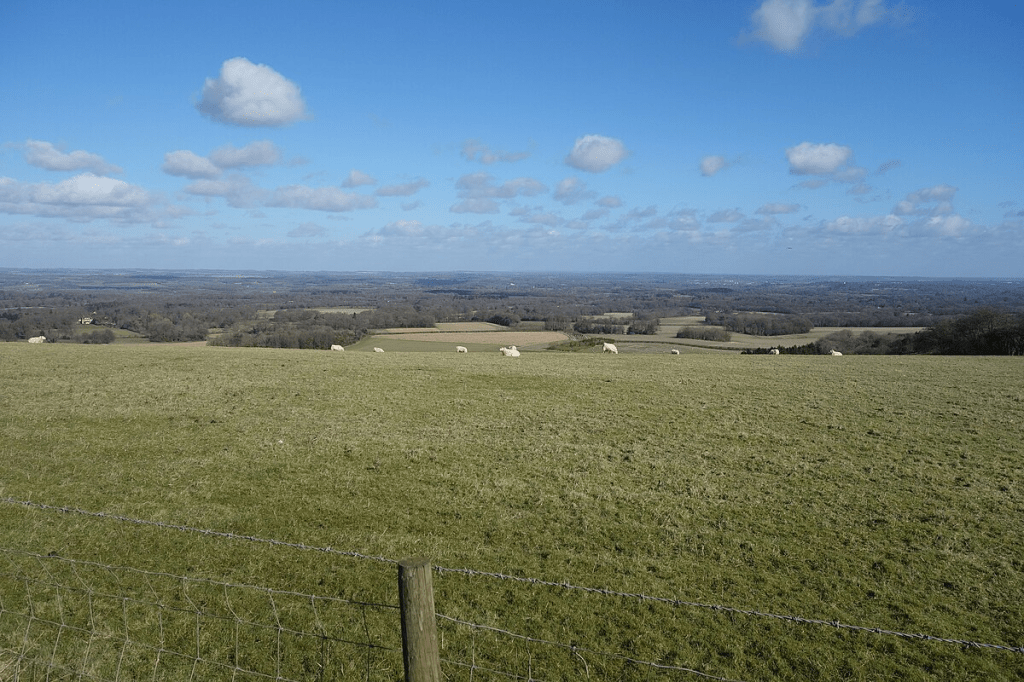
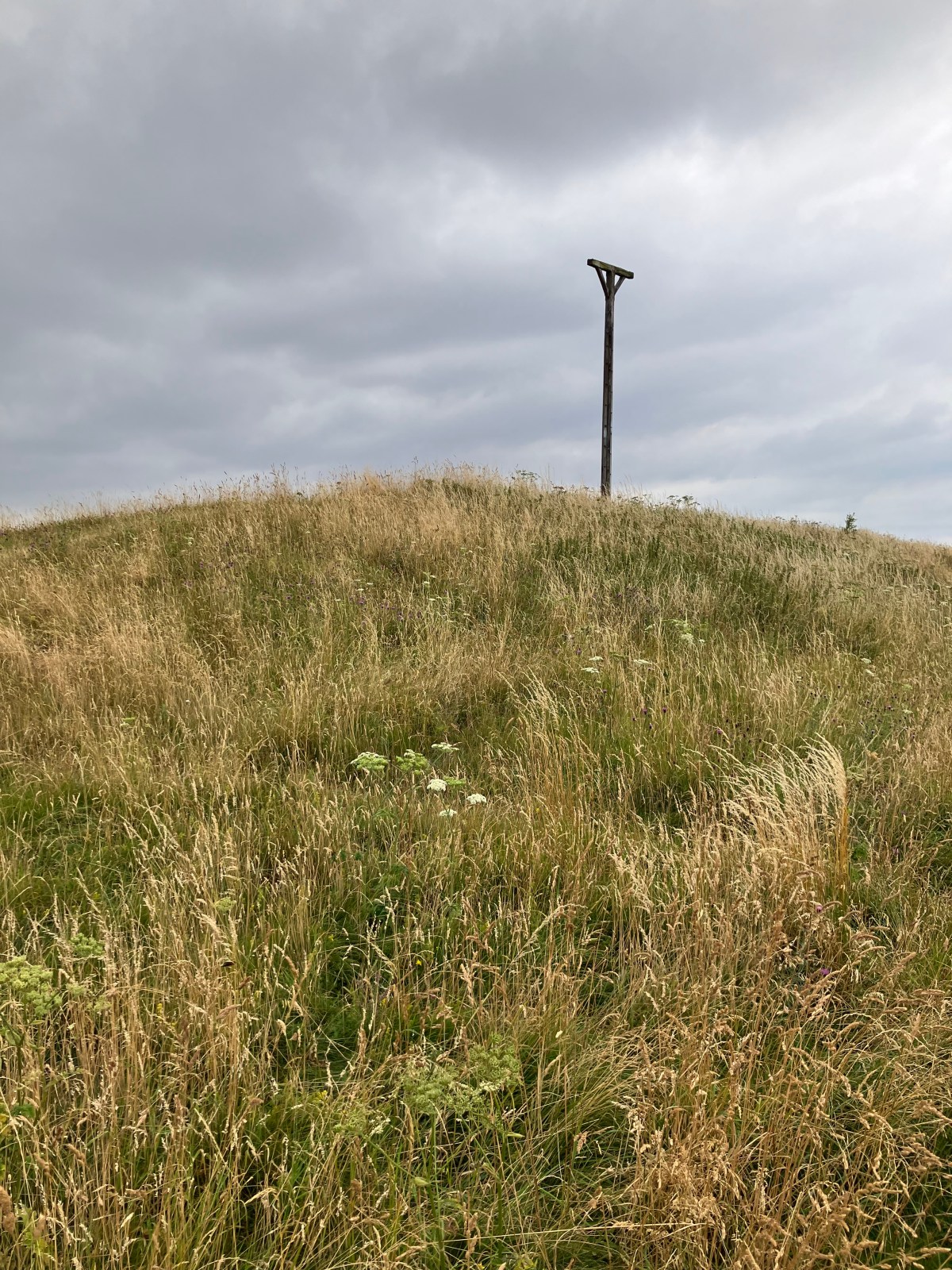
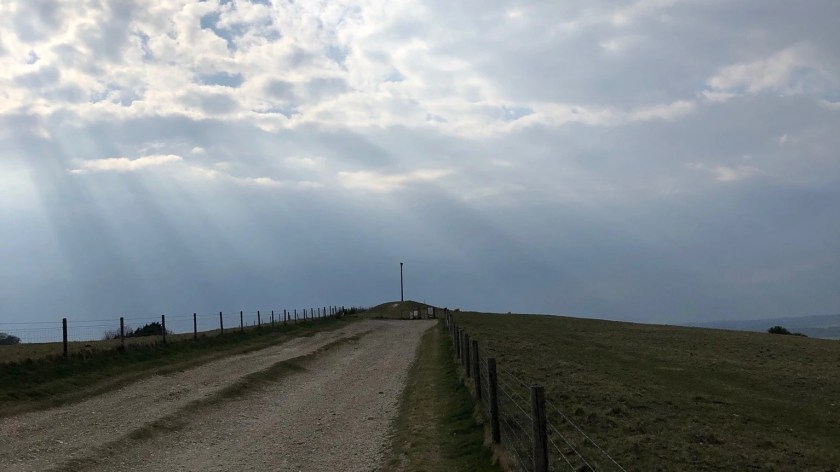
A favourite local destination for many of us in our area is Combe Gibbet above Gallows Down, close to the highest point on chalk in England and affording spectacular views particularly to the north across the Kennet valley. Standing right next to the gibbet we admire the view and identify local landmarks. It is an uplifting and spectacular spot.
But is there something that we miss? I know I did when I first walked up to the gibbet. As it stands on one of the highest points of the hill, it is easy to overlook the fact that the gibbet has been erected on a mound. The mound on which it stands is actually a neolithic long barrow.
There are around 500 neolithic long barrows in England of which three are in Berkshire and many more over the borders in Wiltshire and Dorset. Generally speaking most are in the Cotswolds or Wessex.
Our local barrow is oriented east to west and measures 65 meters by 20 meters and is surrounded by a ditch about 7 meters wide. Constructing it was no mean feat particularly when the only tools available were made from bone or flint and would have required a well-organised and dedicated work force.
But why was it built up here?
Long barrows were important communal burial sites during the neolithic. A chamber was usually constructed of wood or stone with an entrance at one end, then covered over with earth. Members of the community were laid to rest in the tomb but, in a practice that seems strange to us, often only certain bones were placed within and it seems likely that the remains were, at times, taken out and replaced.
It is likely that the long barrow would have been an important ritual site for the local community and might have indicated ownership of a particular area by a particular group of people. A location commanding an impressive view seems to have been important; for example, Wayland’s Smithy Long Barrow near Uffington and West Kennet near Avebury are also sited on higher ground.
The long barrow above Gallows Down was likely to have been the focus of communal events. However it may well be that our neolithic neighbours would have travelled further afield to meet up with other family members or community groups; the henge and stones at Avebury could have been reached by following the river Kennet westwards, for example. We know that neolithic peoples often travelled hundreds of miles to join in the ceremonies at Stonehenge so the thirty or so from here across Salisbury Plain would have seemed any easy journey to people used to walking long distances
So, as we traipse up to the gibbet and admire the view, perhaps we should remember that beneath our feet is a construction that would have been important to our neolithic neighbours – something that would have been revered and respected, which had taken much time and effort to build. After all, we can not imagine a time when we would walk through Winchester Cathedral whilst ignoring its significance as a place of worship, or pass Windsor Castle without seeing it as something just a bit special.
Our local long barrow, up above Gallows Down, might not look particularly important to us now, but it is worth remembering that 6000 years ago it might have been the most significant thing in the landscape.













 Kintbury and Beyond