Kin & Kintbury

In this article, Ellen Lock Ireland discusses Jane Auten’s close relationship with friends and extended family in Kintbury.

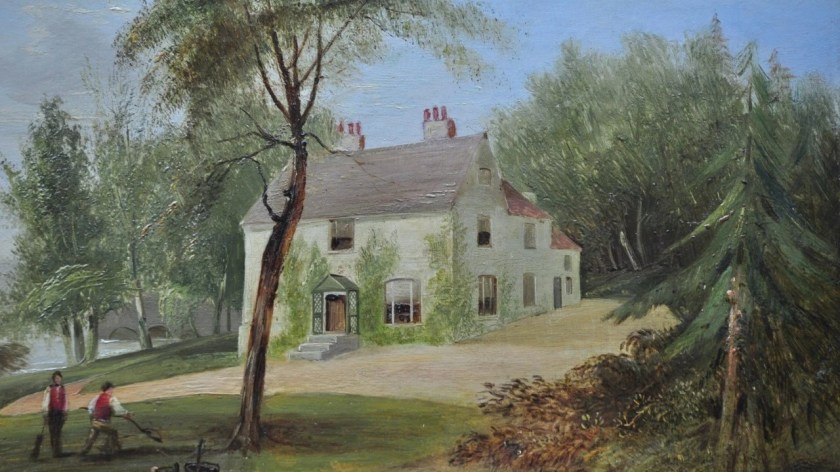
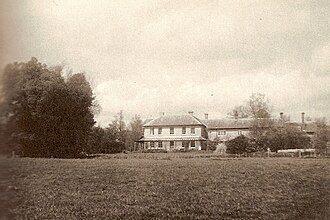
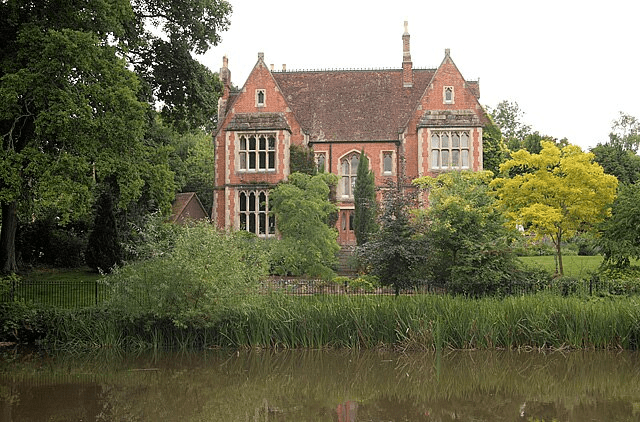
The Old Vicarage in Kintbury

Similarly to the way in which we meet the families in Jane Austen’s novels (the Bennets, Bingleys, Dashwoods, Morlands, Bertrams etc), we can get to know a real life Kintbury family through her letters to her sister. As Jane herself says “the true art of letter writing…is to express on paper exactly what one would say to the same person by word of mouth…”

Jane Austen’s writing table

The protagonist family in Kintbury’s particular local story, which we might call “Kin and Kintbury”, are, of course, the Fowles, a dynasty of local vicars. The two families first becoming acquainted when George Austen met Thomas Fowle Senior during their university days at Oxford. The relationship was solidified for the next generation when Thomas Fowle sent his sons Fulwar, Thomas, William and Charles to study with George at the Steventon rectory prior to their going to university. Studying and living in the same house alongside the Austen children inevitably resulted in lifelong friendships.

The closeness of these two families is reflected in the fond memories shared by James Austen in his poem, Lines written at Kintbury- May1812:

“And still in my mind’s eye methinks I see

The village pastor’s cheerful family.

The father grave, yet oft with humour dry

Producing the quaint jest or shrewd reply;

The busy bustling mother who like Eve,

Would ever and anon the circle leave,

Her mind on hospitable thoughts intent;

Careful domestic blunders to prevent.

And ever ready on her guests to pour

The corner beaufet’s rich and savoury store.

While yet a gayer group, 4 manly boys

Heightened the relish of domestic joys

Of future happiness gave promise fair”

James Austen

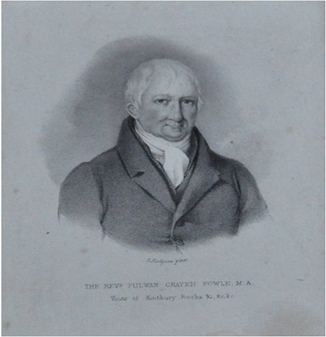
As we know, Fulwar became Vicar at Kintbury in 1798, taking on the role from his father Thomas. As a fan of Jane’s fictional clergy, it is perhaps gratifying to read her description of Fulwar’s response to a less than successful card game session of 1801, reporting to Cassandra “We played at Vignt-un, which as Fulwar was unsuccessful, gave him an opportunity to expose himself as usual”.  Fortunately, perhaps, for Fulwar’s legacy, the plaque installed in his memory leaves a somewhat more positive impression for posterity, stating that it was commissioned “by the parishioners of Kintbury, in testimony of their respect and affection for him as their pastor, friend and neighbour”.

Rev Fulwar Craven Fowle

Fulwar’s wife, Eliza, nee Lloyd, also features in frequent subplots in Austen’s letters, with Jane impatient for news of the familial goings on in her life, for example complaining to Cassandra prior to the birth of one of Eliza and Fulwar’s children in 1798 “No news from Kintbury yet- Eliza sports with our impatience! She was very well last Thursday…”

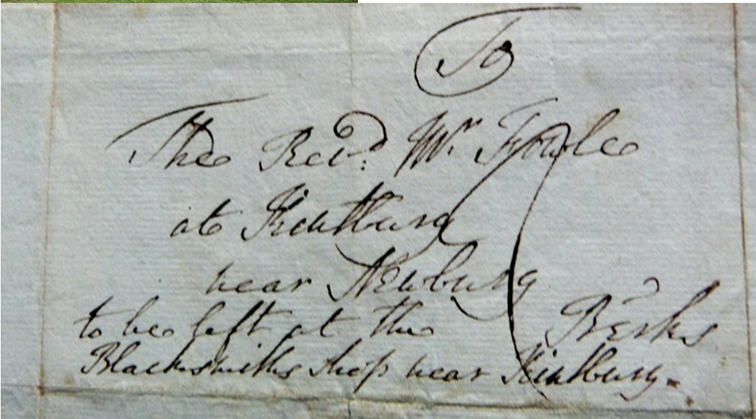
A letter addressed to the vicarage at Kintbury

In a letter of 1801, Jane provides us with a less than flattering impression of Eliza, telling Cassandra “Eliza says she is quite well, but she is thinner than when we saw her last, & not in very good looks. I suppose she has not recovered from the effects of her illness in December.- She cuts her hair too short over her forehead, & and does not wear her cap far enough upon her head- in spite of these many disadvantages however, I can still admire her beauty.”

As well as being the wife of an old family friend, Eliza also had the familial claim, not only as the sister of Jane’s brother James’ wife, but also the sister of her particular friend Martha Lloyd, whom Jane once described as “the friend and sister under every circumstance”. Martha is known to have lived with Jane, Cassandra and their mother in various residences including those in Southampton and Chawton. The close bond is reminiscent of that between sisters, with Jane complaining in jest to Cassandra “I would not let Martha read First Impressions again upon any account…she means to publish it from Memory, & one more perusal must enable her to do it.”  

The close bond between the families is further highlighted at times of personal tragedy. Following the death of Edward Austen-Knight’s wife Elizabeth, in 1808, Jane wrote to Cassandra of Eliza’s correspondence to her, quoting Eliza’s own words “A very kind and feeling letter is arrived today from Kintbury. Mrs. Fowle’s sympathy and solicitude on such an occasion you will be able to do justice to, and express it as she wishes to my bother. Concerning you, she says “Cassandra will, I know, excuse my writing to her; it is not to save myself but her that I omit so doing. Give my best, my kindest love to her, and tell her that I feel for her as I know she would for me on the same occasion, and that I most sincerely hope her health will not suffer”.

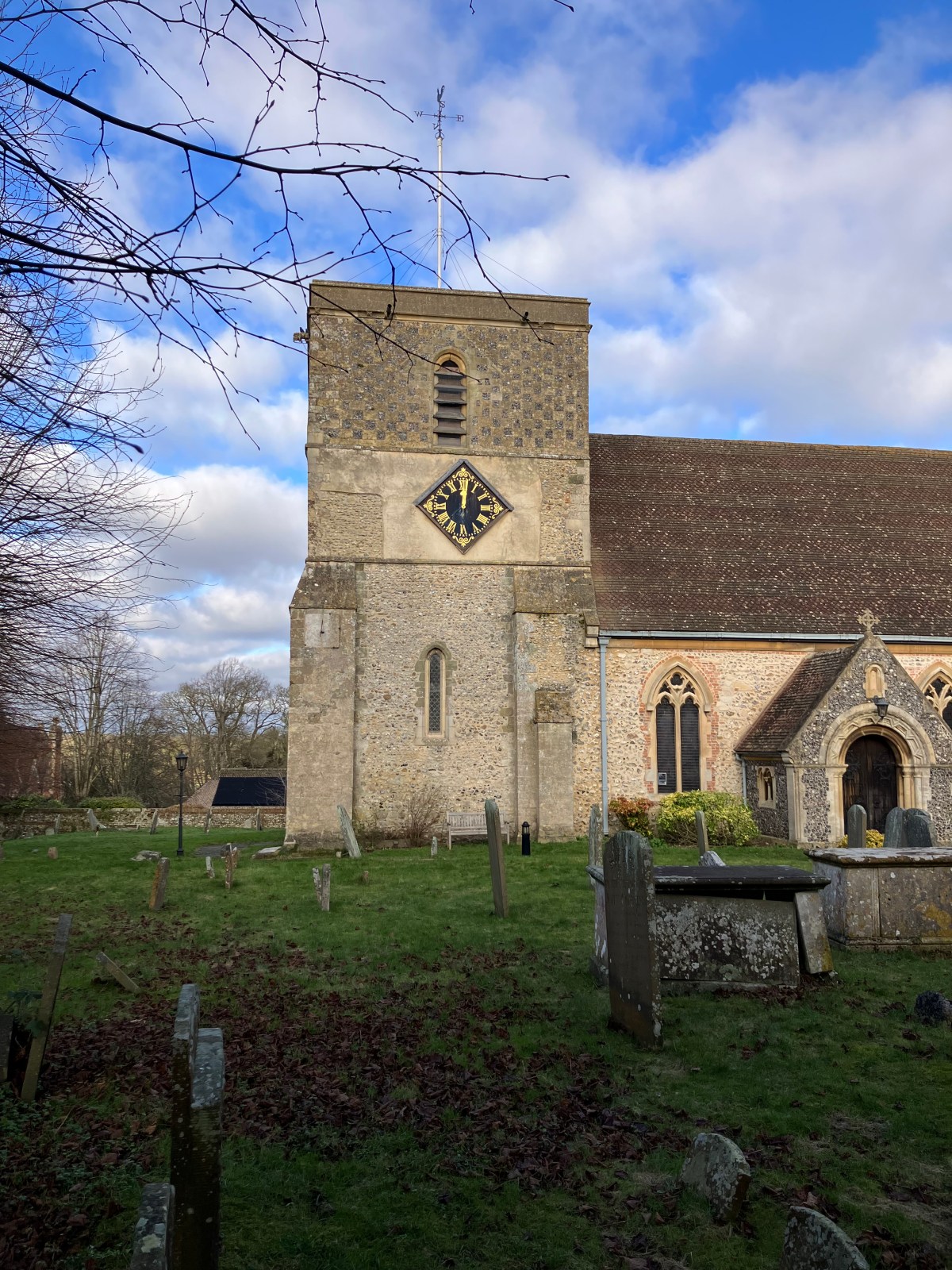
West door of St Mary’s, Kintbury

Just as the Fowle and Austen family links survived into a second generation, Jane and her family eagerly concerned themselves with the development and news of Fulwar and Eliza’s growing family. The couple, in total, welcomed 8 children, Fulwar-William, Mary Jane, Thomas, Caroline Elizabeth, who sadly died in her first year, Elizabeth Caroline, Isabella, Charles and Henry.

As with the families in her novels, Jane provides us with a vivid image of various interactions and her opinions of her friends’ children:

Fulwar William, the eldest, is described by Jane as “attentive” and “affectionate”, although Jane seems to have difficulty keeping track of his age, commenting to Cassandra that he “is actually 14, what are we to do?”

During one family gathering, Jane recalls her impressions of various of the Fowle clan, telling Cassandra,

“William & Tom are much as usual; Caroline”  (who we also learn was Christened by James Austen in 1799 , “is improved in her person; I think her now really a pretty Child. She is still very shy, & does not talk much.”

As is a theme in Jane’s novels, another, perhaps more distant, character of interest in Jane’s letters regarding the Fowle family is Fulwar’s distant relative, Lord Craven, the token member of the landed gentry in our story, whose far reaching impact is felt closer to home.

Lawrence, Thomas; Lieutenant-General William Craven (1770-1825), 1st Earl of Craven; National Army Museum; http://www.artuk.org/artworks/lieutenant-general-william-craven-17701825-1st-earl-of-craven-182755


Jane informs Cassandra that “Eliza has seen Lord Craven at Barton, and probably by this time at Kintbury, where he was expected for one day this week.”

Jane eagerly seizes on the opportunity to relish in the gentleman’s foibles, telling Cassandra that Eliza “found his manners very pleasing indeed. The little flaw of having a Mistress now living with him at Ashdown Park, seems to be the only unpleasing circumstance about him.”

Let us not forget, of course, Lord Craven’s most lasting impact on the two families. In a seeming act of generosity, Lord Craven appointed Tom Fowle, Fulwar’s brother and by this time Cassandra Austen’s fiance, to the role of domestic chaplain, a role which would see Tom travel to the West Indies with his kinsman, where he sadly contracted yellow fever and died.

When reading “Mansfield Park” in this context, what is striking is that Jane Austen writes about a Tom, who is sent to The West Indies, during which time there is much fear around the dangers of such a trip, and speculation that he may not return. The marked difference is, of course, that in her fictional world, Jane Austen was able to ensure that her Tom returned home safe and sound, when in reality, sadly, our Tom could not. Movingly, as was the case for Cassandra in real life, Tom in Jane’s fictional world, remains unmarried.

Cassandra Austen

As discovered above, there is much more to the Austen family connection with Kintbury than originally meets the eye and, as a life long Janite local to the village, it is fascinating to continue to explore this. To leave the last word to Miss Jane Austen herself:

  “It is pleasing to be among people who know one’s connections and care about them” (June 1808).

(C) Ellen Lock Ireland 2025

Charles Wright & the White Horse of Inkpen

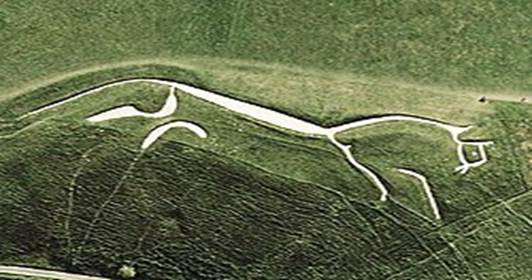
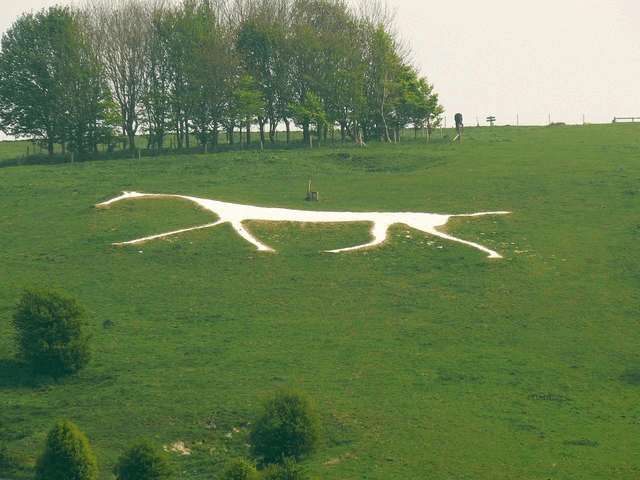
There are many hill figures cut into the chalk downland of southern Britain. The oldest and probably the most famous is the Uffington White Horse in Oxfordshire (formerly in Berkshire before 1974) cut into the scarp slope of the North Wessex Downs overlooking the Upper Thames Valley, which is over 3,000 years old.

The Uffington white horse

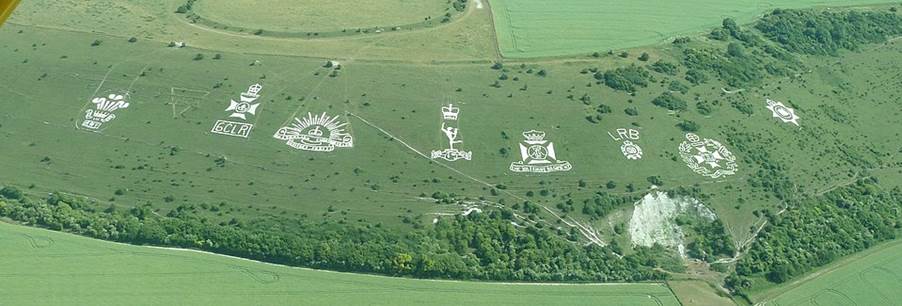
By contrast, the Fovant Badges were originally cut in the years after the First World War. These depictions of  military badges were cut to honour the hundreds of soldiers who had been training near the village of Fovant in south west Wiltshire.

Fovant badges Marchibald.fly via Creative Commons

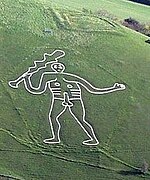
Dorset boasts two hill figures. The horse and rider on Osmington Down near Weymouth was created in 1808 in honour of George III, a frequent visitor to the town. However, no one really knows why the Cerne Abbas giant  – a figure of more likely humorous or satirical intent – was created above the village in Early Medieval times.

Humerous or satirical intent?
Pete Harlow via Creative Commons

However, the majority of white horses can be found across Wiltshire. The Westbury white horse is believed to have been made sometime in the late seventeenth century which would make it the oldest figure in the county. Next comes the white horse above Cherhill, which is believed to date from 1780. Pewsey’s  horse was cut in 1785 and then in 1808, pupils at a boys’ school in Marlborough constructed the town’s white horse.

The Cherhill white horse
Brian Robert Marshall via Creative Commons

At Broad Hinton, it is believed that the parish clerk, Henry Eatwell, may have been responsible for the Hackpen Hill white horse, which was constructed in 1838 to commemorate Queen Victoria’s coronation. 

Broad Hinton white horse
Brian Robert Marshall via Creative Commons

The Devizes white horse first appeared in 1845. Then, rather later than the rest, Broad Town in 1885.  

But how many people know that, sometime in the early 1870s, Inkpen was added to this list?

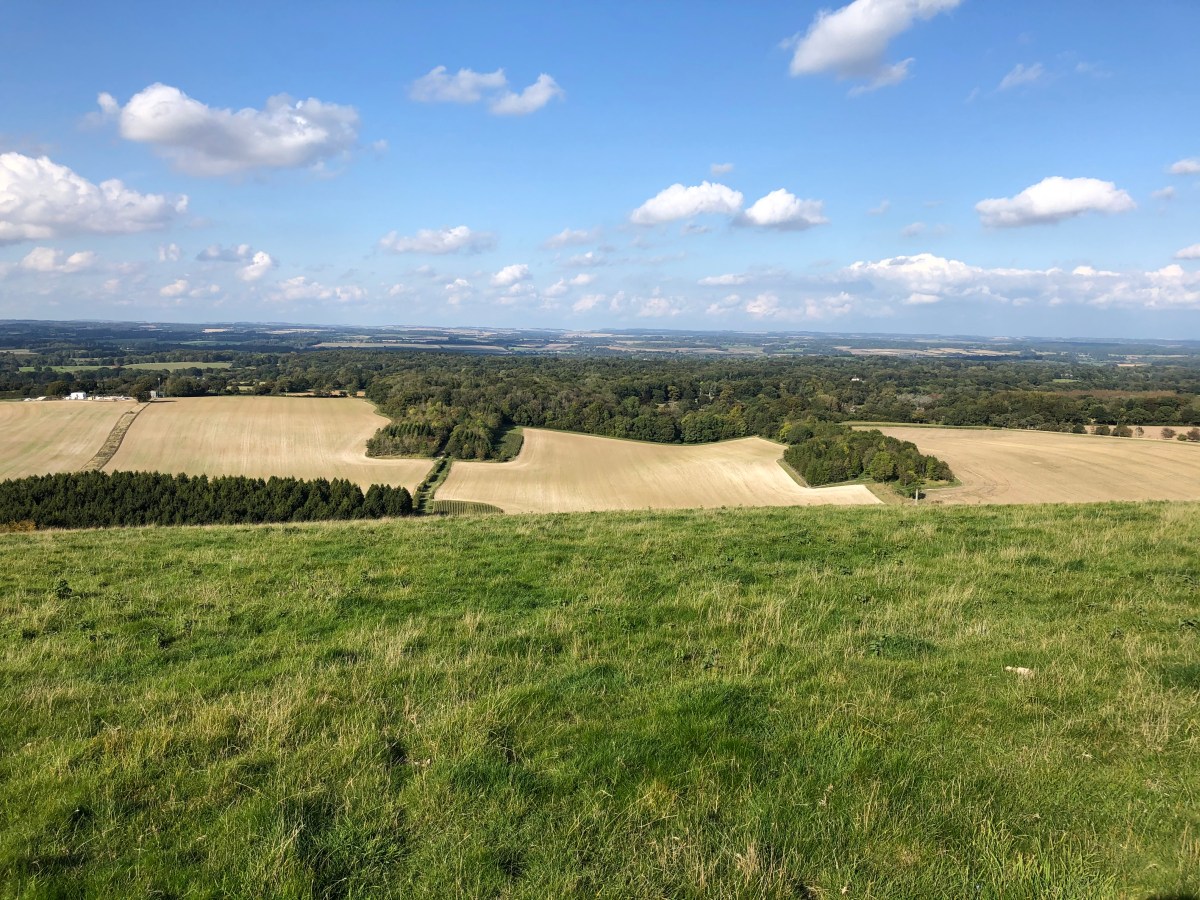
The Ordnance Survey map, Berkshire, Sheet XLI, surveyed in 1873 and published in 1877, does  indeed show another white horse, situated on the north facing slope of Inkpen Hill and just over the county boundary in Wiltshire.

So, who was responsible for Inkpen’s white horse and what happened that we can no longer see it?

The Inkpen ( or Ham ) white horse was constructed on land owned as part of the Ham Spray estate, just to the east of the small village of Ham in Wiltshire and to the west of Inkpen, Berkshire. In 1869 it was bought by the then thirty year old Charles Wright. In the 1871 census, Wright is described as a farmer of 370 acres employing 8 men and 4 boys, so is clearly quite successful.

Wright had been born in 1839 in the Leicestershire village of Market Bosworth. In 1841 he is living with his grandfather, a clergyman and in 1851 he is a boarder at a grammar school in Derby. By the age of 22 he is living with his father and his older brother Thomas who is in the military.  Charles himself is described as “gent”: a very precise distinction at this socially divided time.

Ten years later, Thomas Wright has a seat of his own: Tidmington House in Worcestershire, where he lives with his wife and eight staff. Younger brother Charles has relocated to the south west.

When Charles Wright bought Ham Spray House, it was a modern building still only around thirty years old. Perhaps Charles wanted to establish his own seat, distinct and away from the family in Leicestershire.

Ham Spray House
Charles Richard Sanders via Creative Commons

Some nineteenth century landowners become high profile figures within their towns or villages and their names feature frequently in the local press. This cannot be said of Charles Wright in the time he lived at Ham Spray House. The only reference I can find to him in local papers, aside from details of the sale of his property, was when he contributed generously, along with other local gentry, to a fund for the sick.

Finding himself in a county famed for its white horses cut into the chalk downland, Wright may have wanted the distinction of adding to that number. Perhaps he wanted to impress his neighbours, or just to add to the view from his house. So, sometime in the early 1870s he had his workers cut the outline of a horse into the downs. The new white horse must have been distinctive enough for the Ordnance Survey surveyors to notice it when working in the area in 1873 and include it on the latest edition of the O.S. map, published four years later..

However, the 1877 O.S. map is the only one to include the new, Inkpen white horse. Sadly, it did not endure partly because it had been constructed by stripping away the turf with out digging and packing out trenches with compacted chalk. Further, subsequent landowners did not bother to clear away the encroaching grass.

Charles Wright died on 12th December 1876 at Ham Spray House. He was only 37.  The estate, his house and all its contents were sold. His time at Ham Spray House, like that of his newly cut white horse on the downs above Inkpen, had been brief.


Ancestry

British newspaper Archive

(C) Theresa A. Lock, 2025

Kintbury’s Doctors Lidderdale

John Lidderdale, b.1802 & John Lidderdale, b.1839

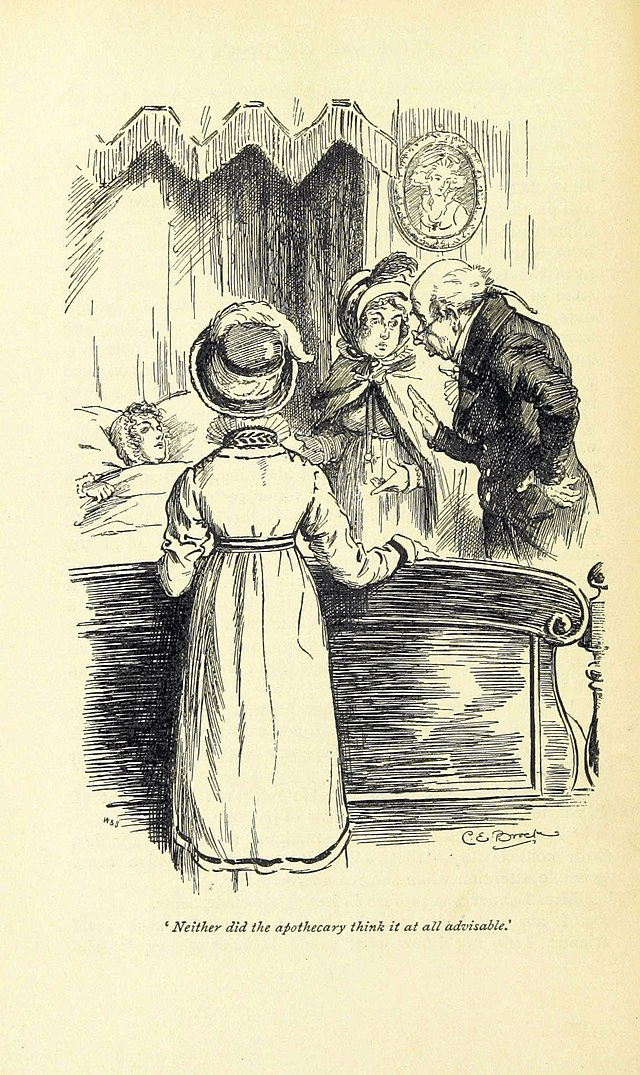
 He had been at the pains of consulting Mr. Perry, the apothecary, on the subject. Mr. Perry was an intelligent, gentlemanlike man, whose frequent visits were one of the comforts of Mr. Woodhouse’s life.

As readers of Jane Austen’s novel Emma (1816) will know, the village medic, Mr Perry, was an important figure in the life of Mr Woodhouse who was constantly in need of reassurance as regards to his health. Austen describes Mr Perry as an apothecary; however, by the 1830s the Mr Woodhouses of Kintbury might have considered themselves as more fortunate as their general practitioner could be described as “surgeon”.

So who was Kintbury’s Dr Lidderdale?

John Lidderdale I had been born in Hungerford in 1802. He was the eldest son of Captain John Lidderdale of Hungerford and his  wife, Ann, née Pearce. John senior had been a Captain in the 17th Hussars and his family had come, originally, from Dumfriesshire in Scotland. Ann was from a local family, having been born in Standen, near Hungerford.

In the 1820s John was a student at the London Hospital Medical College, at that time still a relatively new establishment, having been founded in 1785. He became LSA ( Licensed Surgical Assistant )  in 1825 then MRCS ( Member of the Royal College of Surgeons ) in 1826. Studying medicine at that time was expensive and John’s fees, board and lodgings may have cost him between £500 and £1000 – enormous amounts for the time. It was not as if he could expect to become a high earner upon qualifying, either; whilst a medic practising in a wealthy part of London, for example, might earn up to £1000 a year, a country doctor was more likely to make between £150 and £200, comparable to better-paid teachers.

By 1839, John is listed in Robson’s Directory as surgeon and registrar of births and deaths for the Kintbury district. At the time of the 1841 census, his younger brother James is living with him, most probably in the role of an apprentice as James would later go on to study medicine.

Four years later, John married Isabella Fowle, the youngest daughter of the late Fulwar Craven Fowle who had been for many years the vicar of Kintbury. Although it is impossible to say how prosperous or otherwise the Kintbury practice was proving to be, the 1851 census indicates that John has an apprentice, one Francis Owen, and three live-in servants. By 1861, he has an assistant, one Michael Cuff, and two live- in servants. The same year he was awarded the degree of MD ( Doctor of Medicine )  by the University of St Andrews – the prestigious Scottish university which at this time awarded the degree of MD without the recipients having to attend its campus on the Fife coast.

John Lidderdale died in October 1863. His obituary in the Newbury Weekly News noted,

“ Few men had so extensive a practice as the late doctor, and none worked harder for it. His kindness of manner, his skill and attention, and his patience in tedious cases, will ever be gratefully remembered”.

Large numbers of villagers filled the church for the funeral including many tradesmen who had closed their shops for the occasion. Kintbury certainly showed its respect for the late doctor.

However, where was this popular doctor in the strict social hierarchy of early nineteenth century England? Looking again at the Jane Austen quote I used at the top of this article, the respected Mr Perry is described as gentlemanlike. That last syllable carries a lot of weight: for as much as Perry was respected, he was not, within the hierarchy of the time, a gentleman.

And neither was Dr John Lidderdale.

The Kelly’s Directory of 1848 lists 19 Kintbury people as members of the Gentry which includes Mrs Lidderdale’s unmarried sister, Elizabeth Caroline Fowle and her widowed sister, Mary Jane Dexter. But the man who has achieved the recognition of an MRCS, who is trusted to take care of the villagers’ health, is regarded as being of lower status than the great and the good many of whom were most probably not qualified in anything.  

By the time of the 1871 census, Kintbury had a new doctor. Also named John Lidderdale, this young man was the son of the John Lidderdale I’s brother, William.

William Lidderdale had been born in Hungerford in 1805. It seems likely that he had an involvement with the East India Company in his younger adult years although by 1851 he was a Chief Officer with the Coast Guard Agency living in Tyneham and then Osmington Mills, Dorset where his wife Elizabeth died in 1852.

John Lidderdale II had been born in 1839 when the family were in Ilford, Essex, then educated at a boarding school in Southampton. The 1861 census shows him to be a medical student in London although there is some evidence to suggest he had been an apprentice in Kintbury before that, presumably under his uncle. In 1861 he became a Member of the Royal College of Surgeons.

In 1863, the Board of Guardians of the Hungerford Union (in other words, those responsible for the work house ) unanimously voted him Medical Officer of the Kintbury District.

John Lidderdale II served Kintbury as general practitioner for over twenty years. These were changing times: by 1869, Kelly’s Directory had dropped the category, “Gentry” in favour of “Private Residents” in which category both John Lidderdale and his uncle’s widow,  Mrs Lidderdale are included.

John Lidderdale retired in 1891 when he married Emma Louisa Mathews, the widow of a farmer from Boxford. To mark this occasion, Dr Lidderdale, “entertained to supper the whole of the adult population ( of Kintbury ), it taking two evenings to do so, and subsequently gave a tea to all juveniles aged between five and sixteen.”

To show their respect to the retiring doctor, 433 of the villagers had subscribed to the cost of a solid silver epergne  engraved with the Lidderdale crest.

Both John Lidderdales are frequently mentioned in the pages of the Newbury Weekly News with regards to the sick or injured they have attended  during their times as general practitioners in Kintbury. For as much as one can tell, neither were particularly involved in public life, however the reports of their respective funerals show that both had earned the respect and appreciation of village’s working people.

John Lidderdale II died in April 1894. According to the Newbury Weekly News he was remembered as, “ a kind neighbour, devoted friend and approachable councillor.”

Isabella Lidderdale, widow of John Lidderdale II continued to live in Kintbury until her death in 1884. Isabella had lived in Kintbury through times of great social change and also has the distinction of having been, quite probably, the very last village person to have known Jane Austen personally.

William Lidderdale, father to John Lidderdale II, died in Newbury in 1881 but was buried in Osmington, Dorset along with his wife.

Charles Lidderdale, brother of John Lidderdale I became an actuary of the Sun Life Assurance Company but died in Hungerford in 1863.

James Lidderdale, brother of John Lidderdale I, practised as a GP in Great Bedwyn, Wiltshire and died in 1882.  

Emma Louisa Lidderdale, widow of John Lidderdale II, continued to live in Kintbury until her death in 1920. The village’s long association with the Lidderdale family had come to an end.

Sources:

The origin of the general practitioner I. S. L. LOUDON, DM, FRCGP, DRCOG Wellcome Research Fellow, University of Oxford, and Honorary Archivist, Royal College of General Practitioners

Journal of the Royal College of General Practitioners, January 1983

hhtps://www.bartshealth.nhs.uk/the-royal-london-our-history

hhtps://livesonline.rcseng.ac.uk

Newbury Weekly News via British Newspapers online

Ancestry.co.uk

(C) Theresa Lock 2025

Not what you expect of a vicar?

The story of Kintbury’s Rev James Whitley Deans Dundas

In 1840, Rev Fulwar Craven Fowle, who had been a close friend of Jane & Cassandra Austen, died aged 76. He had been the third generation of his family to be vicar at Kintbury so his death must have seemed like the end of an era to his parishioners.

One wonders how Kintbury villagers felt when the next person to be appointed to the parish was a much younger man. Twenty eight year old James Whitley Deans Dundas must already have been known to local people, being the son of Admiral James Whitley Deans Dundas, a member of the well-connected and influential family of Barton Court, Kintbury. He held an MA degree from Magdalen College, Cambridge, had been ordained in 1835 and had become vicar of Ramsbury, ten miles away in Wiltshire, in 1839.

Although I have not been able to find James Dundas on the 1841 census, the 1851 census shows that he is still vicar of St Mary’s, Kintbury. He has, living with him in the vicarage, a cook/housekeeper, a kitchen maid and a groom and, although he is married his wife seems to have been absent on the night of the census. Strangely, the 1861 census also records Dundas as being married, yet his wife is absent again and his staff consists of just one waiting maid.

However, this must have been a time of upheaval in the vicarage, for around this time the original building – the one known to Jane and Cassandra Austen – was demolished and a new, large house in the fashionable Neo Gothic style built to replaced it. Quite why James Dundas chose to do this we do not know; perhaps the old house was in a state of poor repair or perhaps he considered it lacked the style and sophistication fitting a person of his status.

The Old Vicarage in Kintbury
Out with the old: The vicarage known to Jane Austen was demolished

It is easy to imagine the new vicarage filled with a large family and ample servants to run it; but that was not the case. The 1871 census reveals that, whilst Dundas maintained a live-in staff of footman, cook, housemaid and groom, the many rooms did not echo to the sound of children or visiting grandchildren, and, although the vicar is still recorded as being married, Mrs Dundas is conspicuous by being absent.

Designed by Thomas Talbot Bury, the new vicarage replaced the old one in 1860

An online search reveals the rather surprising truth.

Sometime in the mid 1830s, James Dundas had entered into a relationship with Olivia Flora Burslem, the daughter of Captain Nathanial Godolphin Burslem of Harwood Lodge, East Woodhay, Hampshire. Olivia had been born while her father was serving in the army in Java, in the East Indies and it is this rather unusual place of birth which makes Olivia easier to trace on census returns.

Olivia’s relationship with Dundas seems to have been a turbulent one almost from the very beginning. Some of the details can be put together from parish records and various newspaper reports covering the proceedings of the Court of Queen’s Bench in July of 1840.

The couple had been married by special licence at East Woodhay, Hampshire, on February 11th 1836. The groom was 23 and the bride 22.

 However, by 1837 the couple were living separately.  

In 1839, in an attempt to bring about the dissolution of his unhappy marriage, the now Rev Dundas brought a case against a Mr Hoey of Bath, whom he accused of “criminal conversation” with Mrs Dundas. It seems that a witnesses for the prosecution, a  waiter and others who worked at the Castle Hotel in Marlborough, described Mr Hoey and Mrs Dundas arriving there and posing as a married couple.

They stayed for two or three days and “had but one bed”.

The Castle & Ball, Marlborough

Although a case had been built against his wife, witnesses for the defence suggested that Dundas had not been as innocent as he had tried to make out.

The court heard how, in 1834, Dundas had become a frequent visitor at the East Woodhay home of Captain Burslem whose daughter, Olivia, was “possessed of great personal attraction.” Dundas claimed there had been a mutual attraction between the young people and that his intentions were honourable. However, during a period towards the end of 1834, Mrs Burslem had become ill and was confined to her bed for some time. During this time, “the plaintiff was base enough to take advantage of the affections of Miss Burslem and to abuse the confidence reposed in him by her family by effecting her ruin.”

On learning that Miss Burslem was pregnant, the report suggests, Dundas abandoned her. It appears that it was “with great difficulty” that Rev Dundas was persuaded to marry Olivia but after Captain Burslem had settled £10,000 on his daughter and Admiral Dundas had settled £5,000 on his son, the wedding finally took place.

The court heard evidence that, from the time of the marriage, Dundas treated his new wife with cruelty and neglect. There was also evidence to suggest that he was violent towards her. It was even suggested that he had somehow encouraged her into relationships with other men to enable the possibility of a divorce under the very restrictive divorce laws of the time..

At the conclusion of the case, the jury’s verdict was: “We think he had morally deserted her”. Dundas was not granted a divorce.

If Olivia Dundas was not living with her husband in Kintbury, where was she? Although I have not been able to find her whereabouts on the 1841 census, other sources, along with cross referencing, do reveal more about her life after her separation from Dundas.

There is evidence to suggest that Flora was in a relationship with a new partner, one Henry Dean and is styling herself as his wife. In polite Victorian society, this would have been frowned upon by those who knew the truth – although it has to be said that there were likely those willing to”turn a blind eye.” At this time, it would have been almost impossible for Flora to obtain a divorce from Dundas so for a woman who had the means and the opportunity to set themselves up in in another relationship far from the prying eyes of her original home, this was likely the only way to achieve happiness in a new family.

On May 10th 1844 a baby, Olivia Flora Dean, daughter of Henry & Olivia Flora Dean, was baptised at Christ Church, St Marylebone. The record shows that the baby had been born on February 9th 1843. Then, in June 1844, Henry, son of Olivia Flora & Henry Dean is baptised at St Peter’s, Pimlico. In both entries, Henry Dean is described as a “Gentleman” – a precise designation which would have implied social, and most likely economic, status rather than just being a polite term for a man.

How do I know that this Olivia Flora Dean is the same person as Olivia Flora Dundas nee Burslem? This is where Olivia’s rather unusual birth place of Java is helpful.

Although I have not been able to find Olivia Flora on the 1851 census, the 1861 census has a Flora Dean, aged 43 and born in Java. She is head of the household at 2, Charles Street, Westminster and lives alone. Her “Rank, profession or occupation” is described as “Householder Independent”. Of former partner Henry I can find nothing, neither is there any trace of son Henry. However, it is very likely that the daughter baptised in 1844 is now identified as Flora O. Dean, eighteen years old and at a boarding school in Brighton.  

By 1871, Olivia is still living at 2, Charles Street, but by now her daughter, styled Flora Olivia, presumably to avoid confusion with her mother, is living with her. Son Henry is living there as well, and at 27 he is described as “Retired from army.”

Both Olivia and her daughter Flora are described as “annuitant” which suggests that they are being supported financially, somehow. Perhaps the absent Henry senior – if he is still alive – is supporting his partner and their child, or perhaps Olivia is being supported by other members of the Burslem family – we will never know. There has to be the possibility that both Flora and Olivia are in receipt of support from the Dundas family if not from James himself.

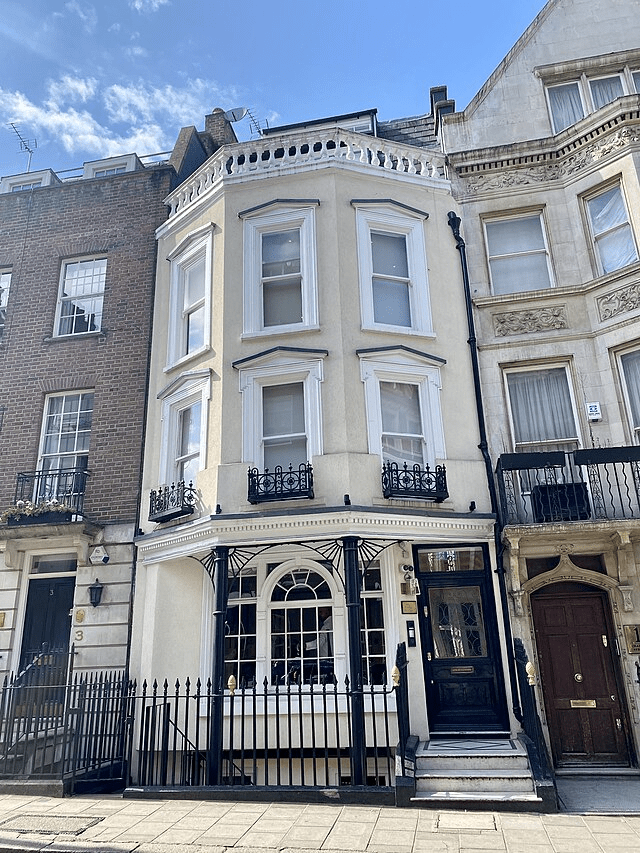
Charles Street, Westminster, today.

By 1881 Olivia Flora and her daughter are still living at 2, Charles Street, although Olivia is now described as “Widow annuitant”. But whose widow is Olivia?

James Dundas, still living in the lonely canal side vicarage in Kintbury, died in 1872 meaning that Olivia was now legally his widow, even though she had not identified or lived as his wife for so long.

 Olivia Flora died in June 1881. It is the entry in the records of Brompton cemetery which confirms for me that the Oliva Flora Dean I have been following through online records is indeed the wife of Rev James Whitley Deans Dundas: the burial register records the deceased as Olivia Flora Dundas of 2, Charles Street – the address at which Olivia Flora Dean had been living for the past twenty years.

The story of Rev James Whitley Deans Dundas and the woman born Olivia Flora Burslem raises questions it is impossible to answer. What became of the child born in Bath before its parents were married? How was James able to secure the living in Ramsbury in 1839 and Kintbury in 1840 despite his somewhat notorious recent past? Or was it that no one in authority – presumably including the Bishops of Salisbury and Oxford in whose dioceses he had ministered – really bothered about it that much?

People will gossip, of course, and Kintbury is not a million miles form East Woodhay, even in a slower age of horse transport. Surely the story of a reluctant groom and a shotgun wedding would be too delicious not to pass on, from village to village? Particularly when the groom is a man of the cloth??

But whatever stories were passed on about the young priest in the 1830s, by the time of his death from heart disease in 1872, James Whitley Deans Dundas was fondly remembered. The Reading Observer spoke of his, “unceasing acts of charity and kindness” and the Newbury Weekly News said he was, “indefatigable in promoting the welfare of his parishioners”. In his time as vicar of St Mary’s, Rev Dundas had overseen a “restoration” of the church, the building of Christchurch at Kintbury Crossways and the building of a new school in the village.

Did anyone in Kintbury know of the estranged wife living in a fashionable part of London? I very much suspect that they did and there may have been raised eye brows and the occasional tuts when stories of Dundas’s past life were passed on. However, to most Kintbury villagers, the life style of the Dundas family must have been so far removed from their own that such irregularities were dismissed with a shrug. And if the Rev James Dundas was regarded as a good man, perhaps any wrong doing in his past would be forgiven.

Rev James Dundas was buried in the Dundas family vault, beneath the chancel of St Mary’s church.

© Theresa Lock, 2025

January 11th 2025: Remembering William Winterbourne

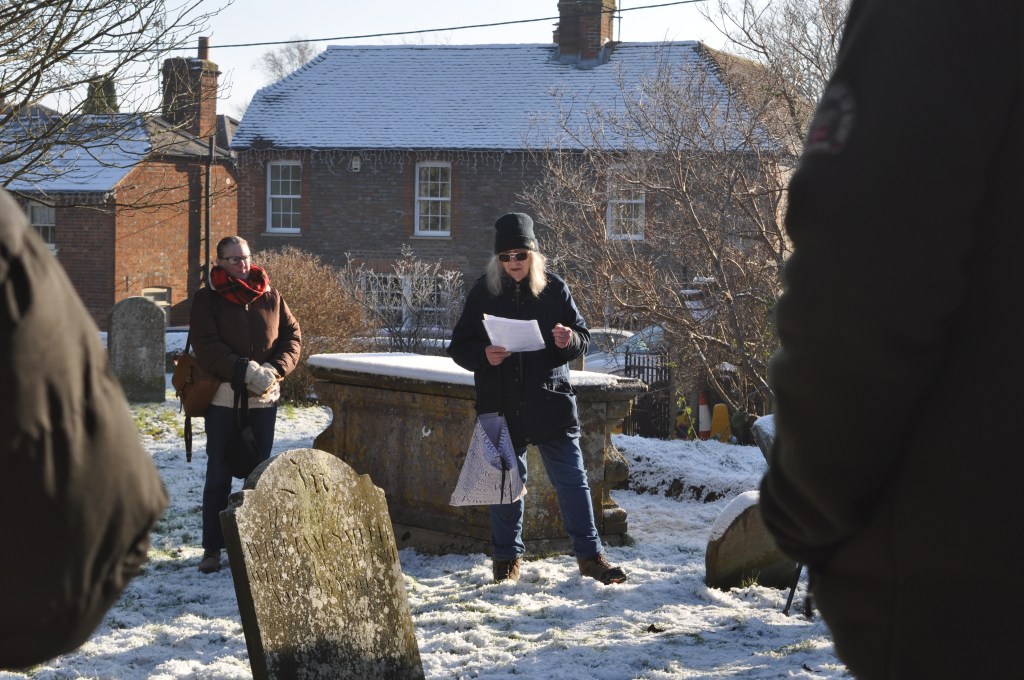
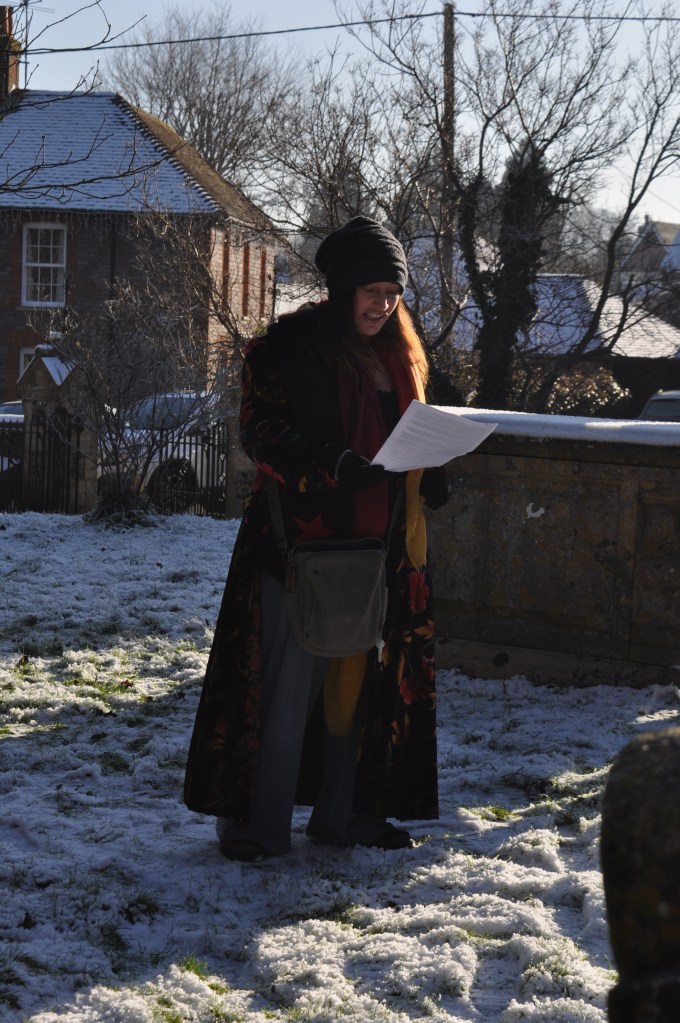
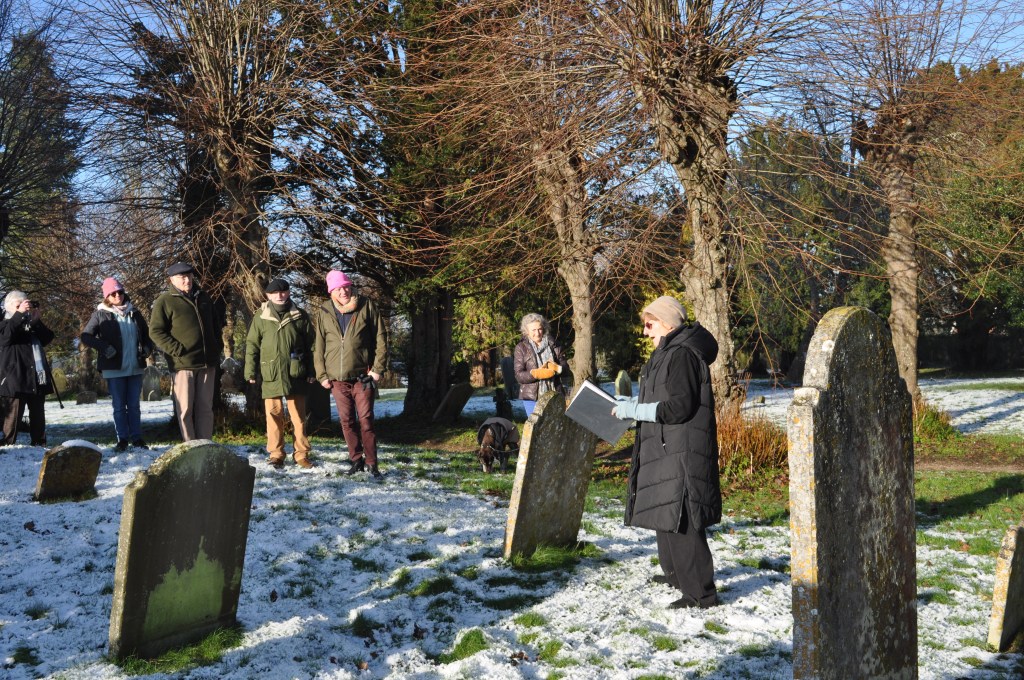
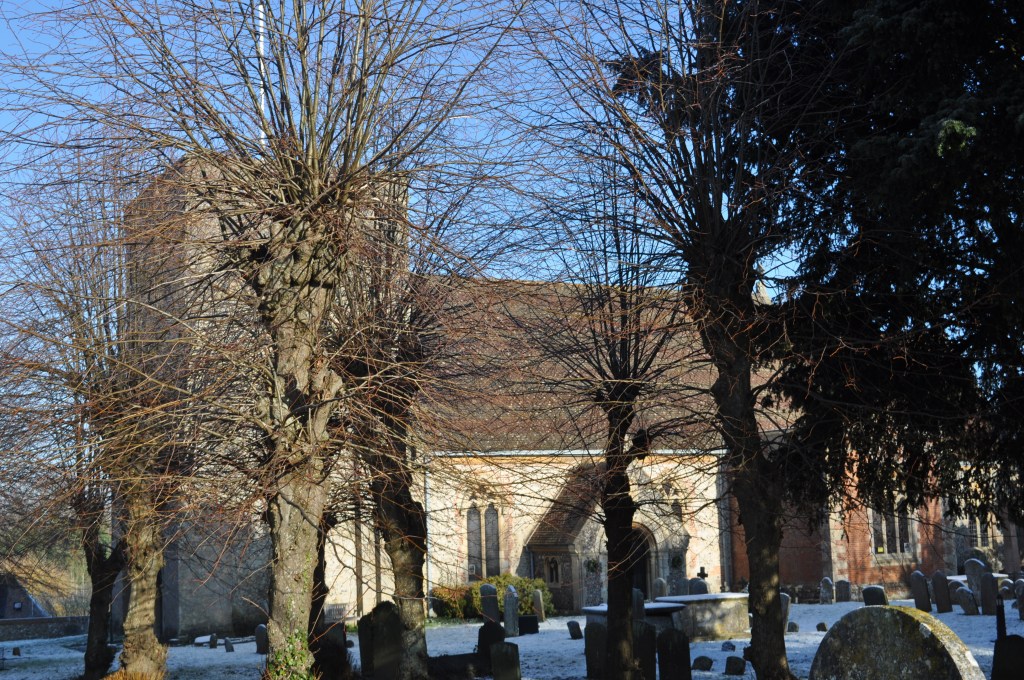
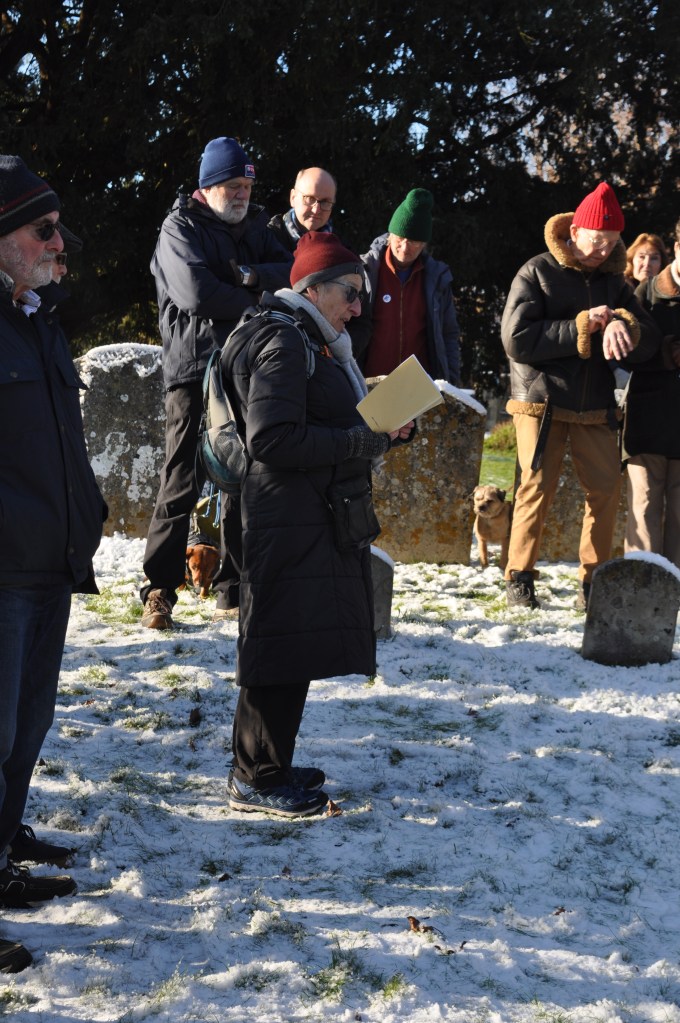
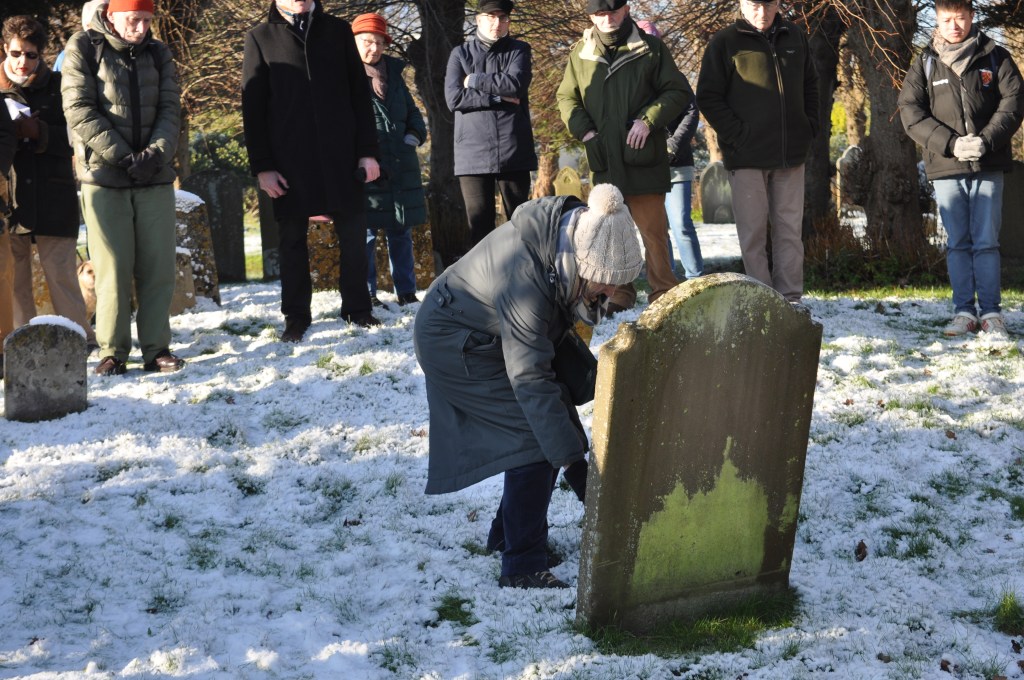
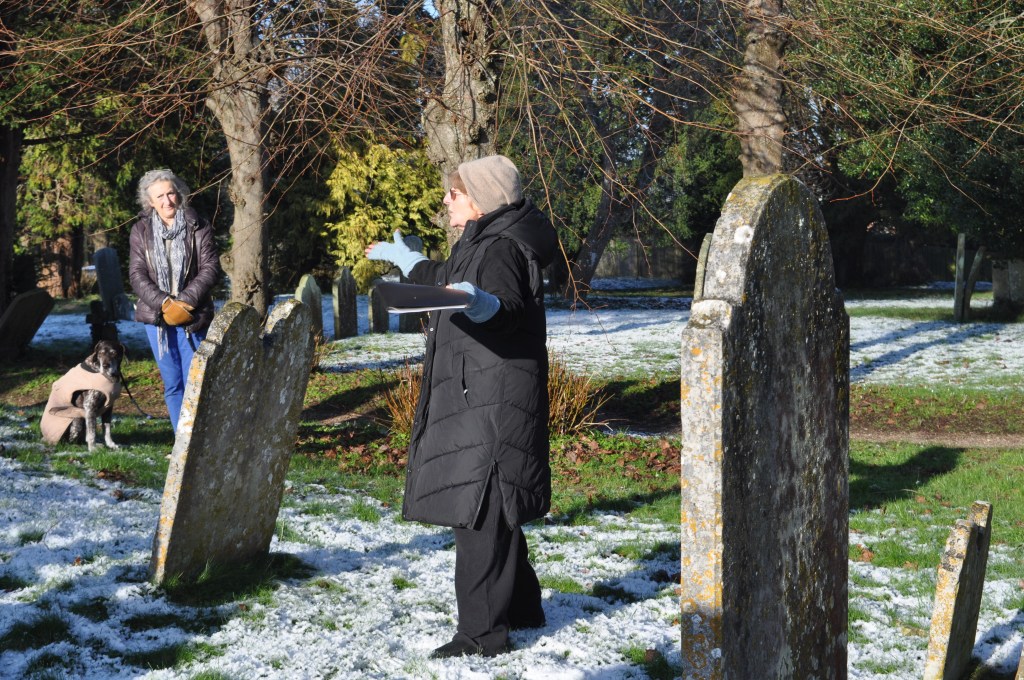
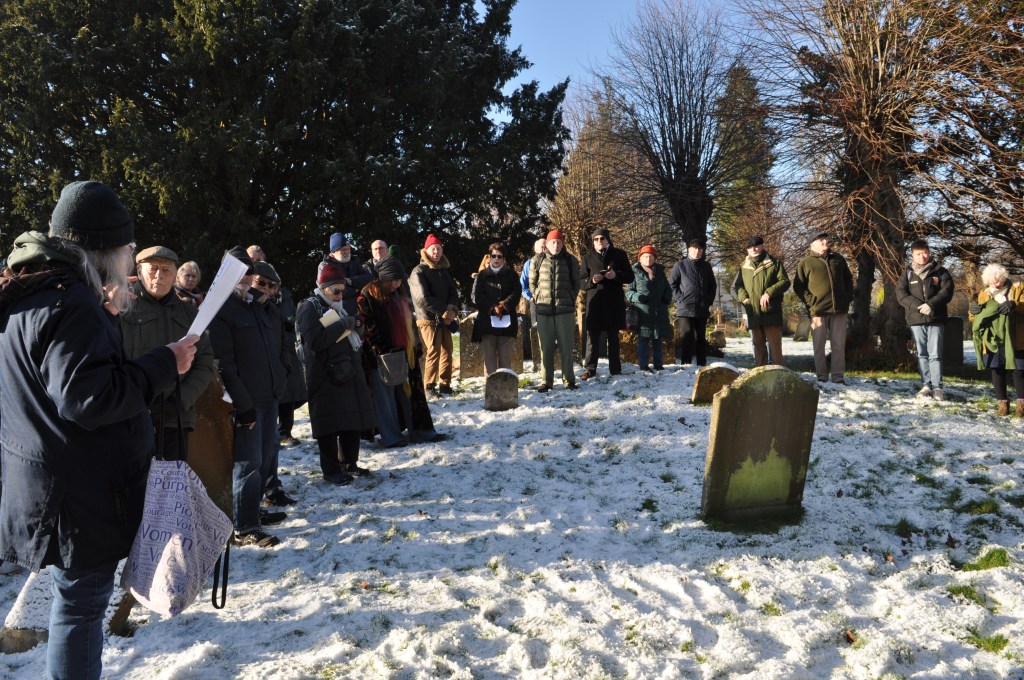
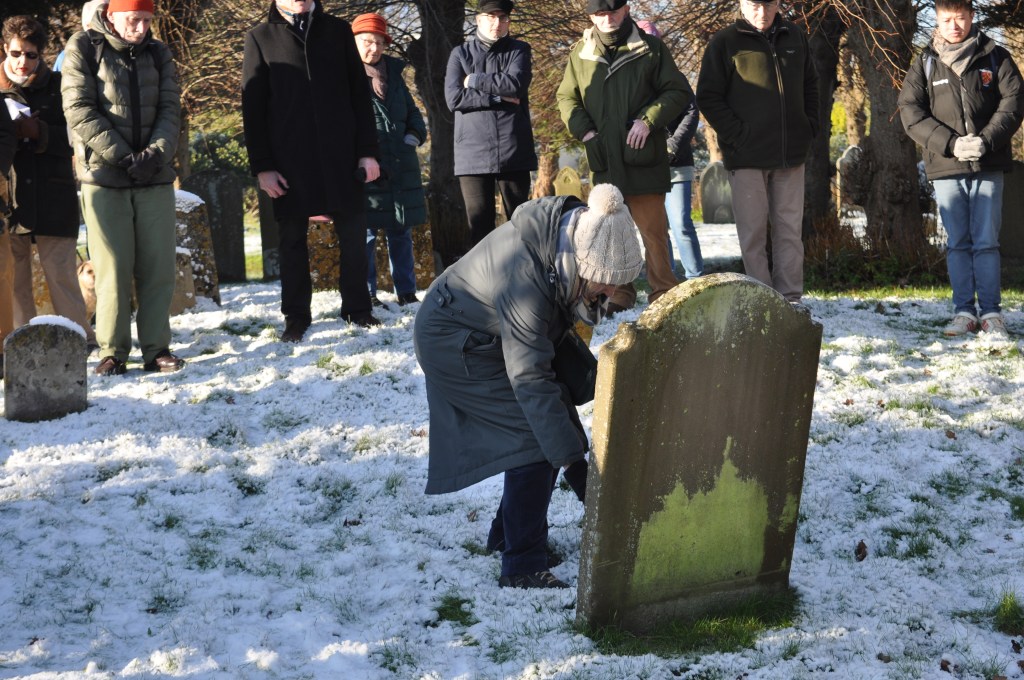
On January 11th each year, local people, family members and supporters from further afield including historians, trade unionists and those concerned with social justice, gather at the grave of William Winterbourne in St Mary’s churchyard.

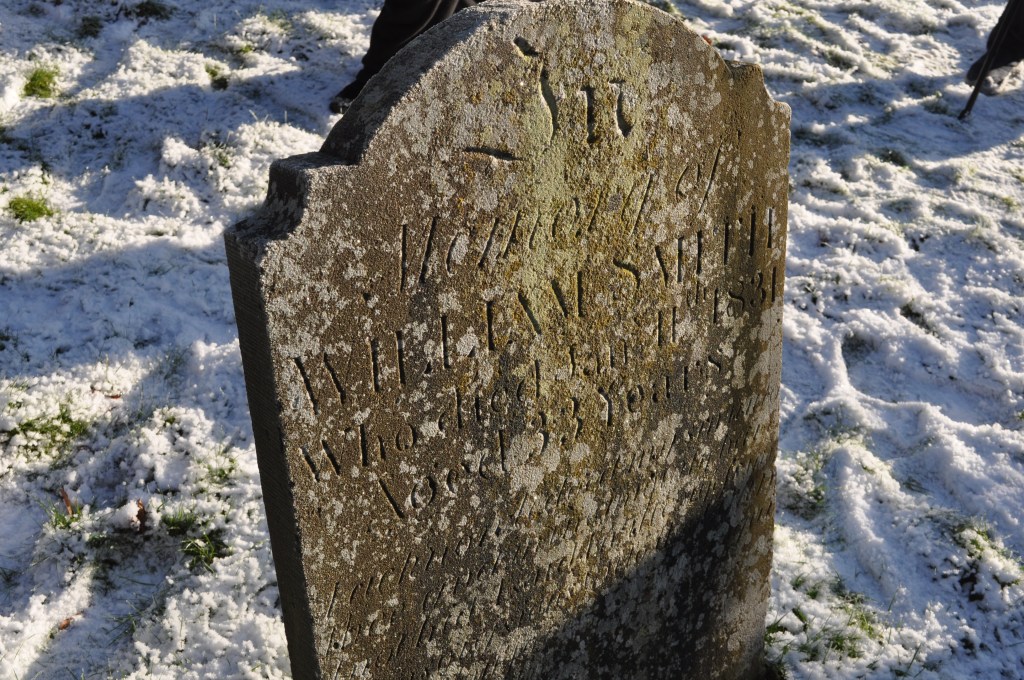
William Winterbourne, also known as William Smith, was hanged at Reading Gaol at 12 o’clock on January 11th 1831. His crime was to have been involved in the protests that swept across southern England the previous autumn as labourers fought for improvements to their pay and conditions of work.

This year, the bright sunlight shone on the lichen covered stone such that William’s name could be read clearly. As his parents were not married at the time of his birth, he is buried under his mother’s name of Smith, in accordance with the custom of the time.

This year, we were joined by over twenty people who gathered to listen to accounts of how the Swing Riots had impacted on this part of West Berkshire, and William’s involvement in them.

All Photos (C) Chloë Wells

You may be interested in further posts about the Swing Riots in West Berkshire, those involved, and also what happened to one who was convicted and transported to Australia:

(C) Theresa Lock January 2025

Traditional Views & Challenging Opinions: Kintbury Men’s Fellowship of the 1950s

In the 1950s the church in Kintbury had a thriving Men’s Fellowship.

Now, as a mere woman, I would not have been able to attend these meetings, however the minute books were passed to me as a possible source of parish history.

The minutes make interesting reading – on the one hand they reflect an echo of earlier time, for example the home- grown entertainments at the Christmas Party could belong to the previous century, whereas the discussion of the Wolfenden Report into Homosexuality reflects a consideration of changing attitudes more associated with the 1960s. The minutes record several comments which reflect  some opinions and values of the time and which would cause raised eye brows if expressed today.

I’ll begin by eavesdropping on the November meeting 1956. All, as the minutes say, were ‘seated in comfort, thanks to the vicar’s good offices’.

The talk was, as you might expect from a Christian fellowship, an exploration of the Bible. The speaker was Kintbury’s  Mr. Sidney Inns (well- remembered by many of us). Sid, it says, probed with an historian’s knowledge into the early writings of the bible. So enjoyable and instructive was the talk that Sid had to promise a further contribution.

This meeting ended with plans being made for the Christmas Party, to which members could invite six people each, and a “Practical Day”,  during which members would decorate the Parish Room. Finally the vicar drew attention to ‘Operation Firm Touch, a means of influencing adolescents back to church’ – so much for those who say that only this generation has deserted the pews.

The party was held in the Coronation Hall on 5th January and seems to have been quite popular as approximately ninety people attended. Entertainment was provided by local people and included Mrs. Bailey and Mrs. Aldridge performing a sketch called ‘Over The Garden Wall’, The Kintbury Handbell Ringers, Gordon Perris singing a selection of popular songs, accordion players Geoff White and Miss Pat Reeves, and four ladies who, apparently, gave a hysterically funny performance of the play, ‘Mr. Macgregor comes to Tea’. Finally the Men’s Fellowship performed the ‘Berkshire Widdicombe Fair’. This last item  was so popular that it was asked for over and again at different gatherings.

However, it is the next meeting that fascinates me most. The Vicar said that he really found it rather difficult to find a suitable bible passage for the topic under discussion. This does not surprise me for the topic was ‘Flying Saucer – Fact or Fiction’

A Mr. A.E. Jones proceeded to convince everyone present that flying saucers were not purely figments of the imagination but really existed. He explained that they had been observed in 1619 and now in 1956 a schoolmaster on the Yorkshire Moors had been confronted by a visitor from Mars and had experienced a strange feeling of peace almost as if the visitor was a deity. Mr. Jones produced other testimonies ranging from Norway to the USA and added the information that the saucers were reckoned to travel at 9000 miles an hour.

Not surprisingly after this stirring stuff the group returned to a safer subject, ‘The Drift From The Churches’. The minutes say that this was the first meeting in the redecorated Parish Room and maybe the brightness of the room demanded that the meeting be bright as it undoubtedly was. But was it safer than flying saucers –   it was certainly a healthy discussion.

‘The Church in its capacity as the established church had backed the wrong horse probably due to tradition and the bowing to the demands of the wealthy section of the community, said Mr. Parry, the leader of the discussion.

This was most likely a controversial opinion to hold in the 1950s. Mr. Parry believed that 40 years ago a large number of poor people attended church regularly, thereby to gain spiritual salvation. Now one could only imagine that the lack of poverty had increased physical greatness with a consequent falling off in spiritual discipline.

Mr Parry was of the opinion that Sunday was now largely a family day, whereby most of the family could be together. No doubt the motor car and coach trip also accounted for absent seats at the local parish church. Further, Mr. Parry felt that a lot of people just didn’t seem to need the church.This provoked a very lively discussion and the majority of members present raised their voices and opinions regarding the apparent falling off and decline in church congregations.

The next talk was to be given by the vicar on ‘Church Architecture’ causing a Mr. O’Rourke to comment, ‘From Flying Saucers to Flying Buttresses’.

 The meeting concluded with Mr. Palmer inviting members back to his home for cups of tea. Despite being newly decorated, the Parish Room did not have mod cons and refreshments could not be catered for.

A committee meeting in March brought forth suggestions for future gatherings. Some topics under consideration were of a seriously religious nature and included a Clarification of The Creed in Three parts, and a further two talks by the ever- popular Sidney Inns. However other suggestions were more topical and concerned contemporary issues such as,  ‘Does the Welfare State Make for Better People?’, ‘Education Today,’ ‘Love Thine Enemy’, ‘Blood Sports’, ‘Local Government’, and ‘Trades Unions.’

It seems the men of Kintbury did not shirk from a subject because it might upset someone, put them off church, or create tensions. Lively debates took place and there was what might be called a ‘frank exchange of views’.

In March, 1957, the Bishop of Reading wrote to the Fellowship telling them of a meeting in Reading to be addressed by the Bishop of Coventry and titled, “Operation Firm Faith”. It was hoped that 2,000 men would attend although it seems that women were not invited.

 In the event over 1,000 men turned up and  were, apparently, held in the palm of the Bishop’s hand as he convinced them of the joy of being a Christian. Five points, he said, needed to be practised and the churches would be filled to over flowing. The points were Go Out, Stay Out, Think Out, Speak Out, Live Out.

This stirring meeting ended with the singing of Jerusalem and the minutes say that ‘words cannot describe the harmony of sound produced by so many male voices’.

There might also have been harmonious voices at the Annual General Meeting in May. It was a glorious evening and members set out to a private room in the Red House. There were abundant refreshments and a private bar. The title for the evening was; ‘Thirst after Righteousness’. The minutes record that, with regard to suggestions for the coming year, one suggestion, ‘Is beer our favourite beverage’? was no doubt prompted by the proximity of the beverage – the Red House was – and still is – a pub. The rest of the evening was devoted to general good will and the vicar soared to the heights of comedy by his presentation of Norfolk rustic life.

The following meeting was devoted to ‘Does the Welfare State make for Better People’?  Speaking in favour, Mr. Cummings thought that education enabled people to choose their way of life rather than follow like sheep and be fearful of the consequences as happened in ‘the good old days’. Mr. Jones, opposing, felt that the Welfare State brought about a selfish outlook on life and mentioned that in eastern countries it was honourable to care for one’s parents in old age. The ensuing discussion was ‘most enlightening and many controversial facts were raised tho’ politics did not intervene.‘ It was thought that it would make interesting reading to have a similar discussion in fifty years time.

The spring of 1957 had seen the publication of the Wolfended Report which recommended that homosexual acts between two consenting adults should no longer be a criminal offence. At the time this was a contentious issues but the Men’s Fellowship did not shy away from it and the report was discussed at the April meeting. Question time produced many interesting items but they were evidently considered too risqué to record in the minutes. So what the men of the Kintbury Fellowship thought about this proposed change in the law, we shall never know.

January 1958 was devoted to a very touchy subject for a rural parish: Should Blood Sports be Abolished? Mr. Bob Sanders spoke about his boyhood in Devon and the damage that a stag and his harem can do to crops. Hunting, he said, was nature’s way of controlling vermin. Mr. R. Westcott proposed the motion and although secretly he agreed with hunting, from his vehemence one would have thought that all hunters and hounds should be boiled in oil. Hunting, he said, was a form of sadism in a civilised world. He ended by announcing that if the meeting voted to retain bloodsports they would all leave the meeting forever branded as sadists! Controversial stuff for a village.

Despite this ominous note members did condemn themselves by voting for retention which was probably not surprising

The following talk, once again by popular speaker Sidney Inns, was on a completely different – and much lighter – subject: Superstitions. Sidney explained the significance of different numbers and why horse shoes were considered to bring luck.

In May a touch of the exotic was introduced when Mr. Parry brought along his guest, Mr. Mohammed El Amin Ghabshawi, who was wearing the national costume of the Sudan. He explained the history of the Sudan and spoke with enormous enthusiasm about his country. The Sudanese government, he said, was friendly to all and welcomed foreign capital investment. It is rather sad in view of all that has happened since to read that the overall picture gained was that ‘here was a people who were striving in the right ways to improve their economy and by their general attitude to all other nations might very well attain a very high standard of living in the not too distant future.‘

The speaker in March 1959 was happy to express views that very few would concur with today. This was the era of apartheid in South Africa and the subject was inspired by a cutting from the Sunday Times in which the Prime Minister, Harold MacMillan,  said that the South Africans were making a grave mistake in handling racial affairs.

The speaker, a  Mr. Wallace, expressed some very controversial opinions which today would seem prejudiced and ill-informed. He said that he had not been in South Africa but he knew the Africans and had employed some of them on his farm. The word ‘freedom’ was being shouted by all Africans and they were becoming very unruly, in his opinion. He did not see what cause they had for shouting this as they had been given many freedoms. For example freedom from slaughter by other tribes and freedom from fear of being sold as slaves. He went on to say that he did not want any mixed race marriages and who really would? Africans, he believed, only understood harsh rulings and were much better off now than one hundred years ago all due to the whites.

Mr Wallace concluded by asking if anyone had any questions or comments. Mr. Inns then asked if witchcraft was still practised. Mr Wallace said that it was and that one of his farmworkers had died when cursed.  He finished by saying that the proposed international boycott of South African goods was stupid.

The minutes do not record what the men of the Christian Fellowship thought about Mr Wallace’s hard line opinions.

Meetings continued into the early 1960s and Sidney Inns’ faith themed talks were still popular. In his next talk, Sid gave a brief description of four major religions in which he included – rather surprisingly – Mithraism along with Hinduism, Buddhism and Islam.

The  recently published New English Bible – the New Testament of which had been published in 1961 – was, not surprisingly, a topic for discussion and the men were informed by a speaker that the new version was now listened to with more interest than the “King James” version of 1611.  

 These were the days before the Church of England updated its forms of service and the Book of Common Prayer of 1662 was the most frequently used. Opinions were expressed that the  service of matins was very hard to understand particularly for the younger generation and a “Family Communion” in which all share would be easier to understand.

Other reforming ideas were discussed and during one of the periodic ‘Any Questions’ it was decided that it was a good idea, within certain limits, for priests to work side by side with factory workers and get the gospel to them that way. However, the right man ( no women priests back then, of course ) for the job must be found who should be very careful in his manner of approach.

Reforming suggestions continued to be discussed with the proposal – radical to some – that the appointment of a vicar to a living for life would no longer continue –led to a very lively discussion, opinions being divided more or less equally on most points.

Meetings continued throughout the 1960s. One topic that was perhaps surprising for a Christian fellowship was Psychic Research.  Canon Harmon, vicar of Froxfield  spoke about the nature of the mind, spirit, soul, telepathy and visions. Jesus, he believed, had psycho kinetic powers and examples of this were shown in His miracles. Canon Harmon was so interesting that he was invited back again and in his second visit gave examples of séances, materialisations and the return of  departed spirits.

The Fellowship finally demised in the early seventies by which time some subjects under discussion had become a little more political. One of the last topics to be discussed was the war in Vietnam and the justification, or otherwise, of American intervention.

The Kintbury Men’s fellowship was obviously of its time. It is difficult to imagine that so openly racist views as held by Mr. Wallace in 1959 being allowed to go unchallenged today although the topic of bloodsports would still divide opinion. However, over sixty years later, “Does the Welfare State make for better people” might still prove to be a topic for an interesting debate.

© Penelope Fletcher 2024

In the workhouse

The rich man in his castle,
The poor man at his gate,
God made them, high or lowly,
And ordered their estate.
– Mrs Cecil Frances Alexander

This, the third verse of the still popular hymn, All things bright and beautiful, is never sung today. When the hymn was first published in 1848, it was a prevalent view that God had ordained your position in life and if you were poor, that was because it was God’s will. This view persisted for much of the nineteenth century.

For the poor of Kintbury and the surrounding villages, the only option for those who had lost all means of self- support – through job loss, through unavoidable incapacity or loss of the main bread winner – was to enter the dreaded workhouse.

Conditions in the workhouse were deliberately unpleasant to deter the poor from turning to this very last resort unnecessarily. If people knew they could turn to the workhouse, so the prevailing mind set ran, they would not bother to save against hard times or support other family members in their times of need. And so conditions were harsh, food minimal and the enforced labour hard.

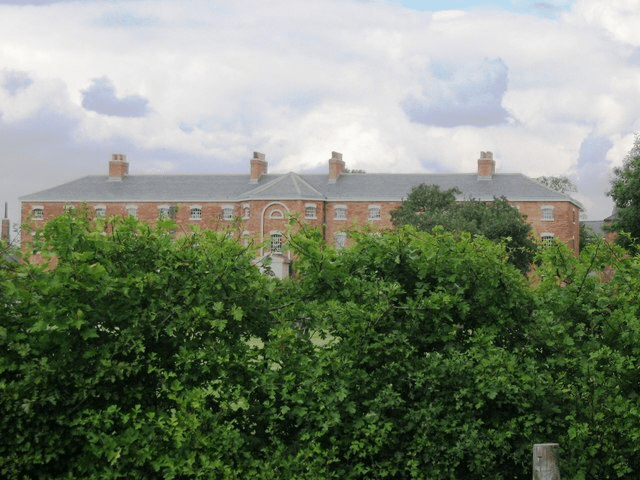
Following the 1834 Poor Law Amendment Act, villages were grouped into unions around a larger town which is why Kintbury’s destitute were housed in Hungerford Union Workhouse in what is now Park Street.

Hungerford Union Workhouse was opened in 1848; it was three storeys high and of the “Stratton” design after the workhouse in Stratton, Wiltshire. 

Inmates were set to work picking oakum – that is to say beating with a mallet then unpicking by hand the tar coated hemp fibres that had been twisted into industrial rope. The finished product – the oakum -was used for such things as  waterproofing the joints in wooden piping and between the planks of wooden ships. It was hard and unpleasant work and oakum pickers suffered from bleeding hands and heavy scarring as well as other more serious conditions.

Typically, workhouses were imposing, prison-like buildings

According to the 1881 census, there were ten Kintbury people in the Hungerford workhouse at that time. This number included Henry Randall, a 44 year old farm labourer and his wife, Ann, 44.

In 1871, Henry – an agricultural labourer – and Ann had been living in Kintbury with their children William 8, Eliza, 6, Lucy 2 and Mary 2 months. What happened to the family in the following ten years we do not know but by 1881 Henry and Ann are inmates of the Hungerford Workhouse.

The eldest son, William, by now 18, is a ploughboy working – and most likely living – on a farm at Radley, to the north of the Bath Road. However his sister, Eliza, now 16, is in the workhouse with her parents and described as a “scholar” which seems somewhat unusual as at that time a young working class woman of 16 might be expected to have entered domestic service. Also there, is 12 year old Lucy.  Mary, who would have been 10 by 1881, is not listed at all so it has to be likely that she has died. Three more children have been born to the Randalls since 1871: Lizzie, now 8, Louisa now 6, and Martha, now 3 and these are all in the workhouse with their parents.

Perhaps the arrival of more children was too much for the Randalls’ household economy or perhaps Henry had lost his job on the farm.

The Randalls of school age are listed on the census as scholars. Although the workhouse originally employed its own teacher, it seems that by 1881 the boys would have walked to the National School in the High Street, to comply, I expect, with Forster’s Education Act which had made universal education compulsory.  The girls, however, received instruction from an “industrial trainer” at the workhouse.

There were 26 other children in the workhouse, all separated from their parents. Similarly, the men were separated from the women.

Twenty nine of the inmates are described as servants and twenty seven as labourers or farm labourers

What I find most surprising, however, is that several of the inmates are listed as having had a trade which might have given them a better chance of supporting themselves but clearly this was not the whole story.

One inmate, Mary Elizabeth Felford, born in Marlborough in 1834, is described as a dressmaker. In 1871 she is living in Wantage with her husband, Edmund, a saddler. However by 1881, Mary is a widow and, one presumes, unable to support herself and her two children so her only option is the workhouse. Why Hungerford, we have no way of knowing but perhaps Mary travelled there in the hope of finding more work but it did not work out.  I can find absolutely no positive trace of Mary or her children after the 1881 census

John Waterhouse is an 18 year old tailor from Newhaven. Why, despite having a trade, he was an inmate of the dreaded workhouse, it is impossible to say but after 1881 he disappears completely from the census records.

Kintbury’s Charles Garlick is a widowed tailor in 1881. In 1841 he had been living with his mother Mary and 16 year old sister Rosa in Kintbury, where, interestingly, Mary is described as “Ind” usually an abbreviation for “Independent means”, suggesting that she was well off enough to support herself. What had happened in the following forty years it is impossible to find out, and both Rosa and Mary disappear from later censuses.

Jacob Brooks is a retired blacksmith of 55 who had, ten years earlier, been working on a farm and lodging at a cottage in Hungerford Church Street. However, by 1881 he is an inmate of the workhouse, most likely because he is too infirmed or otherwise unable to support himself. The workhouse would have been his only option.

But even sadder is the case of William Vincent, 39 from Little Bedwyn. He is deaf and dumb and, it seems, only appears on the 1881 census.

So what became of Kintbury’s Randall family? By 1891, William – the son who did not accompany his parents into the workhouse – is an agricultural labourer in Hungerford Newtown where his sisters, Lizzie, now 18 and Martha, now 13, are living with him.

Louisa is a servant in the family of Eli Brown at the Queen’s Arms, East Garston.

By 1901, William , Lizzie and Martha are all living with Lucy and her husband, Samuel Harding, a GWR railway worker. They were lucky, I think, to have  an in-law who was able to have them lodge with him – it must have made for cramped living conditions as no artisans’ cottages at this time were spacious, but the extra income must have been welcomed.

It makes me very sad not to have found a really positive outcome for any of the Workhouse inmates I have researched here. Not everyone was a permanent resident; I know from my own family history that a set of 2x great grandparents spent sometime in the Chipping Norton workhouse. However, they survived and were able to move on with their lives – otherwise, I suppose, I would not be writing this.

I hope the Randalls’ family story had a happy ending that I have not, so far, been able to find.

(C) Theresa Lock April 2024

Celebrating Victoria’s Golden Jubilee

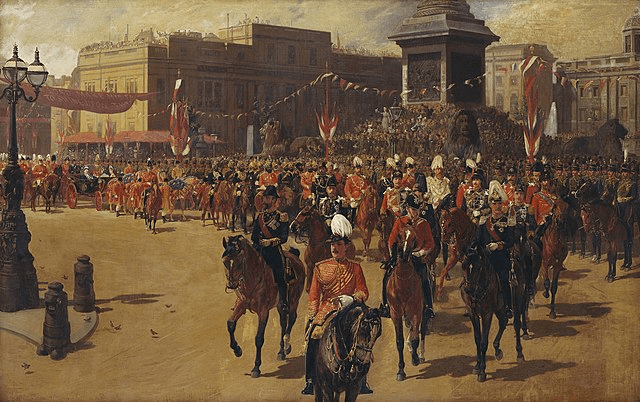
Queen Victoria came to the throne on 20th June 1837 so, by her Golden Jubilee in 1887, many people had grown up knowing no other monarch. Consequently, the fiftieth anniversary of her coronation was seen as a cause for great celebration.

Reports in the Newbury Weekly News covered three local villages: Kintbury, West Woodhay and Combe, although the other villages would certainly have held celebrations. Reading those three reports, what is most interesting, I think, is the way in which events in the two smaller villages are organised – and presumably largely funded – by the families in their respective “big houses” to whom, it is naturally expected, the villagers will demonstrate deference and appreciation.

A church service of thanksgiving was a central to the celebrations in all three villages: at Combe villagers marched behind a banner to St Swithun’s church while St Mary’s, Kintbury flew the Royal Standard and the bells were rung.

Celebrations in the two smaller villages very much revolved around the respective “big houses” with their principal families. At Combe, Mr W.H. Cole gave his workers, game keepers and labourers on the Combe estate a meal “of hot roast beef, mashed potatoes, plum pudding and beer”, all enjoyed on the village green. The villagers, “did not fail to express themselves most grateful”, but then, it would be expected to show appreciation to those you were dependent on for employment. The meal was followed by singing and dancing, “freely indulged in by the village lads and lasses” and – presumably for the men only – the, “fragrant weed, too, liberally supplied by Mr Cole, was thoroughly enjoyed.”

At West Woodhay, celebrations kicked off in sporting vein with a cricket match although presumably this was something to be enjoyed more by the men than the women. The church service was held at a quarter past five after which parishioners proceeded to the home of Mr & Mrs Cole at “the big house” (sic) for hot roast beef and plum pudding which, the report tells us, consumed in a West Woodhay fashion “cannot be beaten.” What “West Woodhay fashion” was, we are left to wonder. The meal was followed by a “Jubilee pipe” and “a good packet of Jubilee tobacco for every man”. If anything special was given to the women of the village, the NWN report does not say. I doubt it was.

The Cole’s son, Mr A.C. Cole, had returned to his parents’ home for the celebration; he gave a speech which was, apparently, well received especially as he had recently been, “in town” where he had been, “viewing Her Majesty in her world-famed  procession and at personal inconvenienced had come down to assist in making his father’s servants happy.”

So that was nice.

At 9 o’clock everyone proceeded to “our beacons” to watch bonfires and rockets.

The NWN report of the celebrations in Kintbury illustrate a village which did not revolve around one family in a “big house”, although the report mentions the names of certain influential and benevolent villagers. Celebrations commenced with a peal of church bells at 5 am so an early start was assured whether the good people of Kintbury wanted it or not! The village was decorated with bunting the like of which had never been seen before, apparently, and music was supplied by the Hungerford Town Band.

Kintbury was then, as it is now, a much bigger village than the others and this is reflected in its celebrations. A table covered with a calico cloth was placed in Dr Lidderdale’s meadow, to seat nearly one thousand people – presumably all at once! A meal of roast and boiled beef as well as boiled ham was served, accompanied by hot potatoes and plum pudding, washed down with a pint of beer or two bottles of ginger beer for each person. Somewhere referred to as “the Baths” was loaned by Mrs General Dunn for tea making. It seems no expense was spared and during the meal, children were entertained by one Professor Burssord, allegedly of London, who performed various and amusing tricks with great dexterity.

Sports and music followed the meal and about 450 children enjoyed bread and butter and cake with tea served in a Jubilee mug. I hope they were able to take the mug home with them afterwards!

Those unable to get to the event due to age or infirmity had their dinners delivered to them.

The day concluded in sports at which money prizes could be won.

What became of all that calico used as table cloths? It was later given to the local schools (interestingly, there must have been more than one either in Kintbury or the satellite hamlets) to be made into children’s garments.

Apart from the size of the village – perhaps that should be small town – the big difference between celebrations in Kintbury and the other two villages is that the event in Kintbury did not revolve around the benevolence of one particular family. The NWN report says that the celebrations were enjoyed by, “ all classes, creeds, in all conditions of life” who “evinced a desire not only to participate in the celebration but also to contribute towards the expenditure thereof.” There is no sense in which the people of Kintbury were expected to show gratitude to one particular family; there is no sense of there being forelock tugging or cap doffing to anyone in a Lord of the Manor role. The celebrations were organised – much more democratically – by a committee chaired by Mr W. H. Dunn with the vicar, Rev Edwards as vice chair. Altogether, dozens of other Kintburians contributed to making the day something to remember.

Queen Victorian lived and reigned for a further fourteen years and her Diamond Jubilee was celebrated in 1897. This , however, was a much more low key event throughout the country, perhaps because by now the aged Queen was seen very little in public – I do not know for sure. But I am sure those who celebrated in 1887 would have remembered  the roast beef, the hot potatoes, the tobacco and the beer – not forgetting the Jubilee mugs – for a very, very long time!

(C) Theresa A. Lock June 2024

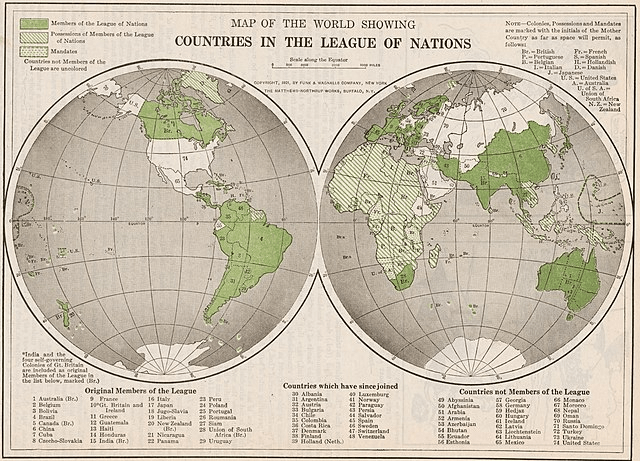
The League of Nations Union in Kintbury

The League of Nations Union was formed in Britain in October 1918 to promote justice and peace between nations following the end of the First World War, with its aims and ideals based upon those of the League of Nations. Enjoying cross-party support politically, by the mid 1920s it had over a quarter of a million members with branches established in many towns and villages.

It seems likely that a branch was first established in Kintbury in 1930 although there are no records of meetings being held until 1933.

Although the LNU, as an organisation, is now long gone and pretty much forgotten, the minutes reveal a time of awareness of international affairs and a concern for what was happening in the world beyond Kintbury. Meetings in local village halls were addressed by influential and well-informed speakers, reflecting, in its early years, a sense of optimism throughout the LNU. What had happened between 1914 and 1918 must not be allowed to happen again. However, as the international situation deteriorated and the League of Nations seemed increasingly powerless, disillusionment set in, as these minutes reflect.

1933

According to the minutes of the March AGM, held in the Methodist schoolroom, the previous year had seen eight committee meetings and two public meetings, one in Inkpen and one in Kintbury. Membership numbered 86 and included the President, Mr H.D.Watson and Rev’d C.R.G. Hughes who was Hon.Sec. and Hon Treasurer. The committee comprised Messers Lawrence, Rolfe, Pinnock, Browne, Bridgeman and Giles. A very male dominated committee. 

The March meeting, a public one, was very well attended. Four members of the Reading Youth Group addressed the meeting on their visit to Geneva and the Kintbury Choral Society sang a chorus. A lively discussion followed.

Committee meetings were held at the Vicarage and between May, and August 1933, five open air meetings had taken place on the Kintbury street corner. In October 1933, Mr. Hughes offered his resignation because of his impending departure from the village.

Education was important to the LNU and across the country schools were encouraged to take up corporate membership as were cooperatives and also churches.

 In November, 1933, a Mr. Archer came to Kintbury from the Federal Council to address members and local schoolchildren. He apparently gave ‘every satisfaction’ and proved himself capable of keeping the children to whom he lectured at a ‘high pitch of interest’.

1934

A year later in November, 1934, committee meetings were resumed in the vicarage as the new vicar, Rev’d Guthrie Alison, became a member of the League. It was agreed during this year to canvass the village for the Peace Ballot, which was being organized across the country. Nationally, over 11 million people voted in favour of the aims of the LNU. In Kintbury, 540 voting papers were collected, but the time taken to organise the ballot locally prevented canvassing for new members and there was a slight drop in membership. However, Mr. Alison recruited at least one new member in November, Mrs. Goodheart of Inkpen.

1935

On a wet summer evening of 19th July, 1935, a very enjoyable and successful meeting and whist drive took place at ‘Windrush’, home of Mr. H. D. Watson. Sixty members attended and partook of pleasant refreshments as well as listening to an attractive and illuminating speech by Mr. Alec Wilson on the work of the League.

LNU Head Quarters suggested an effort be made to increase membership by arranging a campaign. However, the Kintbury contingent felt that this had better be left until after the General Election in November and until after the Italo-Abyssinian war had concluded. Mussolini, the Italian leader, had invaded Ethiopia (Abyssinia) with the intention of expanding Italian influence across East Africa. Such aggression ran counter to the pacifist-mindset of many in the LNU.

In October, 1935, Mr. Alison read aloud a pamphlet on ‘Five Minutes of Your Time’ by A. A. Milne, the popular author who was, at that time, a pacifist. This was sent by H.Q. and deemed very suitable for propaganda. (Used here and at that time, the word did not imply political or ideological bias as it has since come to mean. It implied more of a dissemination of information.)

 All branches were asked to find the views of their parliamentary candidates on the vital international issues of the moment. This, Mr. Watson had done for the Kintbury Branch and he drew attention to the answer of local M.P. General Clifton Browne in the Newbury Weekly News.

In November, Mr. Alison, now President, talked of his recent visit to Geneva and his inspection of the League of Nations’ new building. There was a suggestion of acting a play for propaganda purposes but, as the last play had not been a success it was decided to postpone the suggestion. Arrangements were made however, for a public meeting to be held in December, in the Coronation Hall, Vice Admiral S. R. Drury Lowe to speak.  The vicar was successful in gaining the consent of Barton Court’s Lord Burnham to take the chair.The secretary was asked to communicate with the Heads of the Mothers’ Union, Women’s Institute and Christchurch School regarding this meeting and the vicar was to give notice in church and see the Head of St. Mary’s School. It seems every effort was being made to ensure this meeting was well attended.

1936

Another public meeting was held in Inkpen on Wednesday, 29th January, 1936. An omnibus ran from Kintbury to Inkpen free of charge and a good many members availed themselves of this facility. Fifty or more people were present to hear the most fluent explanatory and interesting speech by Mr. Anthony Mouravieff. Mouravieff, a Parliamentary Private Secretary to an MP, and a prominent member of the League, was a popular speaker on international affairs and addressed many branch meetings across the country at this time. Inkpen must have been lucky to secure his appointment to address their meeting. Discussion followed with several short speeches made with animation and new members enrolled.

At the February AGM, Mr. Pinnock mentioned that Mr. Liggins secretary of the Thatcham Branch would be willing to bring a cinematograph with a League of Nations film to Kintbury!

Meanwhile, the crisis surrounding Abyssinia had not been resolved. The League of Nations had banned weapons sales although these actions were generally ignored by Mussolini. The British government wanted to keep Mussolini on side as an ally against Hitler and were reluctant to enforce sanctions. Together with France, Britain began secret negotiations with Italy without involving the Ethiopian leader, Heili Selassie.

Britain had adopted a position of neutrality and non-intervention with regards to the Spanish Civil War which began in 1936. This way, it was reasoned, made it less likely that the conflict would escalate. However, many young idealistic British men and women travelled to Spain to fight against the rise of fascism. Despite many countries having signed the League of Nations’ Non Intervention agreement, this was ignored by many; Italy and Germany provided military support to Spain’s military general Franco who was aiming to establish a fascist dictatorship. For many, events in Spain served to illustrate how ineffectual the League of Nations actually was at preventing or resolving conflict.    

In Kintbury, a resolution was proposed and sent to H.Q. that:

the Branch expresses its concern about the present position of the League in relation to the action taken by this country alone in the Mediterranean without a mandate from the League and would be interested to know if H.Q. of the League considers that such concern is justified’.

In June the League was in sad financial straights. Indeed. Mr.Jowett, organising secretary for Bucks, Berks and Oxon, was told that his salary must cease owing to the need for economy. However, he agreed to carry on for a while without salary.  Mrs. Goodheart meanwhile, resigned from the committee and the Union. While still believing in the ideal, she could not approve of the Union or belong to it. The worsening political situation must have made many people reconsider where they stood on issues such as pacifism and appeasement.

Another open air meeting was proposed for late July. Unfortunately, July, 1936 was extremely wet and as rainy day succeeded rainy day, an open air meeting became impossible and instead an open meeting was held in the Methodist schoolroom.

Mrs. Corbett-Fisher made a strong and extremely interesting speech and the popular amateur dramatic group, the Reading Pax Players performed “Gas Masque”. This was fresh, well-acted and caused much amusement – it was sadly disappointing that so few people came.

In October it was announced that nationally, 3,000 more members had joined than at the same time last year.  The Chairman, who had attended a meeting in Scarborough, went on to report that

 ‘The League is always most useful in some matters if apparently useless to stop a war. The constitution was not elastic, not workable with regard to some affairs – but might be altered.’ 

 When the League’s debts became known people hastened to its support and £10,000 raised to pay the debt. There was still enthusiasm and resignations were not taking place in large numbers.  Discussion took place on the League’s actions and inactions. Mr. Padel wished to form a protest from Kintbury with regard to the League’s inaction in relation to Abyssinian and the Spanish troubles. The League was not doing its duty, he believed. Mr. Giles opposed intervention in Spain but joined in warm criticism!

The vicar resigned as a committee member in November. Whist Drives were suggested as a fund raiser but it was thought that these were overdone at the moment. There followed a discussion concerning the International Peace Campaign – a movement started in 1935 as a response to Italy’s invasion of Abyssinia. Mr. Giles hoped that the League of Nations would try to prevent war, not wait and only try to stop it when it had already begun.

On December, 7th, 1936, there was a public meeting in the Methodist Schoolroom.  The Chair was taken by Lord Faringdon and the Speaker was once again Vice Admiral S. R. Drury-Lowe, who had achieved splendid work for The League.  The Admiral spoke of the difficulties and weakness of the League at times but stressed its great possibilities and unique position.  He spoke of its inability to stop the last war of aggression, but its immense good in the cause of workers in all parts of the world.  It did much good for children and had opposed the opium and so-called white slave traffic, doing work no other organization could do. There was no other organisation to do the work.  It must be helped and strengthened to allow it to rise to greater power and influence.

It was an extremely cold evening with a searching wind, the attendance at the meeting was very poor.  The Vice Admiral had a whimsical story and a light touch to occasionally relieve his earnest speech, but no new members were made and no new faces seen.

1937

By 1937, the financial situation of the local branch seems to have been less than robust as at the March meeting Mr. Pinnock was asked to find out from the Methodist Trustees, Mr. Phillips and Mr. Mackrill, if the schoolroom could be hired for less than the usual five shillings.

The following month, at the A.G.M. the President, H. D. Watson Esq. gave the little meeting an informal, delightful talk as they sat around a fire. He spoke of his recent visit to Geneva where the League was housed in a magnificent building. However, he reported an atmosphere of depression as regards the peace work of the League particularly amongst the Italian delegates.

In the International Labour Section there was a keen and enthusiastic spirit, as if the good work done was heartening. He spoke of the wonderfully good work done in the ‘Save The Children Branch’ its great activity and hopefulness.  The League was doing magnificent work for the so-called white slave traffic, drug smuggling and slavery.

It was decided that all accounts must be audited as was the case in all other Kintbury Societies.

The Vicar consented to be Vice-President again. As H.Q. was in great need of money Kintbury forwarded ten shillings in November 1937.

1938

The public meeting on January, 17th, 1938, was a great success.  Miss. Chu Chan Koo (Miss. Wellington Koo), daughter of China’s representative at Geneva, made a moving speech on the history of China and its present sad state which was particularly well received.  This was followed by a short pageant play entitled ‘Friendships Chain’. The parts were taken by 23 Kintbury ladies and girls and watched by an audience of over 200 people. A collection for medical relief for Chinese sufferers raised £3-17s-0d.

It was announced that Mr. Lloyd resigned as President of the Berkshire Federal Council. He still adhered to the League of Nations but not to its instrument, the League of Nations Union.  Lord Neston of Agra agreed to take his place.

At the March meeting of 1938, the committee spoke with great regret of the death of Mr. Rolfe, ‘an important member of the committee’. The committee also lost two other members, Miss Joan Ewins resigned and Mr. Gordon Abraham moved to Surrey.

 Mr. Watson continued as President. He had just visited Geneva again and reported on the international situation which was not optimistic. In May, it was explained, Italy will require Abyssinia to be acknowledged as part of the Italian Empire.  All nations, with the possible exception of Russia, will have to do this. It would be necessary for Great Britain to recognise Italy’s conquest of Abyssinia in order to keep the peace and be on good terms with Mussolini. In return, Italy was apparently anxious to maintain good relations with Great Britain because of affairs in Austria.

The outlook in Geneva seemed gloomy and the League was anxious.  Great Britain still believed in the work of the League but acknowledged that reconstruction of it might be necessary. Although it might not be able to maintain international peace it still had important work to do regarding the sale of dangerous drugs and so-called white slave traffic, and, importantly, continuing to help all refugees and keep up the Save The Children Fund.

Mr. Watson was thanked for his talk and the vicar continued in a ‘happy little speech’, to hint that such an end as peace perhaps justifies the means i.e. the recognition of Abyssinia’s conquest. A lively general discussion followed.

In May, the vicar suggested that a meeting be held soon in Kintbury in which a speaker could explain the current situation in central Europe, particularly with regards to Czechoslovakia and the threat to peace. This was arranged to take place in the Coronation Hall at 7.30pm on Sunday, 19th June.

Mr. Anthony Moore gave an interesting address to an audience of fifty to sixty people. He explaining that the Czechoslovakians are not an upstart nation, but Bohemians, a small nation now since the 14-18 war.  Their country was a buffer state with a German minority population likely to cause trouble, he believed, in the near future. It was Hitler’s intention, he explained, to acquire all the smaller nations of Central Europe.  The Germans, he believed, had taken against the Jews because they were “international”.

  The League of Nations Union has passed a resolution to ask the British Government to support Czechoslovakia and present a bold front to Hitler.

Mr. Moore answered several pertinent questions from the audience, who keenly enjoyed his fluency and grasp of the subject.  A vote of thanks was warmly seconded by General Rennie, who said that he appreciated the speech but not the League of Nations Union.  The vote was carried with acclamation.

1939

Attendance at the May A.G.M., 1939, was very poor: President, Secretary, Treasurer, four committee members only. At the Public Meeting that followed, Mr. Alec Wilson, M.I.R.A., gave a short, optimistic speech: ‘After the Great War there were widespread results. The League of Nations was formed to help peace and goodwill among nations. After the great slump set in over the world, Germany was very low in money and work. Hitler, whose plans were for all Germans to be one huge family, rose as Dictator or Leader.  His book, ‘Mine Kampf’, shows his idea that the Germans are the only people fit to govern Central Europe’.

The lecturer traced events from 1914 up to date, showing how the German threat to Poland arose and that part of South Russia called the Ukraine.  Wilson was of the opinion that Britain’s alliance with Russia posed a problem as the British had a dislike for communism and also there was much danger in naval and military commitments in a vast distant territory. 

On 30th July, 1939 it was decided that ‘the time had come for the Kintbury and Inkpen Branch to acknowledge that no work was done in connection with the League of Nations’.

The Treasurer, Mr.Pinnock, had left the neighbourhood, the Secretary, Mrs. Norton, said she wished to resign because the League of Nations Union seemed quite dormant here and she had other work to do.  The President said that although other branches were closing many were active, especially in the north. He wished some remnants of the branch to be kept – in view of a revival, when their time came again, when peace was near.  The vicar agreed to keep the minute book and list the members until peace came and a working secretary was needed.

Ironically, peace was to be a long time coming as war broke out across Europe in September of that year. The League of Nations was officially disbanded in 1946 although its aims and intentions were enshrined in the United Nations, established by charter in 1945. Its work continues to this day.

(c) Penelope Fletcher, 2024
The Lloyd family of Enborne…and beyond

On the chancel wall of St Michael & All Angels, Enborne, near Newbury, is a plaque to the memory of a former rector with a rather unusual name.

Nowes ( pronounced “Noise” ) Lloyd had been born in Essex and was baptised on 6th September 1719. His father was the Rev John Lloyd of Epping and his mother Isabella. Isabella’s maiden name had been Nowes, hence the baby’s rather unusual name.

As a young man, Nowes seems to have taken the traditional route to the priesthood for the time, having graduated with a BA from St John’s College, Oxford in 1742 before being ordained by the Bishop of London at Whitehall on 9th June, 1745. However, his vocation was to take him out of the city and into rural Wiltshire. By 1751, Nowes had become vicar of Bishopstone as well as Rector of the next door parish of Hinton Parva, near Swindon.

St Mary’s church, Bishopstone, Wiltshire

 The position of parish priest has never been a lucrative one, and this may be why the Rev Lloyd did not marry until 1763, when he was 43. His bride, ten years her husband’s junior, however, may well have been used to a more affluent lifestyle than the vicarage could offer, since she was Martha Craven, the daughter of the Honourable Charles Craven of Hamstead Marshall, and his wife Elizabeth, Lady Craven.

 Martha’s father had been the first Governor of South Carolina in what is now the U.S. Martha’s mother is reputed to have been something of a socialite and a very difficult person, with little time for Martha or her sisters, Mary and Jane. Consequently, Mary left home to make a very unhappy marriage with a horse dealer whilst Martha worked for a time as a seamstress at a school, using a false name to hide her identity before marrying Nowes.

Martha Craven and Nowes Lloyd were married by licence at Bishopstone on 2nd June 1763. I do not know why the marriage was by licence rather than banns; there may have been a very simple reason although I wonder if Martha’s difficult relationship with her mother might have caused the couple to arrange their marriage at short notice thereby requiring a licence rather than banns. We will probably never know.

 In the same year that Martha married Nowes, her sister Jane married Rev Thomas Fowle of Kintbury.

Martha and Nowes began their married life at Bishopstone, where four children were born to them. The first child, also Martha, was baptised there on 16th November 1765, to be followed by Elizabeth on June 15th, 1767, Charles on December 21st, 1768 and Mary on May 20th 1771.

The Rev Lloyd’s relationship with what is now the Walbury Beacon Benefice seems to have begun in 1764 when he became Domestic Chaplain to William Craven, 5th Baron Craven of Hamstead Marshall. Baron Craven was, of course, a relative of Martha Lloyd. These were the days when who you knew rather than what you knew could make a really big difference to your life.
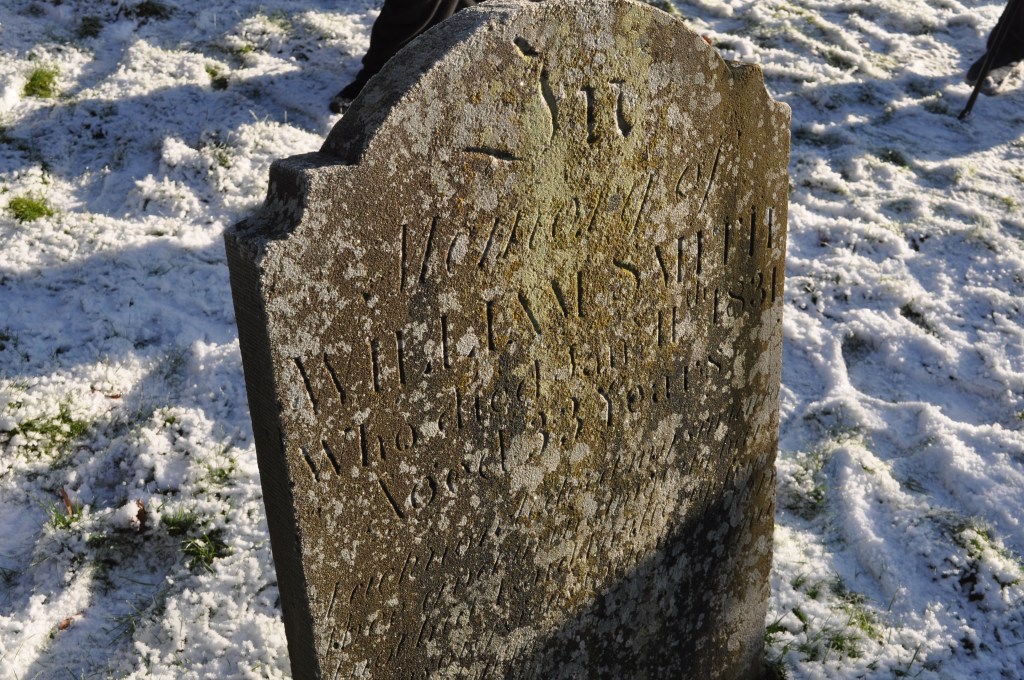
St Michael’s & All Angels, Enborne, Berkshire

 In 1771, Nowes Lloyd became rector of Enborne whilst retaining his position at the other parishes, even though they were over thirty miles apart. This was not an unusual situation for the time, when it was quite common for a curate to undertake all the duties of the absent priest. Eventually, the Lloyd family moved to Enborne where Martha would be much closer to her sister Jane at Kintbury. Their mother, however, was by now also living in Kintbury, at Barton Court, with her second husband, Jemmet Raymond. We can only wonder what Elizabeth Raymond’s relationship with her daughters was like by this time.

 Sadly, there was an outbreak of smallpox in the Enborne area in 1775 and, whilst his sisters survived, Charles Lloyd, then only six, died. He was buried in the churchyard on 13th April of that year. Martha’s mother, meanwhile, had died in 1771. As if to demonstrate the wealth and status of the Raymond family, an elaborate marble memorial was commissioned from the renowned sculptor, Peter Scheemakers, to be placed next to the altar in Kintbury church. A letter written by Nowes Lloyd to his brother-in-law, Rev Thomas Fowle, regarding arrangements with Scheemakers, is still in the church’s possession.

Letter from Rev Nowes Lloyd to Rev Thomas Fowle concerning the Scheermackers monument, Kintbury

 You might have seen Elizabeth Raymond, formerly Lady Craven, in Kintbury church. If you happen to be standing in a pew near the front and to the left hand side of the aisle, possibly singing a favourite hymn, and casually turn your head to the left – there, in her current position in the north transept will be Elizabeth, stonily staring back at you as if in disapproval of something, you know not what.

Elizabeth, former Lady Craven

Nowes remained as rector of Enborne until his death on February 3rd, 1789. The previous year, his daughter Elizabeth had married her cousin from Kintbury, Fulwar Craven Fowle. At this time  Martha and Mary were still living at home. There was a need to vacate the Enborne rectory but fortunately for Rev Lloyd’s widow and her daughters, a friend of the Fowles offered them his parsonage at Deane. The move to Deane proved to be quite significant for Martha Lloyd in particular as she became a close friend of the vicar’s daughter, later living with her, her sister and their mother in Bath.

 Martha’s friend was creative and lively with a keen if sometimes wicked sense of humour. She loved walking, wrote long, detailed letters whenever she was away from her family and friends and, in particular, would entertain them all by reading to them the stories she had spent hours writing. In this way, Martha Lloyd, formerly of Enborne, became one of the first people to read what have become some of the best loved novels in the English language. Martha’s close friend was none other than Jane Austen. In 1797, the link between the Lloyds and the Austens became even stronger when Mary Lloyd became the second wife of the Jane Austen’s widowed brother, James. When Jane Austen, along with her mother and sister Cassandra moved back to their native Hampshire, Martha went with them to share the cottage in Chawton, now the Jane Austen’s House Museum. It says something of the position of women in the early nineteenth century that Martha Lloyd, grand daughter of Lady Craven with her elaborate and expensive monument in Kintbury church, had no home of her own except the one she shared with her friends. But life had another surprise in store for the young woman from Enborne. After Jane Austen’s death in 1817, Martha continued to live in the cottage at Chawton with Cassandra Austen. However, on 24th July 1828, she became Sir Francis Austen’s second wife and therefore, Lady Austen.

 Today, the name of Martha Lloyd is well known to Jane Austen fans all over the world. A facsimile of her household book containing the recipes for dishes she cooked at Chawton, has been published and earlier last year saw the publication of Jane Austen’s Best Friend: The Life and Influence of Martha Lloyd by Zoe Wheddon . So, while Janeites (as fans of Jane Austen are known) all over the world think of Martha Lloyd as Jane Austen’s best friend, I will always think of her as the young woman from Enborne.

Many thanks to Alec Morley of Romsey Local History Society https://www.ltvas.org.uk/ for information regarding Nowes Lloyd’s family and also for clarifying for me how to spell and pronounce his unusual first name.

© Theresa A. Lock 2024