It is mind boggling to think of people living in this area over 6000 years ago. However, if you know where to look for it you can still see evidence of those people who lived around here between c4000 and 2500 years BC in the neolithic period.
The neolithic, or new stone age, was the period which saw a more settled way of life with the domestication of plants and animals and the beginning of farming rather than a hunter/gatherer life style.
During this period there were communal constructions of large scale earth works, banks and ditches. The famous henge monument at Avebury dates from this period.
But where is the evidence that neolithic people once lived in this area?
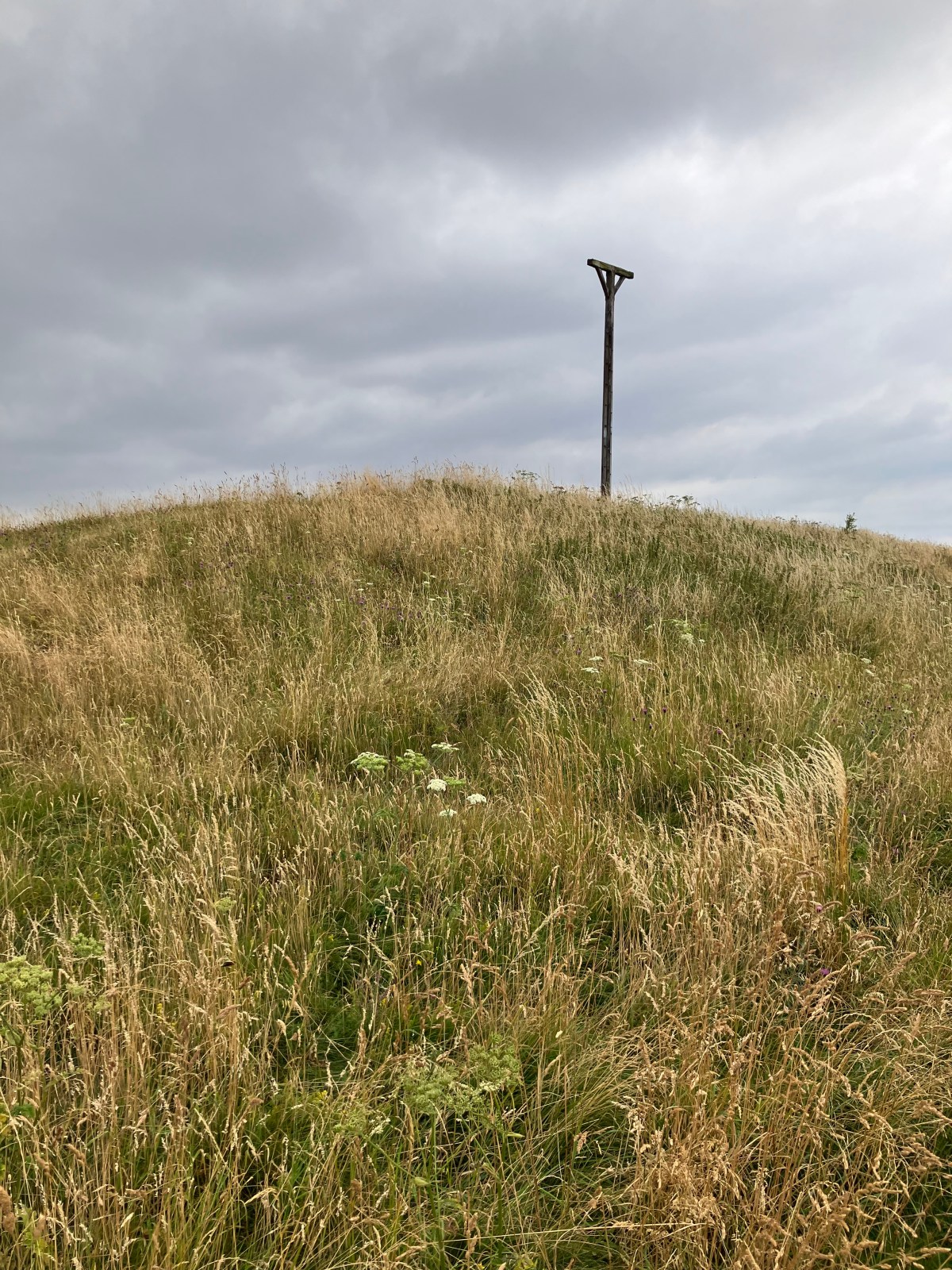
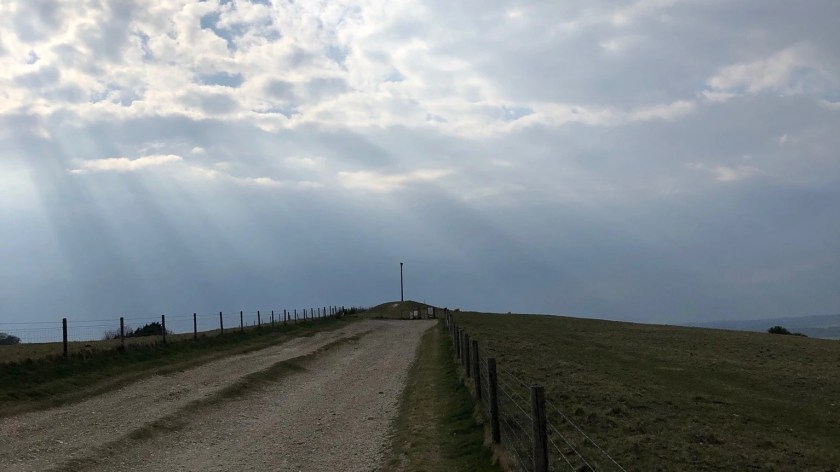
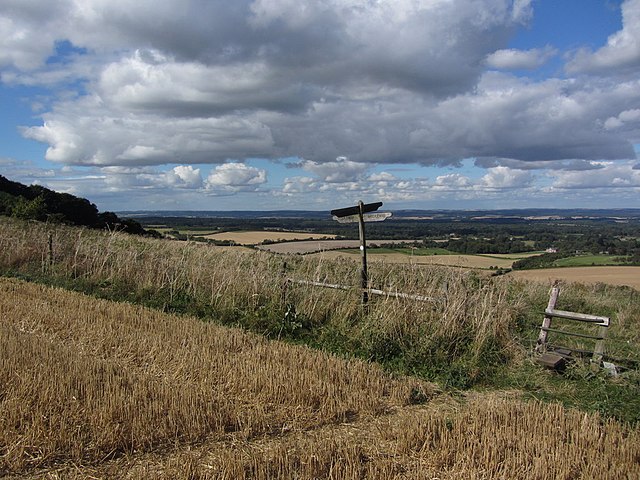
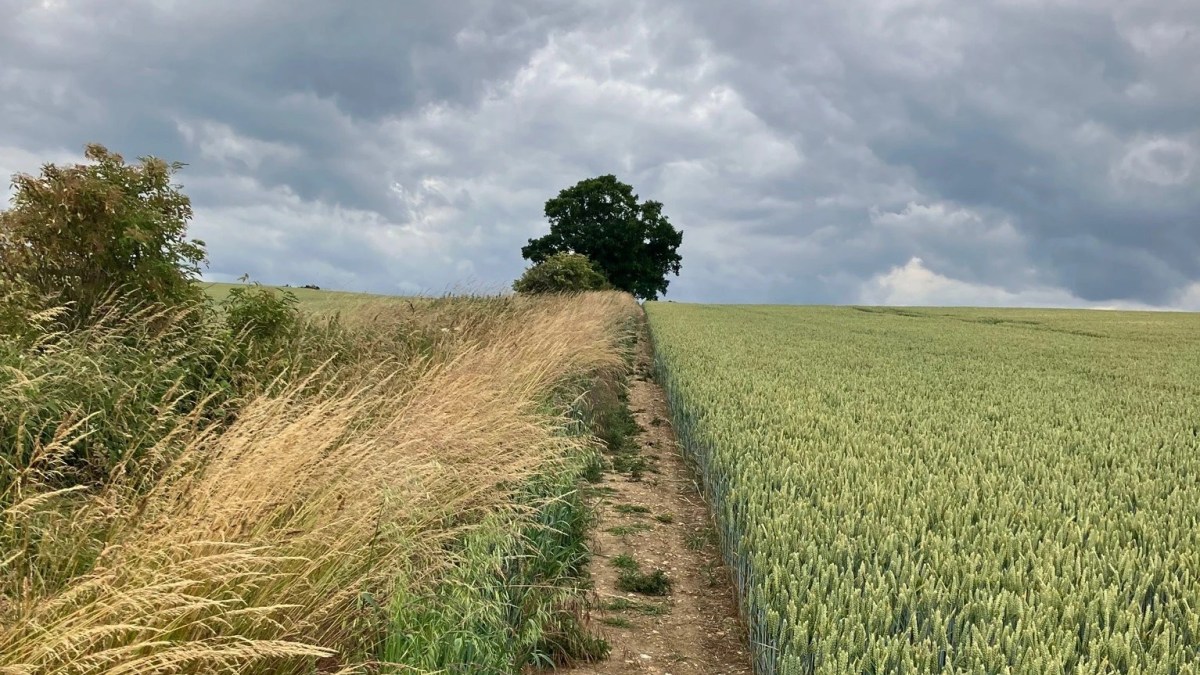
A favourite local destination for many of us in our area is Combe Gibbet above Gallows Down, close to the highest point on chalk in England and affording spectacular views particularly to the north across the Kennet valley. Standing right next to the gibbet we admire the view and identify local landmarks. It is an uplifting and spectacular spot.
But is there something that we miss? I know I did when I first walked up to the gibbet. As it stands on one of the highest points of the hill, it is easy to overlook the fact that the gibbet has been erected on a mound. The mound on which it stands is actually a neolithic long barrow.
There are around 500 neolithic long barrows in England of which three are in Berkshire and many more over the borders in Wiltshire and Dorset. Generally speaking most are in the Cotswolds or Wessex.
Our local barrow is oriented east to west and measures 65 meters by 20 meters and is surrounded by a ditch about 7 meters wide. Constructing it was no mean feat particularly when the only tools available were made from bone or flint and would have required a well-organised and dedicated work force.
But why was it built up here?
Long barrows were important communal burial sites during the neolithic. A chamber was usually constructed of wood or stone with an entrance at one end, then covered over with earth. Members of the community were laid to rest in the tomb but, in a practice that seems strange to us, often only certain bones were placed within and it seems likely that the remains were, at times, taken out and replaced.
It is likely that the long barrow would have been an important ritual site for the local community and might have indicated ownership of a particular area by a particular group of people. A location commanding an impressive view seems to have been important; for example, Wayland’s Smithy Long Barrow near Uffington and West Kennet near Avebury are also sited on higher ground.
The long barrow above Gallows Down was likely to have been the focus of communal events. However it may well be that our neolithic neighbours would have travelled further afield to meet up with other family members or community groups; the henge and stones at Avebury could have been reached by following the river Kennet westwards, for example. We know that neolithic peoples often travelled hundreds of miles to join in the ceremonies at Stonehenge so the thirty or so from here across Salisbury Plain would have seemed any easy journey to people used to walking long distances
So, as we traipse up to the gibbet and admire the view, perhaps we should remember that beneath our feet is a construction that would have been important to our neolithic neighbours – something that would have been revered and respected, which had taken much time and effort to build. After all, we can not imagine a time when we would walk through Winchester Cathedral whilst ignoring its significance as a place of worship, or pass Windsor Castle without seeing it as something just a bit special.
Our local long barrow, up above Gallows Down, might not look particularly important to us now, but it is worth remembering that 6000 years ago it might have been the most significant thing in the landscape.
O.G.S. Crawford – the man who put history on the O.S. Maps
I have always enjoyed looking at Ordnance Survey maps – to plan routes for days out or just afternoon walks, or simply to see the names of woods, rivers, hills or countless other features all carefully recorded. But for me one of the most fascinating features of O.S. maps are those places labelled in a gothic or Old English font which indicate a site of historic or archaeological significance. “Walbury”, “long barrow” ( on Gallows Down ) and “moat” ( at Balsden Farm ) are all good examples from the Kintbury area.
Although the Ordnance Survey started publishing maps over 200 years ago, originally for military purposes, it was not until the 1920s that historic and archaeological sites were first identified as they are now. And the person first responsible for including that information had an interesting connection with our area.
Osbert Guy Stanhope Crawford was born in 1886 in Bombay, India where his father was a judge. However, as his mother died soon after his birth, he was sent back to England to live in London with two of his aunts. While the young Osbert was still of school age, he moved with them to The Grove, East Woodhay, a few miles from Kintbury and just over the border in Hampshire. Later the Crawfords relocated to Tan House, Donnington, just outside Newbury.
Crawford was educated at Marlborough College in Wiltshire and it was there that his interest in archaeology grew. As a member of the College’s Natural History Society, Crawford visited various Wiltshire archaeological sites such as Stonehenge, West Kennet Long Barrow and Avebury.
From Marlborough, Crawford went up Oxford University where his interest in archaeology continued. In 1908, whilst still a student, he excavated a Bronze Age round barrow at Inkpen, not far from his aunts’ East Woodhay home, as well as other – possibly less successful – work excavating at Walbury Beacon.
It was around this time that Crawford became friends with archaeologist and anthropologist Harold Peake and his wife Charlotte, excavating with them at Botley Copse near Marlborough. Harold Peake is particularly remembered in this area as being curator of the Borough of Newbury Museum from 1867 to 1946 and the person responsible for building up an important collection for what was later to become the West Berkshire Museum.
The Peakes lived at Westbrook House, Boxford, just to the north of Kintbury. Their interests included not only archaeology and anthropology but music, folklore and drama and they were very supported of younger people such as Crawford. It is believed that, under Peake’s influence, Crawford began to question the kind of extreme religious beliefs held by his aunts, in favour of a more science-based world view.
After graduating from Oxford, Crawford worked as an archaeologist in both Britain and Sudan. During the First World War he served as a photographer with the Royal Flying Corp but spent time in a German P.O.W. camp, having been shot down.
In the 1920s, Crawford worked for the Ordnance Survey in Southampton, as its first Archaeological Officer. It was around this time that historians and archaeologists began to use aerial photography in identifying and interpreting historic sites which could no longer be seen clearly above ground. The remains of structures and earth works which have long disappeared can be identified through crop marks and shadows which can then be studied using aerial photographs. Crawford’s time with the Royal Flying Corp would have given him first hand experience of how useful such photographs can be.
Crawford used the study of aerial photographs as well as information gathered from local antiquarian and historical societies to identify the locations of many ancient monuments which would not have been visible to cartographers working in the field. He also conducted his own surveys, often travelling across the countryside on his bicycle. Crawford then annotated each O.S. map by hand, adding the names and locations we are now familiar with but which today are identified on our maps in a gothic font.
At this time, Alexander Keiller, heir to the family fortune made in marmalade, was living at Avebury Manor. An amateur archaeologist, he had been involved in excavating the world-famous neolithic henge and other associated sites. In 1924 Crawford joined Keiller in an aerial survey of Wiltshire and Somerset as well as Berkshire, Hampshire and Dorset and in 1928 they published Wessex From The Air, a groundbreaking aerial photography survey of our area and the landscape of the wider Wessex.
Crawford assisted Keiller in the fund raising which enabled Stonehenge to be bought for the nation, and in 1927 he founded the influential archaeological journal, Antiquity.
Keiller worked for the O.S. until 1946 when he turned his attention to the preservation of those historic buildings in Southampton which had survived the devastation of the blitz during the Second World War.
Today, O.G.S. Crawford is recognised as an important figure in twentieth century archaeology. It is interesting to think that this important career began in part with an excavation at Inkpen and a friendship in Boxford.
In the world of late Georgian England, laws governing the sale of alcohol were very different to what they are today.
The 1830 Beerhouse Act – sometimes known as “Wellington’s Act, after the prime minister of the day – allowed any rate payer to brew and sell beer on payment of a two guinea licence. This was an attempt by the government to increase competition between the brewers, to lower the prices for the consumer and to dissuade drinkers from drinking spirits such as gin, which at that time was very cheap to buy.
Not surprisingly, the act resulted in new beerhouses opening. Many were no more than houses or cottages where the householder brewed beer at home. They were nothing like what we might think of today as an inn or “pub”. It is almost impossible to identify today where our local beerhouses might have been, although it is true that some which opened as a result of the 1830 Act might have gone on to become established public houses in the modern sense.
The Reading Mercury of April 1833 has a report concerning an unfortunate event which occurred at beerhouse in Enborne.
Apparently, two young men from East Woodhay, Samuel Pocock, a carpenter and Solomon Rose a labourer, were drinking in the beerhouse, the precise location of which is unidentified. Perhaps they had been drinking for too long, or perhaps the home-brewed beer was too strong, we shall never know, but things became very unpleasant when the subject came up of a young woman known to both men. Discussion turned to argument and argument would have turned into a fight there and then, but the owner of the beerhouse intervened to stop it.
Unfortunately, the two young men were reluctant to leave the matter there and it was agreed that they should fight it out. Consequently at 7 o’clock on the following Monday they met up.
Today, such a planned fight would seem to be nothing more than an extension of a drunken brawl. However, to put this event into its early nineteenth century context, it may be that the participants did not see themselves as brawling or being particularly disorderly.
Duelling, which is to say combat between two people using guns in order to settle a dispute, had not officially become illegal until 1819 although this had not prevented some continuation of the practice among the fire arm owning classes. As a form of entertainment, bare knuckle fighting was a popular sport amongst all classes and even between some women. There had been attempts to make “prizefighting” illegal but as matches were popular and constables of the newly formed police force thin on the ground, many prizefights went ahead, anyway.
Seen in this context, therefore, a fight following a disagreement in a beer house might have seemed to those involved to be a legitimate response – almost “sporting” perhaps.
The chosen venue was a field and the young men were accompanied by John Rose and Edward Pocock, presumably to see fair play.
The ensuing fight went on for a dozen rounds before Pocock hit Rose with a violent blow under his left ear. He was killed immediately.
An inquest was held and it was discovered that the blow had ruptured a blood vessel at the base of the victim’s brain and he had lost nearly a pint of blood.
Pocock was arrested and charged with manslaughter. John Rose and Edward Pocock were charged with aiding and abetting.
It was three months before the case came to Winchester Assizes and for Rose and the two Pococks, as well as for their families and friends back in East Woodhay, it must have been a very stressful time. Sentences available to a judge at this time included execution or transportation for life as well as imprisonment. Two years previously, William Winterbourn, from the nearby village of Kintbury, had been executed for his part in the Swing Riots and he had not killed anybody.
However, the judge’s decision might come as a bit of a surprise. According to the newspaper reports of the time,
“The learned judge, in addressing the prisoners, said that there did not appear to be anything unfair in the fight which had taken place in consequence of a quarrel and under such circumstances the offence did not call for severe punishment. Sometimes, persons went out to fight for money, and when that was the case, it should be known, that all persons who were present were equally guilty with those who were actually fighting. Taking all the circumstances into consideration, and that the prisoners had already been imprisoned for three months, the sentence of the Court was that they should pay a fine of 1 shilling and be discharged.”
So, in the opinion of the judge, the fight had not been unfair. Presumably it would have been considered that both men knew the risks they were taking and so Pocock was not held culpable for Rose’s death. Furthermore, no money had been involved, which, the judge had been at pains to point out, made all the difference.
Samuel Pocock returned to East Woodhay where, in 1841, he is living with his wife, Jane and their four children.
Was Jane the woman over whom Pocock and Rose were fighting? It has to be possible, although as Jane came from Great Bedwyn, a village in Wiltshire a few miles to the west, it is unlikely.
Though I can find no record of Edward Pocock after the tragic events of 1833, John Rose, the other witness to the fight, continued to live in East Woodhay with his wife Elizabeth and their family.
Was there any ill feeling between the Pocock and Rose family? We shall never know.
References & sources:
Photo: Pilot Hill, East Woodhay. Colin Park, Creative Commons
On the chancel wall of St Michael & All Angels, Enborne, near Newbury, is a plaque to the memory of a former rector with a rather unusual name.
Nowes ( pronounced “Noise” ) Lloyd had been born in Essex and was baptised on 6th September 1719. His father was the Rev John Lloyd of Epping and his mother Isabella. Isabella’s maiden name had been Nowes, hence the baby’s rather unusual name.
As a young man, Nowes seems to have taken the traditional route to the priesthood for the time, having graduated with a BA from St John’s College, Oxford in 1742 before being ordained by the Bishop of London at Whitehall on 9th June, 1745. However, his vocation was to take him out of the city and into rural Wiltshire. By 1751, Nowes had become vicar of Bishopstone as well as Rector of the next door parish of Hinton Parva, near Swindon.
St Mary’s church, Bishopstone, Wiltshire
The position of parish priest has never been a lucrative one, and this may be why the Rev Lloyd did not marry until 1763, when he was 43. His bride, ten years her husband’s junior, however, may well have been used to a more affluent lifestyle than the vicarage could offer, since she was Martha Craven, the daughter of the Honourable Charles Craven of Hamstead Marshall, and his wife Elizabeth, Lady Craven.
Martha’s father had been the first Governor of South Carolina in what is now the U.S. Martha’s mother is reputed to have been something of a socialite and a very difficult person, with little time for Martha or her sisters, Mary and Jane. Consequently, Mary left home to make a very unhappy marriage with a horse dealer whilst Martha worked for a time as a seamstress at a school, using a false name to hide her identity before marrying Nowes.
Martha Craven and Nowes Lloyd were married by licence at Bishopstone on 2nd June 1763. I do not know why the marriage was by licence rather than banns; there may have been a very simple reason although I wonder if Martha’s difficult relationship with her mother might have caused the couple to arrange their marriage at short notice thereby requiring a licence rather than banns. We will probably never know.
In the same year that Martha married Nowes, her sister Jane married Rev Thomas Fowle of Kintbury.
Martha and Nowes began their married life at Bishopstone, where four children were born to them. The first child, also Martha, was baptised there on 16th November 1765, to be followed by Elizabeth on June 15th, 1767, Charles on December 21st, 1768 and Mary on May 20th 1771.
The Rev Lloyd’s relationship with what is now the Walbury Beacon Benefice seems to have begun in 1764 when he became Domestic Chaplain to William Craven, 5th Baron Craven of Hamstead Marshall. Baron Craven was, of course, a relative of Martha Lloyd. These were the days when who you knew rather than what you knew could make a really big difference to your life.
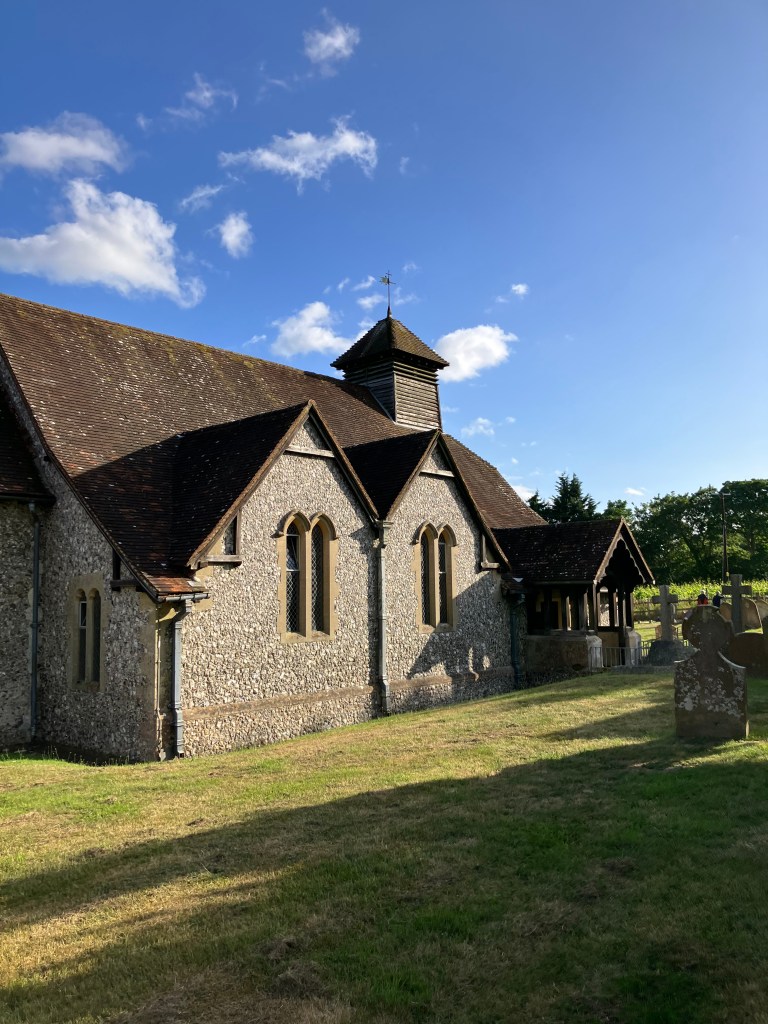
St Michael’s & All Angels, Enborne, Berkshire
In 1771, Nowes Lloyd became rector of Enborne whilst retaining his position at the other parishes, even though they were over thirty miles apart. This was not an unusual situation for the time, when it was quite common for a curate to undertake all the duties of the absent priest. Eventually, the Lloyd family moved to Enborne where Martha would be much closer to her sister Jane at Kintbury. Their mother, however, was by now also living in Kintbury, at Barton Court, with her second husband, Jemmet Raymond. We can only wonder what Elizabeth Raymond’s relationship with her daughters was like by this time.
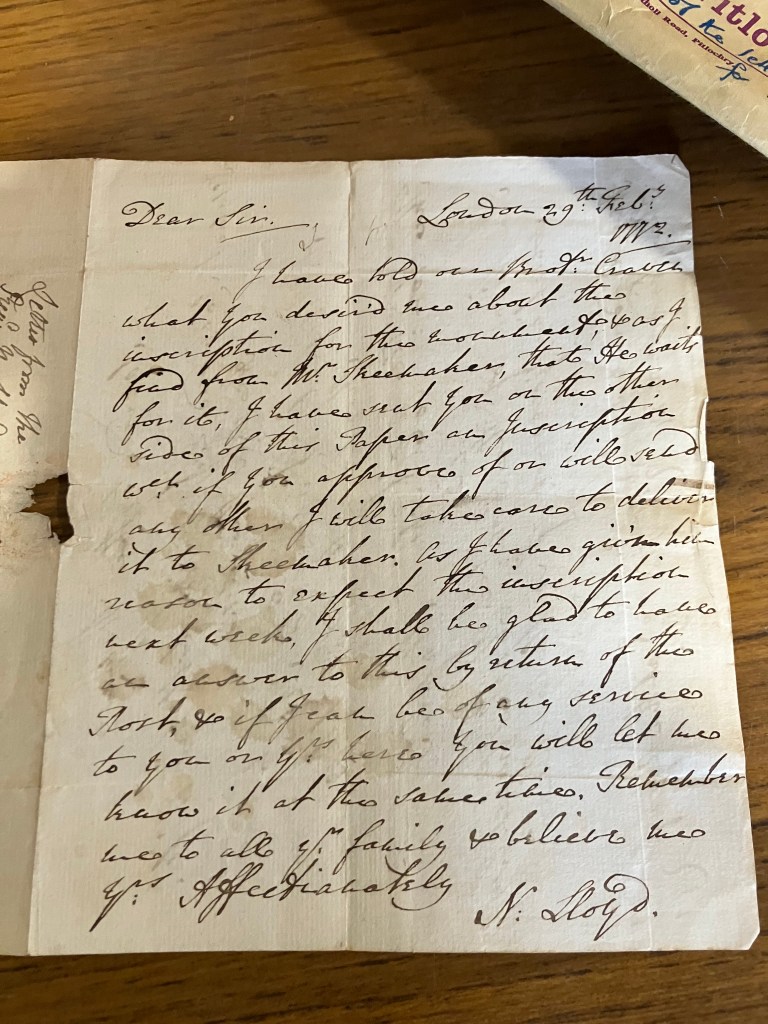
Sadly, there was an outbreak of smallpox in the Enborne area in 1775 and, whilst his sisters survived, Charles Lloyd, then only six, died. He was buried in the churchyard on 13th April of that year. Martha’s mother, meanwhile, had died in 1771. As if to demonstrate the wealth and status of the Raymond family, an elaborate marble memorial was commissioned from the renowned sculptor, Peter Scheemakers, to be placed next to the altar in Kintbury church. A letter written by Nowes Lloyd to his brother-in-law, Rev Thomas Fowle, regarding arrangements with Scheemakers, is still in the church’s possession.
Letter from Rev Nowes Lloyd to Rev Thomas Fowle concerning the Scheermackers monument, Kintbury
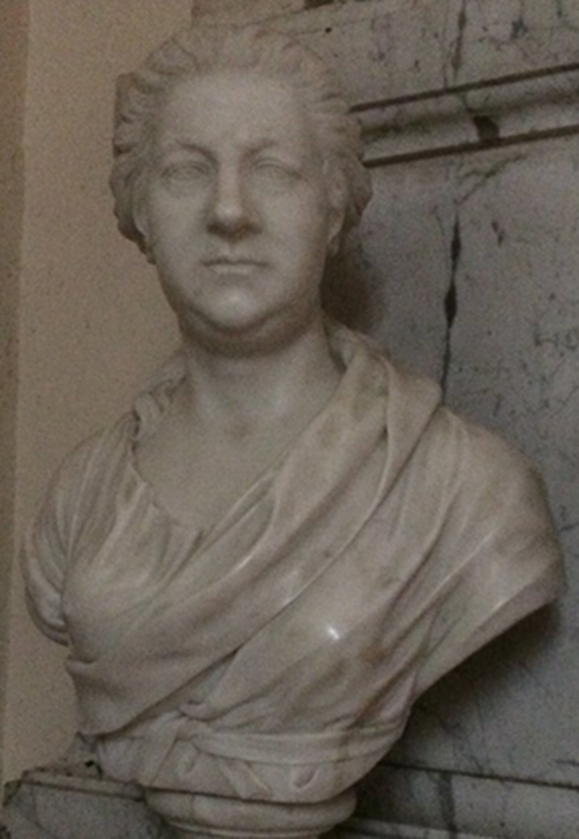
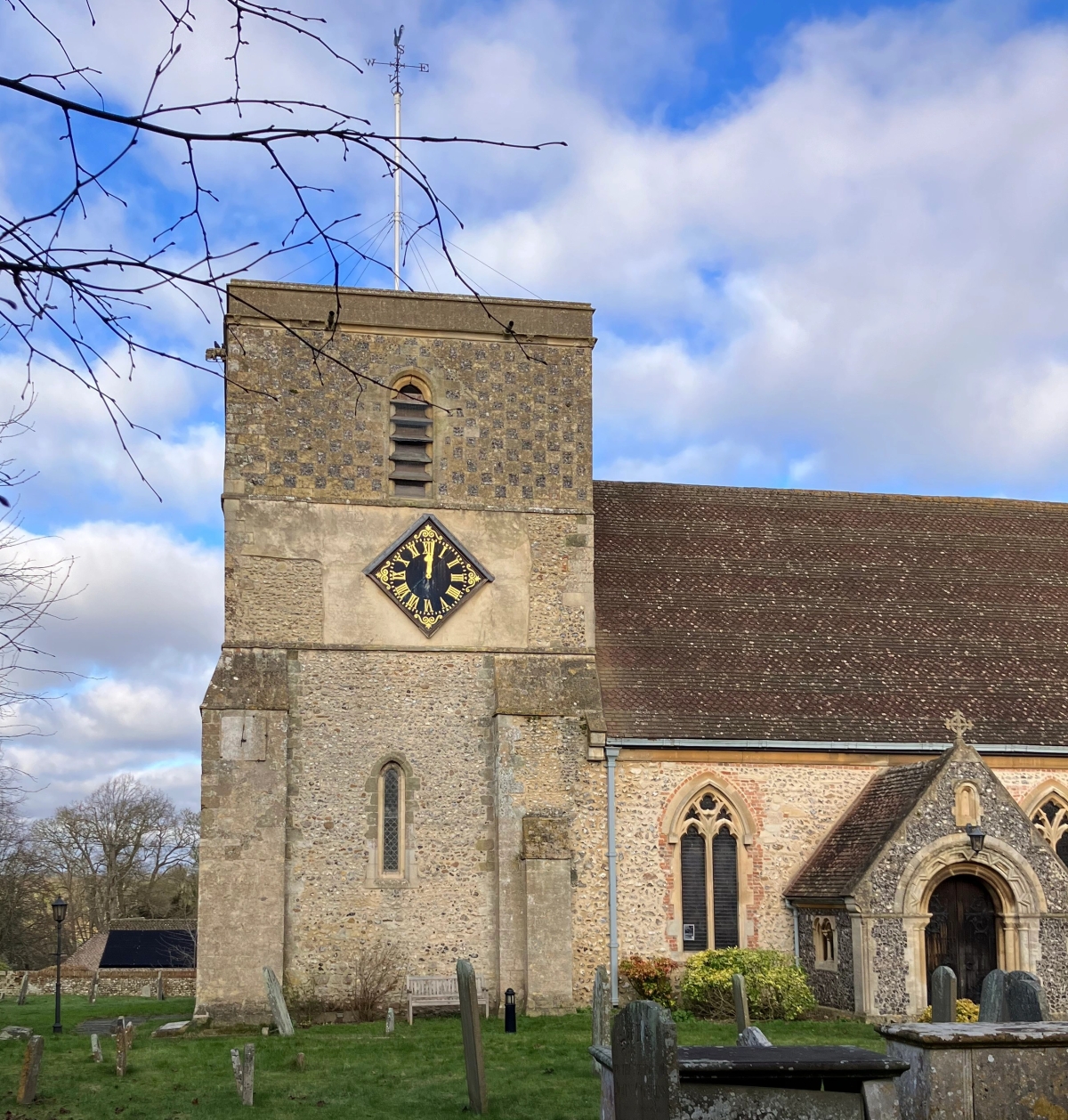
You might have seen Elizabeth Raymond, formerly Lady Craven, in Kintbury church. If you happen to be standing in a pew near the front and to the left hand side of the aisle, possibly singing a favourite hymn, and casually turn your head to the left – there, in her current position in the north transept will be Elizabeth, stonily staring back at you as if in disapproval of something, you know not what.
Elizabeth, former Lady Craven
Nowes remained as rector of Enborne until his death on February 3rd, 1789. The previous year, his daughter Elizabeth had married her cousin from Kintbury, Fulwar Craven Fowle. At this time Martha and Mary were still living at home. There was a need to vacate the Enborne rectory but fortunately for Rev Lloyd’s widow and her daughters, a friend of the Fowles offered them his parsonage at Deane. The move to Deane proved to be quite significant for Martha Lloyd in particular as she became a close friend of the vicar’s daughter, later living with her, her sister and their mother in Bath.
Martha’s friend was creative and lively with a keen if sometimes wicked sense of humour. She loved walking, wrote long, detailed letters whenever she was away from her family and friends and, in particular, would entertain them all by reading to them the stories she had spent hours writing. In this way, Martha Lloyd, formerly of Enborne, became one of the first people to read what have become some of the best loved novels in the English language. Martha’s close friend was none other than Jane Austen. In 1797, the link between the Lloyds and the Austens became even stronger when Mary Lloyd became the second wife of the Jane Austen’s widowed brother, James. When Jane Austen, along with her mother and sister Cassandra moved back to their native Hampshire, Martha went with them to share the cottage in Chawton, now the Jane Austen’s House Museum. It says something of the position of women in the early nineteenth century that Martha Lloyd, grand daughter of Lady Craven with her elaborate and expensive monument in Kintbury church, had no home of her own except the one she shared with her friends. But life had another surprise in store for the young woman from Enborne. After Jane Austen’s death in 1817, Martha continued to live in the cottage at Chawton with Cassandra Austen. However, on 24th July 1828, she became Sir Francis Austen’s second wife and therefore, Lady Austen.
Today, the name of Martha Lloyd is well known to Jane Austen fans all over the world. A facsimile of her household book containing the recipes for dishes she cooked at Chawton, has been published and earlier last year saw the publication of Jane Austen’s Best Friend: The Life and Influence of Martha Lloyd by Zoe Wheddon . So, while Janeites (as fans of Jane Austen are known) all over the world think of Martha Lloyd as Jane Austen’s best friend, I will always think of her as the young woman from Enborne.
Many thanks to Alec Morley of Romsey Local History Society https://www.ltvas.org.uk/ for information regarding Nowes Lloyd’s family and also for clarifying for me how to spell and pronounce his unusual first name.
This year Keith Jerome, a retired trade unionist, was able to join us as we remembered William Winterbourne. Keith has given us permission to reproduce here the speech he gave, reflecting on the injustices suffered by the Kintbury Martyr and his comrades.
William Smith, known as Winterbourne, has been referred to as ‘The Kintbury Martyr‘. And why not? The men of Tolpuddle, the Six Men of Dorset, also achieved this title without a trip to the gallows.
The document Sentences of the Prisoners tried at the Special Assizes at Reading, began December 27, ended January 4, 1831 shows that several village communities were to be deprived of many members of their agricultural workforce and, most of all, deprived of family members who were the principal breadwinners. The ‘Swing Rioters‘ had been acting in protest against poverty and starvation and for those families losing wage earners from January 1831 the prospect was bleak. They too would share the punishment meted out.
The Kintbury men, like their comrades further to the South West, were apprehended and taken to gaol. They went to Abingdon and to Reading, leaving their homes to which they would never return.
Our Kintbury Martyrs were hunted down by a posse of 300 horsemen who were on a bonus of 50 guineas for each prisoner they delivered up to Reading Gaol. They shared £600 from the County Sheriff (Probably a four figure sum in today’s money). They were led by Charles Dundas and Lord Craven and included ex Yeomanry troops plus Grenadier Guards and Special Constables. Both the Red Lion (today the Dundas Arms) and the Blue Ball were raided and many began the onward journey to Reading Gaol where they remained pending the Special Assizes. This activity was described as “A good day’s sport” by Mr Dundas..
Twenty–two men from Kintbury and Hungerford were sentenced to be transported, of whom fourteen were married. Six were farm labourers and the remainder were country tradesmen and all were destined for the ‘Hulks‘. These were old wooden warships used as floating prisons They were utilised as a temporary measure in 1777 but were still in use 70 years later. Described as “Hell on Earth“, scrofula, consumption and scurvy were rife. Retired battleship the ‘York‘ at Portsmouth to which the Berkshire men were taken held 500 prisoners. Men were held here until convict ships became available and prisoners were judged fit to sail. That could be months and “Men died almost immediately from disease induced by despair and a great many died later due to despair and a deep sense of shame and desperation“.
“Naval guards were brutal, tyrannised, cruel by consciousness of the power they possessed“. Beatings, punishments and reduction in rations, together with “Floggings of unspeakable severity” were inflicted on prisoners.
Fortunately, the Berkshire men did not have to wait too long. The Kintbury Martyrs left Portsmouth on 19 February 1832 on the convict ship the ‘Eleanor‘ while four of them sailed on the ‘Eliza‘. They sailed via Madeira and Cape Verde, round the Cape of Good Hope and on 26 June were in sight of Sydney, New South Wales while the ‘Eliza‘ was bound for what was then Van Diemens Land.
Although the sentence of transportation was not for life, it was in fact a life sentence, as few had any hope of returning home. Back in Berkshire, their families were reliant on the support given by parish relief, principally to be able to feed their children and themselves.
We remember William Winterbourne in 2024 as we have done for many years. We must also remember his fellow comrades and their families, who did not suffer the ultimate punishment of being deprived of life but the lives they had known were changed completely.
The hope that change for the better has befallen those seeking a better life and freedom from tyranny is challenged when we recall that the concept of transportation has been promoted by the current government. However, it is faltering in its intent to use modern methods of transportation to ship refugees and so called ‘illegal‘ immigrants to Rwanda. It also faces a problem of the costs of housing the increasing number of refugees in hotels.
But here comes an eighteenth century solution! Buy in a ‘hulk‘ (from Holland), the barge now moored in Portland Harbour in Dorset. Conditions on board, while not like those of the eighteenth and nineteenth centuries, are far from ideal for providing shelter to men accused of no crime, who are merely seeking freedom and a better life.
As we recall the terrible fate suffered by William Winterbourne and the life sentences to which his comrades and their families were condemned in 1831 let us recognise that the protest against the tyranny which seeks to deprive people of their freedom and their right to a better quality of life must go on.
Quotes thanks to the late Norman Fox, Author ‘Berkshire to Botany Bay‘. Teacher, Trades Unionist, Marxist and friend. Keith Jerrome 11 January 2024.
William Winterbourne remembered, Kintbury, January 11th 2024
19th October is the day that the Anglican communion commemorates St.Frideswide, patron saint of the Oxford Diocese, to which we in this area belong.
The earliest account of Frideswide’s life comes from a 12th century manuscript. According to the story, Frideswide was the daughter of Didan, King of that part of the Ango Saxon kingdom of Mercia which surrounded Oxford.
Frideswide was the only child of Didan and his wife Safrida. When Safrida died, Frideswide asked her father to build a monastery, which he did, and the still very young Frideswide became its abbess.
As an abbess, Frideswide had, of course, taken a vow of celibacy, but, unfortunately, this did not stop Algar, King of Mercia, from trying to persuade her to marry him. When Frideswide refused his advances, Algar tried to abduct the young abbess.
Luckily, Algar’s attempts failed and, under cover of darkness, Frideswide was able to escape Oxford by rowing a small boat up the Thames until she came to the village of Bampton, nearly twenty miles to the west. Here, Frideswide was able to hide in a pigsty belonging to a local swine herd.
The persistent Algar refused to be deterred, and eventually discovered Frideswide’s secret location. But, just as he was about to ride out in hot pursuit, a miracle occurred. Algar was struck blind!
Frideswide, however, was compassionate and using the waters of a holy well which she had caused to bubble up from the earth, she was able to restore his site.
Algar now abandoned his pursuit of Frideswide and she returned safely to Oxford where she was able to establish a priory.
Frideswide died on October 19th 727. Her grave became a place of pilgrimage and many miracles were attributed to her.
In 1440 Henry Chichele, Archbishop of Canterbury declared Frideswide the patron saint of Oxford. In 1546 the monastery church became (and still remains) the cathedral church for the Oxford Diocese.
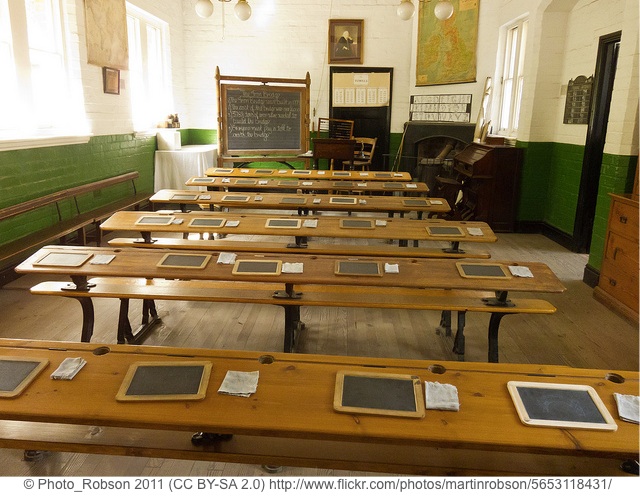
Today, three of our local villages have village schools. Two of them, Inkpen and Enborne, are still based in their original Victorian buildings just like many other primary schools in West Berkshire. However, you might be surprised to find out that, at the end of the nineteenth century, there were twice that many village schools in our area.
By the middle of the nineteenth century, many towns and villages benefitted from schools established by churches or charitable organisations. However, it was not until Forster’s Education Act of 1870 that local school boards were created with the power to levy rates to finance building and running of so-called National Schools in their areas. Thus universal education became available to all children up to the age of 13.
It would be fascinating to research our village schools through documents in the Berkshire Records Office. For now, however, I decided to begin my research by looking at the 1881 census as by this time those schools opened as a result of Forster’s Act would be well established.
At the time of the 1881 census, the occupant of the Kintbury St Mary’s school house is 25 year old James Humphries, originally from Ditton Marsh, Wiltshire. James is described as a “certificated teacher” meaning he has gained a professional qualification at a teacher training college. His sister, Catherine, 20, who is living with him, is described as “assistant teacher” which might indicate that she trained to teach by learning “on the job” as a pupil teacher which was how the majority of teachers qualified at that time. How Kintbury parents would have viewed this fresh faced young man and his even younger sister, both in positions of authority over the village sons and daughters, we can only imagine!
James and Catherine did not stay in Kintbury for long, or so it seems. In November 1883 the Newbury Weekly News reported on a recent Diocesan Inspection at the school which found it to be, “in very good condition. The children are well taught throughout.” The master at this time was a Mr T. Sadgrove. But he did not stay long either. In May of the following year the NWN carried a report concerning the schoolboy Alfred Sturgess who was charged with stealing 2 shillings and 6 pence from the National School Board ( in other words, from St Mary’s school ), the case being proved by the master who was then W. Garrett Jones.
Perhaps Messrs Humphries, Sadgrove and Garrett Jones all found Kintbury too challenging to stay long, or perhaps they were ambitious and wanted to move on to bigger schools in towns. So far I can find no record of any of them to suggest where they were living when they moved on from Kintbury, or if they even stayed in teaching.
Things were different down the road in Inkpen. In 1881 the occupant of the village school house is 49 year old certified teacher Jesse Collins. Jesse was a retired naval captain originally from East Tilbury, Essex, whose teaching post in 1871 had been in Portsmouth.
Interestingly, Jesse’s wife, Charlotte, is also described on the census as “School mistress”, although at this time women were not – officially – allowed to teach after they had married.
Life in the relatively isolated, rural community of Inkpen must have been very different to life in Portsmouth for the Collinses, although it seems to have suited them as they were still there in 1891. Despite, that is, Jesse having appeared before the local magistrates in 1884, charged with having assaulted one Alfred Abraham, a school boy, and having been fined 5s and 16s 6d costs. Perhaps the experience of his former naval career led Jesse to take this in his stride as he is otherwise involved with the local community and, according to the NWN, with local politics.
If Inkpen was a relatively isolated rural community, then Enborne was more so. Back then as now, the school with its adjoining school house was in an isolated spot in Crockham Heath, on the road up to Wash Common where, in 1881, the school mistress was 58 year old Ann Elizabeth Pears. Ann was an experienced teacher: in 1871 she had been teaching near Salisbury in Wiltshire and in 1861 in Suffolk.
According to a report in the NWN of March 1887, two men broke into the school house when Ann was away from home and stole 10 shillings and a quantity of brandy. This must have been particularly unpleasant for a woman living on her own in an isolated house and might have contributed to Ann’s decision to move on. By the time of the 1891 census, Ann has relocated to Hampshire but not yet retired from teaching. At 68 Ann is head teacher at East Woodhay school.
Today there is no primary school in the village of West Woodhay – by modern standards it would probably be considered too small a community to support its own school. The censuses of 1881, 1891 and 1901 indicate that there were no teachers living in the village in those years which suggests to me that there was not a school or accompanying school house ( the usual Victorian arrangement, common in many local villages.) The evidence suggests that West Woodhay’s children attended East Woodhay school as, in December 1903, the NWN reported that a request had been made for a footbridge to be placed “over the water between East and West Woodhay” as “children went down there on their way to school and got their feet damp.”
However, for fifty years, from about 1903 to 1961, West Woodhay did have its own school, marked on early 20th century OS maps as being somewhere near the village hall but on the opposite side of the road. Perhaps surprisingly, the NWN does not seem to have covered the opening of the school although the 1911 census shows assistant teacher, Celia Cook, 29, from Walworth, London, living in the school house.
Another local school I have, so far, found out very little about is Christchurch. Built at Kintbury Crossways close to the now demolished church which shared its name, Christchurch School opened in 1870 to relieve crowding at the established school down in Kintbury. Whilst the Reading Mercury reported on the opening, for some reason the more local paper, the NWN, did not.
I can find no record of the head teacher at the time of the school’s opening. However, the NWN of February 1884 reported that complaints had been made that a mistress, Agnes Peacock, had been ill treating the children. Unfortunately, a parent, Mary Ann Nash of Kintbury, had decided to take things into her own hands after Miss Peacock had patted her son on the hand by way of discipline. The teacher reportedly pushed the boy and he fell over. Nash went to the house where Miss Peacock was lodging and struck the teacher on the head with a stick. She was subsequently charged with assault and fined 9 shillings 6 pence with 10 shillings 6 pence costs.
As the smallest village in our benefice, then as now, it is perhaps most surprising that Combe had its own school. Although I can find no trace of when it first opened, the NWN of September 1894 reported that the school in the village had been, “nobly restored” with, “all the necessary requirements”. Local dignitary, Mr A.C.Cole had, “spared no expense” and the village children no longer had to walk to the neighbouring school, 2 or 3 miles distant. The school house furniture was supplied as a gift from Mrs Cole, as was that of the school, “according to government requirements”. Three cheers, then, for the Cole family.
In 1901, the schoolmistress at Combe was 34 year old Elizabeth Dingwall. Born in Chelsea, Elizabeth had been teaching in Fulham in 1891. At Combe, she shared the school house with her sister Isabella, a nurse and, although life the tiny village must have been very different from Chelsea or Fulham, the Dingwall sisters are still there in 1911.
One thing that has surprised me in researching this is that none of the teachers, either masters or mistresses, are local people. Whether this was a deliberate policy or coincidence, it is impossible to say for certain, although the weight of evidence suggests to me that the school boards deliberately chose to appoint people from out of the local area. For those single schoolmistresses, living alone in a village schoolhouse, life must have been very lonely. Whilst we know very little about the lives of Ann Elizabeth Pears, Celia Cook, Agnes Pocock or Elizabeth Dingwall, we do know a bit more about a schoolmistress living and working about 20 miles from here, in Denchworth, formerly North Berkshire, in the 1860s. Mary Hardy had been born near Dorchester in Dorset and trained to teach at the teacher training college in Salisbury so she was a “certified teacher”. Denchworth village school, 80 miles from her home and family, was her first post for which she was paid £40 a year and expected to play the church organ. Mary found the experience of living in Denchworth to be so lonely that she persuaded her parents to allow her younger sister, Kate, still a school pupil herself, to come to Berkshire to live with her.
We know a little more about Mary Hardy than we do about most Victorian village schoolmistresses because her brother, Thomas, was to become the celebrated novelist and so some of her correspondence is preserved in Dorset Museum. But while the names of most of the other women – and men – are mostly forgotten, many of the nineteenth century school houses are still standing. During my time as a supply teacher I was lucky enough to work in many village schools still using their original buildings, though now much adapted and extended. The school house has been, in some instances, sold off but in others the former living accommodation is now used as classrooms, staff rooms or storage. As you walk from late 20th century extensions back into those Victorian rooms, there is, I think, a distinct change in atmosphere, an awareness that you have entered somewhere that has been in constant use for over 150 years.
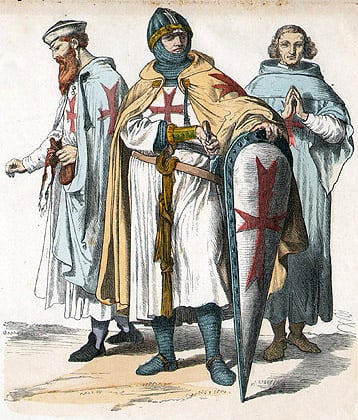
For many people, their mental image of a knight from the “olden days” (whenever that was!) is of a male figure brandishing a sword, his face covered by a cylindrical helmet and wearing a white tabard on which is emblazoned a large red cross of St George.
This enduring picture book image most likely has its origins in an actual medieval Christian military and religious order known as “The Poor Knights of the Temple of King Solomon”, or more familiarly, the Knights Templar. Originally founded to protect Christians on pilgrimages to Jerusalem, they followed the austere Rule of Templars which restricted, amongst other things, the eating of meat to three days a week and an insistence upon wearing only plain clothing.
The Knights were recognised by the Pope in 1129 and were supported by rulers throughout Europe such that they eventually became very wealthy, owning property in many countries.
However, after coming into disrepute, the Order was eventually dissolved in the early fourteenth century and its lands given to the Order of the Hospital of St John.
So what is their link with the hamlet of Templeton, between Kintbury and Inkpen? It is believed that, as its modern name implies, this was once the site of a house belonging to the Knights Templar and then subsequently to the Knights Hospitallers of St John. Although it is difficult to find out very much about the early history of the settlement, the online archives of the Newbury Weekly News and the Reading Mercury have some interesting reports from 1884 concerning archaeological finds there.
In the early 1880s, Templeton Manor belonged to the Dunn family. They were having an extension built and the architect for the work just happened to be Newbury architect and eminent local historian, Walter Money.
As the workmen were digging a foundation trench in land which had never previously been built upon, three skeletons were discovered at a depth of about eighteen inches. According to the report in the Newbury Weekly News, the remains represented men of “robust form and vigorous physique”, of average stature, about 5 feet 8 inches. Unfortunately, the skulls, which at the time would have been the only way of getting more vital evidence, were missing. This, of course, was in the years before DNA profiling and other scientific techniques which would be able to indicate gender and more about a person’s origins.
According to the report, no coffins were found with the remains, which were “laid in regular order”, head to toe and in east to west orientation.
This discovery must have been of particular interest to architect and enthusiastic local historian Walter Money, who, a few months later, submitted the results of some research to the Reading Mercury.
According to Money’s research, as reported in the Reading Mercury, the manor of Templeton with Walkott (sic) had belonged to the Preceptory of the Knights Hospitallers at Sandford, near Oxford. Then, on 28th December 1543, it was granted by the King, Henry VIII, “upon the possessions of the hospitallers being vested in the Crown, to Richard Brydges Esq of West Shefford and John Knyght Esq of Newbury.”
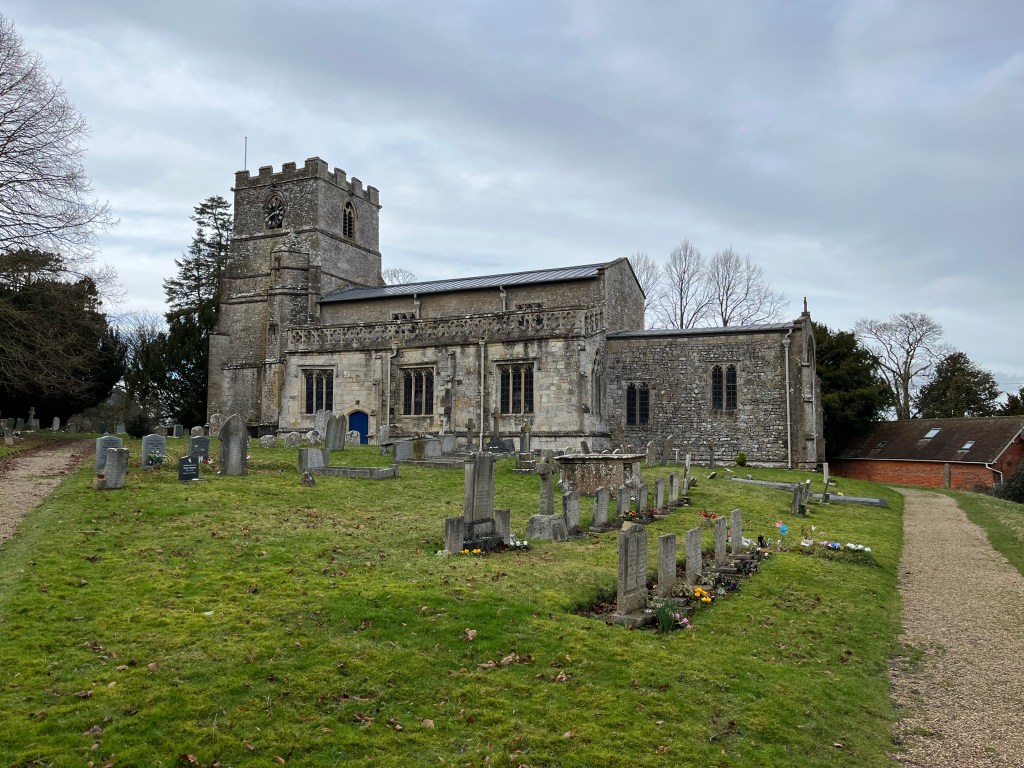
It is difficult to imagine the area around Kintbury and Inkpen in medieval times. At Balsdon farm, slightly to the south of Templeton, a moat still exists which is believed to have surrounded a thirteenth century manor house but it is otherwise very difficult to picture a landscape in which almost all our modern points of reference are missing – with the exception of our village churches, that is.
Perhaps, some seven hundred or more years ago, Knights Templar, having disembarked their ship at a south coast port, made their way up and over the downs, travelling northwards. Perhaps they carried with them travellers’ tales of Jerusalem, of encounters with Jews and Muslims, of seemingly strange beliefs and perhaps complex new mathematical and scientific ideas previously unheard of in medieval England. Maybe, when they reached Walbury Hill and looked down to the north west, they were relieved to see the familiar sight of Inkpen and Kintbury in the distance and considered themselves to be nearly home.
In January 1801, Jane Austen wrote to her sister Cassandra,
Eliza has seen Lord Craven at Barton, & probably by this time at Kintbury…
The Eliza she mentions here was the wife of the Rev Fulwar Craven Fowle, vicar of Kintbury, and Lord Craven the influential land owner and member of the aristocracy then living with his mistress at Ashdown Park. But where was Barton and why was whoever lived there playing host to a local “bigwig”?
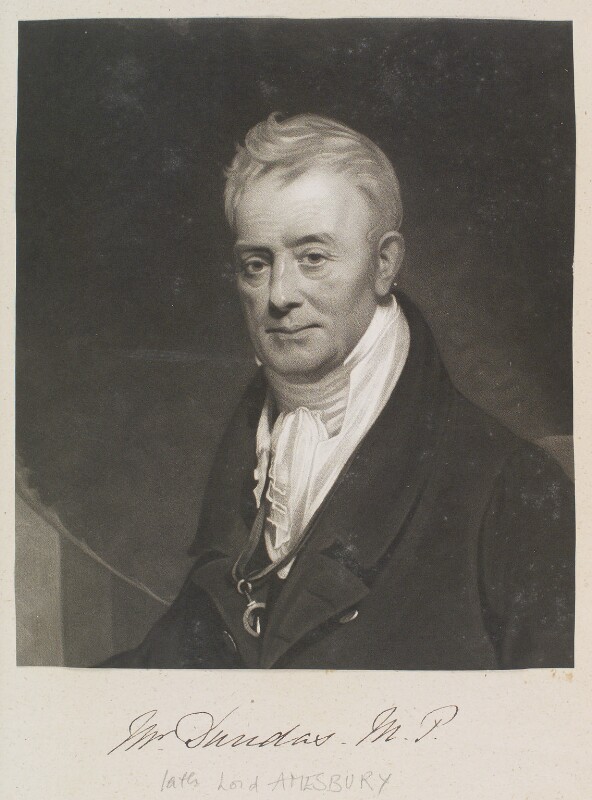
Barton – or Barton Court – still an imposing residence which can be reached along the Avenue, at that time the main route into Kintbury for traffic from the Bath Road, was the home of Charles Dundas. Since 1794 he had been Member of Parliament for the constituency of Berkshire, at that time stretching as far north as the Thames and including Wantage and Abingdon. As a member of a titled Scottish family, Dundas moved in some of the best circles of the time.
In keeping with their station in life and the fashions of the time, the Dundas family are well represented on the walls of Kintbury church where we can read that Charles and his wife, Anne Whitley, whom he had married in 1782, “had issue one daughter, Janet”. Anne died in 1812 and in 1822 Charles married Margaret Erskine, formerly Ogilvy, née Barclay.
Reading the Dundas memorials on the church walls, anyone would conclude that Charles Dundas had just one daughter. However, research into historical records reveals that this was not the case. Charles’ daughter Marrianne was most likely born in 1793. Her mother was not Anne Whitley. At the time, a child born to a mother not married to its father was often referred to as the “natural” child of whoever; Jane Austen gives an example of this in her novel, Emma, where Harriet Smith is referred to as the “natural” daughter of an unknown person Emma choses to imagine as someone well-to-do. Harriet Smith has been sent to live at a boarding school for girls and, it seems, no one acknowledges her as their daughter and her family remain a mystery.
We know from looking at the 1851 census that Marrianne had been born in Kintbury but I can find no record of her baptism or indeed who her mother might have been. It is impossible to find out anything of her early life – perhaps, like Harriet Smith, she was sent away to a girls’ boarding school. However, thanks to online marriage records, we know that in 1815 Marrianne Dundas married the Rev William Everett of Romford, Essex at the then very fashionable St George’s, Hanover Square, Westminster. We know Charles Dundas was present at the ceremony as he has signed the register.
It is particularly interesting that Marrianne is known by her father’s surname although all the available evidence suggests that Charles Dundas was never married to her mother. This was a time when a “natural” son or daughter was usually known by their mother’s surname, an example from Kintbury being William Winterbourn who, during his lifetime, was known by his mother’s name of Smith as his parents weren’t married. It would seem to me that, by the time of her marriage at least, Charles Dundas acknowledged Marrianne as his daughter.
Marrianne and William Everett had three children: William, born and baptised in Kintbury in 1821 became a fellow of New College, Oxford and also a barrister; Charles Dundas Everett, born in Kintbury in 1825 entered the church; finally Alicia was born in Kintbury 1827. Interestingly, the 1861 census actually shows Alicia having been born at Barton Court so it has to be likely that her brothers were born there, too. There is no evidence that the Everett’s family home was ever in Kintbury; perhaps it had been decided that Barton Court was a preferable place for a confinement that the Rev Everett’s draughty vicarage!
We can only assume that Charles Dundas’ second wife was welcoming to Marrianne and her children.
On November 27th 1851, the youngest child, Alicia, married the Oxford master brewer, James Morrell of Headington, at St George’s, Hanover Square – the same fashionable church at which her parents had married. The service was taken by her brother, Charles.
James had inherited Headington Hill Hall which he had extended in the Italianate fashion and this large, imposing residence became the family home for him and Alicia. Marrianne was living there herself when she died on 4th December 1861.
James and Alicia’s only child, Emily, was born in 1854. In 1874 Emily married her cousin, George Herbert Morrell and so the Oxford brewing business continued to be run by the Morrell family for the next three generations. By the 1960s the company was run by one Colonel Morrell, a well known name in the Oxford area, not least in the Lock household as my father’s firm did a lot of work for the brewers. I believe Colonel Morrell would have been Marrianne’s great, great grandson. The natural daughter of Charles Dundas, therefore, can be regarded as the dowager matriarch of Oxford’s celebrated brewing family.
In 1953 the Morrell family sold Headington Hill Hall to Oxford City Council from whom it was later leased by one Robert Maxwell, infamous for having defrauded his employees’ pension fund and having disappeared from his yacht named the Lady Ghislaine, after his daughter.
Today, Headington Hill Hall is leased by Oxford Brookes University.
So, whilst there are many Dundas names on the walls of Kintbury church, Marrianne’s – due, I suppose, to the circumstances of her birth – is not one of them. But despite being Charles Dundas’s “natural” daughter, her fate was not that of a Harriet Smith. Her life might not be recorded on the walls of our church but through the generations her family certainly made their mark in Oxford.
One mystery, however, remains: there seems to be no way of knowing the name of Marrianne’s mother. That chapter of her story is no different from that of Harriet Smith.
According to records kept by the National Archive, at the time of the 1901 census, just over 40% of adult women in the UK were employed as domestic servants.
The early 20th century was a time when access to education and onwards to the professions was denied the great majority of young women for whom a position in the household of a wealthy family might have seemed the only employment option. For a significant minority, however, there were alternatives to domestic servitude.
In the nineteenth and early twentieth century, Kelly’s Directories published lists of gentry, landowners, charities and those employed in commerce for every town and village throughout England. Listed under “Commercial” in the 1903 edition for Berkshire, Kelly’s Directory records 64 names in Kintbury, 33 in Inkpen, 17 in Enborne, 11 in Hamstead Marshall and 1 in Combe. But of the grand total of 130 people involved in “commerce” across what is now our benefice, only 13 are women.
In Kintbury, Mrs Maria Abraham and Mrs Ann Bance are both listed as bakers while Mrs Harriet Penny is a butcher. Mrs Eliza Peck is a shopkeeper and Mrs Elizabeth Taylor is a beer retailer, presumably running a pub. In Inkpen, Mrs William Killick is a grocer. It is likely, I think, that most of these women, if not all, are widows continuing with the businesses previously run by their husbands.
The same would appear to be true for the two carriers listed by Kelly’s: Mrs Emma May in Inkpen and Mrs James Miles in Hamstead Marshall are both continuing with businesses recorded in the 1901 census as having been run by their husbands. Of course, it may well have been that the women had long helped their spouses run the family business, but this would not have been recorded by the census enumerator.
Women had been employed by the Post Office nationally since the 1870s, where they could sort the mail and operate the telegraph system. In Inkpen, the Post Office at Upper Green was run by Miss Matilda Goodfellow Froom and in Kintbury by Mrs Emma Page who is also listed as a stationer. Although the smallest village, even then, Combe has its own post office, which is run by Miss Rose M. Salt.
Two women to have control of what must have been larger businesses are Mrs John Goddard of Hamstead Marshall and Mrs Mary Jane Dymond of Inkpen who are both listed by Kelly’s as farmers.
According to the 1881 census, John Goddard was farming 67 acres. In Hamstead Marshall. By 1891, his son, Richard was also working on the farm. However, John died in 1894 and by the census of 1901 Martha, John’s widow, is recorded herself as farmer with Richard employed by her.
It is a similar story over in Inkpen where Mary Jane Dymond had been running her 30 acre farm for over twenty years since the death of her husband John.
It would be easy to presume that these women must have had equal status with the men running similar businesses close by. Surely Eliza Peck or Maria Abraham’s experience of running their shops would have been largely similar to that of the male shopkeepers further down the road? Would life on a farm have been so very much different for Mary Jane Dymond or Martha Goddard when compared to farms run by men?
Apart from everyday sexism expressed in such phrases as , “the weaker sex” and “a woman’s place is in the home” and so on, the perceived inferior status of women was enshrined in certain laws. For example, whilst many women would have controlled a business budget, they would not have been able to open a bank account in their own names or apply for a loan.
However, for Mary Jane Dymond, Martha Goddard and the rest, the position of women in society was changing – but very, very slowly. The 1882 Married Women’s Property Act had enabled women to own and control property in their own right although it was not until 1922 that the Law of Property Act gave men and women equal rights to inherit property from each other.
Women ratepayers – that is to say, women who owned or rented property – had been able to vote in borough and county elections since 1888. So most, if not all, of the women in business in 1903 would have been able to vote for their local councillors although as women there were not able to stand for election themselves. Women – and many poorer men- were still unable to vote in parliamentary elections.
In 1902, textile workers in the north of England had presented a petition to parliament demanding votes for women and 1903 saw the formation, at the home of Mrs Emmeline Pankhurst in Manchester, of the Women’s Social & Political Union, a campaigning group concerned with extending the franchise to women. It is likely that both these events passed by even the most avid newspaper-reading folk of West Berkshire – however, news of the burgeoning women’s suffrage movement would gradually appear in the pages of the Newbury Weekly News.
Emmeline Pankhurst addressing a crowd in Trafalgar Square by Central Press, by Central Press, bromide press print, October 1908, 7 in. x 8 7/8 in. (177 mm x 226 mm) image size, Given by Terence Pepper, 2008, Photographs Collection, NPG x131784
The NWN of March 31st 1904 reported that the local Women’s Liberal Association held a packed meeting at which Mr Richard Heldene MP spoke on the subject of women’s suffrage. In 1906 members of the same association listened to an address given by Mrs Eva McLaren, “in favour of political rights for women”.
It seems that the issue of women’s suffrage had not always been taken seriously. On 21st March 1907, the NWN carried a report of a debate in Reading at which Mr Mackarness, MP for South Berkshire had spoken. According to the report,
…there was a great deal of joking on the subject but for his part he always looked on it from a common sense point of view… They had given women votes in all local affairs therefore he could not quite see upon what line of argument … they were to refuse them a vote in Parliamentary matters.
Whilst the NWN was happy to report objectively on debates or speeches in favour of women’s suffrage, this seems not to have been the case when covering the actions of more militant campaigners such as the members of the WSPU. On 28th March, 1907, it reported,
The women suffragists made another scandalous disturbance on Wednesday in avowed attempts to enter the House of Commons.
But it would seem that not everyone in the area agreed that the tactics employed by the more militant suffragettes ( as they were eventually known to distinguish them for the more peaceful suffragists ) were “scandalous”.
In November 1909, the newspaper of the WSPU, “Votes for Women” reported that a Miss Keevil, “is speaking at two meetings in Newbury. Sympathizers there are very anxious to hear about militant methods.”
In June 1911, the same newspaper reported that there were to be outdoor demonstrations in Reading, Newbury and Basingstoke, and that the Newbury & Reading contingent would march under a banner bearing the words, “Pro aris et foris”. A Miss Daukes of Newbury would be acting as sergeant, the newspaper reported. The WSPU was nothing if not well organised and this was expressed in the use of such military language.
“Votes for Women” was eventually replaced by a new newspaper representing the WSPU campaign, The Suffragette. Copies were sold in Newbury Market Place and reports included the successful, “At Home” held by Newbury’s Mrs Whittington and a meeting held at the Guildhall Hotel, Mansion House Street. The campaign for women’s suffrage had definitely come to town.
Nationally, Emmeline Pankhurst’s WSPU involved women from all social classes at all levels of the organisation. However, it must have been far easier for women of comfortable financial means and less demands upon their time to participate in local campaigning. Marian Daukes, Hon Sec of the Newbury WSPU branch, was the daughter of an architect and lived during the early 1900s at a house called Diglis on the Andover Road. At the time of the 1891 census she had been living on independent means in Surrey which suggests that she was most likely of the class of women able to spend their time as they chose. To working women such as Mary Jane Dymond and Martha Goddard, or Maria Abraham and Ann Bance, Marian’s life would have seemed a world away from theirs. It is impossible to know if these women from the villages ever saw a copy of The Suffragette, sold in Newbury Market Place. We do not know what they would have thought, had they read anything in the NWN of the campaign for women’s suffrage – I think it likely that some would have ignored it, others would have been appalled at the more disruptive or militant campaigns, whilst others may well have approved – but possibly secretly.
The 1907 Qualification of Women Act allowed women to be elected as borough and county councillors, also as mayor. Thus women were able to participate in local decision making for the first time. In Newbury, it was not until 1922 that Elsie Kimber was elected the town’s first female councillor. Elsie went on to become the first female mayor in 1932 and first woman Alderman in 1943.
The Representation of the People Act of 1918 granted the right to vote to all men over 21 but only to women over 30 who owned or rented property with a yearly value of at least £5, or to be married to a man who qualified to vote in local government elections. For many women who had run businesses or taken the places of men in agriculture or other industries during the 1914 to 1918 war, this must have been a bitter disappointment. For the many women still employed in domestic service, their position in the eyes of the law had changed very little.
In May 1919, political discussion came to Kintbury when a meeting of the Kintbury Branch of the South Berks Women’s Unionist Association, an organisation of the Conservative party, was held in the Coronation Hall. In attendance were many well known ladies of the village including Mrs Dunn and Mrs A.E. Gladstone. One speaker, the Hon Ethel Akers-Douglas spoke of the urgent need for self education with regards to politics. Another, Mrs W.A. Mount, wife of the local Member of Parliament, spoke of the “threat” of a Labour candidate in the constituency at the next general election. She explained the party’s intentions to see the conditions of the working men improved, however, “when people said there could be full equality, it was their duty to point out that such a state of things was absolutely impossible.”
Such was the mind-set of many at the time, although we do not know how many of the women running shops or businesses, particularly on behalf of men killed or disabled in the war, would have agreed with her. I wonder what Elsie Kimber, at her family’s shop in Newbury, would have thought.
Women were not granted equal voting rights with men until 1928. The first woman to be elected to the Westminster Parliament was Constance Markievicz in 1918, although as a member of Sinn Fein she refused to take her seat and so the distinction of being the first woman to sit in parliament goes to Lady Nancy Astor who won the Plymouth Sutton seat in 1919.
Emmeline Pankhurst believed that, once women achieved parliamentary representation, it would follow that other legislation to benefit the lives of women would soon be enacted. I think she would have been shocked to know just how long it took for women to achieve equality with men in so many areas. Back in 1903, Mary Jane Dymond would have been unable to open a bank account independently. This situation did not change until the 1960s and it was not until the 1970s that a woman could apply for a loan without having her application endorsed by a man – literally any man. Similarly, the Equal Pay Act did not come into law until 1970 before which it was quite legal for businesses, including high street banks, for example, to offer career prospects to young men with salaries higher than those offered to similarly qualified young women.
I believe Marian Daukes and her fellow WSPU supporters in Newbury would be disappointed – or even incredulous – that by the 2019 parliamentary election, out of 650 seats only 220 were filled by women. Similarly, although the position of women in society has changed in many ways that would surprise a Mary Jane Dymond or Martha Goddard, many businesses still have only male names over the door or in trade directories. Further more, to see the words, “And daughter” on a commercial vehicle is still very, very rare. So much has changed, but then, so much has remained the same.