A rich man in his castle?

Motte and bailey castles are the stuff of children’s story books: picture a mound surrounded by a ditch and topped with a wooded palisade, inside of which is a wooden or stone fortress. Perhaps knights in armour are seen approaching on horseback, or an elegant lady wearing the inevitable wimple or cone-shaped head dress. Somewhere nearby, colourful flags and banners ripple in the wind.

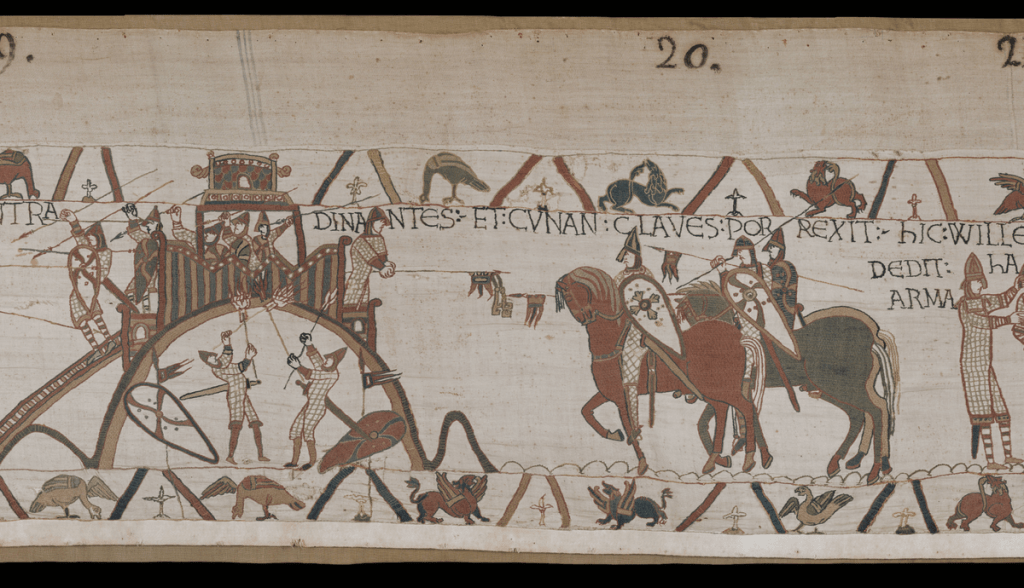
In reality, the motte and bailey castles of history were introduced by the Normans after the invasion of 1066 and an example can be seen on the Bayeaux tapestry:

Windsor Castle is an example of a motte and bailey, although over the years of its existence, the building has had much more added to it. By contrast, in Oxford only the motte survives of the original castle construction.

Most interestingly, the OS map of our area records a motte in the village of West Woodhay. A little way from St Laurence’s church, but on the opposite side of the road, and now surrounded by trees, most passers-by will be totally unaware of its existence. However, thanks to the work of O.G.S.Crawford (see a previous post) we can still identify the site of early medieval activity in our area as the word “motte” in a Gothic font is clearly marked on the map. But does the presence of a motte also indicate that there was once a castle, or at least some sort of defensive structure, in the now quiet and peaceful village?

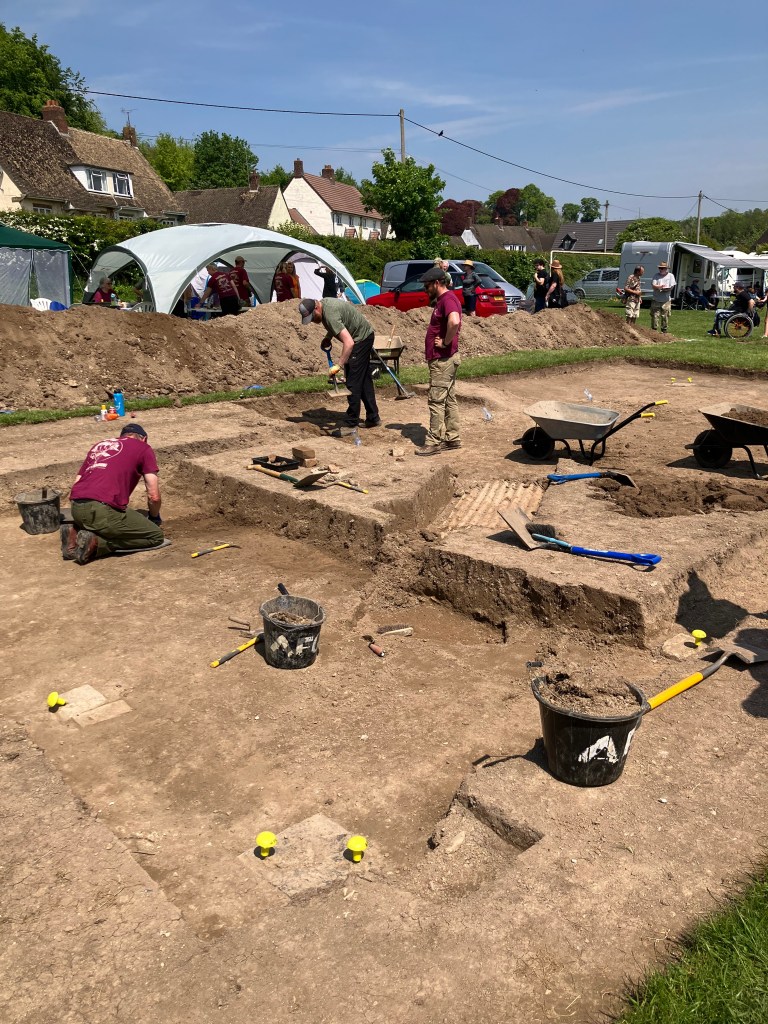
There have never been extensive excavations in the West Woodhay area – perhaps I should add, as of yet. However, in the 1930s enthusiasts of the Newbury Field Club did painstakingly dig the site. Their findings were recorded by one E. Jervoise and you can read what he discovered in volume 7 of the Newbury Field Club Journal in Newbury Library.

The West Woodhay motte is of modest size – the Field Club members recorded its rise to be just 8 feet and the diameter at the top just 30 feet. These dimensions, of course, would have dispelled any expectation of a substantial building so I can forget any fanciful thoughts of a West Woodhay castle. However, red and brown roof tiles and eighty iron nails were found on the crest of the mound, suggesting some sort of construction even if quite small. Broken pottery was found on the top of the mound and in the surrounding ditch, including rims and bases of what was believed to be at least 40 cooking pots or bowls of a type in use in the twelfth century. Some of the sherds found showed traces of glaze. The excavators weighed these finds and found there to be 40lbs of them.

The diggers also recovered soes believed to have belonged to oxen. Also discovered was what Jervoise describes as a “hone” by which he must mean a stone for the sharpening of blades. It had been, “ made of fine grained silicous schist, a rock occurring in Scotland and Normandy.” Most probably a valued or valuable item, then.

Jervoise was particularly pleased by the discovery of a small bronze buckle “of fine workmanship” and having, “an unusually perfect green patina”.

He concluded that it might have been the site of an early medieval hunting lodge and it was certainly somewhere that food was prepared and eaten.

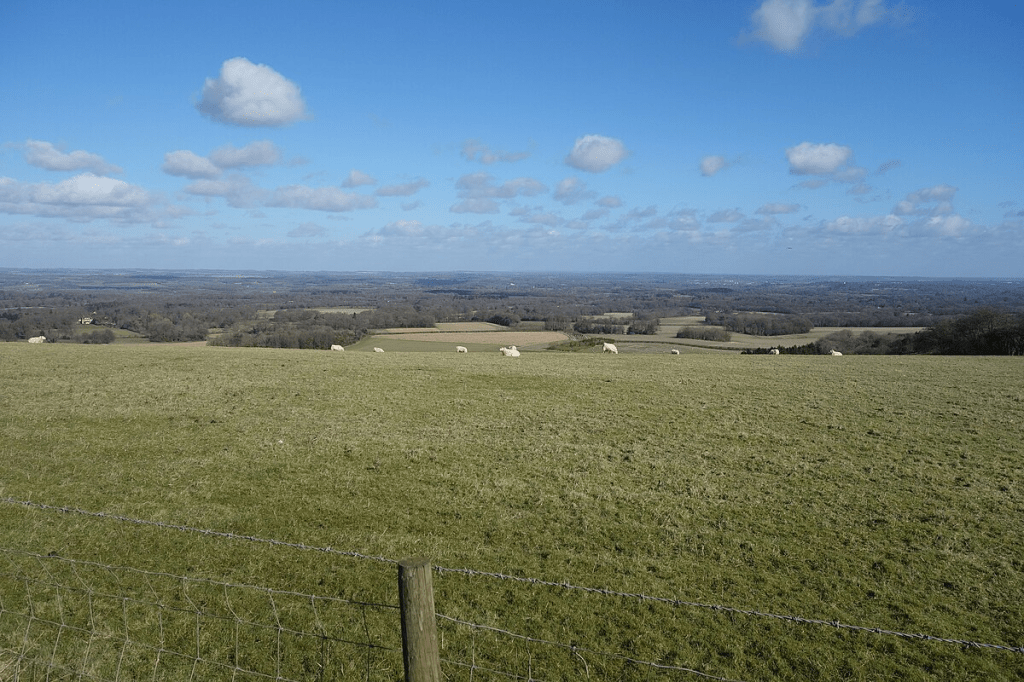
Hunting lodges were not uncommon in the medieval period – a time when a popular sport amongst the nobility was hunting for deer or boar. The lodge would have been the place where visitors, on what in later times might have been referred to as a “straightforward hunting weekend ” would stay or just return after a day’s sport for food and refreshments. With its slightly elevated position on the motte, its view towards Walbury Hill to the south west and the wide open Kennet valley to the south east, the hunting lodge might well have been built to impress.

Although the West Woodhay motte was likely never the site of a defensive structure, or indeed anything at all like a castle, I think it is quite safe to assume that the owner of this land in the twelfth century would have been a wealthy man and most likely of Norman descent, speaking Norman French. But while the nobility and upper classes generally would have spoken Norman French, it has to be likely that those preparing the food and washing the cooking pots were of humbler stock. These working people are likely to have spoken the language of the West Saxons or even Middle English – possibly a mixture of both.

Today West Woodhay is in many ways a quintessential English village – typical of many smaller settlements on the southern chalk lands. It is difficult to imagine a time when the English language, as we speak it today, would not have been understood there. Perhaps it is even more mind boggling to imagine a time when the local land owners would have conversed in Norman French!

© Theresa Lock January 2025

The short life of Kintbury’s Catholic chapel

It is easy to forget that, before the reformation, all English parish churches would have been Catholic and all priests looked to the authority of the Pope. Although ancient buildings such as St Mary’s in Kintbury or St Michael’s in Enborne might seem to represent an enduring and continuing tradition of Christian worship, over the hundreds of years parishioners will have experienced turmoil and change particularly in respect of the break with the Catholic church in Rome.

After the Reformation, life became very difficult for those people who chose to follow the “Old” religion as keeping the Catholic faith became prohibited by law. Catholic positions in public life were restricted, for example Catholics were not allowed to enter the legal profession until 1791 and no Catholics were able to vote – even if they fulfilled other restrictive requirements – until 1829. Catholics were not accepted at either Oxford or Cambridge university until 1871.

It is not surprising, therefore, that in the south of England most people in towns or villages were either members of the Anglican church or one of the other protestant denominations – Baptist, Methodist, Congregationalist, Quaker and so on. However, some prominent families were able to maintain their Catholic faith and, in the south at least, these were mostly the wealthier families.

The Dukes of Norfolk, whose family seat is at Arundel in Sussex, are one such example. The present Duke is the country’s most eminent Catholic. Nearer to Kintbury, Sir John Throckmorton of Buckland House – the man who, in 1811 put up the wager which resulted in the Newbury Coat – was Catholic. Unusually for a small English village, mass was regularly held in the Catholic church in Buckland until the beginning of the twenty first century.

In 1893, a member of a wealthy Catholic family from the north of England chose to relocate to West Berkshire.

 Humphrey J.G. Walmsley had been born in 1846 in Wigan, second son of William Gerard Walmesley & Caroline De Trafford of Westwood House, Lower Ince in what is now Greater Manchester. In common with other wealthy Catholic families of the time, the Walmesleys had a private chapel of their own which had been built between 1855 & 1856, the work having been overseen by the prominent church architect, Edward Welby Pugin.

In the world of church architecture, Pugin was a name to be reconned with. E.W. Pugin was the son of Augustus Northmore Welby Pugin, particularly remembered for having designed the interior of the palace of Westminster and the Elizabeth Tower which houses “Big Ben”. When his father died in 1875, E.W. Pugin took up the family business and continued as a successful designer of buildings in the then much admired Gothic style.

In employing  E.W.Pugin to design the family chapel, the Walmesleys must have been making a statement not only of their commitment to the Catholic faith but also one which spoke of their ability to afford this addition to their home in the most fashionable design.

When Walmesley relocated to Inglewood House, a mansion near Kintbury, the nearest  Catholic church was in Newbury. This must have been one of the reasons why the new owner decided to have a chapel erected at Inglewood. However, rather than commissioning the building of an entirely new place of worship, Walmesley had the chapel at his home in Wigan removed and transported brick-by-brick to Berkshire using the canal system for transportation. It must have been a slow and laborious process – to say nothing of the expense.

The re-erected chapel was consecrated on 26th July 1905 by the Right Reverend Dr Cahill, Bishop of Portsmouth. According to the Wigan Observer, the new chapel was a site to behold with an altar of marble and alabaster, the altar steps of Italian marble. The stained glass had been designed by Hardman & Co., one of the leading designers of the time. Lamps, candlesticks, candelabra and vases were of brass burnished with gold. “It is a gift to West Berkshire” the report concludes.

It seems that everything about Humphrey Walmesley’s chapel was lavish. Not surprisingly, perhaps, as this family newly arrived from the north were clearly very wealthy. During his time at Inglewood, Walmesley was able to purchase several neighbouring farms to add to his estate making him a prominent local landowner and person of standing in the Kintbury area. The 1901 census had shown that he was living on independent means and, not surprisingly, he and his wife Marie employed 16 live-in staff at Inglewood House  as well as their own Roman Catholic priest.

The Walmesleys welcomed other local members of their faith to hear mass with them at their chapel thus enabling Catholics from the Hungerford area to attend a service without having to travel to Newbury or Woolhampton. I have not been able to find out if baptisms or weddings were ever celebrated at Inglewood, although I believe it must be likely that some baptisms would have been.

Inglewood House remained in the Walmesley family until 1928 when it was purchased by the De La Salle brothers, meaning it remained a centre for the local Catholic community

However, in 1972 the De La Selle brothers left Inglewood for Wallingtons, a similarly large property a little nearer to Kintbury. From 1972 the house was home to the Inglewood Health Hydro, then in 2006 it was sold to Raven Audley Court as a retirement home.

This sale was bad news for what remained of the relocated Pugin chapel and those with a fondness for Victorian ecclesial architecture, as well as those local Catholics who may have had very fond memories of hearing mass there. Despite representations to English Heritage from both the Victorian Society and the Pugin Society, the demolishers moved in before the building could be listed and subsequently preserved. The English Heritage report of 2006 gives us some idea of what it might once have looked like:

The chapel is built in Gothic style and is brick built with stone dressing.

Historic photographs indicate that the windows had tracery and stained glass.

The painted ribs to the nave ceiling and painted panels and ribs to the chancel survive as does the highly colourful tiled floor to the chancel. The tiles are Minton and are decorated with fleur-de-lys and floral motifs. There is also an elaborate metal-work rood screen in blue and gold incorporating the family coat of arms.

Historic photographs indicate that the chapel was very richly decorated internally with fixtures and fittings that were originally of the Pugin scheme. These included stained glass depicting the name saints of the Walmesley family, and a carved altar and reredos in alabaster and marble.

The walls were part covered in carved wooden panels.

All these features are believed to have been removed in the last couple of weeks.

So, to all intents and purposes, Humphrey Walmesley’s chapel was no more, its fittings and stained glass sold or given away to who knows where. The rest of the building was finally demolished and Kintbury’s small Pugin masterpiece became just a memory.

©Theresa A. Lock, 2024

References & sources:

https://www.hungerfordvirtualmuseum.co.uk/

English Heritage adviser’s report re possible Listing of Chapel, 22 Dec 2006.

The Wigan Local History and Heritage Society website on Humphrey J.G. Walmsley.

 “Bulldozers outpace the Heritage bureaucrats”, The Times, 9 Feb 2007.

https://www.britishnewspaperarchive.co.uk

https://www.ancestry.co.uk

Christmas for the new Edwardians: December 1901

“The past is a foreign country: they do things differently there.”  L.P. Hartley

Queen Victoria had come to the throne as an eighteen year old in 1837 and reigned for 63 years. Consequently, at the turn of the century in January 1901 (the 20th century was deemed to have begun in 1901, not 1900) most people had known no other monarch.

Victoria died on the Isle of Wight on January 22nd 1901 and was succeeded by her son, the new king, Edward VII. And so, the people of Britain were no longer Victorians, but Edwardians.

So what was the Christmas period like for the new 20th century Edwardians? I looked through the pages of the Newbury Weekly News to find out.

The first thing that I noticed was that the Christmas period was much more low-key than at present with very few Christmas themed events, if any, and far fewer advertisements for Christmas goods. Life in our part of West Berkshire was not much different from any other two week period in the autumn or winter. Disappointingly, there are hardly any news reports from the villages in our area at this time although there are several reports from Hungerford and a few from Kintbury.

 A colder spell before Christmas 1901 had resulted in the canal freezing over such that the inhabitants of Hungerford had been looking forward to an ”oldfashioned” Christmas, presumably looking back to the very cold winters of the mid 19th century. Hopes were dashed, however, when the weather turned wet and windy.  To prepare for the inclement weather, inhabitants of Newbury could, if they so liked, purchase a mackintosh with velvet collar for between 5 shillings 11 pence and 18 shillings 11 pence from McIllroy & Rankin of Cheap Street, and compliment the new coat with an umbrella from 1 shilling three farthings. Bailey’s of Northbrook Street boasted selling the cheapest boots: ladies’ at 1 shilling 9 pence a pair, gentlemen’s at 2 shillings 6 pence and children’s at 1 shilling 4 pence.

Despite the availability of wet weather clothing, Hungerford Primitive Methodist choir abandoned their customary carol singing in the town as the weather was considered too bad to go out. Perhaps instead they stayed at home and read by the light of a gas lamp, obtainable form Joseph Hopson of Newbury, which, it was advertised, would burn for 10 hours for only a farthing.

Although outdoor carol singing might have been abandoned, the pages of the NWN reveal that much local indoor entertainment was music- based. “Choral classes” were established in Kintbury with a Mr. S. Argyle conducting. The choir were practising a cantata called “King Harold” by Cunningham Wood. Also in Kintbury, a musical evening was held in the Wesleyan Methodist church on December 18th where members of the newly formed Guild Band were hoping to raise funds for a harmonium by presenting a concert of religious songs, instrumentals and readings.

“The band is only in its infancy, “ the NWN reported, “ and does not yet expect criticism but promises to be worth hearing at no distant date”.

For the more energetic ladies of Hungerford, a Spinsters’ Dance was held at the Town Hall on a Friday before Christmas. It was attended by between 80 and 90 people and took place between 8 o’clock and 3 o’clock, which, I am presuming, was am rather than pm, although the report does not specify!

I had expected to read something of children’s Christmas parties but, if these were held in the local villages, no reports of them appeared in the pages of the NWN. Fundraising, however, did continue in Kintbury, where, in the week before Christmas, £1, 15 shillings 11 pence was raised by the children of St Mary’s School for Dr Barnado’s Waifs Association.

On the subject of schools and education, however, a letter in the NWN reveals that a very retrogressive attitude toward education still existed in some sectors of society, despite this being the 20th century. A letter printed just after Christmas and sent from a former Newbury teacher reads:

“Sir, I am sorry to notice in your paper that there are a few people who are still of the opinion that education is not good for farm labourers and other working folk…

They themselves do not object to education but on purely selfish grounds they would keep it from the poor lest they should be less servile.”

If educational opportunities did not present themselves for the new Edwardians, servile or otherwise, an advertisement in the local paper suggested a career in the military might be beckoning as recruits were wanted for all branches of His Majesty’s army. I wonder how many local lads responded to the offer.

On the Monday after Christmas, the Craven Hunt met at Wallingtons, Kintbury, the residence of Mr William Hew Dunn. Attended by various of the great and the good of the area, the occasion was “of particular interest” as a portrait  of Mr Dunn was presented to him in recognition of his service to the hunt.

Elsewhere, the Christmas period was a quiet one; at Hungerford market, corn had been in short supply due to the meagre attendance of farmers and traders. Anyone looking to buy “Native Guano” however, could obtain a 1 cwt bag mail order, which would be sent carriage paid to any station in England on receipt of a postal order for 5 shillings. I wonder how many were delivered to Kintbury, or whether the local equine population provided local gardeners with all they required.

The Christmas period does not seem to have been a time of conspicuous consumption and over-spending for the new Edwardians. However, should any one of them need some extra money, and just so happen to have an old set of false teeth lying around, an advertisement in the NWN of January 1902 has the answer.  RD & JB Fraser of Princes Street, Ipswich would buy your old false teeth from you. So the new century was not without opportunities to make that bit of extra cash!

(C) Theresa Lock 2024

Our Neolithic neighbours

So who were our neolithic neighbours?

It is mind boggling to think of people living in this area over 6000 years ago. However, if you know where to look for it you can still see evidence of those people who lived around here between c4000 and 2500 years BC in the neolithic period.

The neolithic, or new stone age, was the period which saw a more settled way of life with the domestication of plants and animals and the beginning of farming rather than a hunter/gatherer life style.

During this period there were communal constructions of large scale earth works, banks and ditches. The famous henge monument at Avebury dates from this period.

But where is the evidence that neolithic people once lived in this area?

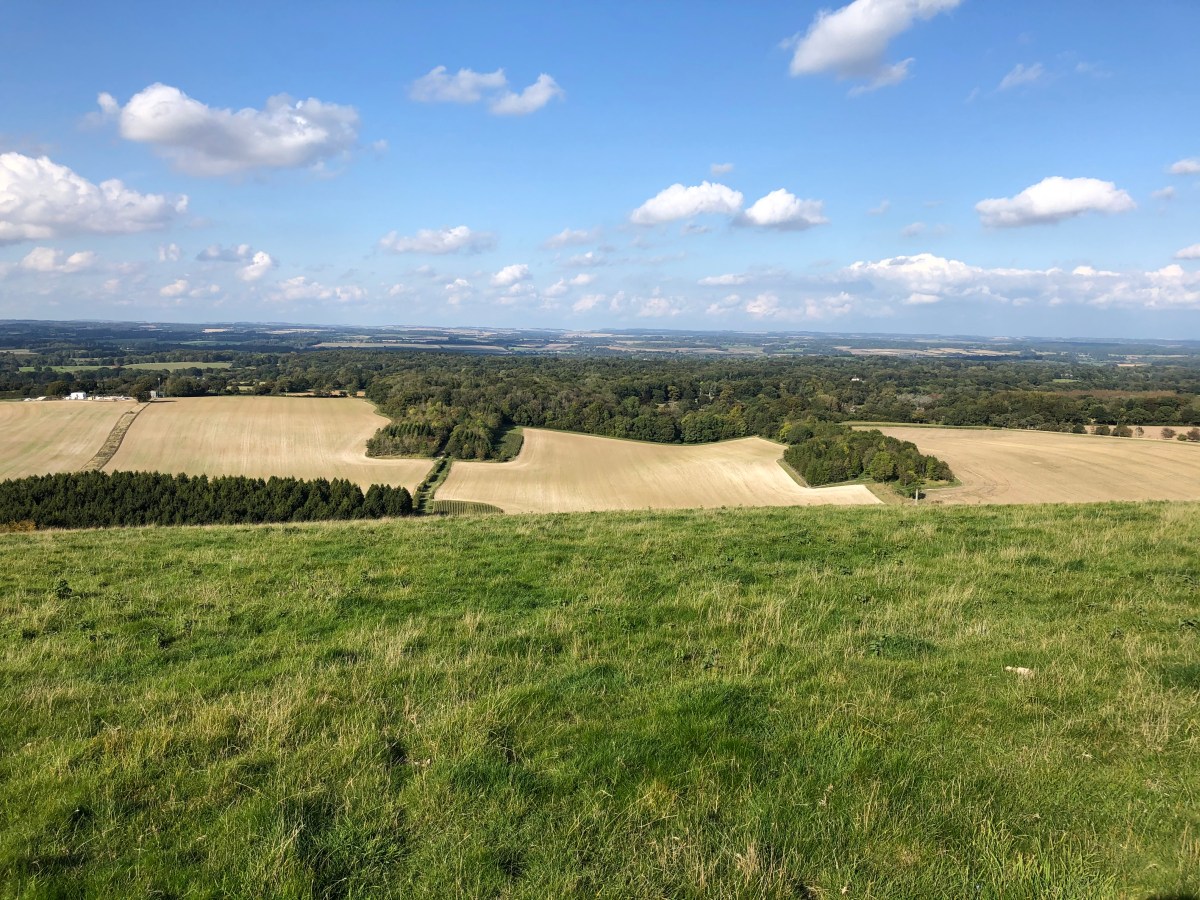
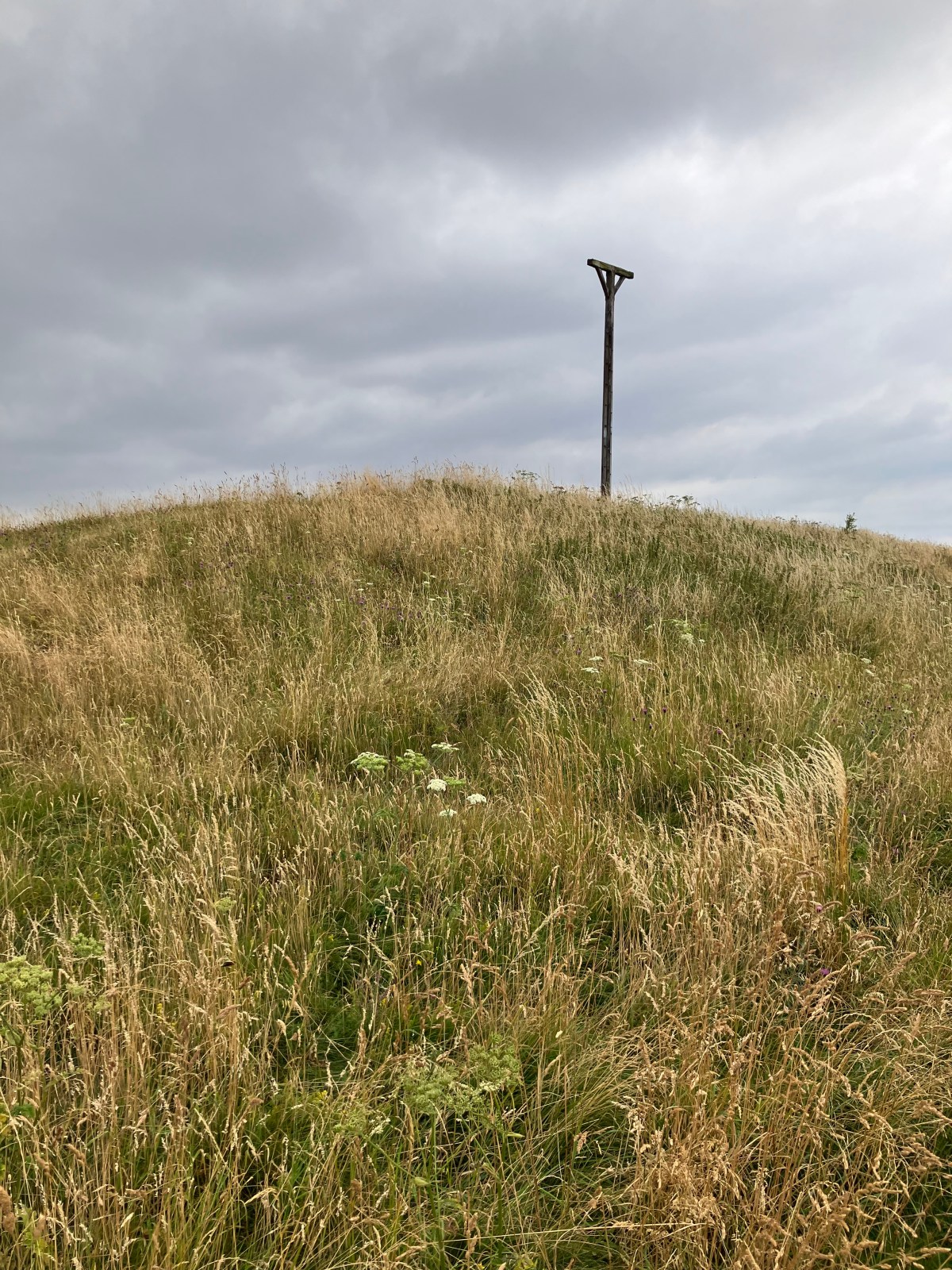
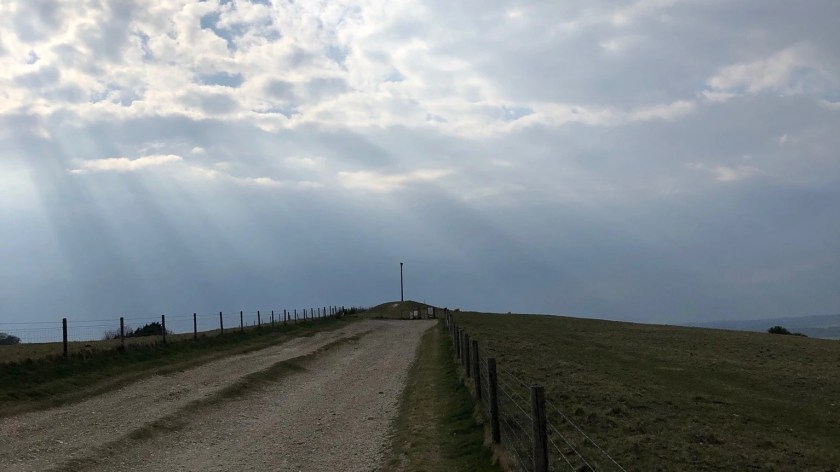
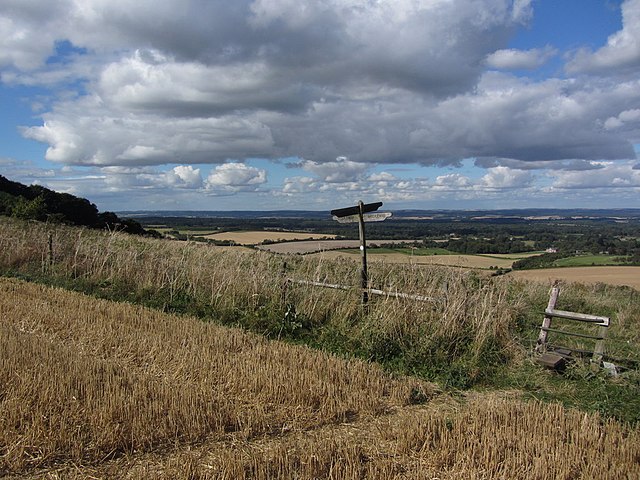
A favourite local destination for many of us in our area is Combe Gibbet above Gallows Down, close to the highest point on chalk in England and affording spectacular views particularly to the north across the Kennet valley. Standing right next to the gibbet we admire the view and identify local landmarks. It is an uplifting and spectacular spot.

But is there something that we miss? I know I did when I first walked up to the gibbet. As it stands on one of the highest points of the hill, it is easy to overlook the fact that the gibbet has been erected on a mound. The mound on which it stands is actually a neolithic long barrow.

There are around 500 neolithic long barrows in England of which three are in Berkshire and many more over the borders in Wiltshire and Dorset. Generally speaking most are in the Cotswolds or Wessex.

Our local barrow is oriented east to west and measures 65 meters by 20 meters and is surrounded by a ditch about 7 meters wide. Constructing it was no mean feat particularly when the only tools available were made from bone or flint and would have required a well-organised and dedicated work force.

But why was it built up here?

Long barrows were important communal burial sites during the neolithic. A chamber was usually constructed of wood or stone with an entrance at one end, then covered over with earth. Members  of the community were laid to rest in the tomb but, in a practice that seems strange to us, often only certain bones were placed within and it seems likely that the remains were, at times, taken out and replaced.

It is likely that the long barrow would have been an important ritual site for the local community and might have indicated ownership of a particular area by a particular group of people. A location commanding an impressive view seems to have been important; for example, Wayland’s Smithy Long Barrow near Uffington and West Kennet near Avebury are also sited on higher ground.

The long barrow above Gallows Down was likely to have been the focus of communal events. However it may well be that our neolithic neighbours would have travelled further afield to meet up with other family members or community groups; the henge and stones at Avebury could have been reached by following the river Kennet westwards, for example. We know that neolithic peoples often travelled hundreds of miles to join in the ceremonies at Stonehenge so the thirty or so from here across Salisbury Plain would have seemed any easy journey to people used to walking long distances

So, as we traipse up to the gibbet and admire the view, perhaps we should remember that beneath our feet is a construction that would have been important to our neolithic neighbours – something that would have been revered and respected, which had taken much time and effort to build. After all, we can not imagine a time when we would walk through Winchester Cathedral whilst ignoring its significance as a place of worship, or pass Windsor Castle without seeing it as something just a bit special.

Our local long barrow, up above Gallows Down, might not look particularly important to us now, but it is worth remembering that 6000 years ago it might have been the most significant thing in the landscape.

(C) Theresa Lock 2024

From a dig at Inkpen to the skies above Stonehenge:

O.G.S. Crawford – the man who put history on the O.S. Maps

I have always enjoyed looking at Ordnance Survey maps – to plan routes for days out or just afternoon walks, or simply to see the names of woods, rivers, hills or countless other features all carefully recorded. But for me one of the most fascinating features of O.S. maps are those places labelled in a gothic or Old English font which indicate a site of historic or archaeological significance. “Walbury”, “long barrow” ( on Gallows Down ) and “moat” ( at Balsden Farm ) are all good examples from the Kintbury area.

Although the Ordnance Survey started publishing maps over 200 years ago, originally for military purposes, it was not until the 1920s that historic and archaeological sites were first identified as they are now. And the person first responsible for including that information had an interesting connection with our area.

Osbert Guy Stanhope Crawford was born in 1886 in Bombay, India where his father was a judge. However, as his mother died soon after his birth, he was sent back to England to live in London with two of his aunts. While the young Osbert was still of school age, he moved with them to The Grove, East Woodhay, a few miles from Kintbury and just over the border in Hampshire. Later the Crawfords relocated to Tan House, Donnington, just outside Newbury.

Crawford was educated at Marlborough College in Wiltshire and it was there that his interest in archaeology grew. As a member of the College’s Natural History Society, Crawford visited various Wiltshire archaeological sites such as Stonehenge, West Kennet Long Barrow and Avebury.

From Marlborough, Crawford went up Oxford University where his interest in archaeology continued. In 1908, whilst still a student, he excavated a Bronze Age round barrow at Inkpen, not far from his aunts’ East Woodhay home, as well as other – possibly less successful – work excavating at Walbury Beacon.

It was around this time that Crawford became friends with archaeologist and anthropologist Harold Peake and his wife Charlotte, excavating with them at Botley Copse near Marlborough. Harold Peake is particularly remembered in this area as being curator of the Borough of Newbury Museum from 1867 to 1946 and the person responsible for building up an important collection for what was later to become the West Berkshire Museum.

The Peakes lived at Westbrook House, Boxford, just to the north of Kintbury. Their interests included not only archaeology and anthropology but music, folklore and drama and they were very supported of younger people such as Crawford. It is believed that, under Peake’s influence, Crawford began to question the kind of extreme religious beliefs held by his aunts, in favour of a more science-based world view.

After graduating from Oxford, Crawford worked as an archaeologist in both Britain and Sudan. During the First World War he served as a photographer with the Royal Flying Corp but spent time in a German P.O.W. camp, having been shot down.

In the 1920s, Crawford worked for the Ordnance Survey in Southampton, as its first Archaeological Officer. It was around this time that historians and archaeologists began to use aerial photography in identifying and interpreting historic sites which could no longer be seen clearly above ground. The remains of structures and earth works which have long disappeared can be identified through crop marks and shadows which can then be studied using aerial photographs. Crawford’s time with the Royal Flying Corp would have given him first hand experience of how useful such photographs can be.

Crawford used the study of aerial photographs as well as information gathered from local antiquarian and historical societies to identify the locations of many ancient monuments which would not have been visible to cartographers working in the field. He also conducted his own surveys, often travelling across the countryside on his bicycle. Crawford then annotated each O.S. map by hand, adding the names and locations we are now familiar with but which today are identified on our maps in a gothic font.  

At this time, Alexander Keiller, heir to the family fortune made in  marmalade, was living at Avebury Manor. An amateur archaeologist, he had been involved in excavating the world-famous neolithic henge and other associated sites. In 1924 Crawford joined Keiller in an aerial survey of Wiltshire and Somerset as well as Berkshire, Hampshire and Dorset and in 1928 they published Wessex From The Air, a groundbreaking aerial photography survey of our area and the landscape of the wider Wessex.

Crawford assisted Keiller in the fund raising which enabled Stonehenge to be bought for the nation, and in 1927 he founded the influential archaeological journal, Antiquity.

Keiller worked for the O.S. until 1946 when he turned his attention to the preservation of those historic buildings in Southampton which had survived the devastation of the blitz during the Second World War.

Today, O.G.S. Crawford is recognised as an important figure in twentieth century archaeology. It is interesting to think that this important career began in part with an excavation at Inkpen and a friendship in Boxford.

Crawford died in 1957.

Sources:

https://www.ordnancesurvey.co.uk/about/history

https://historicengland.org.uk/images-books/archive/collections/aerial-photos/

https://hantsfieldclub.org.uk/ihr100/profiles-c/crawford.html

https://www.sarsen.org/2018/04/capturing-material-invisible-ogs.html

© Theresa Lock 2024

Fists at dawn: A tragedy at Enborne

In the world of late Georgian England, laws governing the sale of alcohol were very different to what they are today.

The 1830 Beerhouse Act – sometimes known as “Wellington’s Act, after the prime minister of the day – allowed any rate payer to brew and sell beer on payment of a two guinea licence. This was an attempt by the government to increase competition between the brewers, to lower the prices for the consumer and to dissuade drinkers from drinking spirits such as gin, which at that time was very cheap to buy.

Not surprisingly, the act resulted in new beerhouses opening.  Many were no more than houses or cottages where the householder brewed beer at home. They were nothing like what we might think of today as an inn or “pub”. It is almost impossible to identify today where our local beerhouses might have been, although it is true that some which opened as a result of the 1830 Act might have gone on to become established public houses in the modern sense.

The Reading Mercury of April 1833 has a report concerning an unfortunate event which occurred at beerhouse in Enborne.

Apparently, two young men from East Woodhay, Samuel Pocock, a carpenter and Solomon Rose a labourer, were drinking in the beerhouse, the precise location of which is unidentified. Perhaps they had been drinking for too long, or perhaps the home-brewed beer was too strong, we shall never know, but things became very unpleasant when the subject came up of a young woman known to both men. Discussion turned to argument and argument would have turned into a fight there and then, but the owner of the beerhouse intervened to stop it.

Unfortunately, the two young men were reluctant to leave the matter there and it was agreed that they should fight it out. Consequently at 7 o’clock on the following Monday they met up.

Today, such a planned fight would seem to be nothing more than an extension of a drunken brawl. However, to put this event into its early nineteenth century context, it may be that the participants did not see themselves as brawling or being particularly disorderly.

Duelling, which is to say combat between two people using guns in order to settle a dispute, had not officially become illegal until 1819 although this had not prevented some continuation of the practice among the fire arm owning classes. As a form of entertainment, bare knuckle fighting was a popular sport amongst all classes and even between some women. There had been attempts to make “prizefighting” illegal but as matches were popular and constables of the newly formed police force thin on the ground, many prizefights went ahead, anyway.

Seen in this context, therefore, a fight following a disagreement in a beer house might have seemed to those involved to be a legitimate response – almost “sporting” perhaps.

The chosen venue was a field and the young men were accompanied by John Rose and Edward Pocock, presumably to see fair play.

The ensuing fight went on for a dozen rounds before Pocock hit Rose with a violent blow under his left ear. He was killed immediately.

An inquest was held and it was discovered that the blow had ruptured a blood vessel at the base of the victim’s brain and he had lost nearly a pint of blood.

Pocock was arrested and charged with manslaughter. John Rose and Edward Pocock were charged with aiding and abetting.

It was three months before the case came to Winchester Assizes and for Rose and the two Pococks, as well as for their families and friends back in East Woodhay, it must have been a very stressful time. Sentences available to a judge at this time included execution or transportation for life as well as imprisonment. Two years previously, William Winterbourn, from the nearby village of Kintbury, had been executed for his part in the Swing Riots and he had not killed anybody.

However, the judge’s decision might come as a bit of a surprise. According to the newspaper reports of the time,

“The learned judge, in addressing the prisoners, said that there did not appear to be anything unfair in the fight which had taken place in consequence of a quarrel and under such circumstances the offence did not call for severe punishment. Sometimes, persons went out to fight for money, and when that was the case, it should be known, that all persons who were present were equally guilty with those who were actually fighting. Taking all the circumstances into consideration, and that the prisoners had already been imprisoned for three months, the sentence of the Court was  that they should pay a fine of 1 shilling and be discharged.”

So, in the opinion of the judge, the fight had not been unfair. Presumably it would have been considered that both men knew the risks they were taking and so Pocock was not held culpable for Rose’s death. Furthermore, no money had been involved, which, the judge had been at pains to point out, made all the difference.

Samuel Pocock returned to East Woodhay where, in 1841, he is living with his wife, Jane and their four children.

Was Jane the woman over whom Pocock and Rose were fighting? It has to be possible, although as Jane came from Great Bedwyn, a village in Wiltshire a few miles to the west, it is unlikely.

Though I can find no record of Edward Pocock after the tragic events of 1833, John Rose, the other witness to the fight, continued to live in East Woodhay with his wife Elizabeth and their family.

Was there any ill feeling between the Pocock and Rose family? We shall never know.  

References & sources:

Photo: Pilot Hill, East Woodhay. Colin Park, Creative Commons

https://www.britishnewspaperarchive.co.uk/

https://www.ancestry.co.uk/


© Theresa Lock 2024 


The Lloyd family of Enborne…and beyond

On the chancel wall of St Michael & All Angels, Enborne, near Newbury, is a plaque to the memory of a former rector with a rather unusual name.

Nowes ( pronounced “Noise” ) Lloyd had been born in Essex and was baptised on 6th September 1719. His father was the Rev John Lloyd of Epping and his mother Isabella. Isabella’s maiden name had been Nowes, hence the baby’s rather unusual name.

As a young man, Nowes seems to have taken the traditional route to the priesthood for the time, having graduated with a BA from St John’s College, Oxford in 1742 before being ordained by the Bishop of London at Whitehall on 9th June, 1745. However, his vocation was to take him out of the city and into rural Wiltshire. By 1751, Nowes had become vicar of Bishopstone as well as Rector of the next door parish of Hinton Parva, near Swindon.

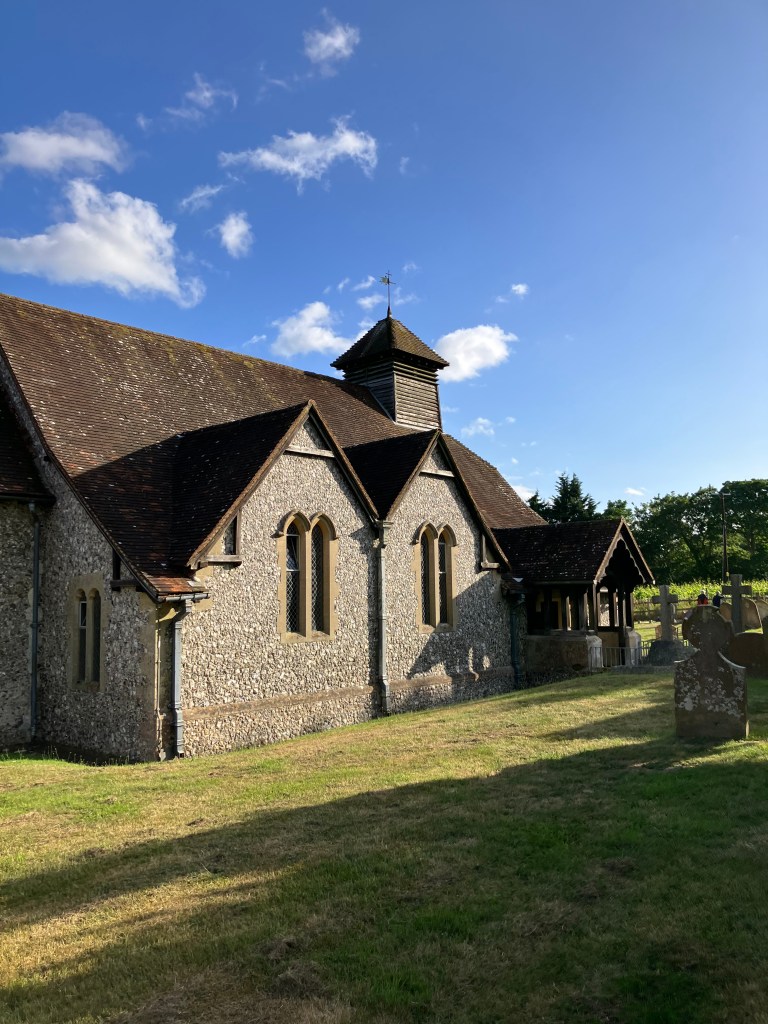
St Mary’s church, Bishopstone, Wiltshire

 The position of parish priest has never been a lucrative one, and this may be why the Rev Lloyd did not marry until 1763, when he was 43. His bride, ten years her husband’s junior, however, may well have been used to a more affluent lifestyle than the vicarage could offer, since she was Martha Craven, the daughter of the Honourable Charles Craven of Hamstead Marshall, and his wife Elizabeth, Lady Craven.

 Martha’s father had been the first Governor of South Carolina in what is now the U.S. Martha’s mother is reputed to have been something of a socialite and a very difficult person, with little time for Martha or her sisters, Mary and Jane. Consequently, Mary left home to make a very unhappy marriage with a horse dealer whilst Martha worked for a time as a seamstress at a school, using a false name to hide her identity before marrying Nowes.

Martha Craven and Nowes Lloyd were married by licence at Bishopstone on 2nd June 1763. I do not know why the marriage was by licence rather than banns; there may have been a very simple reason although I wonder if Martha’s difficult relationship with her mother might have caused the couple to arrange their marriage at short notice thereby requiring a licence rather than banns. We will probably never know.

 In the same year that Martha married Nowes, her sister Jane married Rev Thomas Fowle of Kintbury.

Martha and Nowes began their married life at Bishopstone, where four children were born to them. The first child, also Martha, was baptised there on 16th November 1765, to be followed by Elizabeth on June 15th, 1767, Charles on December 21st, 1768 and Mary on May 20th 1771.

The Rev Lloyd’s relationship with what is now the Walbury Beacon Benefice seems to have begun in 1764 when he became Domestic Chaplain to William Craven, 5th Baron Craven of Hamstead Marshall. Baron Craven was, of course, a relative of Martha Lloyd. These were the days when who you knew rather than what you knew could make a really big difference to your life.

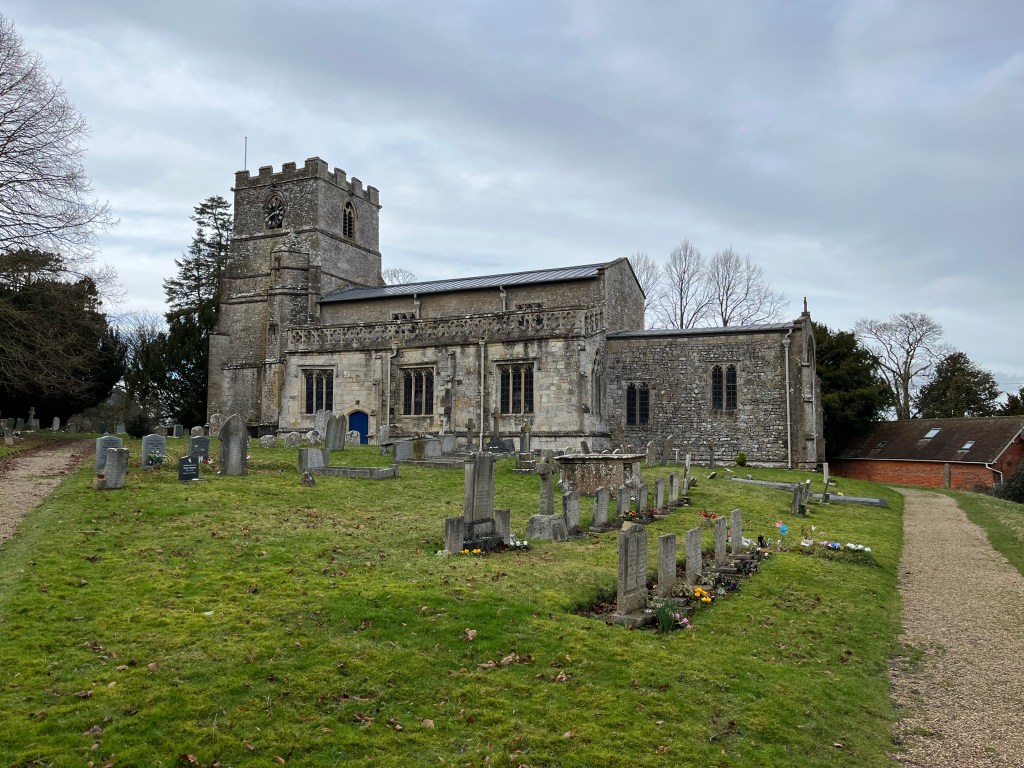
St Michael’s & All Angels, Enborne, Berkshire

 In 1771, Nowes Lloyd became rector of Enborne whilst retaining his position at the other parishes, even though they were over thirty miles apart. This was not an unusual situation for the time, when it was quite common for a curate to undertake all the duties of the absent priest. Eventually, the Lloyd family moved to Enborne where Martha would be much closer to her sister Jane at Kintbury. Their mother, however, was by now also living in Kintbury, at Barton Court, with her second husband, Jemmet Raymond. We can only wonder what Elizabeth Raymond’s relationship with her daughters was like by this time.

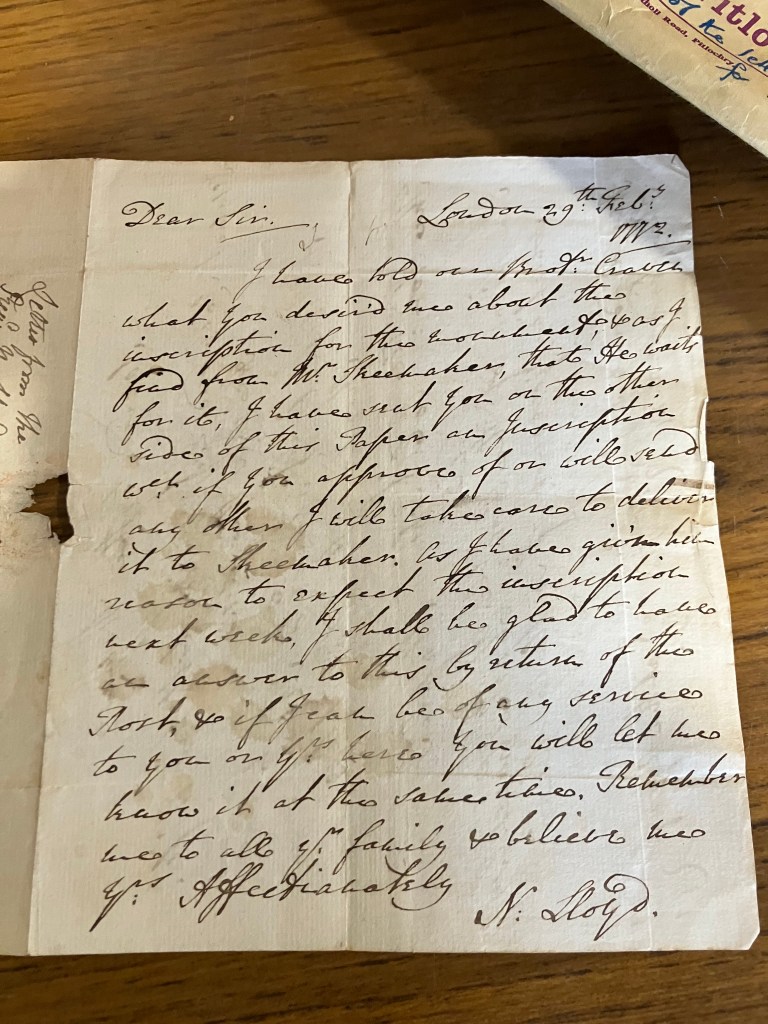
 Sadly, there was an outbreak of smallpox in the Enborne area in 1775 and, whilst his sisters survived, Charles Lloyd, then only six, died. He was buried in the churchyard on 13th April of that year. Martha’s mother, meanwhile, had died in 1771. As if to demonstrate the wealth and status of the Raymond family, an elaborate marble memorial was commissioned from the renowned sculptor, Peter Scheemakers, to be placed next to the altar in Kintbury church. A letter written by Nowes Lloyd to his brother-in-law, Rev Thomas Fowle, regarding arrangements with Scheemakers, is still in the church’s possession.

Letter from Rev Nowes Lloyd to Rev Thomas Fowle concerning the Scheermackers monument, Kintbury

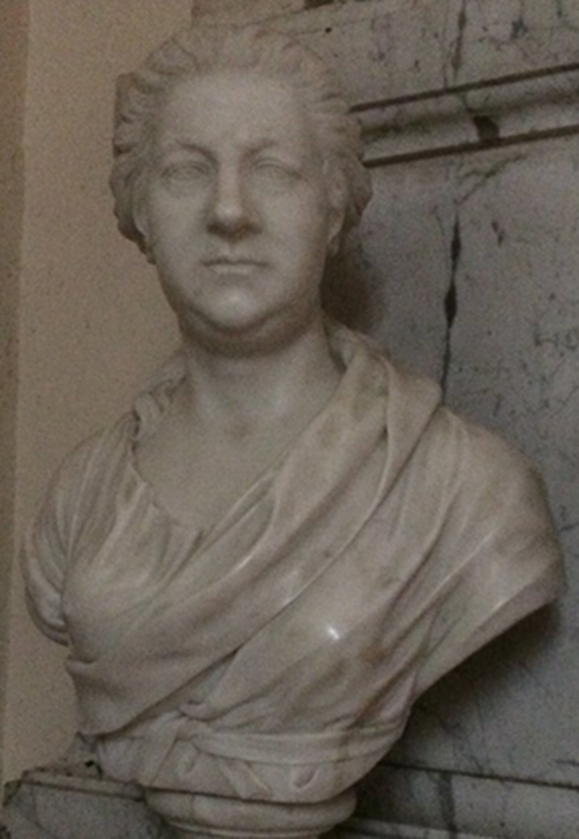
 You might have seen Elizabeth Raymond, formerly Lady Craven, in Kintbury church. If you happen to be standing in a pew near the front and to the left hand side of the aisle, possibly singing a favourite hymn, and casually turn your head to the left – there, in her current position in the north transept will be Elizabeth, stonily staring back at you as if in disapproval of something, you know not what.

Elizabeth, former Lady Craven

Nowes remained as rector of Enborne until his death on February 3rd, 1789. The previous year, his daughter Elizabeth had married her cousin from Kintbury, Fulwar Craven Fowle. At this time  Martha and Mary were still living at home. There was a need to vacate the Enborne rectory but fortunately for Rev Lloyd’s widow and her daughters, a friend of the Fowles offered them his parsonage at Deane. The move to Deane proved to be quite significant for Martha Lloyd in particular as she became a close friend of the vicar’s daughter, later living with her, her sister and their mother in Bath.

 Martha’s friend was creative and lively with a keen if sometimes wicked sense of humour. She loved walking, wrote long, detailed letters whenever she was away from her family and friends and, in particular, would entertain them all by reading to them the stories she had spent hours writing. In this way, Martha Lloyd, formerly of Enborne, became one of the first people to read what have become some of the best loved novels in the English language. Martha’s close friend was none other than Jane Austen. In 1797, the link between the Lloyds and the Austens became even stronger when Mary Lloyd became the second wife of the Jane Austen’s widowed brother, James. When Jane Austen, along with her mother and sister Cassandra moved back to their native Hampshire, Martha went with them to share the cottage in Chawton, now the Jane Austen’s House Museum. It says something of the position of women in the early nineteenth century that Martha Lloyd, grand daughter of Lady Craven with her elaborate and expensive monument in Kintbury church, had no home of her own except the one she shared with her friends. But life had another surprise in store for the young woman from Enborne. After Jane Austen’s death in 1817, Martha continued to live in the cottage at Chawton with Cassandra Austen. However, on 24th July 1828, she became Sir Francis Austen’s second wife and therefore, Lady Austen.

 Today, the name of Martha Lloyd is well known to Jane Austen fans all over the world. A facsimile of her household book containing the recipes for dishes she cooked at Chawton, has been published and earlier last year saw the publication of Jane Austen’s Best Friend: The Life and Influence of Martha Lloyd by Zoe Wheddon . So, while Janeites (as fans of Jane Austen are known) all over the world think of Martha Lloyd as Jane Austen’s best friend, I will always think of her as the young woman from Enborne.

Many thanks to Alec Morley of Romsey Local History Society https://www.ltvas.org.uk/ for information regarding Nowes Lloyd’s family and also for clarifying for me how to spell and pronounce his unusual first name.

© Theresa A. Lock 2024

William Winterbourne: A Reflection by Keith Jerrome

This year Keith Jerome, a retired trade unionist, was able to join us as we remembered William Winterbourne. Keith has given us permission to reproduce here the speech he gave, reflecting on the injustices suffered by the Kintbury Martyr and his comrades.

William Smith, known as Winterbourne, has been referred to as The Kintbury Martyr. And why not? The men of Tolpuddle, the Six Men of Dorset, also achieved this title without a trip to the gallows

The document Sentences of the Prisoners tried at the Special Assizes at Reading, began December 27, ended January 4, 1831 shows that several village communities were to be deprived of many members of their agricultural workforce and, most of all, deprived of family members who were the principal breadwinners. The Swing Riotershad been acting in protest against poverty and starvation and for those families losing wage earners from January 1831 the prospect was bleak. They too would share the punishment meted out

The Kintbury men, like their comrades further to the South West, were apprehended and taken to gaol. They went to Abingdon and to Reading, leaving their homes to which they would never return

Our Kintbury Martyrs were hunted down by a posse of 300 horsemen who were on a bonus of 50 guineas for each prisoner they delivered up to Reading Gaol. They shared £600 from the County Sheriff (Probably a four figure sum in today’s money). They were led by Charles Dundas and Lord Craven and included ex Yeomanry troops plus Grenadier Guards and Special Constables. Both the Red Lion (today the Dundas Arms) and the Blue Ball were raided and many began the onward journey to Reading Gaol where they remained pending the Special Assizes. This activity was described as A good day’s sportby Mr Dundas.

Twentytwo men from Kintbury and Hungerford were sentenced to be transported, of whom fourteen were married. Six were farm labourers and the remainder were country tradesmen and all were destined for the Hulks. These were old wooden warships used as floating prisons They were utilised as a temporary measure in 1777 but were still in use 70 years later. Described as Hell on Earth, scrofula, consumption and scurvy were rife. Retired battleship the Yorkat Portsmouth to which the Berkshire men were taken held 500 prisoners. Men were held here until convict ships became available and prisoners were judged fit to sail. That could be months and Men died almost immediately from disease induced by despair and a great many died later due to despair and a deep sense of shame and desperation

Naval guards were brutal, tyrannised, cruel by consciousness of the power they possessed. Beatings, punishments and reduction in rations, together with Floggings of unspeakable severitywere inflicted on prisoners

Fortunately, the Berkshire men did not have to wait too long. The Kintbury Martyrs left Portsmouth on 19 February 1832 on the convict ship the Eleanorwhile four of them sailed on the Eliza. They sailed via Madeira and Cape Verde, round the Cape of Good Hope and on 26 June were in sight of Sydney, New South Wales while the Elizawas bound for what was then Van Diemens Land. 

Although the sentence of transportation was not for life, it was in fact a life sentence, as few had any hope of returning home. Back in Berkshire, their families were reliant on the support given by parish relief, principally to be able to feed their children and themselves

We remember William Winterbourne in 2024 as we have done for many years. We must also remember his fellow comrades and their families, who did not suffer the ultimate punishment of being deprived of life but the lives they had known were changed completely

The hope that change for the better has befallen those seeking a better life and freedom from tyranny is challenged when we recall that the concept of transportation has been promoted by the current government. However, it is faltering in its intent to use modern methods of transportation to ship refugees and so called illegalimmigrants to Rwanda. It also faces a problem of the costs of housing the increasing number of refugees in hotels

But here comes an eighteenth century solution! Buy in a hulk(from Holland), the barge now moored in Portland Harbour in Dorset. Conditions on board, while not like those of the eighteenth and nineteenth centuries, are far from ideal for providing shelter to men accused of no crime, who are merely seeking freedom and a better life

As we recall the terrible fate suffered by William Winterbourne and the life sentences to which his comrades and their families were condemned in 1831 let us recognise that the protest against the tyranny which seeks to deprive people of their freedom and their right to a better quality of life must go on

Quotes thanks to the late Norman Fox, Author Berkshire to Botany Bay. Teacher, Trades Unionist, Marxist and friend. Keith Jerrome 11 January 2024.

William Winterbourne remembered, Kintbury, January 11th 2024

St Frideswide : Saint of our diocese

19th October is the day that the Anglican communion commemorates St.Frideswide, patron saint of the Oxford Diocese, to which we in this area belong.

The earliest account of Frideswide’s life comes from a 12th century manuscript. According to the story, Frideswide was the daughter of Didan, King of that part of the Ango Saxon kingdom of Mercia which surrounded Oxford.

Frideswide was the only child of Didan and his wife Safrida. When Safrida died, Frideswide asked her father to build a monastery, which he did, and the still very young Frideswide became its abbess.

As an abbess, Frideswide had, of course, taken a vow of celibacy, but, unfortunately, this did not stop Algar, King of Mercia, from trying to persuade her to marry him. When Frideswide refused his advances, Algar tried to abduct the young abbess.

Luckily, Algar’s attempts failed and, under cover of darkness,  Frideswide was able to escape Oxford by rowing a small boat up the Thames until she came to the village of Bampton, nearly twenty miles to the west. Here, Frideswide was able to hide in a pigsty belonging to a local swine herd.

The persistent Algar refused to be deterred, and eventually discovered Frideswide’s secret location. But, just as he was about to ride out in hot pursuit, a miracle occurred. Algar was struck blind!

Frideswide, however, was compassionate and using the waters of a holy well which she had caused to bubble up from the earth, she was able to restore his site.

Algar now abandoned his pursuit of Frideswide and she returned safely to Oxford where she was able to establish a priory.

Frideswide died on October 19th 727. Her grave became a place of pilgrimage and many miracles were attributed to her.  

In 1440 Henry Chichele, Archbishop of Canterbury declared Frideswide the patron saint of  Oxford. In 1546 the monastery church became (and still remains) the cathedral church for the Oxford Diocese.


Our Village Schools in the late 19th century

Today, three of our local villages have village schools. Two of them, Inkpen and Enborne, are still based in their original Victorian buildings just like many other primary schools in West Berkshire. However, you might be surprised to find out that, at the end of the nineteenth century, there were twice that many village schools in our area.

By the middle of the nineteenth century, many towns and villages benefitted from schools established by churches or charitable organisations. However, it was not until Forster’s Education Act of 1870 that local school boards were created with the power to levy rates to finance building and running of so-called National Schools in their areas. Thus universal education became available to all children up to the age of 13.

It would be fascinating to research our village schools through documents in the Berkshire Records Office. For now, however, I decided to begin my research by looking at the 1881 census as by this time those schools opened as a result of Forster’s Act would be well established.  

At the time of the 1881 census, the occupant of the Kintbury St Mary’s school house is 25 year old James Humphries, originally from Ditton Marsh, Wiltshire. James is described as a “certificated teacher” meaning he has gained a professional qualification at a teacher training college. His sister, Catherine, 20, who is living with him, is described as “assistant teacher” which might indicate that she trained to teach by learning “on the job” as a pupil teacher which was how the majority of teachers  qualified at that time. How Kintbury parents would have viewed this fresh faced young man and his even younger sister, both in positions of authority over the village sons and daughters, we can only imagine!

James and Catherine did not stay in Kintbury for long, or so it seems. In November 1883 the Newbury Weekly News reported on a recent Diocesan Inspection at the school which found it to be, “in very good condition. The children are well taught throughout.” The master at this time was a Mr T. Sadgrove. But he did not stay long either. In May of the following year the NWN carried a report concerning the schoolboy Alfred Sturgess who was charged with stealing 2 shillings and 6 pence from the National School Board ( in other words, from St Mary’s school ), the case being proved by the master who was then W. Garrett Jones.

Perhaps Messrs Humphries, Sadgrove and Garrett Jones all found Kintbury too challenging to stay long, or perhaps they were ambitious and wanted to move on to bigger schools in towns. So far I can find no record of any of them to suggest where they were living when they moved on from Kintbury, or if they even stayed in teaching.

Things were different down the road in Inkpen. In 1881 the occupant of the village school house is 49 year old certified teacher Jesse Collins. Jesse was a retired naval captain originally from East Tilbury, Essex, whose teaching post in 1871 had been in Portsmouth. 

Interestingly, Jesse’s wife, Charlotte, is also described on the census as “School mistress”, although at this time women were not – officially – allowed to teach after they had married.

Life in the relatively isolated, rural community of Inkpen must have been very different to life in Portsmouth for the Collinses, although it seems to have suited them as they were still there in 1891. Despite, that is, Jesse having appeared before the local magistrates in 1884, charged with having assaulted one Alfred Abraham, a school boy, and having been fined 5s and 16s 6d costs. Perhaps the experience of his former naval career led Jesse to take this in his stride as he is otherwise involved with the local community and, according to the NWN, with local politics.

If Inkpen was a relatively isolated rural community, then Enborne was more so. Back then as now, the school with its adjoining school house was in an isolated spot in Crockham Heath, on the road up to Wash Common where, in 1881, the school mistress was 58 year old Ann Elizabeth Pears. Ann was an experienced teacher: in 1871 she had been teaching near Salisbury in Wiltshire and in 1861 in Suffolk.

According to a report in the NWN of March 1887, two men broke into the school house when Ann was away from home and stole 10 shillings and a quantity of brandy. This must have been particularly unpleasant for a woman living on her own in an isolated house and might have contributed to Ann’s decision to move on. By the time of the 1891 census, Ann has relocated to Hampshire but not yet retired from teaching. At 68  Ann is head teacher at East Woodhay school.

Today there is no primary school in the village of West Woodhay – by modern standards it would probably be considered too small a community to support its own school. The censuses of 1881, 1891 and 1901 indicate that there were no teachers living in the village in those years which suggests to me that there was not a school or accompanying school house ( the usual Victorian arrangement, common in many local villages.) The evidence suggests that West Woodhay’s children attended East Woodhay school as, in December 1903, the NWN reported that a request had been made for a footbridge to be placed “over the water between East and West Woodhay” as “children went down there on their way to school and got their feet damp.”

However, for fifty years, from about 1903 to 1961, West Woodhay did have its own school, marked on early 20th century OS maps as being somewhere near the village hall but on the opposite side of the road. Perhaps surprisingly, the NWN does not seem to have covered the opening of the school although the 1911 census shows assistant teacher, Celia Cook, 29, from Walworth, London, living in the school house.

Another local school I have, so far, found out very little about is Christchurch. Built at Kintbury Crossways close to the now demolished church which shared its name, Christchurch School opened in 1870 to relieve crowding at the established school down in Kintbury. Whilst the Reading Mercury reported on the opening, for some reason the more local paper, the NWN, did not.

I can find no record of the head teacher at the time of the school’s opening. However, the NWN of February 1884 reported that complaints had been made that a mistress, Agnes Peacock, had been ill treating the children. Unfortunately, a parent, Mary Ann Nash of Kintbury, had decided to take things into her own hands after Miss Peacock had patted her son on the hand by way of discipline. The teacher reportedly pushed the boy and he fell over. Nash went to the house where Miss Peacock was lodging and struck the teacher on the head with a stick. She was subsequently charged with assault and fined 9 shillings 6 pence with 10 shillings 6 pence costs.

As the smallest village in our benefice, then as now, it is perhaps most surprising that Combe had its own school. Although I can find no trace of when it first opened, the NWN of September 1894 reported that the school in the village had been, “nobly restored” with, “all the necessary requirements”. Local dignitary, Mr A.C.Cole had, “spared no expense” and the village children no longer had to walk to the neighbouring school, 2 or 3 miles distant. The school house furniture was supplied as a gift from Mrs Cole, as was that of the school, “according to government requirements”. Three cheers, then, for the Cole family.

In 1901, the schoolmistress at Combe was 34 year old Elizabeth Dingwall. Born in Chelsea, Elizabeth had been teaching in Fulham in 1891. At Combe, she shared the school house with her sister Isabella, a nurse and, although life the tiny village must have been very different from Chelsea or Fulham, the Dingwall sisters are still there in 1911.

One thing that has surprised me in researching this is that none of the teachers, either masters or mistresses, are local people. Whether this was a deliberate policy or coincidence, it is impossible to say for certain, although the weight of evidence suggests to me that the school boards deliberately chose to appoint people from out of the local area. For those single schoolmistresses, living alone in a village schoolhouse, life must have been very lonely. Whilst we know very little about the lives of Ann Elizabeth Pears, Celia Cook, Agnes Pocock or Elizabeth Dingwall, we do know a bit more about a schoolmistress living and working about 20 miles from here, in Denchworth, formerly North Berkshire, in the 1860s. Mary Hardy had been born near Dorchester in Dorset and trained to teach at the teacher training college in Salisbury so she was a “certified teacher”. Denchworth village school, 80 miles from her home and family, was her first post for which she was paid £40 a year and expected to play the church organ. Mary found the experience of living in Denchworth to be so lonely that she persuaded her parents to allow her younger sister, Kate, still a school pupil herself, to come to Berkshire to live with her.

We know a little more about Mary Hardy than we do about most Victorian village schoolmistresses because her brother, Thomas, was to become the celebrated novelist and so some of her correspondence is preserved in Dorset Museum. But while the names of most of the other women – and men – are mostly forgotten, many of the nineteenth century school houses are still standing. During my time as a supply teacher I was lucky enough to work in many village schools still using their original buildings, though now much adapted and extended. The school house has been, in some instances, sold off but in others the former living accommodation is now used as classrooms, staff rooms or storage. As you walk from late 20th century extensions back into those Victorian rooms, there is, I think, a distinct change in atmosphere, an awareness that you have entered somewhere that has been in constant use for over 150 years.

Tessa Lock September 2023