Walter Money and the Romans in Kintbury

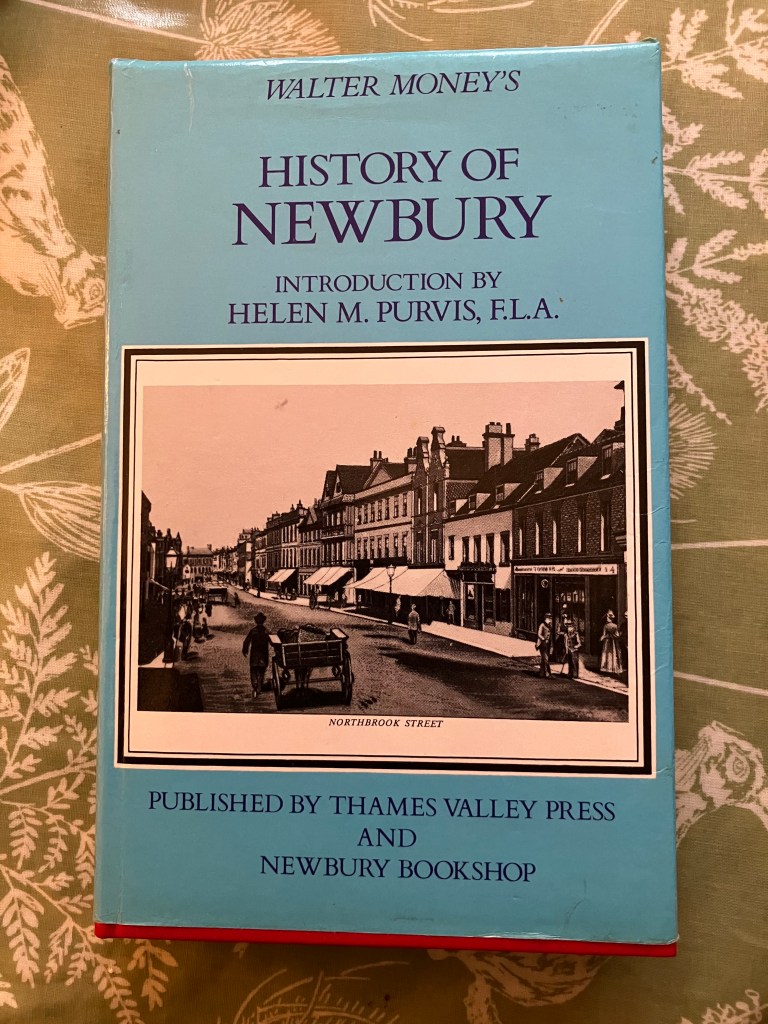
Anyone who has spent some time researching the history of the Newbury area will, eventually, have come across the name of Walter Money.

Born in Shaw-cum-Donnington, Newbury in the 1830s, both Walter and his brother James Money studied architecture in London. Both brothers returned to establish a practice in Newbury where Walter also developed a keen interest in local history and antiquity. His History of the Ancient Town and Borough of Newbury (1887) is still a very useful resource for the local historian and he is one of the people we have to thank for establishing a museum in the town.

Aside from a career as an architect and a notable antiquarian, Walter Money was prominent in civic life where his involvements included, amongst other roles, being a Church Warden at St Nicholas’ church, a promoter of the Newbury, Didcot & Southampton Railway, a member of the Town Council, a Governor of the Grammar School and manager of church schools.  He was also involved with establishing Newbury District Hospital, the Clock Tower and the Falkland Memorial.

There must be few people whose interests in life have left their mark on the town as Walter Money has.  

As I have said above, anyone researching local history in our area will come across the name of Walter Money. My most recent meeting with Walter occurred as I was researching what were believed to be Saxon graves originally uncovered in Kintbury during the late nineteenth century. By chance I found an article from The Journal of the Anthropological Institute of Great Britain and Ireland,  1878

  “An Ancient Burial Ground at Kintbury”  was submitted by Professor Rupert Jones but is the work of Walter Money. In it, Money outlines why he believed the graves to be Roman rather than Saxon.

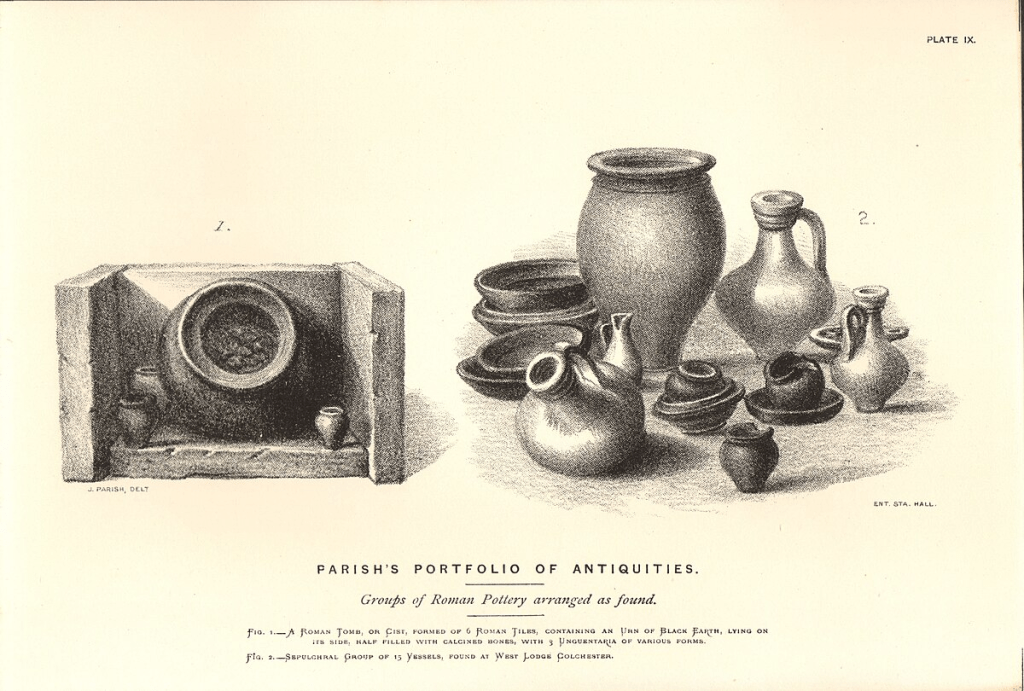
Many of the graves had been revealed when the  chalk pits were excavated for the purposes of whiting manufacture. The banks of the pits were strewn with fragments of Roman pottery including, Money says, “urns and other vessels; the ware is black, brown and red but principally a dark bluish grey colour on fracture, and somewhat coarse in texture.”

Roman Pottery found in Colchester

Money says that he also found glass, two portions of hypocaust tiles and a fluted brick with plaster still adhering to the outer face. The Romans are well known for their use of hypocausts for a sophisticated heating system which the Saxons did not have and similarly the use of plaster was Roman and not Saxon. He suggests that the Saxon graves are evidence of the continued use of a Roman cemetery before the Saxons converted to Christianity.

Tiles from a Roman heating system found in Kent. Had Walter Money identified something like this in Kintbury?

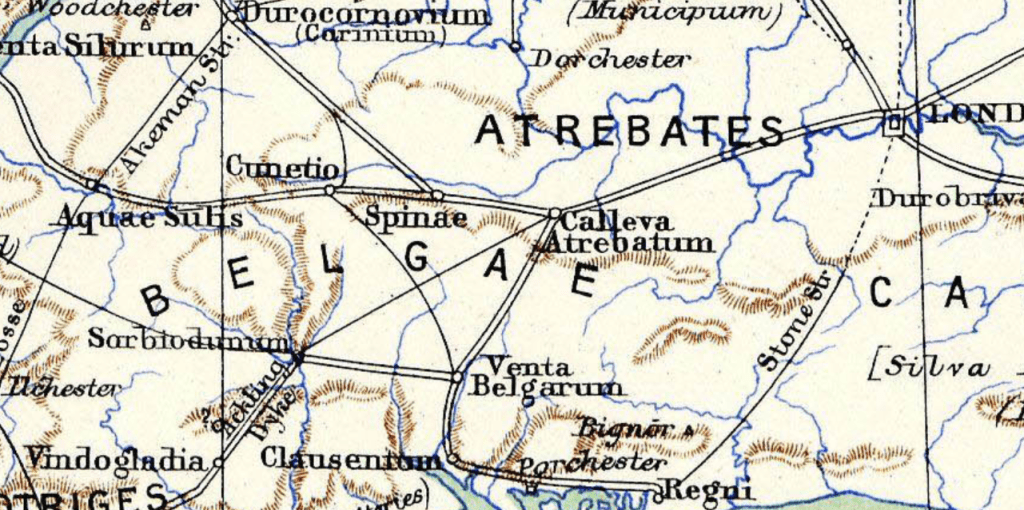
Money believed that Kintbuty was in Roman occupation, and probably a minor station on the road from Aqua Solis (sic) – Bath, through Cunetio – Marlborough, then through Lawn Coppice, Cake Wood, Standgrove, Hungerford and then Kintbury. From Kintbury the road would go on to Spinae, which he believd was the site of Newbury.

Finally, Money throws doubt on the suggestion that the graves are Saxon as  graves from this period are usualy accompanied by grave goods. However, no grave goods had been found. 

Today, archaeological remains can be dated using such techniques as optically stimulated luminescence, radio carbon dating and the study of a person’s DNA. Skeletons such as that belonging to the “Amesbury Archer” in Salisbury Museum can not only be dated but we also know where he travelled from in Europe before settling on Salisbury Plain.  But none of these scientific advancements were avilable to Money.

I do not know what has become of the artefacts that Money describes having found – furthermore it is likely that the contexts in which they were found were never recorded as they would be today. I would like to know why neither Professor Jones, nor the distinguised antiquarian Colonel Lane Fox, who visited the site later, mentioned or drew any conclusions regarding the Roman finds. Perhaps it’s just that I cannot find those details.

We know that there was a Romano-British villa in the valley to the east of Kintbury so surely it is not such a leap to believe that Kintbury itself was a small Roman settlement. Although the evidence is slight, I find myself wanting to believe Walter Money.

References & sources:

 Web Site of Friends of Newtown Road Cemetery – article by  Avril Thesing

http://www.fnrcnewbury.org.uk/persondetails.asp?PersonID=478

The Journal of the Anthropological Institute of Great Britain and Ireland © 1878 

Royal Anthropological Institute of Great Britain and Ireland

© Theresa Lock 2025

A rich man in his castle?

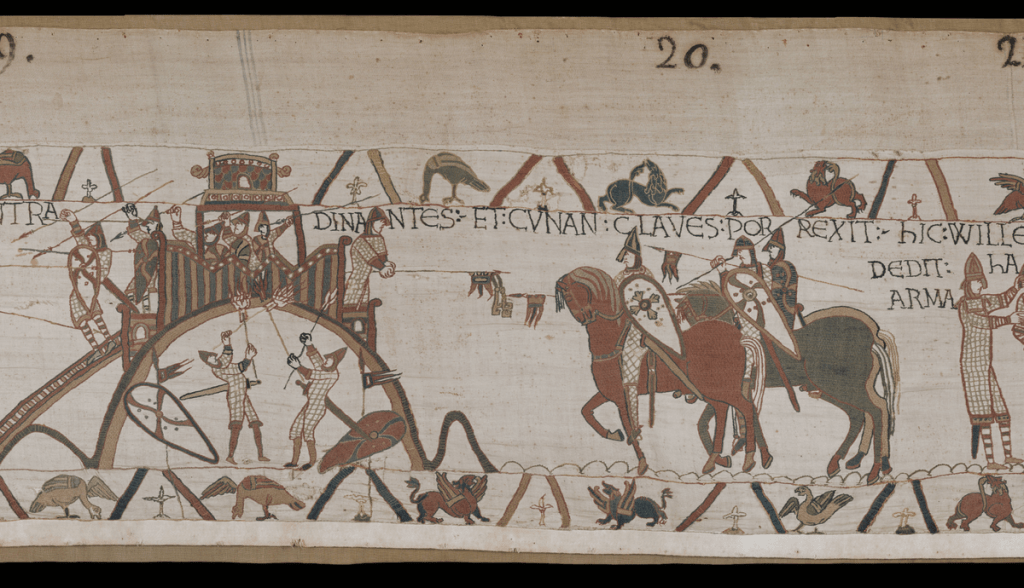
Motte and bailey castles are the stuff of children’s story books: picture a mound surrounded by a ditch and topped with a wooded palisade, inside of which is a wooden or stone fortress. Perhaps knights in armour are seen approaching on horseback, or an elegant lady wearing the inevitable wimple or cone-shaped head dress. Somewhere nearby, colourful flags and banners ripple in the wind.

In reality, the motte and bailey castles of history were introduced by the Normans after the invasion of 1066 and an example can be seen on the Bayeaux tapestry:

Windsor Castle is an example of a motte and bailey, although over the years of its existence, the building has had much more added to it. By contrast, in Oxford only the motte survives of the original castle construction.

Most interestingly, the OS map of our area records a motte in the village of West Woodhay. A little way from St Laurence’s church, but on the opposite side of the road, and now surrounded by trees, most passers-by will be totally unaware of its existence. However, thanks to the work of O.G.S.Crawford (see a previous post) we can still identify the site of early medieval activity in our area as the word “motte” in a Gothic font is clearly marked on the map. But does the presence of a motte also indicate that there was once a castle, or at least some sort of defensive structure, in the now quiet and peaceful village?

There have never been extensive excavations in the West Woodhay area – perhaps I should add, as of yet. However, in the 1930s enthusiasts of the Newbury Field Club did painstakingly dig the site. Their findings were recorded by one E. Jervoise and you can read what he discovered in volume 7 of the Newbury Field Club Journal in Newbury Library.

The West Woodhay motte is of modest size – the Field Club members recorded its rise to be just 8 feet and the diameter at the top just 30 feet. These dimensions, of course, would have dispelled any expectation of a substantial building so I can forget any fanciful thoughts of a West Woodhay castle. However, red and brown roof tiles and eighty iron nails were found on the crest of the mound, suggesting some sort of construction even if quite small. Broken pottery was found on the top of the mound and in the surrounding ditch, including rims and bases of what was believed to be at least 40 cooking pots or bowls of a type in use in the twelfth century. Some of the sherds found showed traces of glaze. The excavators weighed these finds and found there to be 40lbs of them.

The diggers also recovered soes believed to have belonged to oxen. Also discovered was what Jervoise describes as a “hone” by which he must mean a stone for the sharpening of blades. It had been, “ made of fine grained silicous schist, a rock occurring in Scotland and Normandy.” Most probably a valued or valuable item, then.

Jervoise was particularly pleased by the discovery of a small bronze buckle “of fine workmanship” and having, “an unusually perfect green patina”.

He concluded that it might have been the site of an early medieval hunting lodge and it was certainly somewhere that food was prepared and eaten.

Hunting lodges were not uncommon in the medieval period – a time when a popular sport amongst the nobility was hunting for deer or boar. The lodge would have been the place where visitors, on what in later times might have been referred to as a “straightforward hunting weekend ” would stay or just return after a day’s sport for food and refreshments. With its slightly elevated position on the motte, its view towards Walbury Hill to the south west and the wide open Kennet valley to the south east, the hunting lodge might well have been built to impress.

Although the West Woodhay motte was likely never the site of a defensive structure, or indeed anything at all like a castle, I think it is quite safe to assume that the owner of this land in the twelfth century would have been a wealthy man and most likely of Norman descent, speaking Norman French. But while the nobility and upper classes generally would have spoken Norman French, it has to be likely that those preparing the food and washing the cooking pots were of humbler stock. These working people are likely to have spoken the language of the West Saxons or even Middle English – possibly a mixture of both.

Today West Woodhay is in many ways a quintessential English village – typical of many smaller settlements on the southern chalk lands. It is difficult to imagine a time when the English language, as we speak it today, would not have been understood there. Perhaps it is even more mind boggling to imagine a time when the local land owners would have conversed in Norman French!

© Theresa Lock January 2025

January 11th 2025: Remembering William Winterbourne

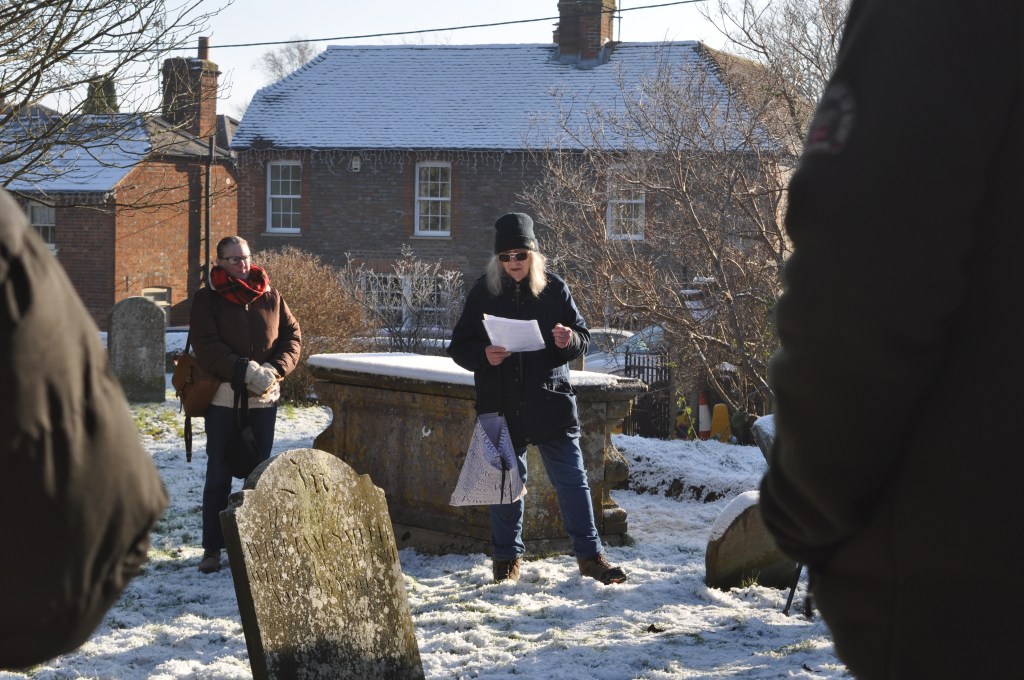
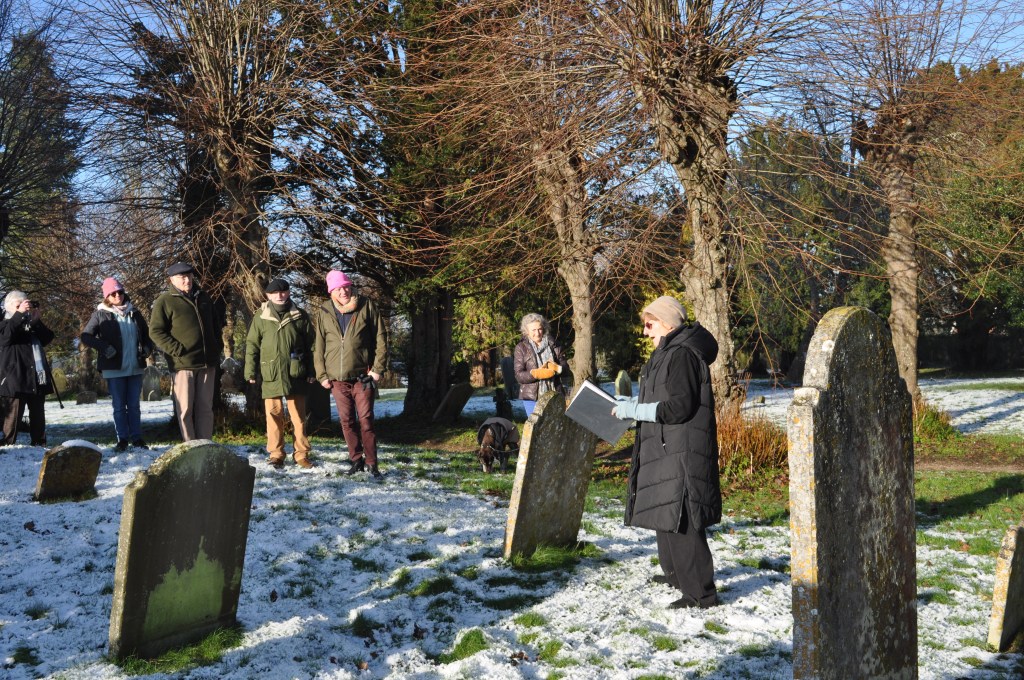
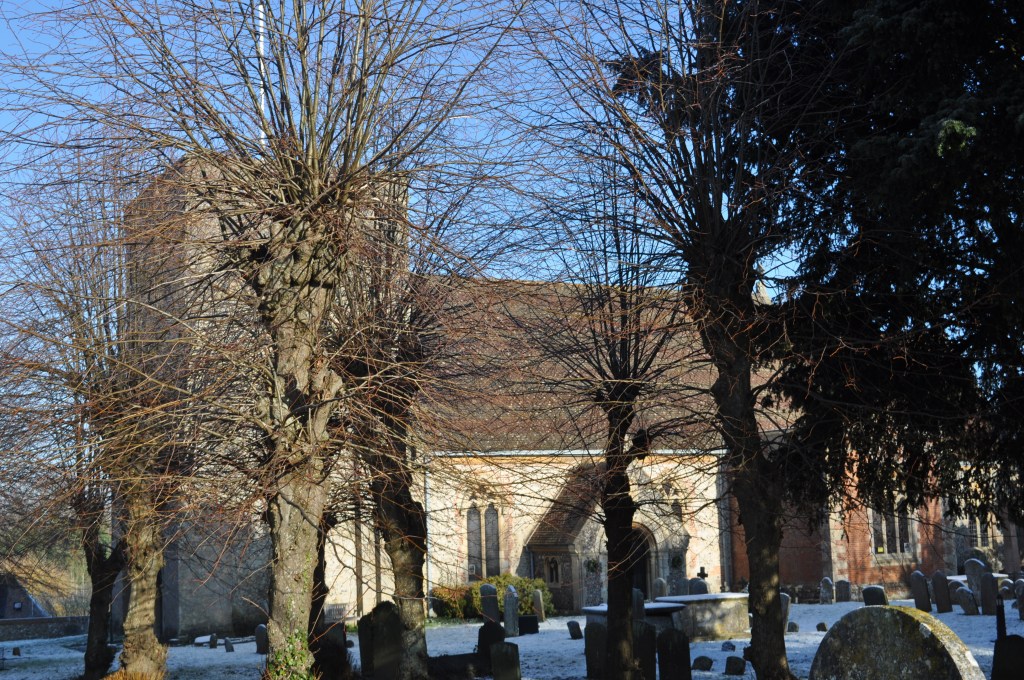
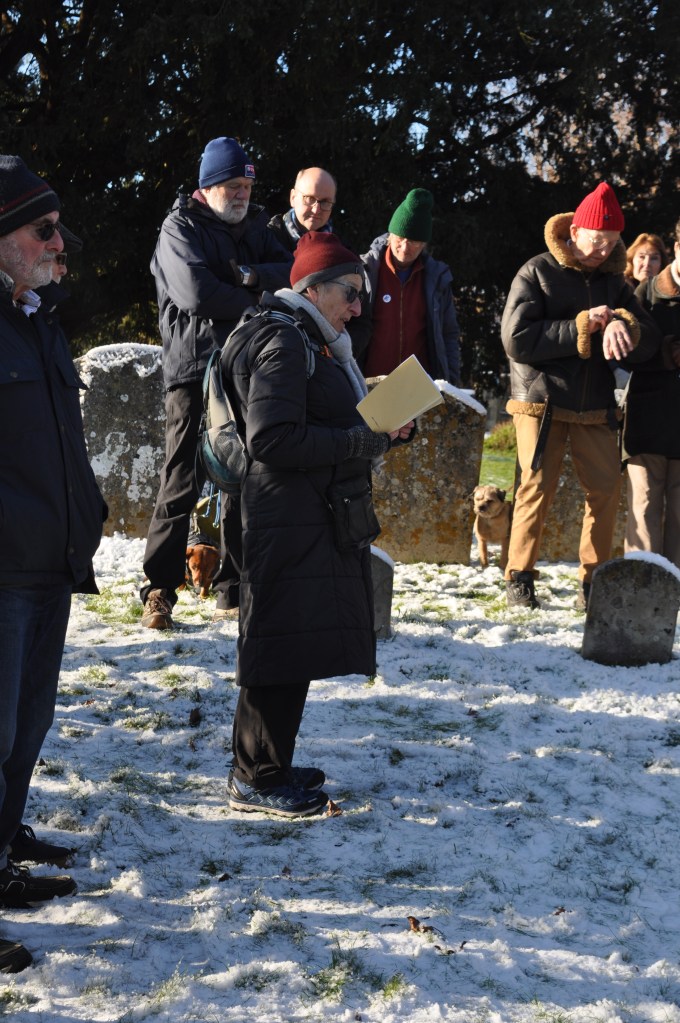
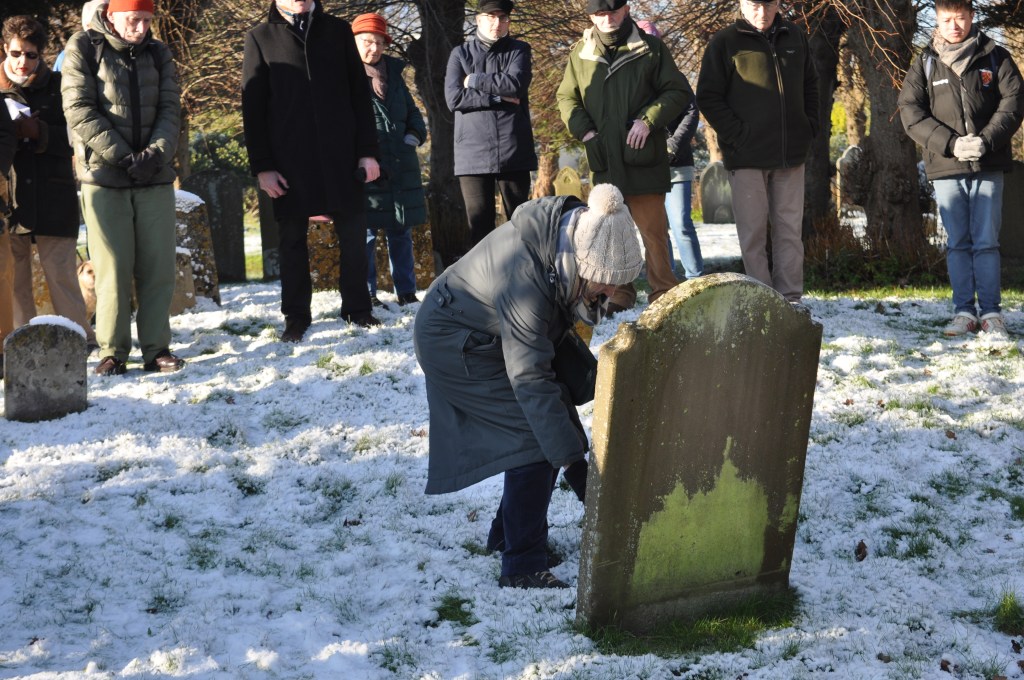
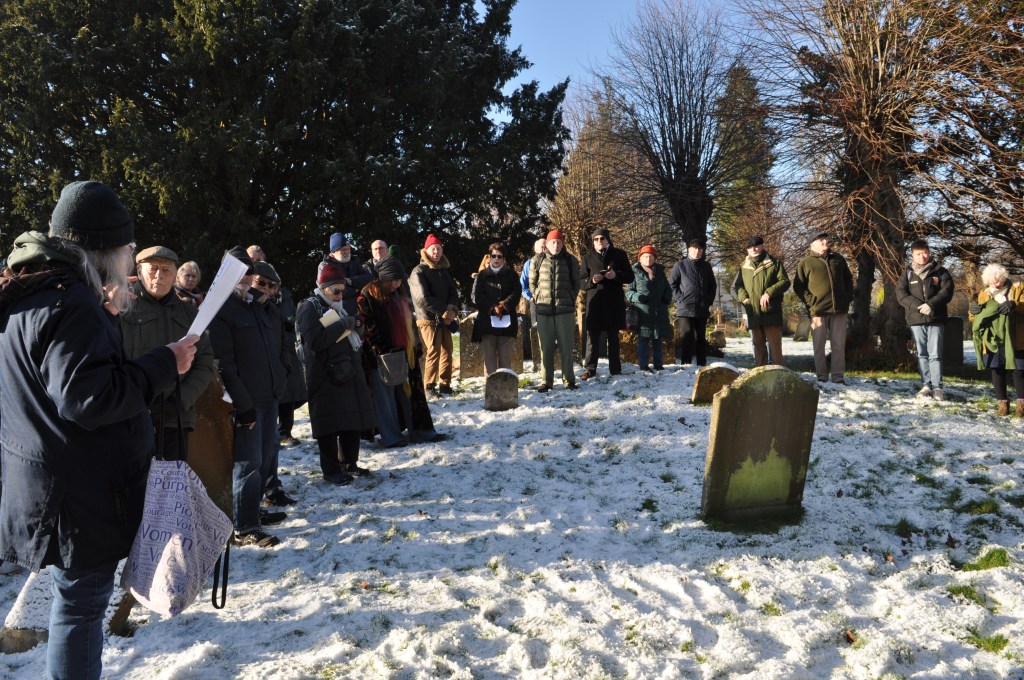
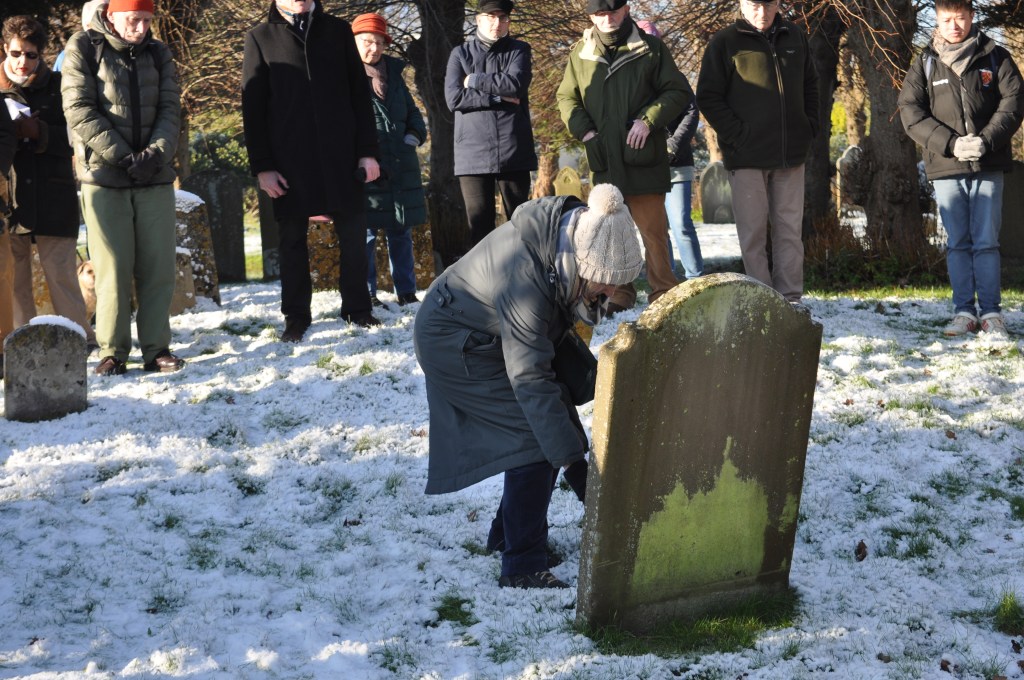
On January 11th each year, local people, family members and supporters from further afield including historians, trade unionists and those concerned with social justice, gather at the grave of William Winterbourne in St Mary’s churchyard.

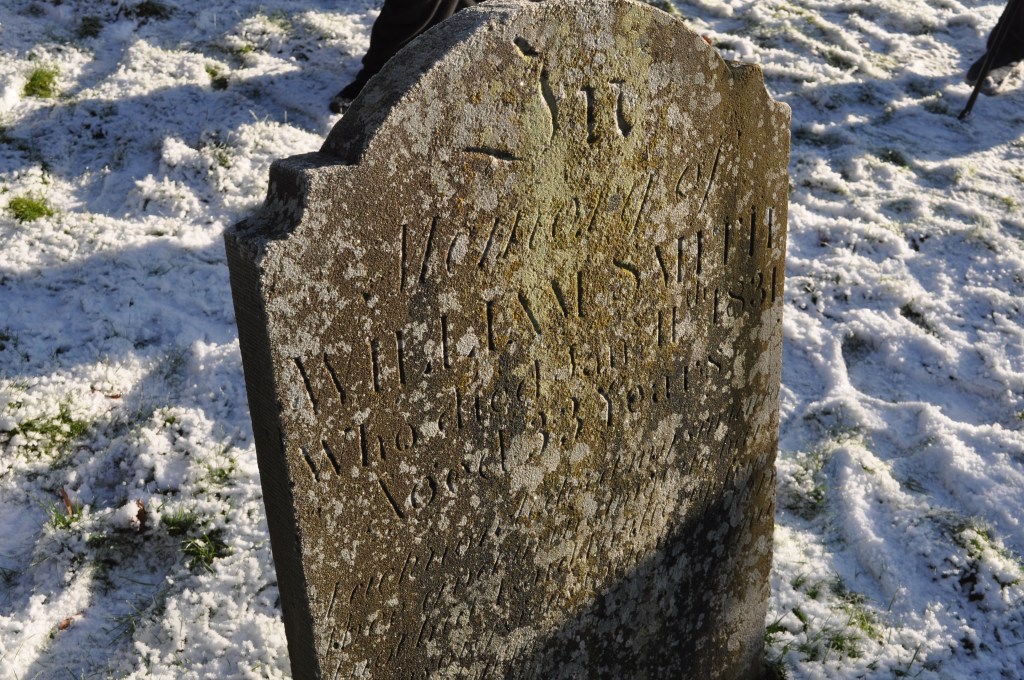
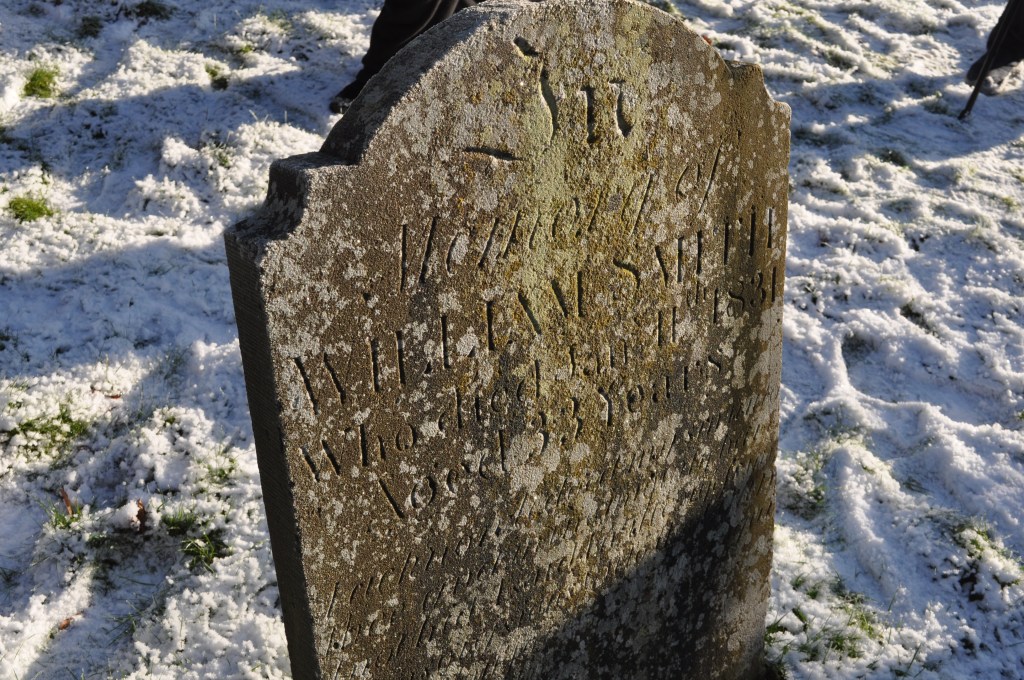
William Winterbourne, also known as William Smith, was hanged at Reading Gaol at 12 o’clock on January 11th 1831. His crime was to have been involved in the protests that swept across southern England the previous autumn as labourers fought for improvements to their pay and conditions of work.

This year, the bright sunlight shone on the lichen covered stone such that William’s name could be read clearly. As his parents were not married at the time of his birth, he is buried under his mother’s name of Smith, in accordance with the custom of the time.

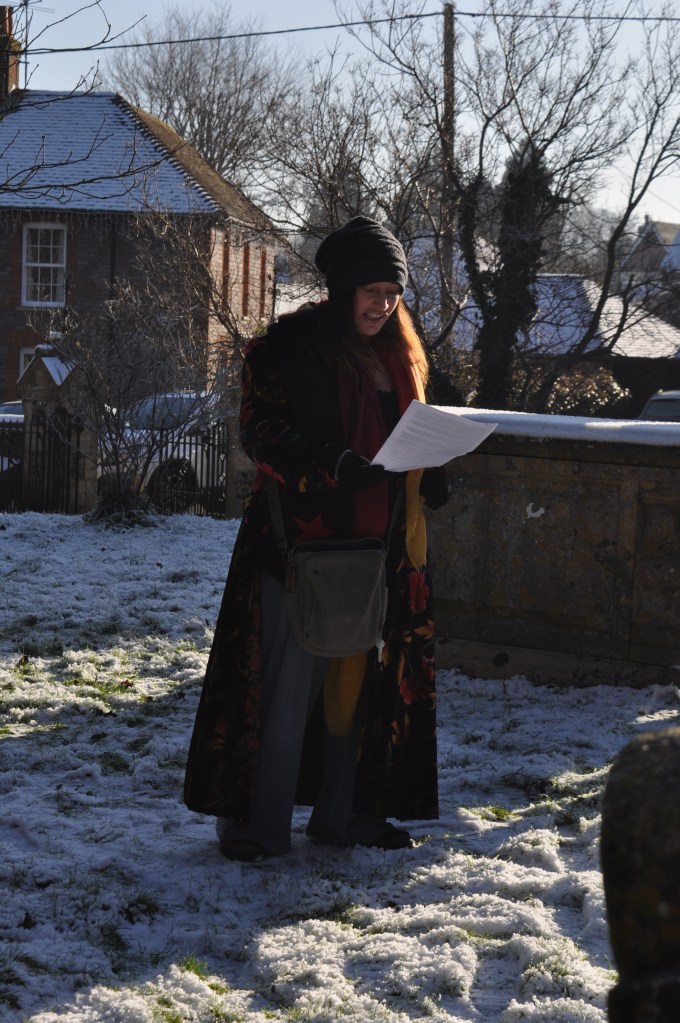
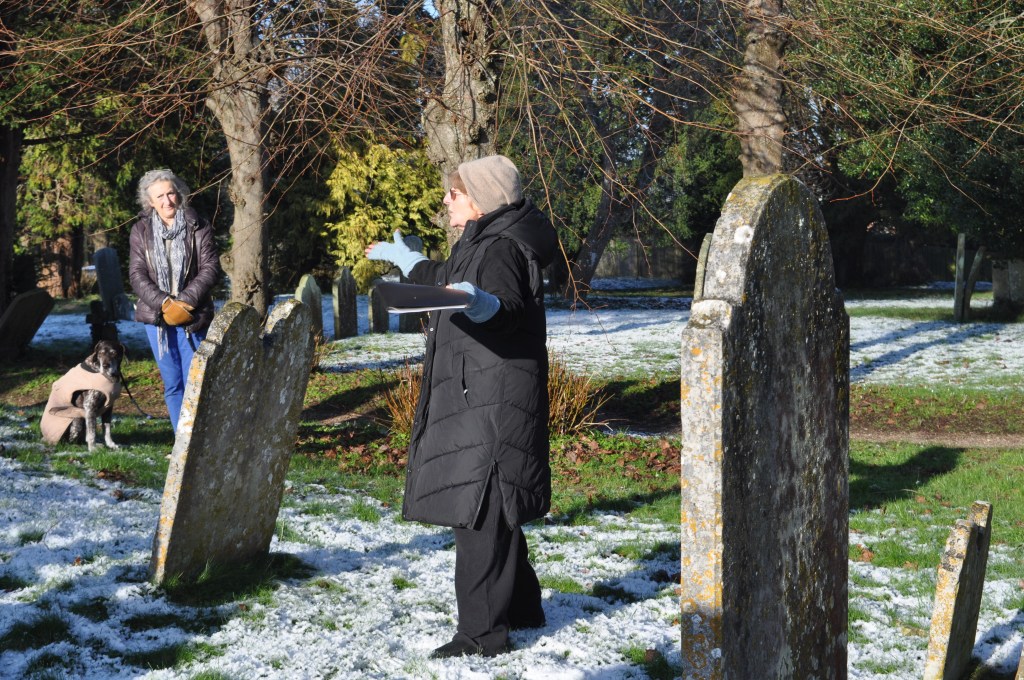
This year, we were joined by over twenty people who gathered to listen to accounts of how the Swing Riots had impacted on this part of West Berkshire, and William’s involvement in them.

All Photos (C) Chloë Wells

You may be interested in further posts about the Swing Riots in West Berkshire, those involved, and also what happened to one who was convicted and transported to Australia:

(C) Theresa Lock January 2025

From a dig at Inkpen to the skies above Stonehenge:

O.G.S. Crawford – the man who put history on the O.S. Maps

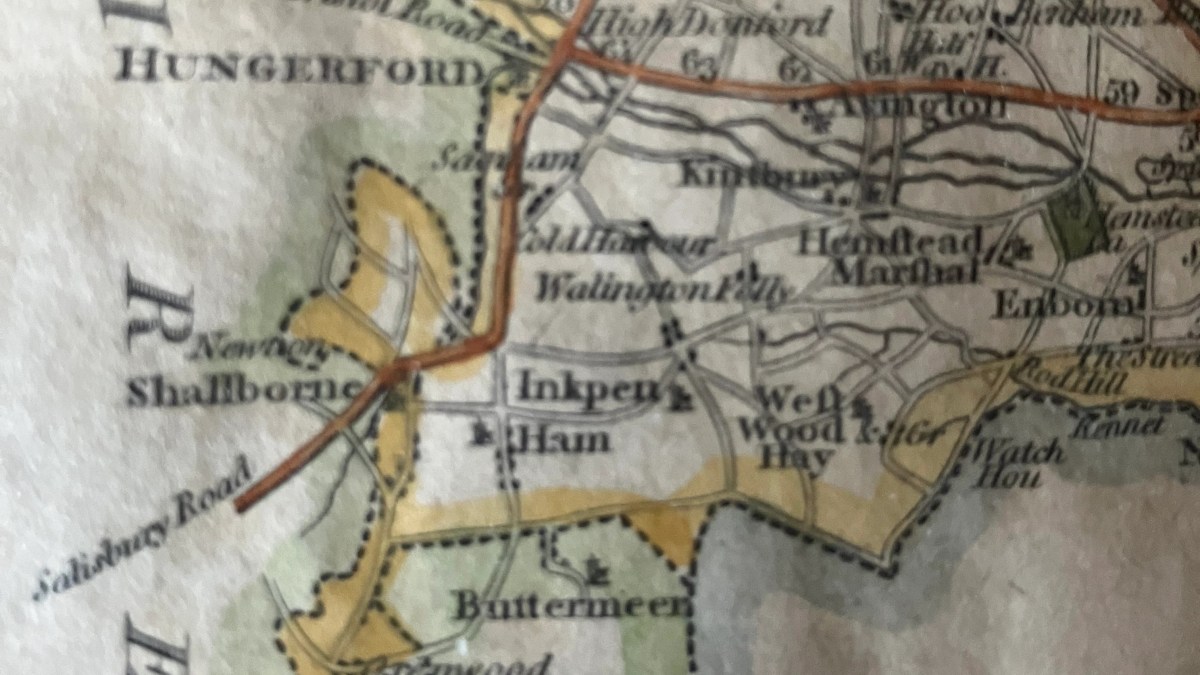
I have always enjoyed looking at Ordnance Survey maps – to plan routes for days out or just afternoon walks, or simply to see the names of woods, rivers, hills or countless other features all carefully recorded. But for me one of the most fascinating features of O.S. maps are those places labelled in a gothic or Old English font which indicate a site of historic or archaeological significance. “Walbury”, “long barrow” ( on Gallows Down ) and “moat” ( at Balsden Farm ) are all good examples from the Kintbury area.

Although the Ordnance Survey started publishing maps over 200 years ago, originally for military purposes, it was not until the 1920s that historic and archaeological sites were first identified as they are now. And the person first responsible for including that information had an interesting connection with our area.

Osbert Guy Stanhope Crawford was born in 1886 in Bombay, India where his father was a judge. However, as his mother died soon after his birth, he was sent back to England to live in London with two of his aunts. While the young Osbert was still of school age, he moved with them to The Grove, East Woodhay, a few miles from Kintbury and just over the border in Hampshire. Later the Crawfords relocated to Tan House, Donnington, just outside Newbury.

Crawford was educated at Marlborough College in Wiltshire and it was there that his interest in archaeology grew. As a member of the College’s Natural History Society, Crawford visited various Wiltshire archaeological sites such as Stonehenge, West Kennet Long Barrow and Avebury.

From Marlborough, Crawford went up Oxford University where his interest in archaeology continued. In 1908, whilst still a student, he excavated a Bronze Age round barrow at Inkpen, not far from his aunts’ East Woodhay home, as well as other – possibly less successful – work excavating at Walbury Beacon.

It was around this time that Crawford became friends with archaeologist and anthropologist Harold Peake and his wife Charlotte, excavating with them at Botley Copse near Marlborough. Harold Peake is particularly remembered in this area as being curator of the Borough of Newbury Museum from 1867 to 1946 and the person responsible for building up an important collection for what was later to become the West Berkshire Museum.

The Peakes lived at Westbrook House, Boxford, just to the north of Kintbury. Their interests included not only archaeology and anthropology but music, folklore and drama and they were very supported of younger people such as Crawford. It is believed that, under Peake’s influence, Crawford began to question the kind of extreme religious beliefs held by his aunts, in favour of a more science-based world view.

After graduating from Oxford, Crawford worked as an archaeologist in both Britain and Sudan. During the First World War he served as a photographer with the Royal Flying Corp but spent time in a German P.O.W. camp, having been shot down.

In the 1920s, Crawford worked for the Ordnance Survey in Southampton, as its first Archaeological Officer. It was around this time that historians and archaeologists began to use aerial photography in identifying and interpreting historic sites which could no longer be seen clearly above ground. The remains of structures and earth works which have long disappeared can be identified through crop marks and shadows which can then be studied using aerial photographs. Crawford’s time with the Royal Flying Corp would have given him first hand experience of how useful such photographs can be.

Crawford used the study of aerial photographs as well as information gathered from local antiquarian and historical societies to identify the locations of many ancient monuments which would not have been visible to cartographers working in the field. He also conducted his own surveys, often travelling across the countryside on his bicycle. Crawford then annotated each O.S. map by hand, adding the names and locations we are now familiar with but which today are identified on our maps in a gothic font.  

At this time, Alexander Keiller, heir to the family fortune made in  marmalade, was living at Avebury Manor. An amateur archaeologist, he had been involved in excavating the world-famous neolithic henge and other associated sites. In 1924 Crawford joined Keiller in an aerial survey of Wiltshire and Somerset as well as Berkshire, Hampshire and Dorset and in 1928 they published Wessex From The Air, a groundbreaking aerial photography survey of our area and the landscape of the wider Wessex.

Crawford assisted Keiller in the fund raising which enabled Stonehenge to be bought for the nation, and in 1927 he founded the influential archaeological journal, Antiquity.

Keiller worked for the O.S. until 1946 when he turned his attention to the preservation of those historic buildings in Southampton which had survived the devastation of the blitz during the Second World War.

Today, O.G.S. Crawford is recognised as an important figure in twentieth century archaeology. It is interesting to think that this important career began in part with an excavation at Inkpen and a friendship in Boxford.

Crawford died in 1957.

Sources:

https://www.ordnancesurvey.co.uk/about/history

https://historicengland.org.uk/images-books/archive/collections/aerial-photos/

https://hantsfieldclub.org.uk/ihr100/profiles-c/crawford.html

https://www.sarsen.org/2018/04/capturing-material-invisible-ogs.html

© Theresa Lock 2024

Traditional Views & Challenging Opinions: Kintbury Men’s Fellowship of the 1950s

In the 1950s the church in Kintbury had a thriving Men’s Fellowship.

Now, as a mere woman, I would not have been able to attend these meetings, however the minute books were passed to me as a possible source of parish history.

The minutes make interesting reading – on the one hand they reflect an echo of earlier time, for example the home- grown entertainments at the Christmas Party could belong to the previous century, whereas the discussion of the Wolfenden Report into Homosexuality reflects a consideration of changing attitudes more associated with the 1960s. The minutes record several comments which reflect  some opinions and values of the time and which would cause raised eye brows if expressed today.

I’ll begin by eavesdropping on the November meeting 1956. All, as the minutes say, were ‘seated in comfort, thanks to the vicar’s good offices’.

The talk was, as you might expect from a Christian fellowship, an exploration of the Bible. The speaker was Kintbury’s  Mr. Sidney Inns (well- remembered by many of us). Sid, it says, probed with an historian’s knowledge into the early writings of the bible. So enjoyable and instructive was the talk that Sid had to promise a further contribution.

This meeting ended with plans being made for the Christmas Party, to which members could invite six people each, and a “Practical Day”,  during which members would decorate the Parish Room. Finally the vicar drew attention to ‘Operation Firm Touch, a means of influencing adolescents back to church’ – so much for those who say that only this generation has deserted the pews.

The party was held in the Coronation Hall on 5th January and seems to have been quite popular as approximately ninety people attended. Entertainment was provided by local people and included Mrs. Bailey and Mrs. Aldridge performing a sketch called ‘Over The Garden Wall’, The Kintbury Handbell Ringers, Gordon Perris singing a selection of popular songs, accordion players Geoff White and Miss Pat Reeves, and four ladies who, apparently, gave a hysterically funny performance of the play, ‘Mr. Macgregor comes to Tea’. Finally the Men’s Fellowship performed the ‘Berkshire Widdicombe Fair’. This last item  was so popular that it was asked for over and again at different gatherings.

However, it is the next meeting that fascinates me most. The Vicar said that he really found it rather difficult to find a suitable bible passage for the topic under discussion. This does not surprise me for the topic was ‘Flying Saucer – Fact or Fiction’

A Mr. A.E. Jones proceeded to convince everyone present that flying saucers were not purely figments of the imagination but really existed. He explained that they had been observed in 1619 and now in 1956 a schoolmaster on the Yorkshire Moors had been confronted by a visitor from Mars and had experienced a strange feeling of peace almost as if the visitor was a deity. Mr. Jones produced other testimonies ranging from Norway to the USA and added the information that the saucers were reckoned to travel at 9000 miles an hour.

Not surprisingly after this stirring stuff the group returned to a safer subject, ‘The Drift From The Churches’. The minutes say that this was the first meeting in the redecorated Parish Room and maybe the brightness of the room demanded that the meeting be bright as it undoubtedly was. But was it safer than flying saucers –   it was certainly a healthy discussion.

‘The Church in its capacity as the established church had backed the wrong horse probably due to tradition and the bowing to the demands of the wealthy section of the community, said Mr. Parry, the leader of the discussion.

This was most likely a controversial opinion to hold in the 1950s. Mr. Parry believed that 40 years ago a large number of poor people attended church regularly, thereby to gain spiritual salvation. Now one could only imagine that the lack of poverty had increased physical greatness with a consequent falling off in spiritual discipline.

Mr Parry was of the opinion that Sunday was now largely a family day, whereby most of the family could be together. No doubt the motor car and coach trip also accounted for absent seats at the local parish church. Further, Mr. Parry felt that a lot of people just didn’t seem to need the church.This provoked a very lively discussion and the majority of members present raised their voices and opinions regarding the apparent falling off and decline in church congregations.

The next talk was to be given by the vicar on ‘Church Architecture’ causing a Mr. O’Rourke to comment, ‘From Flying Saucers to Flying Buttresses’.

 The meeting concluded with Mr. Palmer inviting members back to his home for cups of tea. Despite being newly decorated, the Parish Room did not have mod cons and refreshments could not be catered for.

A committee meeting in March brought forth suggestions for future gatherings. Some topics under consideration were of a seriously religious nature and included a Clarification of The Creed in Three parts, and a further two talks by the ever- popular Sidney Inns. However other suggestions were more topical and concerned contemporary issues such as,  ‘Does the Welfare State Make for Better People?’, ‘Education Today,’ ‘Love Thine Enemy’, ‘Blood Sports’, ‘Local Government’, and ‘Trades Unions.’

It seems the men of Kintbury did not shirk from a subject because it might upset someone, put them off church, or create tensions. Lively debates took place and there was what might be called a ‘frank exchange of views’.

In March, 1957, the Bishop of Reading wrote to the Fellowship telling them of a meeting in Reading to be addressed by the Bishop of Coventry and titled, “Operation Firm Faith”. It was hoped that 2,000 men would attend although it seems that women were not invited.

 In the event over 1,000 men turned up and  were, apparently, held in the palm of the Bishop’s hand as he convinced them of the joy of being a Christian. Five points, he said, needed to be practised and the churches would be filled to over flowing. The points were Go Out, Stay Out, Think Out, Speak Out, Live Out.

This stirring meeting ended with the singing of Jerusalem and the minutes say that ‘words cannot describe the harmony of sound produced by so many male voices’.

There might also have been harmonious voices at the Annual General Meeting in May. It was a glorious evening and members set out to a private room in the Red House. There were abundant refreshments and a private bar. The title for the evening was; ‘Thirst after Righteousness’. The minutes record that, with regard to suggestions for the coming year, one suggestion, ‘Is beer our favourite beverage’? was no doubt prompted by the proximity of the beverage – the Red House was – and still is – a pub. The rest of the evening was devoted to general good will and the vicar soared to the heights of comedy by his presentation of Norfolk rustic life.

The following meeting was devoted to ‘Does the Welfare State make for Better People’?  Speaking in favour, Mr. Cummings thought that education enabled people to choose their way of life rather than follow like sheep and be fearful of the consequences as happened in ‘the good old days’. Mr. Jones, opposing, felt that the Welfare State brought about a selfish outlook on life and mentioned that in eastern countries it was honourable to care for one’s parents in old age. The ensuing discussion was ‘most enlightening and many controversial facts were raised tho’ politics did not intervene.‘ It was thought that it would make interesting reading to have a similar discussion in fifty years time.

The spring of 1957 had seen the publication of the Wolfended Report which recommended that homosexual acts between two consenting adults should no longer be a criminal offence. At the time this was a contentious issues but the Men’s Fellowship did not shy away from it and the report was discussed at the April meeting. Question time produced many interesting items but they were evidently considered too risqué to record in the minutes. So what the men of the Kintbury Fellowship thought about this proposed change in the law, we shall never know.

January 1958 was devoted to a very touchy subject for a rural parish: Should Blood Sports be Abolished? Mr. Bob Sanders spoke about his boyhood in Devon and the damage that a stag and his harem can do to crops. Hunting, he said, was nature’s way of controlling vermin. Mr. R. Westcott proposed the motion and although secretly he agreed with hunting, from his vehemence one would have thought that all hunters and hounds should be boiled in oil. Hunting, he said, was a form of sadism in a civilised world. He ended by announcing that if the meeting voted to retain bloodsports they would all leave the meeting forever branded as sadists! Controversial stuff for a village.

Despite this ominous note members did condemn themselves by voting for retention which was probably not surprising

The following talk, once again by popular speaker Sidney Inns, was on a completely different – and much lighter – subject: Superstitions. Sidney explained the significance of different numbers and why horse shoes were considered to bring luck.

In May a touch of the exotic was introduced when Mr. Parry brought along his guest, Mr. Mohammed El Amin Ghabshawi, who was wearing the national costume of the Sudan. He explained the history of the Sudan and spoke with enormous enthusiasm about his country. The Sudanese government, he said, was friendly to all and welcomed foreign capital investment. It is rather sad in view of all that has happened since to read that the overall picture gained was that ‘here was a people who were striving in the right ways to improve their economy and by their general attitude to all other nations might very well attain a very high standard of living in the not too distant future.‘

The speaker in March 1959 was happy to express views that very few would concur with today. This was the era of apartheid in South Africa and the subject was inspired by a cutting from the Sunday Times in which the Prime Minister, Harold MacMillan,  said that the South Africans were making a grave mistake in handling racial affairs.

The speaker, a  Mr. Wallace, expressed some very controversial opinions which today would seem prejudiced and ill-informed. He said that he had not been in South Africa but he knew the Africans and had employed some of them on his farm. The word ‘freedom’ was being shouted by all Africans and they were becoming very unruly, in his opinion. He did not see what cause they had for shouting this as they had been given many freedoms. For example freedom from slaughter by other tribes and freedom from fear of being sold as slaves. He went on to say that he did not want any mixed race marriages and who really would? Africans, he believed, only understood harsh rulings and were much better off now than one hundred years ago all due to the whites.

Mr Wallace concluded by asking if anyone had any questions or comments. Mr. Inns then asked if witchcraft was still practised. Mr Wallace said that it was and that one of his farmworkers had died when cursed.  He finished by saying that the proposed international boycott of South African goods was stupid.

The minutes do not record what the men of the Christian Fellowship thought about Mr Wallace’s hard line opinions.

Meetings continued into the early 1960s and Sidney Inns’ faith themed talks were still popular. In his next talk, Sid gave a brief description of four major religions in which he included – rather surprisingly – Mithraism along with Hinduism, Buddhism and Islam.

The  recently published New English Bible – the New Testament of which had been published in 1961 – was, not surprisingly, a topic for discussion and the men were informed by a speaker that the new version was now listened to with more interest than the “King James” version of 1611.  

 These were the days before the Church of England updated its forms of service and the Book of Common Prayer of 1662 was the most frequently used. Opinions were expressed that the  service of matins was very hard to understand particularly for the younger generation and a “Family Communion” in which all share would be easier to understand.

Other reforming ideas were discussed and during one of the periodic ‘Any Questions’ it was decided that it was a good idea, within certain limits, for priests to work side by side with factory workers and get the gospel to them that way. However, the right man ( no women priests back then, of course ) for the job must be found who should be very careful in his manner of approach.

Reforming suggestions continued to be discussed with the proposal – radical to some – that the appointment of a vicar to a living for life would no longer continue –led to a very lively discussion, opinions being divided more or less equally on most points.

Meetings continued throughout the 1960s. One topic that was perhaps surprising for a Christian fellowship was Psychic Research.  Canon Harmon, vicar of Froxfield  spoke about the nature of the mind, spirit, soul, telepathy and visions. Jesus, he believed, had psycho kinetic powers and examples of this were shown in His miracles. Canon Harmon was so interesting that he was invited back again and in his second visit gave examples of séances, materialisations and the return of  departed spirits.

The Fellowship finally demised in the early seventies by which time some subjects under discussion had become a little more political. One of the last topics to be discussed was the war in Vietnam and the justification, or otherwise, of American intervention.

The Kintbury Men’s fellowship was obviously of its time. It is difficult to imagine that so openly racist views as held by Mr. Wallace in 1959 being allowed to go unchallenged today although the topic of bloodsports would still divide opinion. However, over sixty years later, “Does the Welfare State make for better people” might still prove to be a topic for an interesting debate.

© Penelope Fletcher 2024
In the workhouse

The rich man in his castle,
The poor man at his gate,
God made them, high or lowly,
And ordered their estate.
– Mrs Cecil Frances Alexander

This, the third verse of the still popular hymn, All things bright and beautiful, is never sung today. When the hymn was first published in 1848, it was a prevalent view that God had ordained your position in life and if you were poor, that was because it was God’s will. This view persisted for much of the nineteenth century.

For the poor of Kintbury and the surrounding villages, the only option for those who had lost all means of self- support – through job loss, through unavoidable incapacity or loss of the main bread winner – was to enter the dreaded workhouse.

Conditions in the workhouse were deliberately unpleasant to deter the poor from turning to this very last resort unnecessarily. If people knew they could turn to the workhouse, so the prevailing mind set ran, they would not bother to save against hard times or support other family members in their times of need. And so conditions were harsh, food minimal and the enforced labour hard.

Following the 1834 Poor Law Amendment Act, villages were grouped into unions around a larger town which is why Kintbury’s destitute were housed in Hungerford Union Workhouse in what is now Park Street.

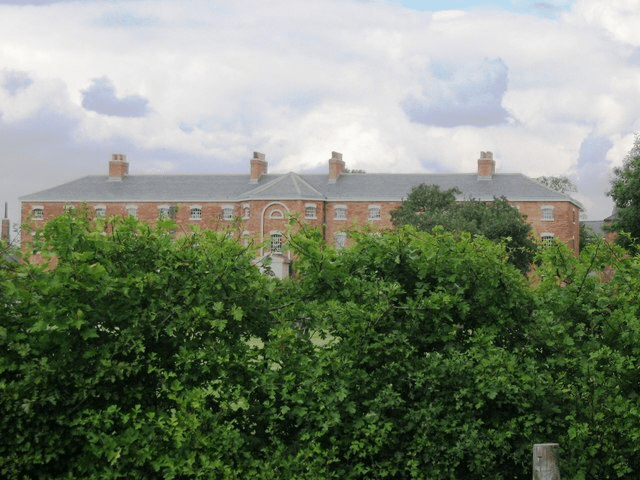
Hungerford Union Workhouse was opened in 1848; it was three storeys high and of the “Stratton” design after the workhouse in Stratton, Wiltshire. 

Inmates were set to work picking oakum – that is to say beating with a mallet then unpicking by hand the tar coated hemp fibres that had been twisted into industrial rope. The finished product – the oakum -was used for such things as  waterproofing the joints in wooden piping and between the planks of wooden ships. It was hard and unpleasant work and oakum pickers suffered from bleeding hands and heavy scarring as well as other more serious conditions.

Typically, workhouses were imposing, prison-like buildings

According to the 1881 census, there were ten Kintbury people in the Hungerford workhouse at that time. This number included Henry Randall, a 44 year old farm labourer and his wife, Ann, 44.

In 1871, Henry – an agricultural labourer – and Ann had been living in Kintbury with their children William 8, Eliza, 6, Lucy 2 and Mary 2 months. What happened to the family in the following ten years we do not know but by 1881 Henry and Ann are inmates of the Hungerford Workhouse.

The eldest son, William, by now 18, is a ploughboy working – and most likely living – on a farm at Radley, to the north of the Bath Road. However his sister, Eliza, now 16, is in the workhouse with her parents and described as a “scholar” which seems somewhat unusual as at that time a young working class woman of 16 might be expected to have entered domestic service. Also there, is 12 year old Lucy.  Mary, who would have been 10 by 1881, is not listed at all so it has to be likely that she has died. Three more children have been born to the Randalls since 1871: Lizzie, now 8, Louisa now 6, and Martha, now 3 and these are all in the workhouse with their parents.

Perhaps the arrival of more children was too much for the Randalls’ household economy or perhaps Henry had lost his job on the farm.

The Randalls of school age are listed on the census as scholars. Although the workhouse originally employed its own teacher, it seems that by 1881 the boys would have walked to the National School in the High Street, to comply, I expect, with Forster’s Education Act which had made universal education compulsory.  The girls, however, received instruction from an “industrial trainer” at the workhouse.

There were 26 other children in the workhouse, all separated from their parents. Similarly, the men were separated from the women.

Twenty nine of the inmates are described as servants and twenty seven as labourers or farm labourers

What I find most surprising, however, is that several of the inmates are listed as having had a trade which might have given them a better chance of supporting themselves but clearly this was not the whole story.

One inmate, Mary Elizabeth Felford, born in Marlborough in 1834, is described as a dressmaker. In 1871 she is living in Wantage with her husband, Edmund, a saddler. However by 1881, Mary is a widow and, one presumes, unable to support herself and her two children so her only option is the workhouse. Why Hungerford, we have no way of knowing but perhaps Mary travelled there in the hope of finding more work but it did not work out.  I can find absolutely no positive trace of Mary or her children after the 1881 census

John Waterhouse is an 18 year old tailor from Newhaven. Why, despite having a trade, he was an inmate of the dreaded workhouse, it is impossible to say but after 1881 he disappears completely from the census records.

Kintbury’s Charles Garlick is a widowed tailor in 1881. In 1841 he had been living with his mother Mary and 16 year old sister Rosa in Kintbury, where, interestingly, Mary is described as “Ind” usually an abbreviation for “Independent means”, suggesting that she was well off enough to support herself. What had happened in the following forty years it is impossible to find out, and both Rosa and Mary disappear from later censuses.

Jacob Brooks is a retired blacksmith of 55 who had, ten years earlier, been working on a farm and lodging at a cottage in Hungerford Church Street. However, by 1881 he is an inmate of the workhouse, most likely because he is too infirmed or otherwise unable to support himself. The workhouse would have been his only option.

But even sadder is the case of William Vincent, 39 from Little Bedwyn. He is deaf and dumb and, it seems, only appears on the 1881 census.

So what became of Kintbury’s Randall family? By 1891, William – the son who did not accompany his parents into the workhouse – is an agricultural labourer in Hungerford Newtown where his sisters, Lizzie, now 18 and Martha, now 13, are living with him.

Louisa is a servant in the family of Eli Brown at the Queen’s Arms, East Garston.

By 1901, William , Lizzie and Martha are all living with Lucy and her husband, Samuel Harding, a GWR railway worker. They were lucky, I think, to have  an in-law who was able to have them lodge with him – it must have made for cramped living conditions as no artisans’ cottages at this time were spacious, but the extra income must have been welcomed.

It makes me very sad not to have found a really positive outcome for any of the Workhouse inmates I have researched here. Not everyone was a permanent resident; I know from my own family history that a set of 2x great grandparents spent sometime in the Chipping Norton workhouse. However, they survived and were able to move on with their lives – otherwise, I suppose, I would not be writing this.

I hope the Randalls’ family story had a happy ending that I have not, so far, been able to find.

(C) Theresa Lock April 2024
Celebrating Victoria’s Golden Jubilee

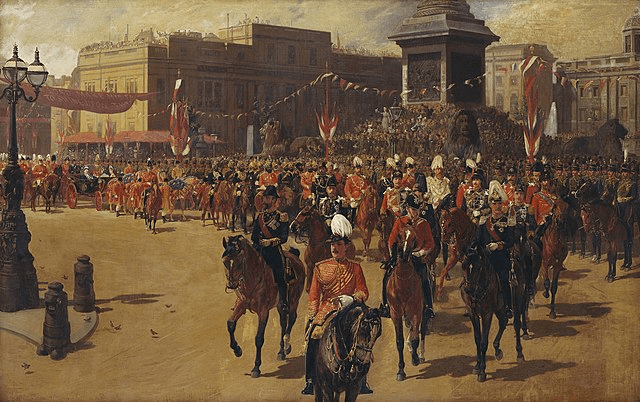
Queen Victoria came to the throne on 20th June 1837 so, by her Golden Jubilee in 1887, many people had grown up knowing no other monarch. Consequently, the fiftieth anniversary of her coronation was seen as a cause for great celebration.

Reports in the Newbury Weekly News covered three local villages: Kintbury, West Woodhay and Combe, although the other villages would certainly have held celebrations. Reading those three reports, what is most interesting, I think, is the way in which events in the two smaller villages are organised – and presumably largely funded – by the families in their respective “big houses” to whom, it is naturally expected, the villagers will demonstrate deference and appreciation.

A church service of thanksgiving was a central to the celebrations in all three villages: at Combe villagers marched behind a banner to St Swithun’s church while St Mary’s, Kintbury flew the Royal Standard and the bells were rung.

Celebrations in the two smaller villages very much revolved around the respective “big houses” with their principal families. At Combe, Mr W.H. Cole gave his workers, game keepers and labourers on the Combe estate a meal “of hot roast beef, mashed potatoes, plum pudding and beer”, all enjoyed on the village green. The villagers, “did not fail to express themselves most grateful”, but then, it would be expected to show appreciation to those you were dependent on for employment. The meal was followed by singing and dancing, “freely indulged in by the village lads and lasses” and – presumably for the men only – the, “fragrant weed, too, liberally supplied by Mr Cole, was thoroughly enjoyed.”

At West Woodhay, celebrations kicked off in sporting vein with a cricket match although presumably this was something to be enjoyed more by the men than the women. The church service was held at a quarter past five after which parishioners proceeded to the home of Mr & Mrs Cole at “the big house” (sic) for hot roast beef and plum pudding which, the report tells us, consumed in a West Woodhay fashion “cannot be beaten.” What “West Woodhay fashion” was, we are left to wonder. The meal was followed by a “Jubilee pipe” and “a good packet of Jubilee tobacco for every man”. If anything special was given to the women of the village, the NWN report does not say. I doubt it was.

The Cole’s son, Mr A.C. Cole, had returned to his parents’ home for the celebration; he gave a speech which was, apparently, well received especially as he had recently been, “in town” where he had been, “viewing Her Majesty in her world-famed  procession and at personal inconvenienced had come down to assist in making his father’s servants happy.”

So that was nice.

At 9 o’clock everyone proceeded to “our beacons” to watch bonfires and rockets.

The NWN report of the celebrations in Kintbury illustrate a village which did not revolve around one family in a “big house”, although the report mentions the names of certain influential and benevolent villagers. Celebrations commenced with a peal of church bells at 5 am so an early start was assured whether the good people of Kintbury wanted it or not! The village was decorated with bunting the like of which had never been seen before, apparently, and music was supplied by the Hungerford Town Band.

Kintbury was then, as it is now, a much bigger village than the others and this is reflected in its celebrations. A table covered with a calico cloth was placed in Dr Lidderdale’s meadow, to seat nearly one thousand people – presumably all at once! A meal of roast and boiled beef as well as boiled ham was served, accompanied by hot potatoes and plum pudding, washed down with a pint of beer or two bottles of ginger beer for each person. Somewhere referred to as “the Baths” was loaned by Mrs General Dunn for tea making. It seems no expense was spared and during the meal, children were entertained by one Professor Burssord, allegedly of London, who performed various and amusing tricks with great dexterity.

Sports and music followed the meal and about 450 children enjoyed bread and butter and cake with tea served in a Jubilee mug. I hope they were able to take the mug home with them afterwards!

Those unable to get to the event due to age or infirmity had their dinners delivered to them.

The day concluded in sports at which money prizes could be won.

What became of all that calico used as table cloths? It was later given to the local schools (interestingly, there must have been more than one either in Kintbury or the satellite hamlets) to be made into children’s garments.

Apart from the size of the village – perhaps that should be small town – the big difference between celebrations in Kintbury and the other two villages is that the event in Kintbury did not revolve around the benevolence of one particular family. The NWN report says that the celebrations were enjoyed by, “ all classes, creeds, in all conditions of life” who “evinced a desire not only to participate in the celebration but also to contribute towards the expenditure thereof.” There is no sense in which the people of Kintbury were expected to show gratitude to one particular family; there is no sense of there being forelock tugging or cap doffing to anyone in a Lord of the Manor role. The celebrations were organised – much more democratically – by a committee chaired by Mr W. H. Dunn with the vicar, Rev Edwards as vice chair. Altogether, dozens of other Kintburians contributed to making the day something to remember.

Queen Victorian lived and reigned for a further fourteen years and her Diamond Jubilee was celebrated in 1897. This , however, was a much more low key event throughout the country, perhaps because by now the aged Queen was seen very little in public – I do not know for sure. But I am sure those who celebrated in 1887 would have remembered  the roast beef, the hot potatoes, the tobacco and the beer – not forgetting the Jubilee mugs – for a very, very long time!

(C) Theresa A. Lock June 2024
Our churches: Not what they seem?

The church’s restoration,

In eighteen eighty-three,

Has left for contemplation,

Not what there used to be.

John Betjeman

Many church guide books will proudly tell you that St Whoever’s is a fine example of, say, Norman architecture. It is easy to imagine, as you sit in your pew, listening to this week’s sermon, that the church you see around you is more or less the same building that, for example, knights would have known as they stopped off on their way to the crusades, carving on the Norman pillars the familiar crosses while their horses chewed on the church yard grass outside.

Although there are very few churches which exist today just as they were when the last mason knocked off work for the last time and the building was consecrated, it was the Victorians who were responsible for the greatest changes to our much-loved buildings. By the nineteenth century, many ancient buildings might well have required building work but in their enthusiasm for what they chose to call restoration, the Victorians swept away many significant features, and at times, entire buildings.

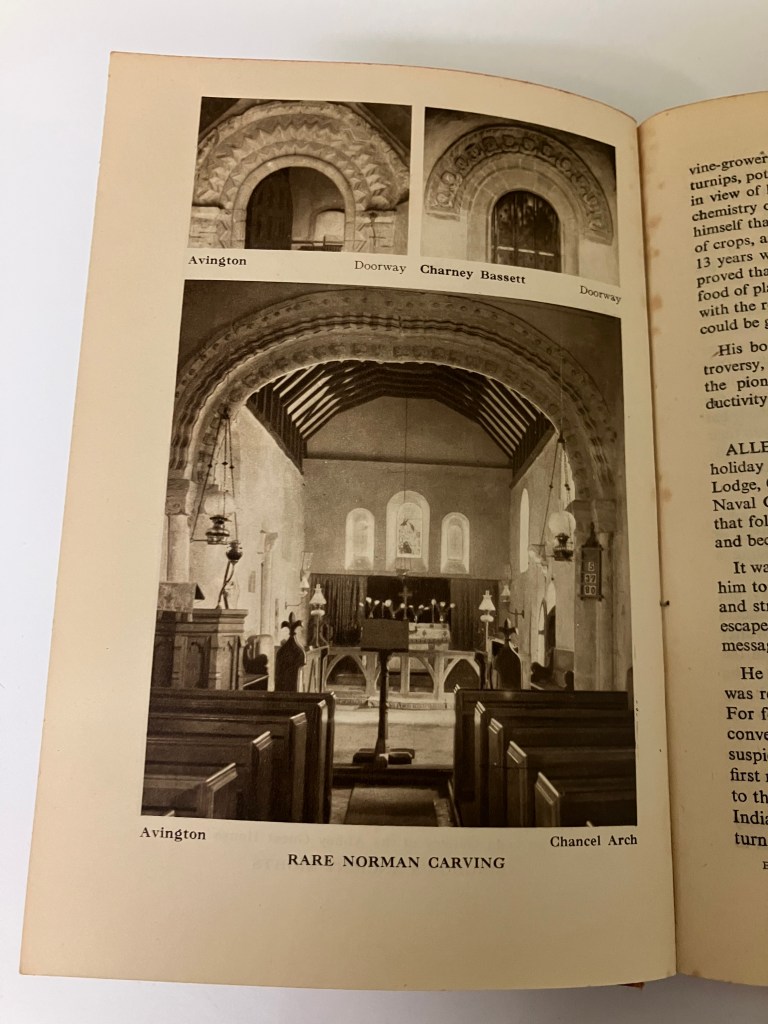
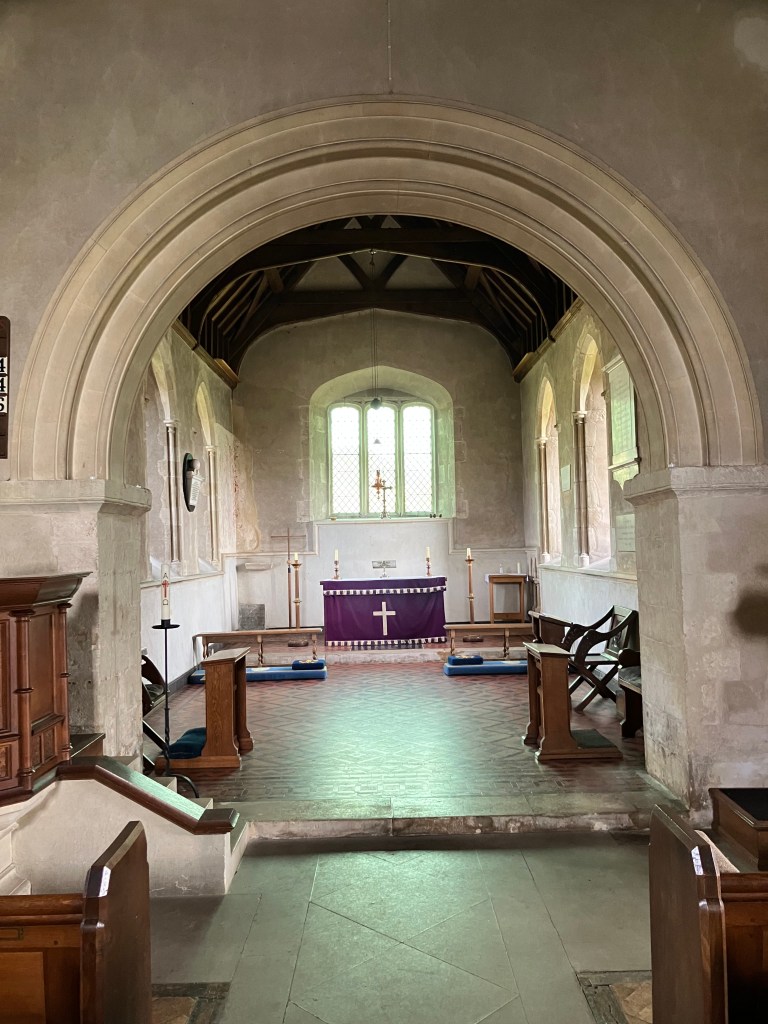
In the Berkshire volume of his series, The Buildings of England, the architecture historian Nikolaus Pevsner, describes St Mark & St Luke’s church at Avington as being, “A memorable little church … Entirely Norman …” so perhaps the crusade-bound knights of my imagination would have seen the very-same church that we see today. Except, that is, for the pulpit and pews, which are Victorian. Also the vestry. And the stained glass, of course.

So how did the other churches in our benefice fare during the nineteenth century?

St Mary’s, Hamstead Marshall seems to have survived the Victorian enthusiasm for restoration relatively unscathed, leaving earlier architectural features as they were. Pevsner says the building underwent a restoration in 1893 and another in 1929 – 30, “preserving and enhancing the C17th & C18th character of the interior.” Perhaps, therefore, the interior of this beautiful church does not look so very different as it did when the first battle of Newbury was being fought in 1643, just a few miles up the road. Perhaps a battle-weary soldier, either cavalier or roundhead, might have staggered into this church and seen before him an interior almost identical to that which we see today.

But what about the other churches?

I used to imagine Jane & Cassandra Austen would have known St Mary’s, Kintbury, just as I know it today, but this is far from the case. In 1859, the architect responsible for the now long-gone Christchurch and also the former vicarage, Thomas Talbot Bury worked on St Mary’s in what Pevsner refers to as a heavy-handed restoration. More restoration work followed 1882 – 84 by George Frederick Bodley & Thomas Garner. All three architects worked in the popular Gothic Revival style which took its inspiration from the medieval buildings much admired by the late Victorians.

In St Mary’s, many changes and remodelling included moving the Scheemakers monuments from their original position by the altar to their present one in the north transept. The gallery was repositioned to its present position under the tower and plans were proposed to enlarge the building, although this never happened. The eye-catching, brightly painted reredos is a Bodley & Garner addition, so one way and another Jane Austen’s view of the altar – in fact the church as a whole – would have been very different to ours.

Pevsner describes St Michael’s at Enborne as “an aisled Norman church” so could this delightful building really be almost exactly the same today as it was when my (imagined) knights passed through on their way to Jerusalem? Unfortunately, although Enborne church retains many Norman features, it did not escape the enthusiastic hand of the Victorians. However, it seems that there might have been a good reason for the work. The Newbury Weekly News of 12th January 1893 included an article in which the Rector of St Michael’s is quoted as saying, “The church at present is in such a dilapidated state that the less said about it the better unless it is of a view of increasing the Restoration Fund at the Newbury Bank. The plans are the result of much care and thought.”

The Reading Mercury of August 12th 1893 reported:

“The restoration of St Michael’s, Enborne is being satisfactorily carried out by Mr G. Elms of Marsh Benham under the direction of the architect Mr James H. Money.”

Apparently, the diocesan architect had recently visited the church along with James Money:

“… and has testified to the great pains being taken to render the restoration a favourable one in all aspects.”

The chancel, St Michael’s, Enborne

Clearly, not everyone approved of what was being done, although there is little evidence of dissenting voices in the local papers.

On March 6th 1897, the Reading Mercury reported on the rededication of St Michael & All Angels’ church, Inkpen, it having been “in restorer’s hands” for more than a year. The rector, the Rev Henry Dobtree Butler believed it had “long fallen into a lamentable state of decay” and so the grandly named Oxford architect, Mr Clapton Crabbe Rolfe, had been engaged to carry out a restoration. And a very thorough job he did of it, too. The Reading Mercury went on to report:

“The greater part of the church has been rebuilt and a new north aisle added …

The only ancient portions of the actual fabric are the exterior walls and one west window.”

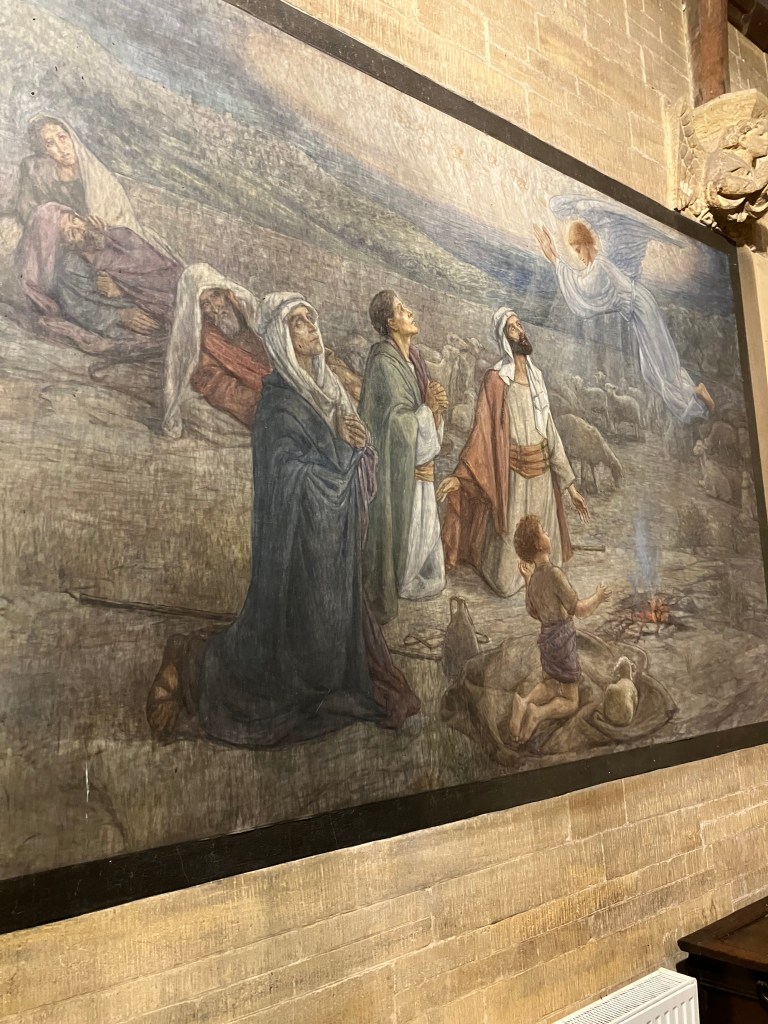
Nineteenth century mural, St Michael & All Angels, Inkpen

Whilst the tone of the Reading Mercury’s report suggests that the destruction of much of the original building was a positive thing, not everyone agreed. According to Pevsner, the recently formed Society for the Protection of Ancient Buildings had opposed the drastic restoration. Founded in 1877 by William Morris and Philip Webb, SPAB was concerned that the fashionable enthusiasm for restoration was destroying the historic fabric of many venerable buildings.

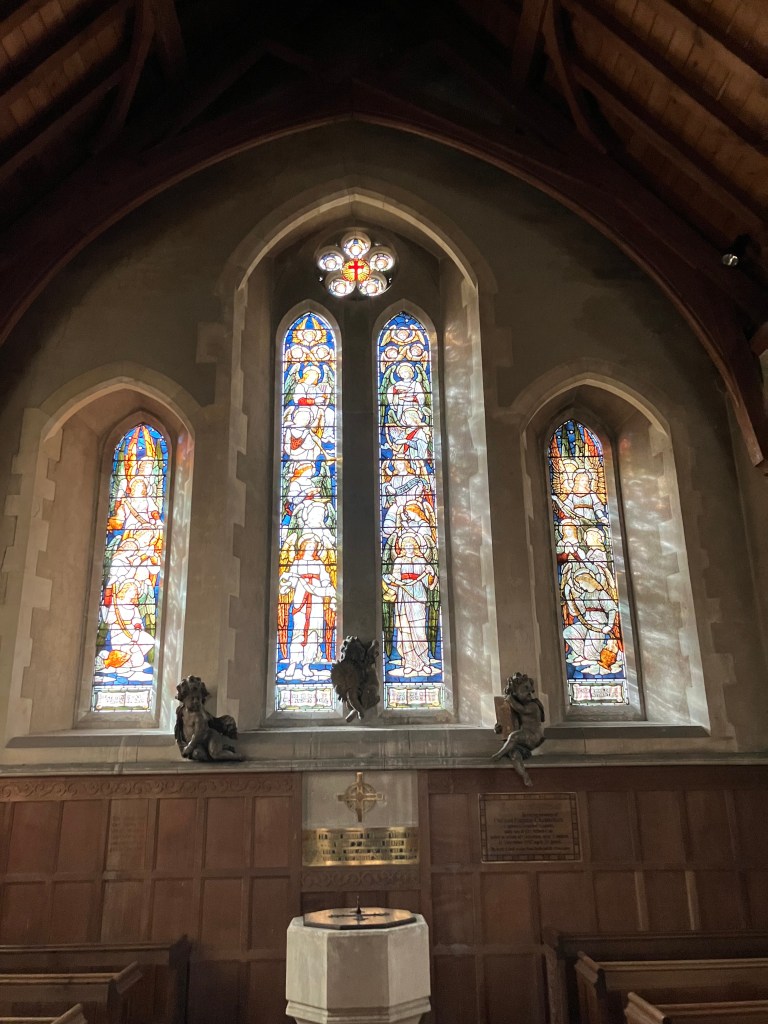
East window, St Laurence’s, West Woodhay

Despite his opposition to the fashion for extreme restoration, William Morris contributed work to many churches, including St Laurence’s, West Woodhay. Here, the red brick church which had stood next to West Woodhay House since 1716 was demolished and a church designed by Sir Arthur Blomfield built on a new site in 1882. The distinctive east window was designed by Burne Jones for Morris & Co as were the side windows of the sanctuary. On 15th April, 1882, the Hampshire Chronicle waxed lyrical in their appreciation of this new amenity:

“The inhabitants of West Woodhay … have reason to congratulate themselves upon having in their midst a resident lord of the manor whose liberality bids fair to effect a great improvement in the social position of all in the village.”

Quite how the new church would effect a great improvement in the social position of the cottagers of West Woodhay, the Hampshire Chronicle does not explain! 

West window, St Laurence’, West Woodhay

So, there is nothing ancient about St Laurence’s, West Woodhay and it remains the only church in our benefice to represent just one period of church building. But this beautiful little church demonstrates, I think, some of the very best of Victorian architecture and design. No crusade bound knight in shining armour may ever have passed through passed through its door. No weary parliamentarian would have sought sanctuary from the battle field to the north. But it is beautiful, all the same.

And I would very much like to know if William Morris or Edward Burne Jones ever visited in person!

© Theresa A. Lock 2024
From Combe Gibbet to Hollywood

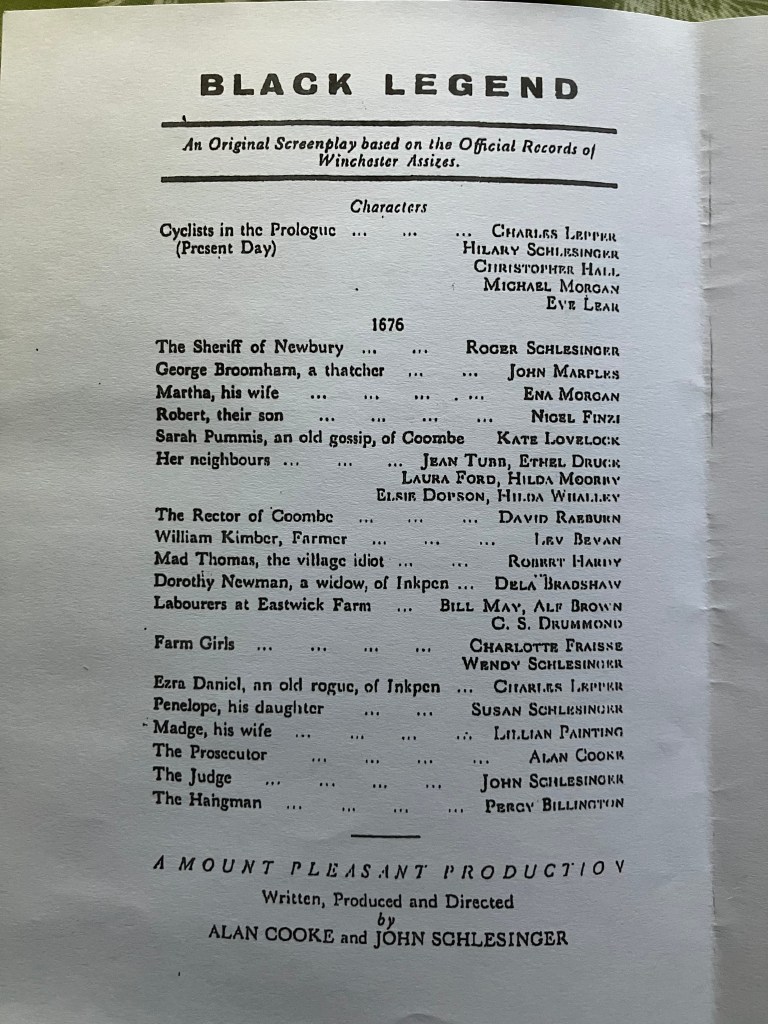
Many people hereabouts are familiar with the story of the two young Oxford students who, in September 1948, set out to make their first feature film.

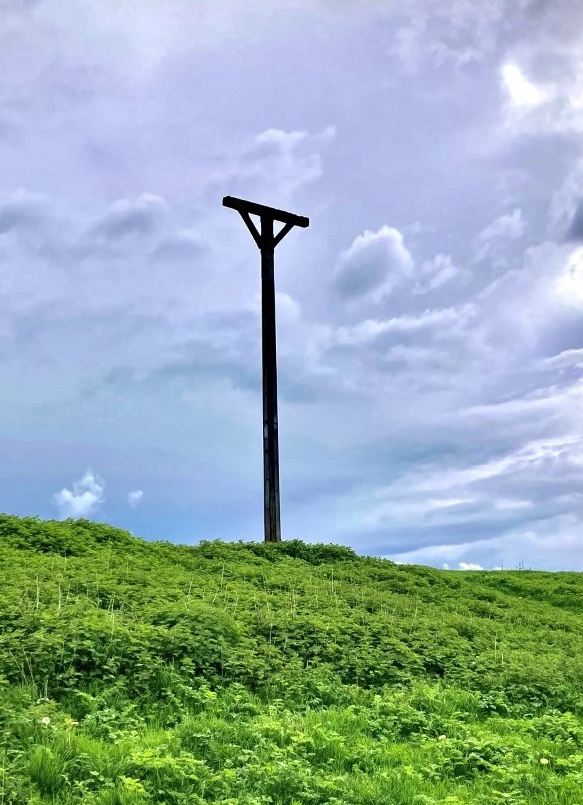
Filmed entirely on location around Inkpen and Combe with many scenes shot on Walbury Hill, the plot of the film is based on true events. These were the murders in 1676, of Combe ’s Martha Broomham and her son Robert, by Martha’s husband George and his lover, Dorothy Newman of Inkpen. The murderers were executed at Winchester and their bodies subsequently displayed on Combe gibbet.

Entitled, Black Legend, the film used actors drawn from, variously, members of Oxford University Dramatic Society, one young director’s family who lived locally, villagers from Inkpen & Combe and children from Christchurch School, Kintbury.

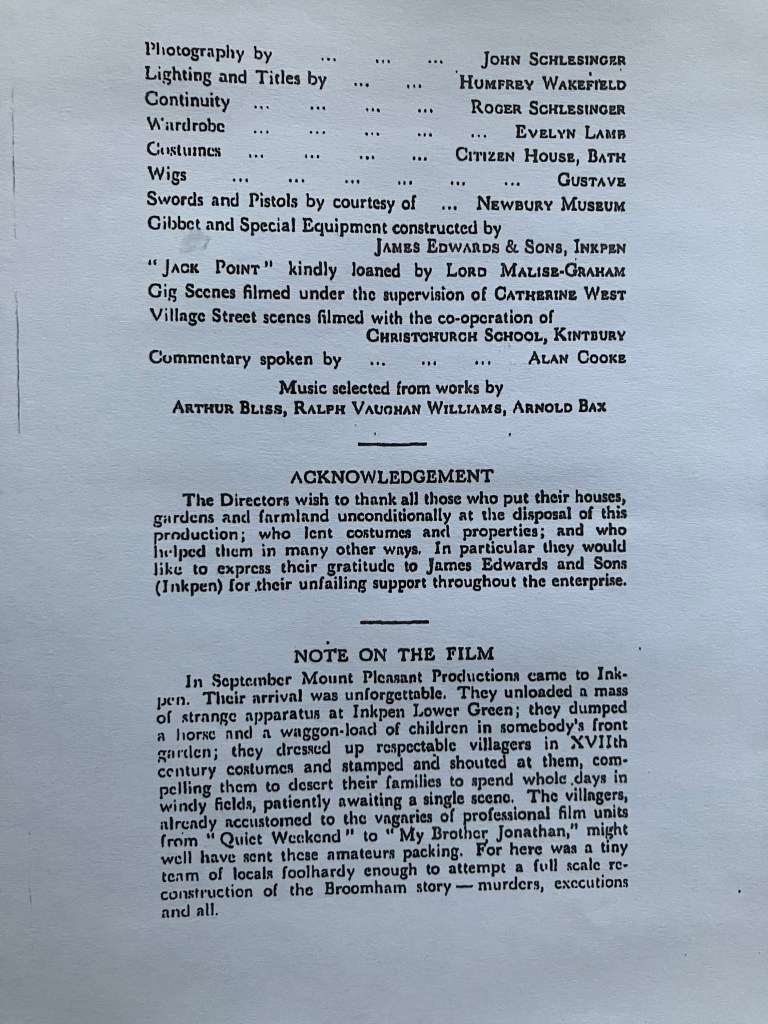
The weather that September was sometimes cold and bleak; shooting was held up when the camera broke and had to be sent away for repairs. However, the young men were pleased with their results, writing in the film’s accompanying programme notes:

But for all its failings we believe BLACK LEGEND to be an achievement that in one respect at least has rarely been equalled. For it shows how much can be achieved by the co-operation of enthusiastic people, even in a project so technical as a film.

Copy of the original programme for Black Legend

Were the young students right to feel so positively about their work? Well, when the finished version was shown – in Hungerford, Inkpen, Ashmansworth and West Woodhay the following January, 1949 – the Newbury Weekly News declared in its advertisement for the screening, “The Film YOU helped to make” and “YOU’LL BE SORRY YOU MISSED IT”.

In its review, the Newbury Weekly News quotes an anonymous film critic as saying:

“Black Legend is a film to see and remember…

The acting is a marvel of cooperation among amateurs, some skilled, some quite inexperienced, but all gifted enough to convey their thoughts and often their probable words without any speech.

Soon, Black Legend was to receive a wider audience than the villages around Newbury. An article in the Scotsman of March 1949 reports that it had been shown in the Grand Committee Room of the House of Commons. The film is now described as, “having all the cinema world by the ears.”

The report goes on to say,

“The wonderful landscape, the local people, the farms and their implements, are all so used … that the compositions are beautifully organised; the photography of these young people with relatively little experience resulting in a work which ought to make the film industry pull up its socks.”

These young men obviously showed promise: but did they fulfil that promise?

In 1965 one of those young men returned to film on the chalk downland not so very far from here. By now, John Schlessinger – whose family had lived near Kintbury in the 1940s – was regarded as part of the British “New Wave” of film directors and his previous movie, “Darling,” had been Oscar nominated.

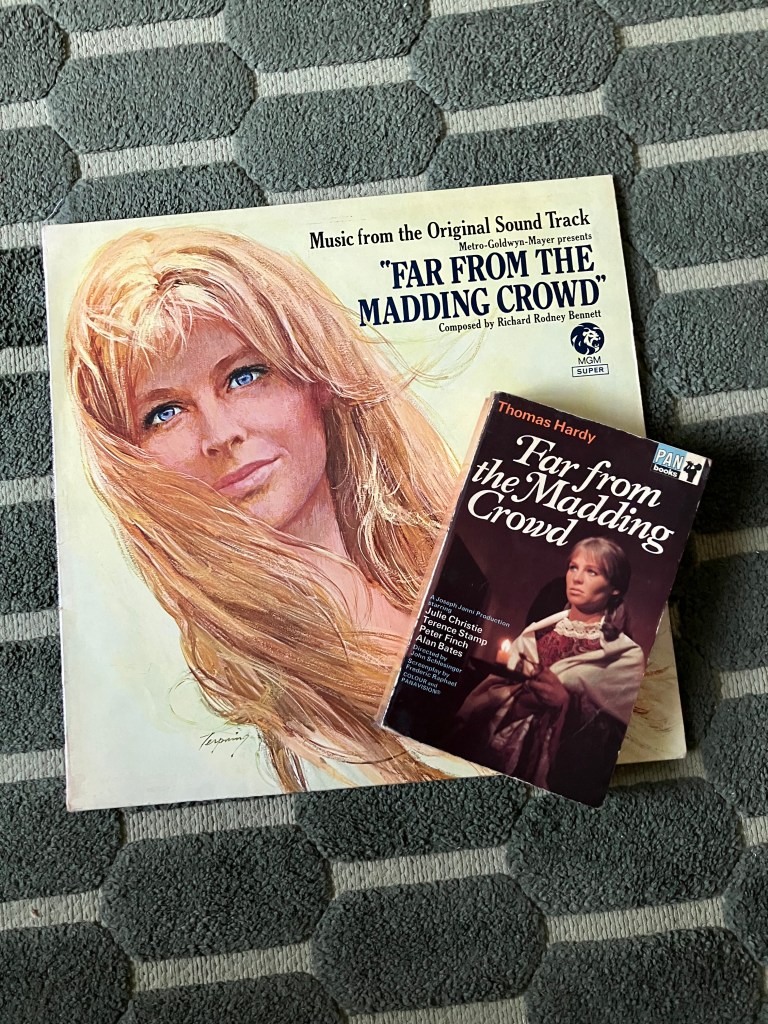
This time, Schlessinger’s leading actors were  well known throughout the movie world of the early 1960s: Terence Stamp, Alan Bates and Julie Christie, although, as with Black Legend, his cast included many local people. “Far from the madding crowd,” an adaptation of the novel by Thomas Hardy, was to be filmed entirely on location – as Black Legend had been – this time in Wiltshire and Dorset. Just as Black Legend had featured music by Vaughan Williams to compliment the film’s rural setting, so Richard Rodney Bennett’s score for “Far from the madding crowd” is frequently reminiscent of Vaughan Williams’ work, similarly using variations on English folk songs to evoke the period and place of the piece.

Schlessinger’s “Far from the madding crowd” is one of my favourite films. It must be one of the most visually beautiful films ever shot in England and captures the Wessex downland like no other, in my opinion. So many shots, I feel, are reminiscent of scenes in Black Legend, almost as if Schlessinger was finally perfecting, on a much higher budget and in glorious technicolour, scenes he had shot with Alan Cooke on and around Walbury Hill, all those years before.

Iconic 60s star Julie Christie starred in Far From The Madding Crowd

Throughout his career as a film maker, John Schlessinger received four BAFTAs and an Academy Award (an “Oscar”). He was made a CBE in 1970 and a BAFTA Fellow in 2002.

He died in 2003.

(C) Theresa A. Lock 2024
References:

https://www.bfi.org.uk/features/where-begin-with-john-schlesinger

Newbury Weekly News Archive, West Berkshire Library

British Newspaper Archive

The Inkpen Temperance Band

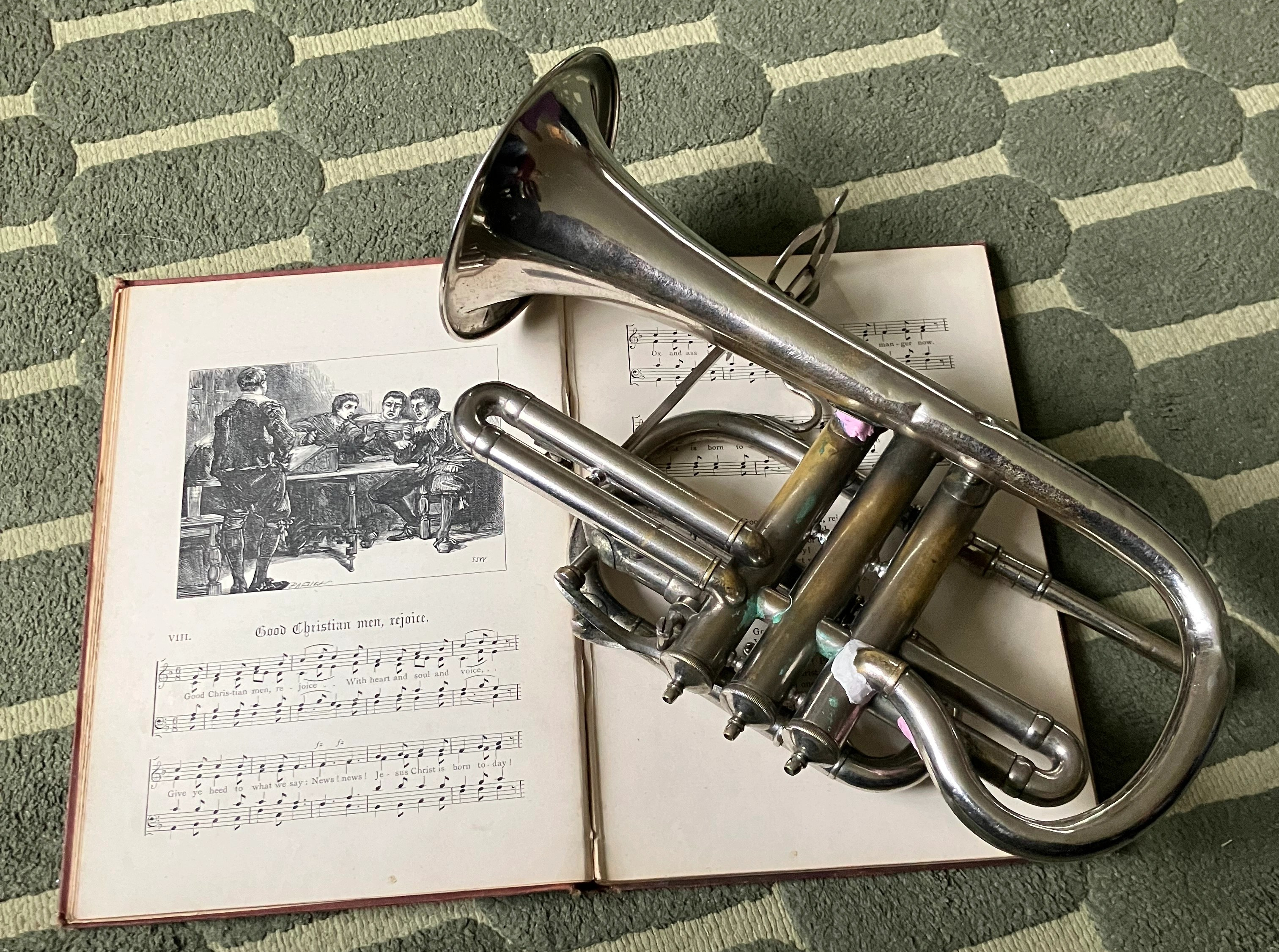
Throughout the nineteenth and into the early twentieth century, brass bands were particularly popular; many towns and villages could boast their own local musicians to offer entertainment at fetes and flower shows, in public houses or to accompany parades

Playing, however, is thirsty work, and unfortunately brass bands were often associated with heavy drinking. This was a time before licencing hours introduced during the First World War restricted the hours a public house could open and, “the sacred freedom of drinking was tampered with” (A. J. P. Taylor).  It had long been recognised that excessive alcohol consumption was becoming a serious problem.

The temperance movement – calling for abstinence from  drinking alcohol – began in Ireland in the 1830s. Throughout the following decades the movement spread across England where temperance coffee shops, hotels, billiard rooms and even music halls were opened. People were encouraged to, “sign the pledge” to say that they would never drink alcohol.

Temperance brass bands were seen as a way of spreading the word. By the turn of the century, hundreds of towns and villages could boast their own temperance bands, a great many of which – although not all – were  associated with methodist churches. Hungerford, Newbury and Thatcham all had temperance bands but one of the smaller communities to host a band was Inkpen.

Mr Arthur J. Edwards, the band’s conductor, was a member of the Edwards family from the Sawmills, Inkpen, on whose land the Methodist chapel had been built and who were well known as Methodist church members.  Edwards was a talented musician himself and clearly very successful at teaching his band of young players. Band practice was held in the Wesleyan schoolroom where rules and regulations were displayed on a card hanging on the wall.

The first reference to the band that appeared in the local press was in a Newbury Weekly News report of April 1902 when the Inkpen Temperance Band performed at a fund raising event for Inkpen Wesleyan Methodists. The chapel in Post Office Road Inkpen had recently been renovated and the event was to make up a shortfall in the costs of doing so.

In June 1904, the band played at another Wesleyan fund raiser, this time for the Wesleyan Sunday School in Kintbury. It seems the band was well received as the same month,  Mr. Edwards placed an advertisement in the Newbury Weekly News stating that the, “12 to 20” performers would play, “First-class, up-to-date- music” but that they were already booked up on August 21st as they were to play at Kintbury Flower Show.

Although Mr Edwards continued to advertise in the newspaper across the following months, the next report of the band’s appearance is not until August 1905 when they play at the Annual Camp Meeting in Gore End. Although the report does not specify, I’m assuming from reading later reports this is an event of the Primitive Methodist Church. The meeting was, apparently, well attended: “A large gathering of people listened to the Word of Life simply and earnestly expounded by men who evidently spoke from a religious experience”.

Presumably no women were permitted to speak, whether they had had a religious experience or not.

By 1906, Mr Edwards is confidently advertising the band as having 20 performers, “open for engagements”, wearing, “Full dress uniform” and playing, “Good class music”. Bookings must have been increasing because, as well as having Mr Edwards as conductor, the advertisement names F.D.Carter of Inkpen as “Hon Sec”.

The Christmas season of 1906 was a very busy one for the band who, according to the report in the Newbury Weekly News were, “in splendid form now, and has received praise all round for their fine playing seeing they are only a young band.”

The committee were planning to buy new instruments and were hoping to receive the aid, “of the generous public”.

In January 1907, band members enjoyed an “excellent supper” in Inkpen’s Wesleyan Schoolroom although the severe weather prevented some members from travelling the long distance. It would seem that the popularity and success of the band was attracting members from villages beyond Inkpen. The “esteemed bandmaster” Mr Edwards and others “gave some capital songs and pianoforte solos while various games were freely indulged in”. A Mr Tilley from Newbury “gave some capital selections on the phonograph” – a rare opportunity for some to hear recorded music, I expect. The report concludes:

Great praise is due to the bandmaster for his never-tiring patience, especially with the younger members, and it is hoped that the members will rally round their leader so that this year might be a record one

1907 proved to be a particularly successful one for the band. In May they played at the Whit Sunday Primitive Methodists camp meeting in Inkpen where a special feature was, apparently, their rendering of the march, “Crown Him With Many Crowns.”

In July the band performed at another Wesleyan fund raising event, this time at a sale of work and jumble sale for the Kintbury Wesleyan Sunday School. 

August was a busy month. The band played at another Annual Camp Meeting, this time at Ashmansworth where, following talks by visiting preachers, the band led the singing and, “rendered a nice selection of sacred music”. The “profitable day” ended with an, “old-fashioned love feast and prayer”.

What an old-fashioned love feast was, I have absolutely no idea – although it sounds to me more like something that would have happened in the late 1960s!

On August 7th – a week day, interestingly – the band played at the Speen and Stockcross Horticultural Society show, and on August 21st – also a week day – they were at the Kintbury and Avington Annual Flower Show & Sports. Then in September, the band won third prize at a band contest at Blenheim Park, Woodstock. This must have been no mean feat as it could not have been cheap or easy to transport twenty band members  and their instruments the 42 miles to Woodstock and back. The Newbury Weekly News commented that great credit was due to Mr A. Edwards, “seeing that the band is quite young”.

By April of 1909, Mr Edwards seems to have achieved his aim of purchasing new instruments although these had not come cheaply. The band’s end of year financial report recorded a total income of £70 13s 2 1/2d although a further £100 was still required to defray the cost of the instruments.

In the following years there are fewer reports mentioning the Inkpen Temperance Band although in August of 1911 they were playing at Kintbury & Avington Cottagers’ Show which suggests that the debt regarding the purchase of the instruments had not resulted in the demise of the band.

In the August of the following year, the band played at the Inkpen Flower Show, although their conductor is now Mr W. Edwards.

I found the last reference to the band in a local newspaper was in a report of March 1913 which records the Inkpen band – now known as the Inkpen Temperance Prize band – as attending a Wokingham & District Band League competition, where they came 3rd in the “March” section and 1st in the “Own choice”. Mr Edwards is once again the conductor.

Perhaps the outbreak of war in August 1914 meant that newspapers had other concerns rather than reporting on the doings of village brass bands. However, the website, brassbandresults.co.uk, records Mr Edwards and the Inkpen band – known variously over the years as Inkpen Silver Band and Inkpen United Band – as continuing to compete in various competitions throughout the south of England. On occasions the band is conduced by Arthur Muddiman, later B. Edwards and then P.G.Dyson. The very last competition the band entered was on February 27th, 1954, in Southampton.
Whether the band retained its strong links with the methodist church, I have no way of knowing. Many bands which began as “temperance” bands eventually dropped that word from their names and many of them are still playing today. Locally, the Reading Spring Gardens Silver Band, the Basingstoke Silver Band and the Tadley Silver Band all began life as temperance bands.

It is, of course, impossible to know how many band members – if any – who played at Southampton in 1953 had also been at Woodstock in 1907. Many reports describe the band as being young then – the generation whose lives would be tragically interrupted by the outbreak of the First World War.

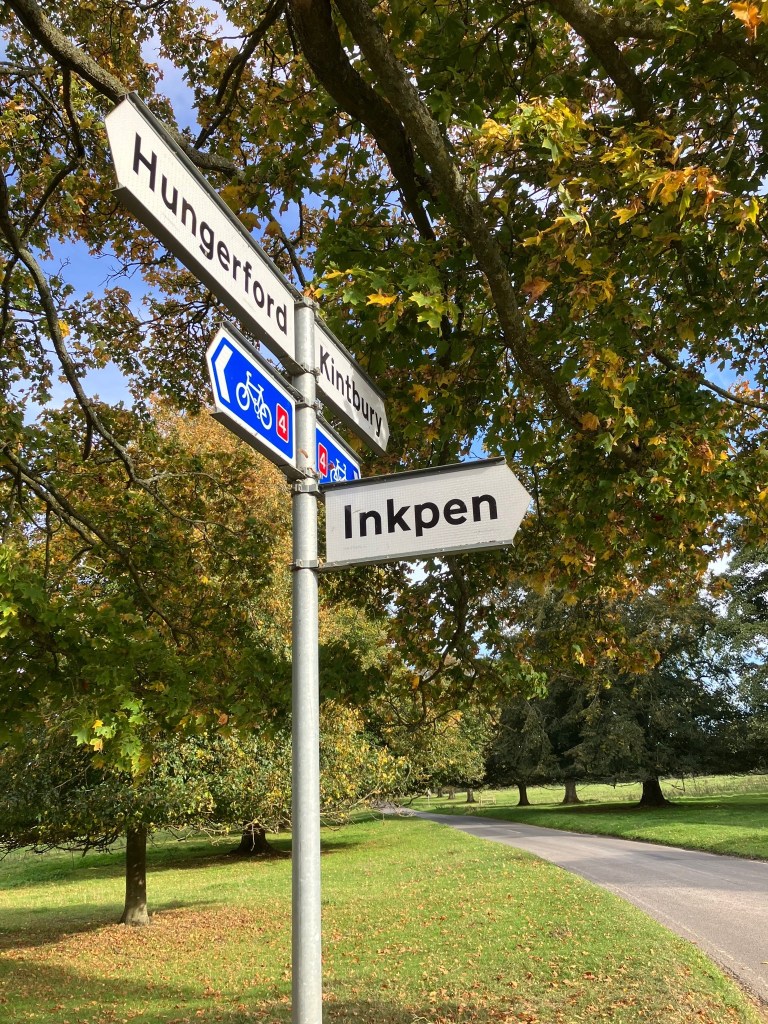
A fingerpost pointing to Inkpen, Hungerford and Kintbury. There are trees on a common with a road going through them behind the sign.

References and sources:

https://www.brassbandresults.co.uk/bands/inkpen

The Newbury Weekly News

E.A.Martin: Inkpen Yesterday 1993

Theresa A. Lock © 2024