
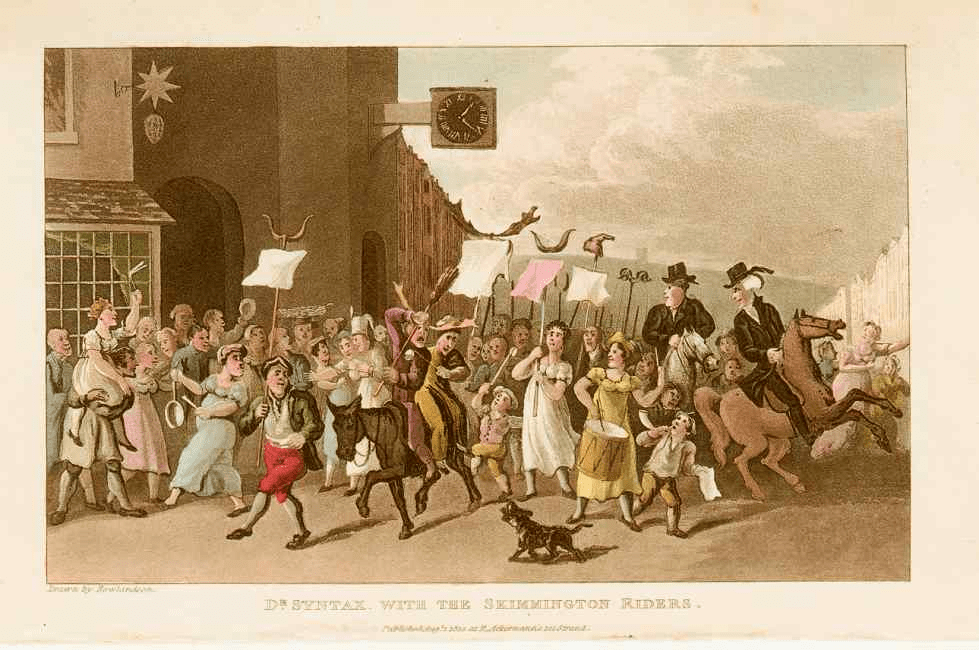
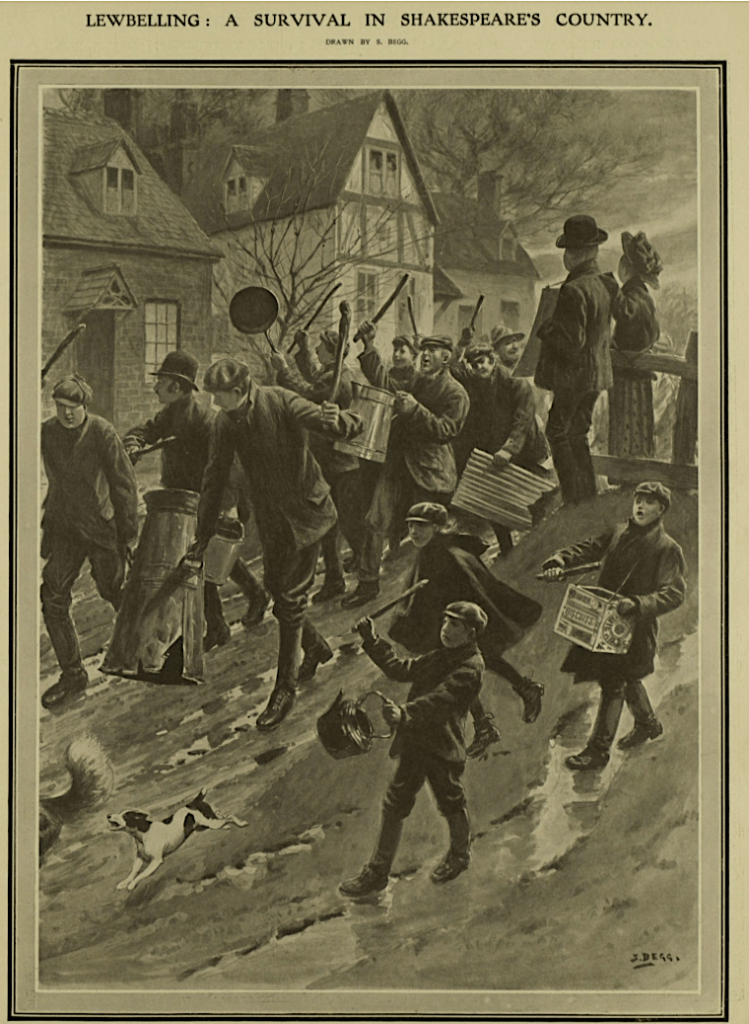
Throughout the nineteenth century, “rough music” was a popular form of protest amongst some sections of society. In parts of the north, these protests were known as “stang riding” and in the midlands, “Lewbelling”. In Dorset the term “skimmington” or “skimmity ride” was used. Thomas Hardy describes one such in his novel of 1886, The Mayor of Casterbridge. Throughout our area, “rough music” seems to have been the accepted expression and a scroll through the local papers on line shows just how frequently these protests occurred.
Most newspaper reports seem to assume that their readers, being local, I suppose, would understand what was meant by the term. However, in a libel case of 1862 between the proprietors of the Hampshire Chronicle and a chemist from Alton, Mr Justice Compton, hearing the case in Westminster, had to ask:
“What is rough music?”
“Old tin kettles and the like”
“And that is what you call music?”
So, whilst banging saucepans, kettles or making a noise in any other impromptu way, the protesters would make their way through their town or village, stopping outside the home of whoever it was they considered not to have lived up to the standards expected in the community. Those who might have cheated on their wife or husband were a particular target. In some examples the protestors carried effigies of the supposed guilty parties, as described by Thomas Hardy in The Mayor of Casterbridge.
However, marital infidelity was not the only reason a person was subjected to rough music. In April 1851, the Reading Mercury reported the inhabitants of Brimpton, “manifested their disgust at the conduct of John Henry Stair… for illtreating his son, a child little more than four years of age… by assembling in great numbers, perading (sic) the village with “rough music” and burning the individual in effigy”.
The Reading Mercury of 1858 reported a local variation of the custom from East Ilsley when James Powell, a local Primitive Methodist preacher appeared before the magistrates on a charge of ill treating his pregnant wife.
“In accordance with an old custom in Ilsley, when a man beats his wife, a quantity of chaff was thrown about in front of Powell’s house. It was intended to have given him a little rough music but the police superintendent removed Powell from the place for Newbury before the party could muster to carry out their intentions.”
In 1860, James Lancaster & Thomas Talbot, labourers of Litchfield, Hampshire, “were charged with having on the 13th December, in the parish of Itchingswell, ( sic – presumably a mis- spelling of Ecchinswell ) assaulted P.C.19, R. Clapsan, whilst in the execution of his duty. It appeared from the evidence that the assault arose through the constable interfering to prevent an obstruction in the road, caused by a large number of persons assembled together for the purposes of having what is called, “rough music” the same being produced by the blowing of cows horns, beating of tin cans, sheep bells etc.”
In October of 1865, the more law abiding inhabitants of Kintbury found that their peace was shattered on two successive nights when, if newspaper reports are to be believed, two hundred people paraded through the streets making, “rough music”.
The ring leaders were members of the Butler family: Thomas, Job & Edward. The newspaper report does not give the men’s ages and as there were at that time many and various Butlers living in Kintbury, it is difficult to work out exactly who these three were. It is likely that all were agricultural labourers and I think it is fairly safe to assume that at the time of the protest, Job was a 39 year old agricultural labourer married to Ann and the father of Charlotte, 12, Ellen, 10 and Julia, 7.
Of whom or what the protestors were objecting we have no idea although as the event drew a substantial crowd, I think we can assume it would have been someone well- known and/or in a prominent position in society. In previous reports from across this area, the names of those targeted by the protestors are given in the newspaper. For some reason this was not the case with the Kintbury incident, which leaves me to wonder if the journalist who originally filed this report was at pains not to offend a local dignitary or person of high profile who had upset so many villagers.
Perhaps the protestors felt they had a right to express their feelings in such a public way; after all, it was what people had been doing for years. The fact that many rough music protestors from other villages had ended up before the local magistrates did not seem to deter them.
However, that would be without reckoning with William Harfield, Superintendent of Police in the Newbury Division of the Berkshire Constabulary.
Superintendent Harfield features frequently in newspaper reports of this period. He had been born in Hampshire around 1825 and by the 1851 census he was a policeman in the New Forest village of Sopley. At this time the Hampshire Constabulary was less than 12 years old, having been formed, along with constabularies in other counties, in 1839. The Berkshire Constabulary was established in 1856 and career policeman Harfield became the first Superintendent of the Newbury Division.
Responding to complaints, Superintendent Harfield arrived in Kintbury and quietly requested the rough music makers to desist. However, “the crowd set him at open defiance, telling him he had no power to interfere.”
Perhaps this was the first time some of these men had come up against the strong arm of the law, or perhaps they were just chancing their luck. Perhaps they thought that Harfield should just go back to where he’d come from and leave the people of Kintbury alone. As “rough music” protests were not uncommon the men may well have believed that they were doing nothing wrong.
Unfortunately, the outcome of this particular protest was an appearance at Hungerford Petty Sessions where all three men pleaded guilty.
According to the newspaper report, Harfield said he : “ had no wish to press the case further than was sufficient to teach them that they must not do such things with impunity.”
All three men were “bound over in the sum of £10 to keep the peace for three months” and ordered to pay 5 shillings costs each within a week.
These sums of money might not seem much to us today; however, £10 in 1865 would be over £1000 in today’s money. As for 5 shillings to be paid within the week, this could easily have proved very difficult for labourers whose weekly earnings would have been little more than 10 shillings, if that.
I cannot find any other references to rough music in Kintbury after this event, so perhaps the fines given out to the Butlers were enough to deter other villagers from expressing their disapproval in this way.
Job and Ann Butler were still living in Kintbury at the time of the 1871 census but after then I can find no trace of them.
William Harfield continued as Superintendent of Police in Newbury until his death in 1874, aged 56.
As for the practice of rough music as an expression of protest at certain people’s behaviour, this continued sporadically until the early decades of the twentieth century. However, I have not been able to find any other examples from Kintbury.
(C) Theresa A. Lock June 2026
Sources:
British Police History/ Berkshire
British Newspaper Archive
Ancestry

