Lord Craven of Hamstead Marshall

Eliza has seen Lord Craven at Barton, and probably by this time at Kintbury, where he was expected for one day this week…She found his manners very pleasing indeed.

Eliza has seen Lord Craven at Barton, and probably by this time at Kintbury, where he was expected for one day this week…She found his manners very pleasing indeed.

Lord Craven was prevented by company at home from paying his visit at Kintbury, but, as I told you before, Eliza is greatly pleased with him and they seem likely to be on the most friendly terms.

Jane Austen, letter to Cassandra, January 1801

The Eliza to whom Jane refers is Eliza Fowle, wife of Fulwar Craven Fowle, vicar of Kintbury and sister to Jane’s close friend Martha Lloyd. Barton – or Barton Court – was the home of Charles Dundas, M.P. and is a large house about half a mile north of Kintbury church on what would have been the old coaching road into Kintbury.

Lord Craven  was a distinguished military gentleman who  served in Flanders and was AD to the King and a favourite of Queen Charlotte. He was reputed to be a bit of a rake before his marriage – as Jane Austen remarked in her letter to Cassandra:

The little flaw of having a mistress now living with him at Ashdown Park seems to be the only unpleasing circumstance about him.

Some people believe that Jane based Willoughby in Sense and Sensibility on Lord Craven.  However, the novelist R. L. Delderfield wrote as a preface to one of his books that,

…every character in fiction is an amalgam of factors drawn from the author’s memory and imagination.

I disagree with the assumption that Willoughby’s character was based on Lord Craven’s. Why? Well Craven’s mistress was the young Harriet Wilson. Craven was 31 and unmarried at the time. Harriett was much younger and does not give Craven a good press. Her memoirs start with the line,

I shall not say why and how I became, at the age of fifteen, the mistress of the Earl of Craven…

Harriet leaves the reader in no doubt that she finds the Earl boring and old-fashioned, with his night caps and his endless talk of his cocoa trees on his estates in the Indies. She left him for Lord Melbourne.  Mind you if as a teenager one had been isolated in Ashdown House on the Lambourn Downs I think most of us would have been a tad miffed even if our career was that of ‘entertaining men’!  

Christopher Hibbert wrote that Harriet had a Swiss father and was renowned not so much for her beauty as easy manners, gaity and flighty charm. Sir Water Scott described her as smart, saucy with the manners of a  wild schoolboy. Harriet was a well-known ‘lady’ in certain circles. When she grew too old to charm, she wrote her memoirs, sent the relevant passages to the gentlemen concerned and offered to suppress it for a fee. This caused the famous reply of Wellington: Publish and be damned! 

So, I believe Harriet Wilson did not resemble the girl described as Colonel Brandon’s ward. She was seduced by Willoughby aged 17, and left without help, friend or home. He promised to return but didn’t and after breaking another girl’s heart married a rich wife.

Lord Craven on the other hand went on to marry an actress, Louisa Brunton, (without informing his very formidable mother) after Harriet had left him. They lived in Hamstead as a close family and the Countess was renowned for her gracious generosity. Obviously unlike Willoughby, Craven did not marry Louisa for money

The Georgian gossip collector Creevy, wrote that in January 1816, Lord Craven embarked, on his own yacht, for the Mediterranean. There were 70 members of his family on board at an expense of £40,000. Creevy added, somewhat ominously, that it gave a good chance to his brother Berkley, especially as he would rely much upon his own skill in the management of the vessel! Evidently they all survived Lord Craven’s seamanship and Berkley was disappointed.

Lord Craven died at Cowes in 1825 aged 55.

Penny Fletcher, May 2023
Olive Emma Witt

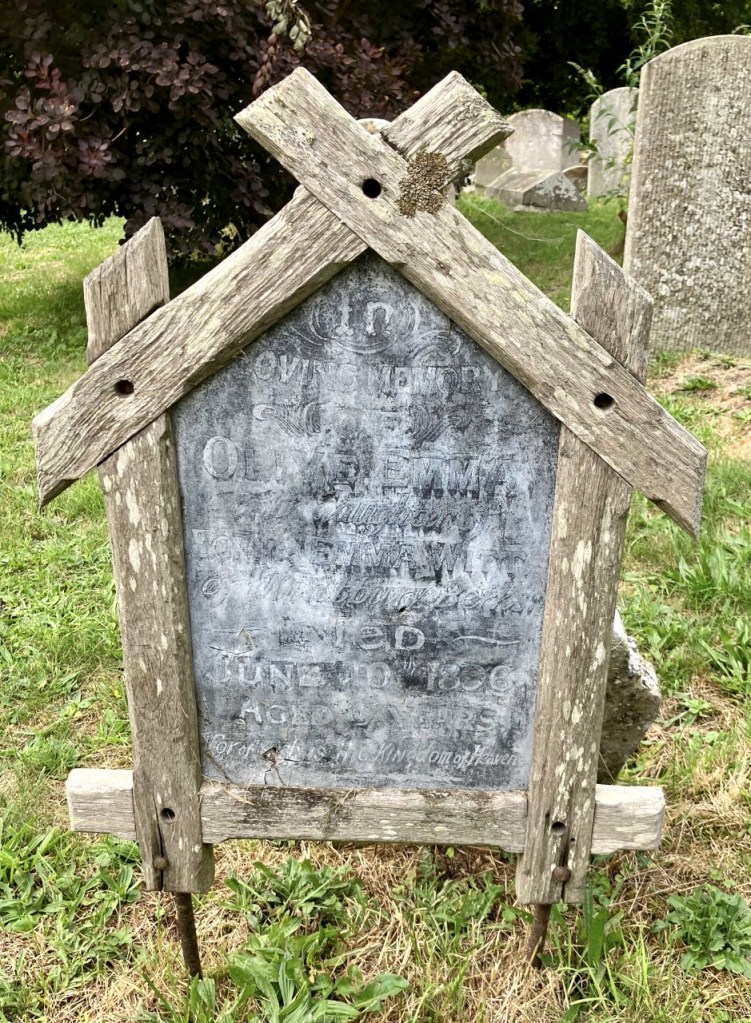
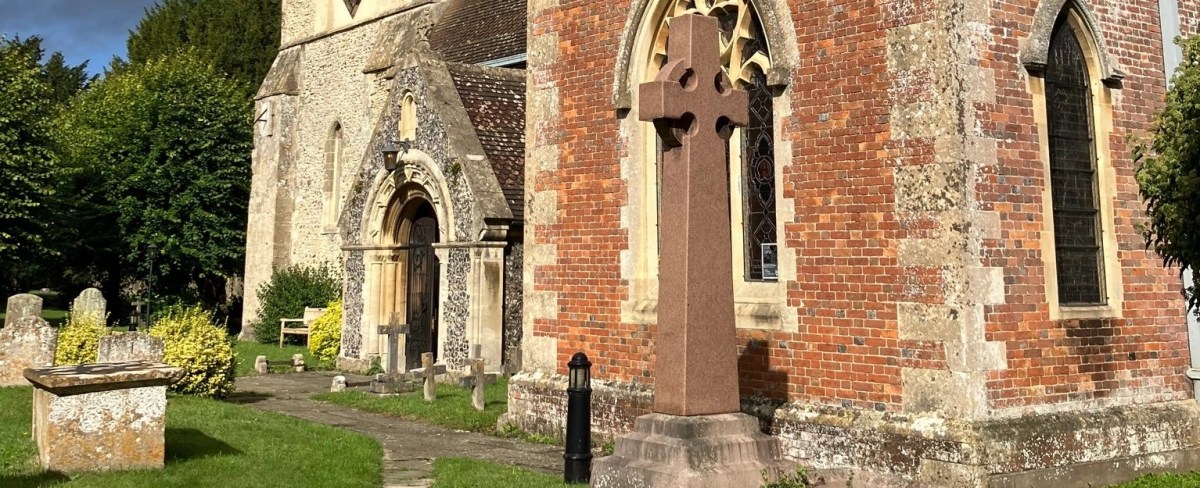
Should you turn to look to your left as you walk up the path to St Mary’s Church, Kintbury, you will see a rather unusual grave marker.

Should you turn to look to your left as you walk up the path to St Mary’s, Kintbury, you will see a rather unusual grave marker. Rather than being stone, as are the great majority of grave markers, this one, standing little over three feet high, is of metal, probably tin, and enclosed in a five-sided wooden frame. From a distance it looks a little like a larger version of a Victorian schoolchild’s slate; perhaps this was deliberate , because the person commemorated was  six year old Olive Emma Witt, who died in 1896.

Olive Emma Witt’s grave marker in Kintbury church yard

The Witts were not originally of Kintbury. Olive’s father, Tom, had been born in 1846 at Braemore, Hampshire, where his father, Charles had been an agricultural labourer. Emma Witt had been born in Salisbury in 1850.

At the time of the 1871 census, Tom was working as a gardener in Salisbury and it has to be likely that it was around this time that he met Emma Skeet, the local girl who would become his wife.

By 1881, the Witts had moved north out of Wiltshire to west Berkshire where Tom now worked as a gardener at Elcot. The family had grown: Walter had been born in 1877 and Herbert in 1880.

It would seem that Tom Witt was an ambitious young man – by the census of 1891 he is a farm bailiff at Inlease Farm on the Hungerford Road out of Kintbury where they have been living for at least six years now. Two more children had been born: Charles in 1885 and Olive in 1890. The household must have been a busy and possibly crowded one as the Witts had four young men lodgers: two carters and two ploughboys, all working on the farm.

Some time within the following six years, Tom progressed from being a bailiff at Inlease to a farmer in his own right at Cullamores Farm on the road out of Kintbury towards Inkpen. Very sadly, however, it was here that, on June 10th, 1896, little Olive died. The grieving family put an announcement in the Newbury Weekly News.

The census of 1901 shows Tom & Emma still at Cullamores with Tom described as an “Employer”. The distinction between “Employed” and “Employer” was particularly significant in an age of increasing social mobility, particularly for someone like Tom whose father had been an agricultural labourer like so many thousands of men in the middle of the century. Tom & Emma were coming up in the world.

Herbert, now 20, was working on the farm. Charles, however, had turned his back on farming and at 16 was a carpenter’s apprentice. Walter had left Kintbury altogether, and was now a police constable at Rochester Row Police Station in London.

The end of the nineteenth century saw decreasing numbers of workers employed in agriculture and this national trend seems to have been reflected in the family experience of the Witts. By 1911, Walter was married with a daughter and living in Harrow, Middlesex. He was still with the Metropolitan Police. Herbert, who had previously been working on the family farm, had followed his elder brother into the police force, but for him a force not so far from home as he was in Wantage.

By 1911, Tom was 64 and no longer working in agriculture and no longer himself an employer. Furthermore, he and Emma have left Kintbury and were now living in Newland, Cogges, close to Witney in Oxfordshire. He has returned to his first occupation, that of gardener and on the census is identified as a “worker”.  

The trajectory of Tom Witt’s life experiences would have mirrored those of many of his contemporaries. Born into an agricultural labourer’s family, Tom had improved his life chances becoming upwardly mobile until he could describe himself as a farmer and employer – a distinction which mattered in this ultra class conscious time. By the time Tom and Emma’s sons had been born, universal education would have given them a far better start in life than that experienced by their grandfather Witt in Hampshire, enabling them to join the police force and ensuring their place in the lower middle classes.

We do not know exactly why Tom & Emma left Cullamores farm but it has to be likely that the slump in agriculture had something to do with it. This was a time when many thousands were still leaving the countryside for the growing towns whilst others were emigrating overseas. For Tom & Emma, perhaps the move northwards to Witney was a fresh start away from the world – and the social status – they had lost.

I wonder if they ever returned to Kintbury and to the little grave in St Mary’s churchyard -the journey back then from Witney would have required three changes of train on the Great Western Railway. The forty mile journey across the downs by road would have been slow and unlikely to be completed easily within a day.

Why Olive’s grave marker was of tin rather than stone I do not know. Iron crosses are not unknown in churchyards but a grave marker of tin is something I have seen nowhere else.

But then, any exploration of family history – any family – raises far more questions than it ever answers.

Tessa Lock