England 1731
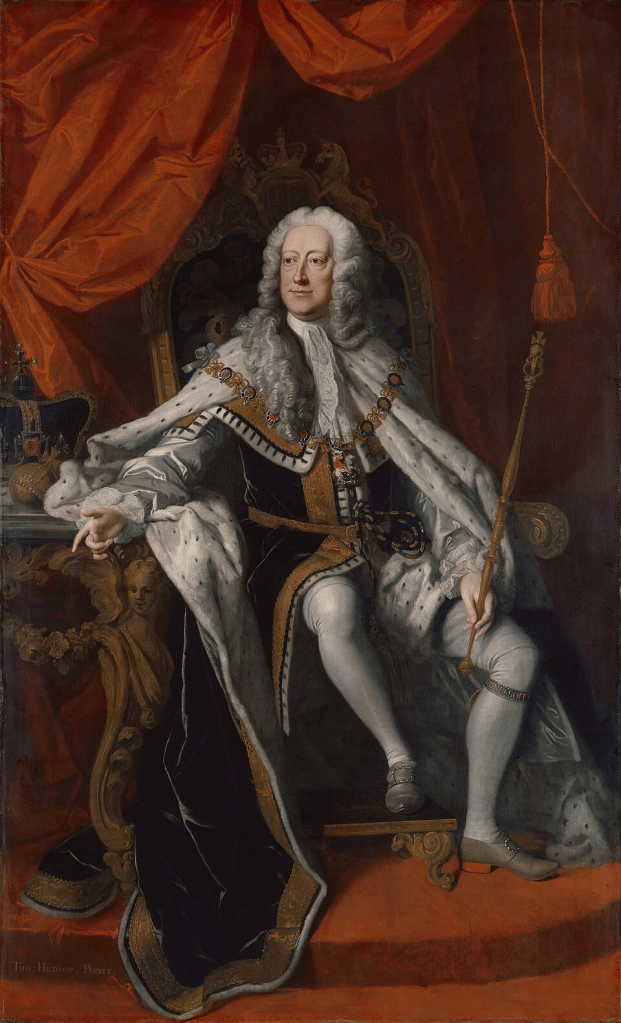
George II had been on the throne since 1727; he had been born and brought up in Northern Germany but at least, unlike his father George I, he could speak English. The average person in the street, or out in the field, was probably little bothered by this as they were never going to talk with him, anyway. The monarchy was completely remote to most people.
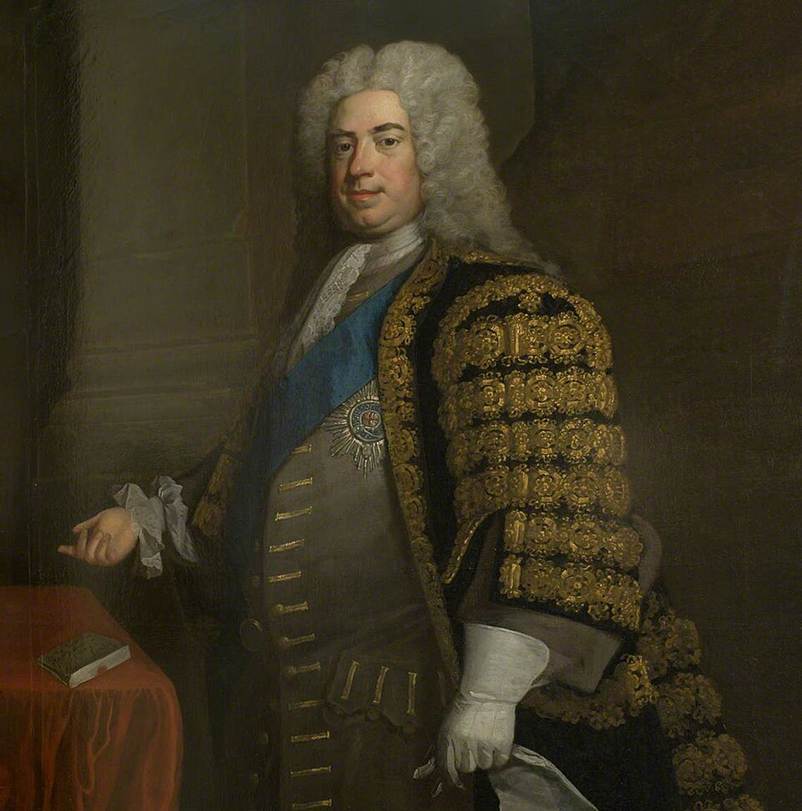
Perhaps the Prime Minister would have seemed a slightly less remote figure: Robert Walpole was a member of the English gentry, born in Houghton, Norfolk, in 1676. He represented the Whigs in Parliament.
However, considering that very few people were eligible to vote in parliamentary elections, it would not be surprising if most people took little interest in what happened in Westminster. To be eligible to vote a man had to own (not rent) property valued for land tax purposes at £2.00 a year, at least. There were other, rather esoteric ways in which a person could qualify which varied greatly across the country but women, Catholics, Jews and Nonconformists could not vote at all. Even Sir Robert Throckmorton, owner of the Buckland estate in north Berkshire, where he would later build Buckland House, would not have been able to vote at this time because he and his family were Catholics.
However, politically this was a time of stability in England and many people in villages like Kintbury could continue with their day to day lives little concerned by the “bigger picture” – they were like the small figures in the border of a medieval manuscript.
Of course every community had its local “big wigs” – quite literally because at that time the more prominent and wealthier members of society would wear big wigs.
Kintbury’s local “bigwig”, was Sir Jonathan Raymonde (1637 – 1711) of Barton Court. He had been a Tory MP from 1690 to 1695 and what seems very strange to us today is that he had represented the east Wiltshire village of Great Bedwyn. That’s it – just Great Bedwyn. By contrast in 1731 the entire county of Berkshire returned just two MPs to parliament. “Pocket Boroughs” like Great Bedwyn were so named because the seat was “in the pocket” of an influential or wealthy person; these were finally abolished under the 1832 Parliamentary Reform Act, but in 1731, that was over one hundred years away.
Before parliamentary reform, being an MP was not really about representing the people because, after all, most of the people did not matter very much. It is not surprising, therefore, that for the great majority of people, governance would have been something only the “Big Wigs” had an involvement in, not them.
What happened in Whitehall or Westminster had very little to do with most people in places like Kintbury. The magistrates- local men chosen from the upper or upper middle classes – were the only level of authority most people would have come up against. As far as day to day life was concerned, issues such as Parish Relief and the upkeep of roads would have been dealt with at a local level. If the road through your village was rutted and deeply in mud, it was up to the local people to do something about it, or it stayed like that.
Similarly, law and order was mostly delt with at local level. In towns, parish constables were appointed at Vestry Meetings for the purpose of law enforcement. They were elected from amongst other private citizens and were armed with a staff and a whistle which they could blow loudly and call, “Hue and cry” to apprehend anyone caught committing a crime. On hearing this, all able bodied men were supposed to join the chase: it was against the law not to do so.
However, one way in which central government could be said to impact on the lives of everyone from the wealthy to the cottager was in the imposition of taxes, although it is likely that the poorer man buying salt or candles did not realise this. These were excise duties and they were levied by parliament on household commodities such as leather, beer, soap, salt and candles. For wealthier consumers, there were taxes on wine, silks, gold and silver thread, hats, horses and coaches. The consumers were, most probably, unaware of the tax as it was paid by the traders.
These taxes were collected by Commissioners of the Excise, a role appointed directly by the King. In June 1728, The London Gazette reported that eight men had recently been appointed to this role, including a certain Thomas Wylde.
However, this Thomas Wylde was not the only person with that name to be appointed a Commissioner of the Excise. Another Thomas Wylde, a member of a prominent Worcestershire family, and a Member of Parliament from 1701 to 1727, was a Commissioner of the Excise for Ireland from 1727 to 1737.
So, how do we know that “our” Thomas Wylde is not the same man? Well, unfortunately, our Thomas was murdered in 1731. We know this because of a report in the Kentish Weekly Post:
Whitehall, Dec 18. 1731. Whereas the Commissioners of his Majesty’s Excise have represented, That Thomas Wylde, instructed in the Excise, was, on the 10th of November last, in the Night, as he was returning from his Business of officiating in the Excise, to his Residence at Kintbury in the County of Wilts, attack’d and robb’d by two Foot Pads, of his Money, Horse, Great Coat, and Boots, and was cut, bruised and beat, in so barbarous and cruel a Manner, that he died on the Twelfth of the said Month.
The report reads, “Kintbury in the County of Wilts” but this is not because there is another Kintbury anywhere else. In very old newspaper reports, Hungerford is sometimes described as being in Wiltshire and indeed part of it – Charnham Street – was, until the 1890s when there was a boundary change. As many people would have little idea as to where county boundaries were, it would have been an easy mistake to think of Kintbury as being in Wiltshire, too.
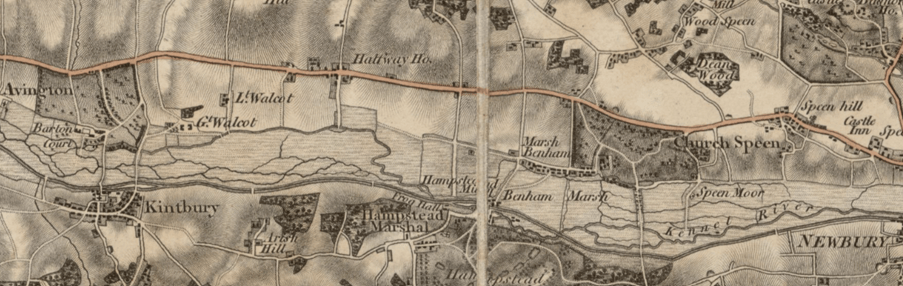
At that time, the Excise was located in Old Jewry, a street in the city of London, to the east of St Paul’s cathedral. In a world in which very few people had the need or even the where withall to travel much beyond their town or village, Thomas Wylde would have been an exception. London was at least a two-days’ ride from Kintbury. If he had been travelling westwards towards his home, it is likely that Thomas Wylde would have ridden along the Bath Road, a public stage coach route since 1657 and wider than any of the smaller roads and lanes that ran closer to the Kennet. Being wider made it easier for riders to avoid the deeply rutted sections and also made it more difficult for highway men or footpads to hide in the shadows. The night of November 10th 1731 was four nights off a full moon so visibility would have been quite good. That autumn had been the third in a row of unseasonably warm weather and that year had been particularly dry. It would be reasonable to presume that the road would not have been too deep in mud at this time.
Wylde had been attacked by “Footpads”. That is to say, criminals who would lay in wait to attack and rob travellers on the highway. Whilst “highway men” such as Dick Turpin rode horses, footpads operated on foot. For someone like Wylde, there was very little defence against footpads and an obviously wealthy man like him, possibly carrying the money he had collected in taxes, would have been a particular target. If the attack was away from the village – as is most likely – there would be no chance of anyone’s noticing or hearing what was happening so absolutely no chance of a “hue and cry”.
The newspaper report continues:
His Majesty, for better detecting of the Persons concerned in the said Murder and Robbery, is pleased to promise His most gracious Pardon to either of the them, who shall discover his Accomplice, so as he be apprehended and convicted thereof. HARRINGTON
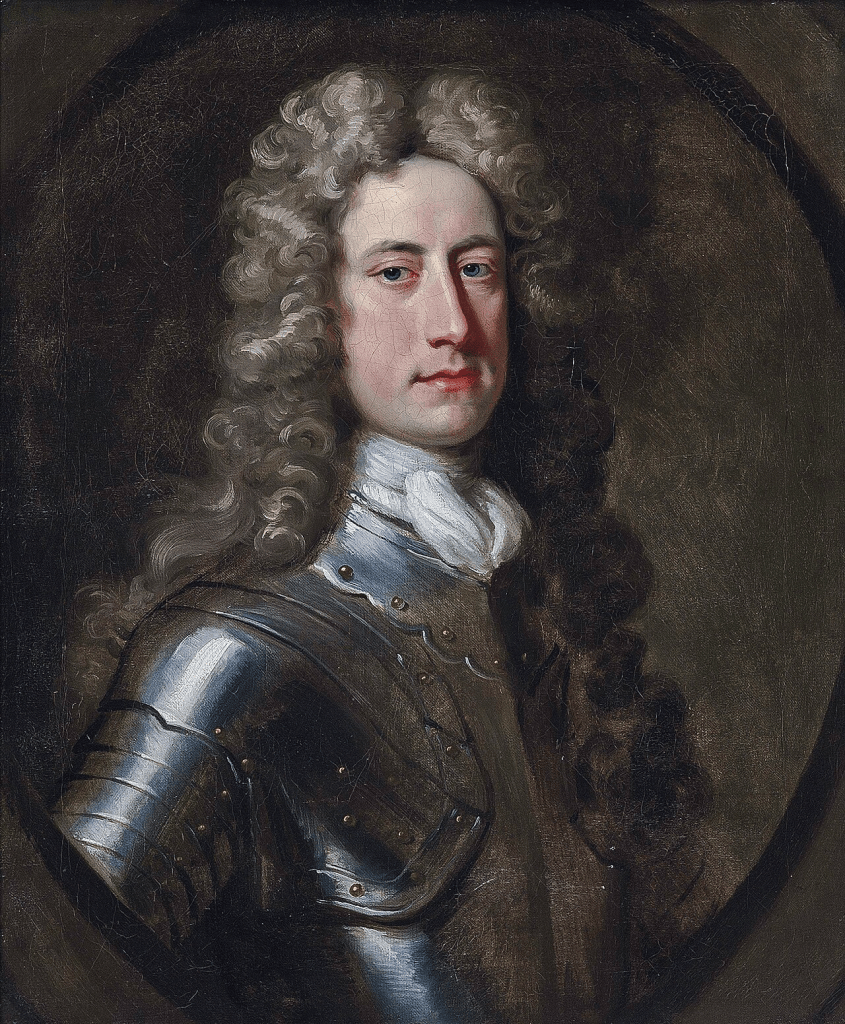
Harrington is William Stanhope, First Baron Harrington, Secretary of State to George II.
In the days before a police force, one way of catching the criminal was, it seems, to hope that any accomplice could be persuaded to “Turn King’s Evidence” , and to inform on their partner in crime. The penalty for murder was the death sentence, but this did little to reduce levels of crime: the penalty for stealing a handkerchief was the same. The possibility of being caught and subsequently hanged was clearly not a threat enough to deter footpads. There is no detective work, no police enquiries. Just an offer to pardon the person willing to turn in his accomplice and see him hanged.
The report continues:
And as a further Encouragement, the Commissioners of his Majesty’s Excise do hereby promise a Reward of Fifty Pounds to the Person making such Discovery, to be paid by Stephen Poyntz, Esq; their Cashier, upon such conviction, as aforesaid.
By Order of the Commissioners Sam. Grey Secr.
Fifty pounds in 1731 equates to over £10,400 today. However, Stephen Poyntz probably knew there was very little chance that he would ever have to hand it over.
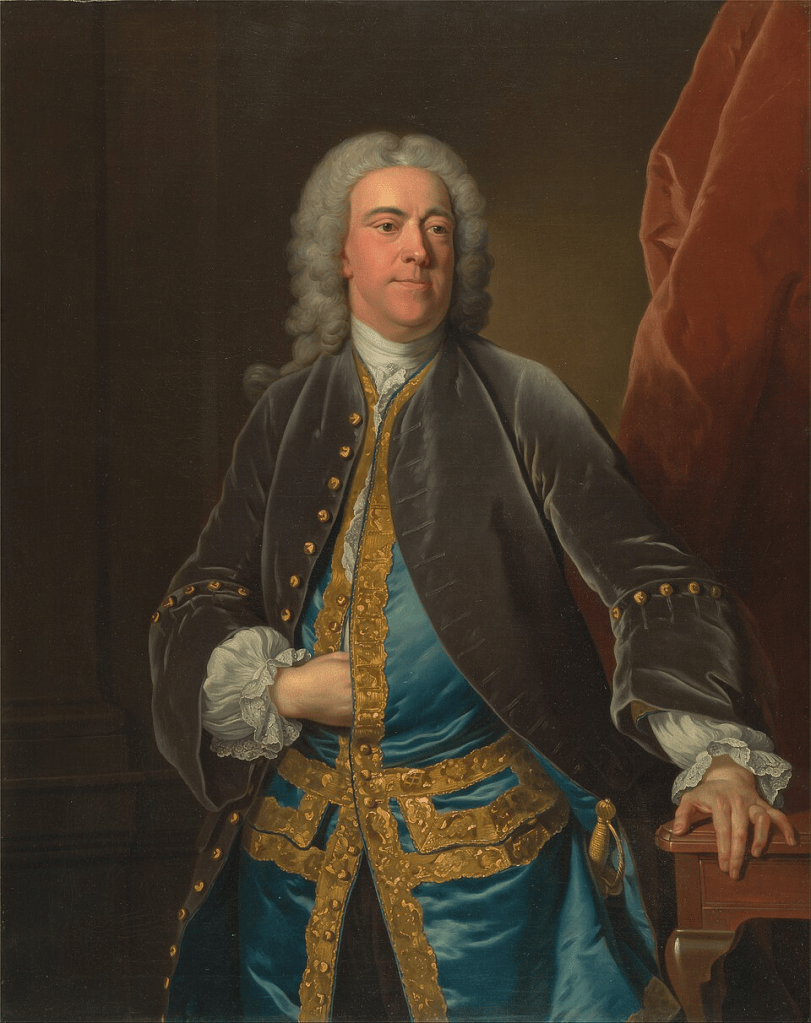
Then, almost as an afterthought, there is a description of the suspects and the stolen items:
N.B. One of the persons suspected of being guilty of the said Robbery and Murder, is marked with the Small Pox, between 30 and 40 years of age, about 5 Feet 8 Inches high, and wore a knit Cap on his Head. The other a …. thin Man about 20 Years of Age, had on a light coloured Coat without Pleates, and a light Wig.
The Horse taken from the said Wylde, was a black Gelding, about 14 hands high, one white Foot behind, a small white Snip down his face, and the great Coat was a light Shag, with 2 Capes, the upper one faced with Plush something lighter than the Coat.
These descriptions are particularly interesting because the details are very much of the time: the “light Wig” worn by one of the footpads recalls an era when many men shaved their heads and wore a wig as a matter of course. The stolen coat was of a “ light shag, with 2 Capes” in the style so often used to represent typical men’s fashion of the period.
There must have been someone accompanying Thomas Wylde to have been able to describe the footpads. It has to be likely that this was a manservant of some sort, but in a lowly position so he does not get a mention. Despite the attack happening in November and at night, this someone got a good look at the thieves and was able to describe their height, what they were wearing and that the older one was pockmarked. Perhaps he was attacked as well, but being of a lower order, this was of no consequence – we do not know.
Assuming that Wylde did indeed have a servant who escaped the attack, there would have been absolutely no way he could have easily raised the alarm or a “hue and cry”, particularly if the attack had happened in the open countryside. But there must have been someone else with or close to Thomas Wylde, to relate what happened and provide a description of the footpads to the authorities in Whitehall.
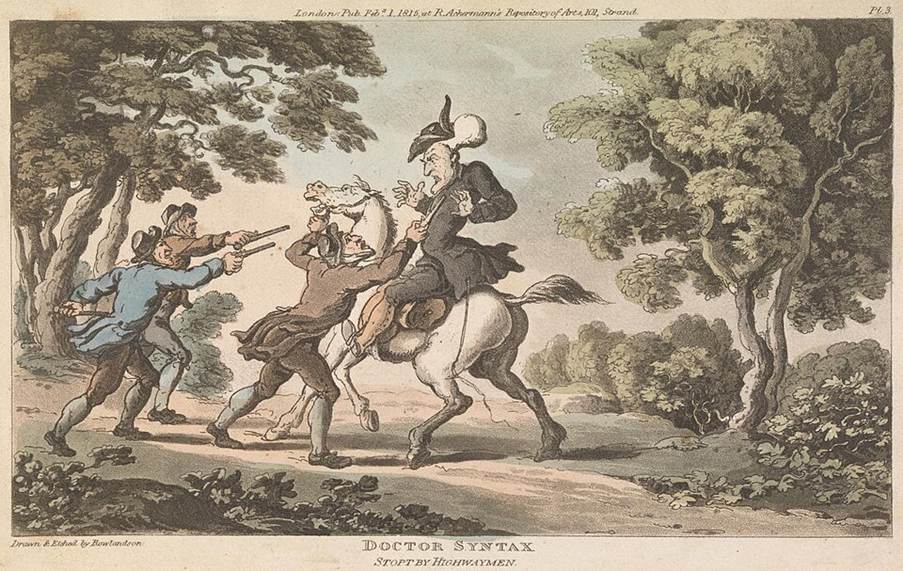
Any footpad or highway man of that time would have been well aware of the punishment if that had been caught. It is likely that the details of one notorious local case would, by the 1730s, have passed into folk lore but not entirely forgotten, due to the presence of the gibbet on Walbury Hill. Back in 1676, George Bromham and Dorothy Newman had been hanged at Winchester Assizes for the murder of George’s wife and son. Their bodies were later hung in chains on the gibbet for all passing by to see. The gibbet was ( and its most recent replacement still is ) clear for all to see who might pass by the highest point on chalk in England, just south of Kintbury & Inkpen. But the unlikelihood of the attackers ever being caught meant that it and its grisley story were not a deterrant.
At this distance of nearly three hundred years and with the resources available to me at present, I can find absolutely nothing else about Kintbury’s Thomas Wylde. Socially, as a Commissioner in His Majesty’s Excise, Wylde would have belonged to the higher echelons of society; he may well have been known to the Raymonde family at Barton Court. Furthermore, for others of the travelling classes, a robbery and murder somewhere on the highway to London is not something you would be pleased to hear about, particularly if your status in society meant you were expected to ride into the city from time to time yourself.
As a tax gatherer Wylde might have been the subject of disapprobation on the part of those who resented paying money to the crown. After all, there had not been much love felt for tax collectors since the days of Zaccheaus in Luke’s gospel. Thomas Wylde, as a member of the Commission for the excise, would have represented authority.
Perhaps, when the news of a robbery and murder reached the villages around, there were those who, knowingly and in lowered voices, muttered the names of whom they suspected as being responsible. Who had recently ridden home on a black gelding, wearing a coat no one had seen before? But no questions would be asked and no stories would be told of what had happened on that mild November night.
premium.weatherweb.net/weather-in-history-1700-to-1749
British Newspaper Archive
Hungerford Virtual Museum
(C) Theresa A. Lock , October 2026

